


Welcome to Foreign Policy’s China Brief.
The highlights this week: The United States blames China for local data center opposition, details emerge about a California killing involving three Chinese immigrants, and Beijing issues new rules on exit bans and offshore trusts.
Welcome to Foreign Policy’s China Brief.
The highlights this week: The United States blames China for local data center opposition, details emerge about a California killing involving three Chinese immigrants, and Beijing issues new rules on exit bans and offshore trusts.
Explaining AI’s Popularity
As public opposition to artificial intelligence data centers rises across the United States, Silicon Valley elites and Republican politicians are accusing China of interference, including by paying local activists, based on scant evidence. Though Chinese propaganda might inflame these tensions, the unpopularity of data centers in the United States is entirely genuine.
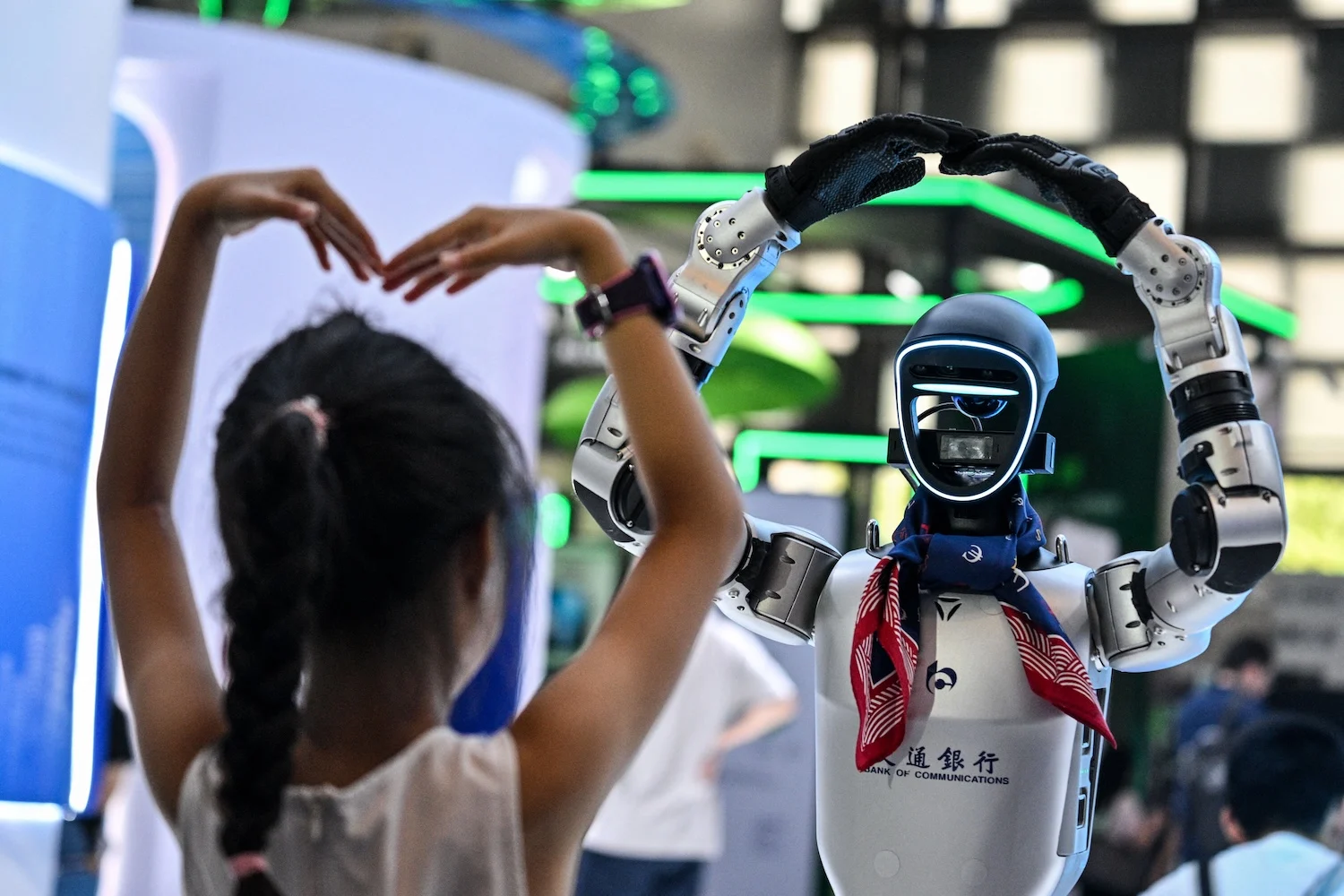
The issue reflects how ideological and socially divisive AI debates have become in the United States. In China, however, the technology is popular, and both the government and the public are considerably cooler-headed about it. A poll published last November found that 87 percent of people in China say they trust AI, compared with 32 percent in the United States.
This divergence was hardly inevitable. Plenty of technologies are unpopular in China even when promoted by the government, such as genetically modified crops. So why is AI such an uncontroversial issue in China and such a divisive one in the United States?
China’s approach to AI situates the technology within a long tradition of cybernetics, the transdisciplinary study of circular flows and self-adjustment within systems. When the “Cambrian explosion” of large language models began in 2024, China integrated them into this existing framework, treating AI as a vital future technology requiring careful management and public education.
There are dark corners to this picture—notably, AI’s growing role in China’s systems of surveillance and social control—but the country’s overall approach is relatively sober. In China, AI is treated as a bureaucratic technology, merely another way of coordinating and controlling systems. (I’ll return to this subject in a future piece.)
The contrast with the AI debate in the United States is striking; there, it is driven by Silicon Valley’s millenarian fantasies about superintelligence—the idea that AI will ultimately render humanity obsolete. At the geopolitical level, this translates into a belief in a winner-takes-all AI race rather than a long-running process of technological progress and exchange.
U.S. tech leaders are largely billionaires who are increasingly detached from reality and obsessed with AI and the apocalypse. China’s archetypal AI thinker is Kai-Fu Lee, a technocrat with a polished public image. More outspoken figures in China’s technology industry were cowed by the government’s crackdown on the sector from 2020-21.
The divergence stems in part from the science-fiction traditions that shape how leaders think. Whereas American writing has fixated on technological singularity, Chinese stories have more often explored interactions between humanlike robots and ordinary people as well as the ethical questions that those encounters raise.
The difference is visible at the everyday level, too. Although the Chinese internet has become dramatically more controlled under President Xi Jinping, China’s integration of apps, fintech, and other aspects of digital life has gone smoothly. For most users, AI is simply another tool in an already highly integrated digital environment.
Digital life in the United States, meanwhile, has undergone a long process of “enshittification,” in which the user experience has steadily deteriorated. The rise of sponsored and deceptive results on Google, for instance, reminds me of the problems with Baidu search in the 2010s, which the company fixed following a major scandal.
When Xi visits the United States for a September summit, the U.S. side will likely focus on maintaining AI superiority and on the supposed existential threat posed by superintelligent computers. The Chinese delegation will be more concerned with AI’s effects on employment, military decision-making, and fraud, as well as maintaining government control over increasingly autonomous systems.
Simply put, Beijing’s concerns over AI are rooted in real questions and problems. Much of the AI debate in the United States is not. It may be no coincidence, then, that the country treating AI as a practical technology has a public that is far more comfortable with it than the country treating it as a civilization-altering gamble.
What We’re Following
California killing raises eyebrows. New details have emerged about a bizarre crime involving three Chinese immigrants in Chino Hills, California. On July 29, Jianquan Bo and Zhengfeng Bo, two Han Chinese brothers, are alleged to have kidnapped Shukur Aikebaer, a Uyghur business associate.
Prosecutors say that after the ensuing police chase, Zhengfeng exited the car and fatally shot Aikebaer, who was stuffed into the trunk. The police then opened fire, killing Zhengfeng.
Several people in the U.S. counterintelligence community raised the case to me as a possible Chinese intelligence operation. That is certainly conceivable, given that China targets Uyghurs overseas and sometimes conducts espionage through underqualified amateurs.
But the available details make that explanation unlikely. All three men were in their 60s, and they had a long-standing business relationship, which deteriorated amid a legal battle over a multimillion-dollar apartment complex. Moreover, Aikebaer immigrated to the United States more than two decades ago and does not appear to have been involved in political activism.
Entry-exit rules. China’s new border-control regulations focus on providing clearer rules for exit bans and tightening oversight of the visa industry. Exit bans are commonly used as a coercive tool, as demonstrated this year when China barred the founders of AI firm Manus from leaving the country amid Meta’s attempted acquisition of the company.
When the rules take effect on Sept. 15, foreigners can officially be prevented from leaving China for up to five years over technological security concerns, underscoring the fact that China is no longer a merely perpetuator of tech espionage but increasingly a target as well.
FP’s Most Read This Week
Tech and Business
Another gene-editing death. Following the recent investigation by Science and Retraction Watch into the death of a child in a Chinese gene-editing trial, Stat News has reported a similar case. The full details are not yet known, but the study involved boys between the ages of 4 and 8 with Duchenne muscular dystrophy, a severe degenerative condition.
There has been extensive coverage of the scandals in Chinese media but none from the state’s most authoritative outlets, including Xinhua and People’s Daily, suggesting that the authorities are still deciding who to blame and what level of investigation to allow. As I noted previously, I worry that the known deaths may only be a fraction of the total.
Offshore taxes. China has issued new rules imposing a 20 percent tax on offshore trusts, shocking wealthy families who are now scrambling to respond. China is by and large a relatively low-tax environment for individuals, but the government maintains tight capital controls and has sought to extend its regulatory reach over Chinese citizens’ overseas wealth.
Like the United States, but unlike almost every other country, China also taxes its nationals living abroad, though it has historically struggled to enforce this. With these new rules, the country’s regulatory ambitions are even clearer.
