


Welcome back to Foreign Policy’s Latin America Brief.
The highlights this week: Brazil sends its foreign minister to a BRICS summit in New Delhi, Guatemalans protest fuel price hikes, and Chile remembers a renowned documentarian.
The BRICS leaders’ summit in New Delhi last weekend underscored how as the global order unravels, cooperation among the grouping deepens. Many long-standing BRICS demands, such as expanding the United Nations Security Council, haven’t materialized. But the bloc has steadily increased economic ties, including by launching its own development bank.
BRICS members have long sought to reform the Western-dominated order, making their joint positions particularly relevant today. This year, the warring parties of Iran and the United Arab Emirates both sent their presidents—marking the furthest international trip for Iranian President Masoud Pezeshkian since the Iran war began in February.
Brazil, a founding member of BRICS and the host of last year’s summit, has had a more difficult time steering the grouping’s priorities since it expanded from five to nine members in 2024. (Indonesia, the newest member, joined in 2025.) Brazil opposed the expansion, fearing a loss of cohesion with the addition of avowedly anti-West Iran. Like India, Brazil wants BRICS to be reformist, not revolutionary.
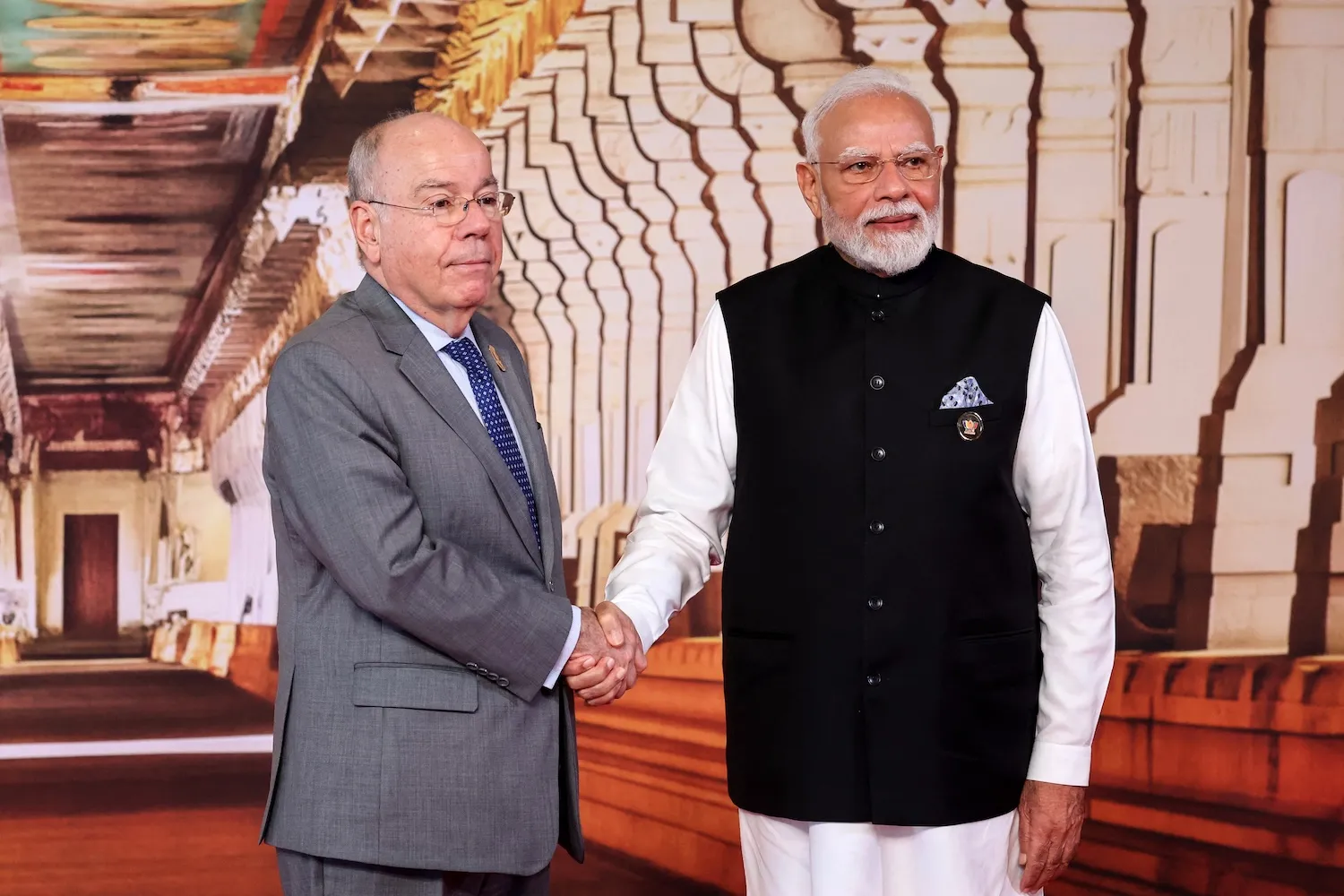
Brazilian Foreign Minister Mauro Vieira attended in place of Brazilian President Luiz Inácio Lula da Silva, who is in the midst of a reelection campaign. Last week, Vieira said Brazil believes “a multipolar world that promises peace and prosperity must not be confused with a world of spheres of influence.” In other words, Brazil wants a system of rules—not rule by the strongest.
Brazil managed to keep some of its priorities alive in this year’s summit declaration. Notably, in the joint statement BRICS reaffirmed its support for the U.N. system and the Paris climate agreement—going further than the G-7, whose most recent declarations did not mention the climate pact.
The summit’s endorsements are words, not actions, and some of the group’s members—most notably Russia—have flagrantly violated the U.N. Charter in recent years. But words still matter when both the U.N. system and climate action are under attack—and when the leadership of the U.N. itself is up for grabs.
Russia may have only begrudgingly endorsed U.N. principles, but the fact that it agreed to acknowledge the legitimacy of the U.N. system at the BRICS summit bodes better for the world body’s future functioning than if Russia had blocked any mention of it.
Brazil’s window to continue shaping BRICS in this direction may be closing as its general elections approach on Oct. 4. Far-right Brazilian presidential candidate Flávio Bolsonaro—whose political camp has a record of U.N.-bashing and climate change denialism—has as strong a chance of winning as Lula, polls say.
Saturday, Sept. 19: Chile marks its Independence Day with a military parade.
Sunday, Oct. 4: Brazil holds presidential and legislative elections.
Support for democracy on the rise. In its latest polling, AmericasBarometer at Vanderbilt University has found increased public support for democracy in Latin America. The share of respondents across the region who agreed that “democracy may have problems, but it is better than any other form of government” rose to 65 percent, up from 59 percent in 2023.
The report attributed this rebound in part to “positive changes in individuals’ lived experiences with crime, corruption, and economic well-being.” Support for democracy was higher among respondents who said their household income had risen in the last two years, who had not run out of food recently, and who had not been victims of crime.
The survey also touched on geopolitics, echoing a recent Pew Research Center survey in finding that views of China in the region are improving relative to the United States. Washington has historically cast itself as Latin America’s partner in democracy. But under U.S. President Donald Trump, democracy promotion has largely fallen off the agenda.
Panama Canal restrictions. A drought worsened by El Niño has Panamanian authorities planning to again reduce the number of daily ship transits through the Panama Canal. Starting in October, an average of 29.5 vessels will be allowed each day, down 18 percent from August, according to a draft plan submitted to the legislature.
Transit prices through the canal, meanwhile, are climbing to record highs. Prices shift with demand, and some Asian energy importers that typically source supplies from the Persian Gulf are now buying from the U.S. Gulf Coast instead, amid the Iran war—and those shipments must pass through Panama.
Chilean director Patricio Guzmán poses for a photo while presenting his documentary film My Imaginary Country at the Cannes Film Festival in Cannes, France, on May 21, 2022. Julie Sebadelha/AFP via Getty Images
Star filmmaker remembered. One of Latin America’s most celebrated documentary filmmakers, Chile’s Patricio Guzmán, died on Tuesday at 85. His three-part series The Battle of Chile chronicled the 1973 coup against Salvador Allende’s government and won international acclaim.
Guzmán was already filming in Santiago when the coup occurred, having originally set out to document the implementation of socialism through the ballot box. His cameras captured the range of opinions on the street about that process—and the military intervention that brought it to a halt.
Guzmán fled Chile immediately after the coup and managed to smuggle the film negatives abroad for processing, but the film’s cinematographer, Jorge Müller, was detained and disappeared during the dictatorship.
Guzmán eventually settled in Paris, where he died, though he returned to Chile over the years to make several more films. “A country that does not have documentary films is like a family without a photo album,” he once said.
Panama’s government is planning to create a new reservoir to ensure higher water levels in the canal. What is its estimated completion date?
2031
2036
2041
2046
The project, called Rio Indio, has also sparked controversy over its plan to relocate some 2,000 residents.

Indigenous people attend a rally against fuel prices in Guatemala City on Sept. 8.Johan Ordonez/AFP via Getty Images
Guatemala has joined the ranks of countries where economic fallout from the Iran war has spilled into political unrest. For more than a week, demonstrators angry over high gasoline prices have blocked highways across the country. Some gas prices topped $6 per gallon this week, Bloomberg Línea reported.
Guatemalan President Bernardo Arévalo has tried to cap gas prices by decree, but the measure—which requires congressional approval—has been blocked by an opposition lawmaker. Arévalo says organized crime groups are encouraging demonstrations and has sent security forces to clear some roads.
The protests are only the latest governance challenge for Arévalo, who was elected in 2023 on an anti-corruption platform but lacks majority support in Congress.
Reformers had high hopes that Arévalo could reshape the political environment this year, when a complex process to elect a new attorney general and judges came due. But Guatemala’s moneyed establishment lobbied Trump to oppose Arévalo’s anti-corruption agenda and achieved some success.
The Trump administration has worked to boost the candidacies of some would-be judges in Guatemala who had themselves been accused of corruption, the Washington Post reported in June. A U.S. State Department spokesperson denied meddling, saying U.S. policy is to respect “Guatemalan sovereignty.”
After the election this year of a top judge who Arévalo has publicly said “lacks integrity” and amid the ongoing fuel price protests, public opinion of Arévalo has nosedived. He had the lowest approval rating among Latin American leaders in a regional CB Global Data poll taken last week.
