


When future historians look back at U.S. President Donald Trump’s second term, the Iran debacle will probably feature as a decisive turning point in his presidency. The conflict exposed the limits of American power. It isolated the United States internationally, added inflationary pressures to the world economy, and drove the president’s domestic approval ratings to unprecedented lows just ahead of midterm elections.
But historians may ultimately deem a different development to be far more consequential: the failure of Trump’s China policy. Over the administration’s first year and a half, the United States let its most formidable geopolitical rival gain ground on nearly every front, from the economy and military balance to science, technology, and geopolitical influence.
China, contrary to much commentary, has little interest in constructing a “Chinese world order” modeled on the postwar Pax Americana. But it is determined to constrain American power, push the United States out of its dominant position in Asia, blunt its financial leverage, weaken Western-oriented international institutions, and discredit its democratic system. Beijing seeks, in other words, to accelerate the historical trend President Xi Jinping has described as the rise of the East and the decline of the West. In less than two years, the Trump administration has done much to bring that outcome closer.
When Xi comes to Washington on Sept. 24, the summit’s pageantry should not obscure the larger picture: how far and how quickly the balance of power has shifted in Beijing’s favor. China has weathered the trade war, narrowed the technology gap, tightened its leverage over critical supply chains, increased pressure on Taiwan, and deepened ties with Russia and much of the global south. It is better positioned relative to the United States than it was when Trump returned to office.
If China has not yet been recognized as Trump’s gravest foreign-policy failure, it likely stems from two main factors: the administration’s lack of clearly articulated goals against which its record can be measured and the long-term nature of the damage incurred. Unlike with Iran, Trump and his administration never articulated a stable hierarchy of objectives toward China. Indeed, the administration’s 2025 National Security Strategy did not identify China as America’s paramount geopolitical competitor. Instead, it framed the China challenge primarily in economic terms, even as other parts of the administration continued to see Beijing as a major military, technological, and security threat. The damage is also harder to grasp because, rather than unfolding in a single, highly visible crisis like Iran, the costs of a failed China policy only emerge over time.
Trump speaks during a campaign stop to address Pennsylvanians concerned about the threat of China to U.S. agriculture at a farm in Smithton, Pennsylvania, on Sept. 23, 2024.Win McNamee/Getty Images
Some failures of the White House’s economic policies toward China are already apparent: The administration has not reduced the trade deficit, it has not significantly lowered U.S. economic vulnerabilities, and it has not prevented Beijing from narrowing the gap in AI competition.
Exhibit one is the trade deficit. Despite long being Trump’s bête noire, the balance of payment has hardly improved. The administration may well claim that “America First Trade Policy is working” and that “China is no longer the trading partner with which the United States has its largest trade deficit.” But, as a recent Peterson Institute study demonstrates, the trade war’s net effect was simply to reroute Chinese exports through third countries, chiefly Vietnam, Taiwan, and Mexico. Weighed against the substantial costs that tariff volatility has imposed on American manufacturers and consumers, Trump’s tariff policy has been a net negative for the U.S. economy.
Second, and more critically, the Trump administration failed to meaningfully reduce the U.S. economy’s supply-chain dependencies on China. This is for rare earths and magnets, the so-called chokepoints that the administration inexplicably failed to anticipate Beijing would use as leverage against Washington’s punitive tariffs. More broadly, though, it is also true for vast swaths of industrial inputs critical to U.S. manufacturing. After threatening to hike up tariffs, for example, the White House was quickly reminded that U.S. farmers’ revenues were to a large extent hostage to Chinese purchases of soy and animal products. As a result, when Beijing retaliated, Trump was forced to reach a truce.
The bigger implications for U.S. economic security are equally significant. Much as Iran discovered by blocking the Strait of Hormuz that its leverage over the United States was stronger than it could have imagined before the war, China has shown that it can withstand, find workarounds, and retaliate against even Washington’s most aggressive trade-war measures. The October 2025 Busan agreement when Trump and Xi met on the sidelines of the Asia-Pacific Economic Cooperation meeting made the point plain: Trump abandoned his threat of an additional 100 percent tariff on Chinese imports in exchange for a fragile truce on rare earths, soybeans, fentanyl, and export controls. The rest of the world duly took note of the limits of American economic leverage with China.

A digital virtual idol performs alongside embodied intelligent humanoid robots, bionic humans, and human singers in an AI concert during a conference in Shanghai on Sept. 11.Chen Yuyu/VCG via Getty Images
Most damaging in the long term is the administration’s failure to maintain America’s once-sizable advantage over China in artificial intelligence. The U.S. still leads, but China has gained ground in both innovation and adoption. Its large language models now rival, and in some functions exceed, U.S. models at a fraction of the cost. The popularity of China’s open-weight models, combined with its manufacturing strength and lead in industrial robot deployment, gives it significant strengths in spreading AI at home and abroad. It’s also making steady progress to overcome its key weakness: limited computing power.
Trump keeps claiming that the United States is “leading China by a lot” in AI. But that lead is narrowing, and not simply because of Chinese policy and ingenuity. The administration ignored the requirements of its own strategy and was incoherent in applying the tools it inherited. It failed to sustain the Biden-era controls on advanced semiconductors and moved too slowly against predictable workarounds. This allowed Chinese firms to train models on banned chips obtained directly or through third countries. Export controls can buy time, but their effectiveness depends on anticipating how a rival will adapt. The administration kept busy blacklisting companies, but its approach remained disorderly and reactive, while China worked methodically to close the gap through a combination of basic and applied research, process innovation, and the stealth exploitation of the advances and capabilities of U.S. AI companies.
Some observers will object that the overall balance sheet still favors Washington: The U.S. economy is powering ahead, markets are at record highs, and American firms are more richly capitalized than ever. Meanwhile, China struggles with a property-debt hangover, adverse demographic trends, and deadening political control. But this snapshot misses the long-term trend. Economic history shows that national power is less a function of pure scientific and technological innovation than the ability to dominate the full cycle of a new general-purpose technology: discovery, commercialization, and diffusion at scale. By that measure, the picture is far less favorable to the United States.
While Washington attacks universities, deters talent through punitive immigration rules, and subjects scientific funding to political review, China is on track to produce nearly twice as many STEM Ph.D.s each year, is filing more patents than the United States (while closing the gap on high-quality ones), and is actively recruiting the talent America turns away. While the White House dismantles support for wind power, electric vehicles, and other clean-energy industries, China is consolidating its worldwide dominance in batteries, solar, and EVs. And while Washington alienates trading partners with tariffs, threats, and the disruption of long-standing trade arrangements, China is expanding its own network of trade agreements and market-access deals, gaining markets across the world and running record surpluses increasingly powered by high-tech exports.

People swim as a Chinese People’s Liberation Army Navy warship sails near the coast, seen from Philippines-administered Thitu Island in the disputed South China Sea, on May 3. Daniel Ceng/Anadolu via Getty Images
Washington has also lost ground on the military and security front. America’s long-standing strategic interest in the Asia-Pacific has been to prevent China from becoming the region’s hegemon. That strategy depends on working to counterbalance China by cooperating with other regional powers and deterring China from using force against Taiwan. This, in turn, requires substantial U.S. forces in the region, credible messaging over Taiwan, and strong, functioning alliances.
On each count, deterrence has weakened under Trump. The most visible aspect is force diversion. By launching a war against Iran, the Trump administration has shifted considerable resources away from the Asia-Pacific. Deploying the USS George Washington from Japan to the Middle East left the Western Pacific without a U.S. carrier. The conflict has also consumed large quantities of the very long-range precision missiles, Patriot interceptors, THAAD interceptors, and Tomahawks critical in any conflict with China.
Messaging has fared no better. Since late 2025, Beijing has conducted its largest and closest exercises around Taiwan, fired rockets into surrounding waters, rehearsed blockade operations, simulated strikes against U.S.-supplied systems, and conducted maritime surveys in Taiwan’ exclusive economic zone off the island’s eastern coast. Washington has protested some of these moves and pledged to continue to provide support to Taiwan. But Trump’s treatment of a $14 billion arms package as a “negotiating chip” has signaled to Beijing that he views Taiwan’s security as something that can be traded against concessions elsewhere in the relationship.
Across the region, the weakening of America’s security assurances is pushing countries to hedge in their relations with Beijing as a form of strategic balancing. South Korea is a case in point. Trump ordered the Pentagon to “substantially reduce” the annual U.S.-South Korea military exercise, citing Seoul’s refusal to support the Iran war and his “great relationship” with North Korean leader Kim Jong Un, whom he called “unthreatening and respectful.” South Korean President Lee Jae-myung, for his part, has announced he was seeking “full restoration” of relations with China. Washington has also needlessly strained its relationship with India, patiently cultivated over several administrations as a key regional counterweight to China. Beijing and New Delhi remain distrustful of each other but are pragmatically converging through BRICS around alternative trade and financial systems insulated from U.S. interference.
The United States still fields the world’s most formidable military, and China remains far from matching its global reach. But America’s forces must meet commitments around the world, while China concentrates on narrower objectives near its shores. In the Western Pacific, Trump has left fewer U.S. assets immediately available, created greater uncertainty over Taiwan, and weakened confidence among key allies. These changes all serve Beijing’s broader aim of convincing regional states that American power is unreliable and that Chinese influence is too costly to resist.

Demonstrators protest Trump’s immigration policies during a rally in Chinatown in Washington, D.C., on Jan. 30. Anadolu via Getty Images
The administration, for its part, argues that shedding financial and diplomatic burdens and demonstrating a readiness to use hard power outweigh the costs of eroding allies’ confidence. From Beijing’s perspective, though, the deterioration of America’s dense web of alliances is an unexpected gift.
China has long struggled to compete with the United States in soft power because the Chinese Communist Party’s authoritarianism, human rights abuses, and “wolf warrior” diplomacy limit its appeal. Under Trump, the gap has begun to narrow—not because China has overcome these liabilities, but because of the sharp deterioration of the United States’ image abroad. Trump’s policies have weakened three pillars of American soft power. They have undercut the appeal of the country’s political values, damaged its reputation as a reliable and generous partner, and eroded the long-standing perception that U.S. power by and large operates within rules and restraints, including honoring formal agreements.
At home, Trump’s aggressive immigration crackdown, pressure on universities and left-leaning civil society organizations, and attacks on the press have damaged the global standing of the U.S. as a model of political freedom. In a Pew Research Center 2026 survey of 36 countries, only 39 percent of respondents said the U.S. government respects the personal freedoms of its people; 56 percent said it does not. In nearly every country where Pew had comparable data from 2021, perceptions of American respect for individual freedoms had fallen sharply.
Trump’s MAGA political culture has also weakened the image of the United States as a multicultural society in which people of different races, religions, and national origins can belong and succeed. Trump’s nativist rhetoric and its effort to draw tighter boundaries around American identity undermines Washington’s credibility when it condemns intolerance and repression abroad. This gives authoritarian governments, including China, ready-made material for portraying U.S. support for democracy and human rights as hypocritical. Brand Finance’s 2026 Global Soft Power Index registered the same trend: The U.S. recorded the largest decline among all 193 countries assessed.
Foreign aid was once another important source of American influence and goodwill. The Trump administration’s abrupt dismantling of the U.S. Agency for International Development disrupted development and humanitarian programs around the world. In 2025, U.S. aid fell by 57 percent. It now provides less international aid than Germany. The human toll aside, this chaotic withdrawal carries its own political cost: It tells countries that America no longer believes that economic development, public health, education, and poverty reduction around the world ultimately benefit the United States.
Trump has also increasingly relied on military coercion, with little regard for the international laws and norms the United States has traditionally claimed to uphold. In January, the U.S. government captured Venezuelan President Nicolás Maduro and flew him to New York. Trump made clear the operation was driven less by Maduro’s record as a ruthless autocrat than by its oil resources and political obedience from the country’s leaders. Washington subsequently struck an oil arrangement under which the U.S. government holds a 35 percent stake in a company controlling major Venezuelan fields. In February, the United States and Israel launched the war against Iran, without consultation with allies or even pro forma consideration for the prescriptions of the U.N. Charter. The Trump administration also continued military support for Israel without any effort to address mounting international concern over civilian casualties and the devastating humanitarian crisis in Gaza.
Xi’s China has not become more liberal domestically or benevolent internationally. But soft power is comparative. As America’s image deteriorates, China gains ground by default. Pew now finds China viewed more favorably than the United States in 25 places surveyed.
There is a more direct international dimension to this as well. The Trump administration has reduced the funding, diplomatic pressure, and coordinated pressure that previously provided a measure of constraint on authoritarian governments. Cuts to foreign aid and State Department democracy programs, as well as attempts to cut funding to the National Endowment for Democracy, have led to a freefall in support for civil society, independent media, election monitoring, and multilateral accountability mechanisms. With fewer of these in place, Beijing has gained more room to shape international norms in its favor, expand its political and media influence, and suppress critics with less coordinated resistance.
The defunding of China-related human rights and democracy work, in particular, has reduced the scrutiny on both Beijing’s domestic repression and its expanding authoritarian influence abroad. China-focused organizations monitoring dissent, labor rights, and religious persecution were forced to suspend projects and lay off staff, while cuts to Radio Free Asia disrupted a rare source of uncensored reporting in Mandarin, Tibetan, and Uyghur. These cuts, alongside the suspension of an initiative designed to combat foreign disinformation in the U.S., have weakened the capacity to monitor Chinese censorship and propaganda, as well as Beijing’s attempts to hollow out the U.N. human rights system.
Because the U.S.-led postwar international order carried a preference for liberal democracy, nondemocratic regimes have long carried a legitimacy deficit in international arenas such as the United Nations, limiting their ability to pursue their foreign-policy goals on equal normative terms. By weakening that constraint, the Trump administration has given China a freer hand to reshape the international system in ways more advantageous to authoritarian states, to the long-term detriment of democracy in the world and to the United States itself.

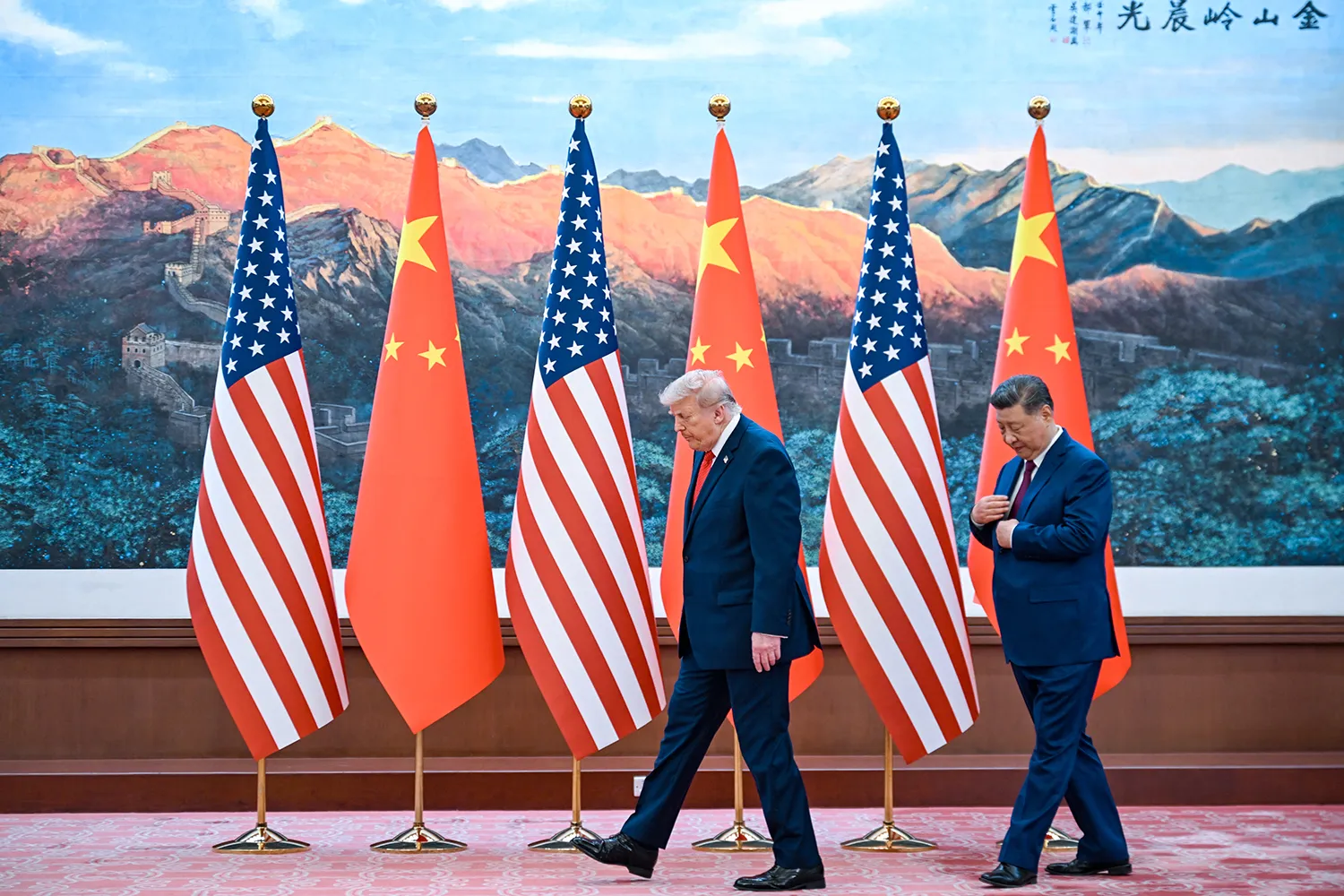
Trump and Xi look at children waving Chinese and U.S. flags during their meeting in Beijing on May 14. Brendan Smialiowski/AFP via Getty Images
Taken together, it is striking the extent to which Washington’s setbacks were self-inflicted. Despite being the U.S.’s most formidable geopolitical rival and one of the very few subjects of bipartisan support, China was effectively neglected as a strategic priority. Most of the administration’s decisions were incoherent and reactive. Trump has also exposed how vulnerable the American economy was to China’s actions, narrowing policy options for future administrations.
That the United States has allowed China to gain so much ground in such a short span of time is all the more striking given how relatively unskillful Beijing has been at capitalizing on Washington’s disarray. As David Shambaugh and Steven F. Jackson have argued, China has been “squandering a golden opportunity” created by Trump’s missteps. Because of Beijing’s threats against Taiwan and maritime claims, many states are responding to U.S. unreliability by hedging against both superpowers rather than gravitating toward China. Meanwhile, Beijing’s economic reforms have ground to a halt, while its formidable export machine is generating a backlash even among countries alienated by Washington.
But China does not need to win the world’s embrace to benefit from America’s retreat. The Xi regime is primarily concerned with its own security and with cultivating an international environment conducive to China’s continued rise. By both these measures, it is doing better now than it was 19 months ago, with more markets, more leverage, more room to pressure Taiwan. Perhaps Trump’s greatest legacy will be confirming Xi’s belief that time is on China’s side.
