


NORTHEASTERN SYRIA—At a former U.S. military base outside of the Syrian city of Hasakeh, Samir Asso—better known by his nom de guerre, Sipan Hamo—sat down for a conversation with Foreign Policy in early July. Until last January, Hamo was a commander in the Syrian Democratic Forces, the Kurdish-led military group that worked with Washington to defeat the Islamic State. Now Hamo is Syria’s deputy defense minister for the eastern region, the first Kurdish commander to hold a senior military post in Syrian President Ahmed al-Sharaa’s government. The room where we spoke featured a large desk, which Hamo sat casually in front of, and several signs bearing the green eagle emblem of the Syrian regime.
Hamo’s new role reflects the latest stage in an ongoing confrontation between Damascus and the Kurdish-led autonomous administration that ruled northeast Syria for the past decade. After 10 months of stalled talks, during which Washington’s support decisively shifted from the Kurds to the Syrian government, clashes erupted in January. Within 24 hours, Syrian forces defeated the SDF and captured 80 percent of Kurdish-held territory. A broader agreement at the end of January laid out a phased plan to incorporate the region’s security, military, and administrative institutions into the Syrian state. But as the last six months show, folding the Kurds’ vision of autonomous, left-wing rule under the authority of a predominantly Arab, Islamist-dominated regime remains a fraught, rocky process.
“If America had stuck to its political position, we wouldn’t have lost a meter of land,” Hamo stated, his low voice emerging from behind a thick mustache. “It’s not a secret,” he went on, that the SDF only accepted integration into the Syrian state under duress. “It was the only solution possible to achieve peace.”
Rows of graves stretch along the highway at the Martyrs’ Cemetery in Kobani, Syria, on June 28.

Workers dig a new grave for the remains of fighters whose graves in Manbij were reportedly vandalized, at the Martyrs’ Cemetery on June 28. Nearby, hundreds of recent graves, outlined with cinder blocks, hold fighters killed in the latest clashes.
At a checkpoint marking the entrance to Kobani, Syria’s three-starred flag blew in the wind, its bright colors contrasting with a weathered placard of the Syrian Democratic Forces. The checkpoint cut across the straight desert road leading into the city along Syria’s northern border with Turkey. Vehicles slowed as soldiers peered inside. They had not yet changed their uniforms, which still featured the red and yellow badge of the SDF’s Military Discipline Forces.
Entering the city, a graveyard stretches along the highway. The rows of well-kept graves extend into the distance, each headstone bearing a photo of a shehid, or martyr. At the back, more than a hundred freshly dug graves—each outlined by a rectangle of cinderblocks—held more recent burials, including SDF fighters killed in the January clashes. Next to them, a bulldozer was digging a massive pit to rebury the remains of fighters whose gravestones in the government-controlled city of Manbij had reportedly been vandalized.
Not far from the graveyard, the yellow-and-blue flag of the Democratic Autonomous Administration of North and East Syria (DAANES) was still planted atop a government building, its facade scarred with bullet marks. On the second floor, the co-chair of the Kobani Executive Council, 66-year-old Farhan Haj Issa, said he would remain in his post until the “integration is finalized.” The flag of the new Syrian government stood in his office, but the documents on his desk all still bore the symbol for DAANES.

Fahran Haj Issa, co-chair of the Kobani Executive Council, talks about Kurdish culture in his office in Kobani on June 28.
“Now, we are open to negotiations. We do not want to fight, but we want our rights to be protected,” Issa said. “Syria consists of many colors—Alawites, Druze, Sunnis, Kurds. If these colors are not accepted, there will be no real peace. Therefore, we are pressuring the government to accept these realities.”
Issa was among the founding members of the Kobani Canton, one of the three administrative units—alongside Afrin and Jazira—that originally made up the Kurdish-led administration. In 2012, anti-regime protests had erupted in the city, ultimately driving out Bashar al-Assad’s forces. Afterward, the Kurdish armed group, the People’s Protection Unit (YPG) stepped in, announcing their commitment to protecting the region. In early 2015, Kobani gained international recognition when YPG forces, with U.S. support, repelled an Islamic State siege following four months of vicious fighting. This, in turn, led to a deeper relationship with Washington, in which the YPG, expanded and refashioned into the Syrian Democratic Forces (SDF), ultimately drove the Islamic State from northeastern Syria.
The autonomous region that emerged from this struggle, commonly referred to as Rojava, was built on ideals of multi-ethnic, gender-equal democratic rule. Governance was broken down to the smallest local level—the commune—each headed by co-chairs, one man and one woman. In practice, though, the government of Rojava did not always live up to these ideals: arbitrary arrests and detention, and other forms of abuse and corruption, were widely reported, especially in the Arab-majority areas it governed, like Raqqa. In these areas, the arrival of government forces in January was celebrated as a liberation.

A statue of Arin Mirkan, a commander in the all-women’s YPJ unit who blew herself up among advancing Islamic State fighters during the 2014 siege, in Kobani on June 28.
After the January integration agreement, Kobani remained under siege for over a month. The internet was cut off and government forces restricted the movement of people and fuel. And while killings there were not on the scale of the massacres on Syria’s coast or in Suwayda, both sides committed violations during the offensive. These included the desecration of Kurdish corpses by government soldiers, a massacre of Arab civilians by one SDF fighter, and thefts and assaults in Kurdish villages.
The situation is largely stabilized now, and free movement is largely restored, but the practical and symbolic nature of daily government is still being negotiated. Kobani now falls within the Aleppo governorate and answers to Aleppo, which in turn answers to Damascus. Issa said that his administration is fighting to retain a degree of autonomy within this centralized system.
In January, Sharaa issued a decree recognizing Kurdish as a national language, restoring citizenship to Syrian Kurds, and recognizing their identities and holidays—a significant reversal after Assad-era Syria banned the language and rendered hundreds of thousands stateless. However, the decree has not been officiated in the constitution, and is revocable. On July 9, large rallies were held after a sign bearing the Arabic name Ayn al-Arab was installed at the city’s entrance, with protestors demanding that the Syrian government officially recognize the Kurdish name (Kobani). Most government signage in areas with significant Kurdish populations, including Hasakeh and Kobani, has both languages: Arabic and Kurdish.
-

A wooden sign with text in Latin script and Arabic hangs on a white wall in a hallway, with a silhouette of a person walking up a staircase in the background. - A bilingual sign in Kurdish and Arabic reads “Office of Social Affairs and Labor” in the Kobani district administration building on June 28.
-

A woman in a leopard-print top sits at a wooden desk signing documents, while three men stand nearby looking on inside an office. - Almaz Roumi, Kobani’s newly appointed mayor, meets with residents seeking housing and land permits in Kobani on June 28.
At the center of the struggle over what integration will mean are people like Almaz Roumi, Kobani’s new 37-year-old mayor. Roumi spoke to Foreign Policy while a line of people flowed into her office, asking her to officiate housing and land permits, among other official documents. Roumi, a native of Kobani, assumed her mayoral post in April, when she was selected by the Aleppo governor from a list of six names submitted by the Kurdish administration. The January integration agreement called for the appointment of Kurdish officials in government posts, a provision that has been largely, if not entirely, followed.
Roumi called for the recognition of Kurdish rights within the Syrian constitution, echoing the demands of other activists and political figures: “We want our rights, such as the Kurdish language, Kurdish identity, and our culture, to be protected in the constitution. We want there to be a free and democratic Syria where everyone’s rights exist, whether they are Kurds or Arabs.”

The Syrian Defense Forces flag remains on display at a checkpoint on the road out of Kobani jointly manned by internal security forces and SDF soldiers in June.
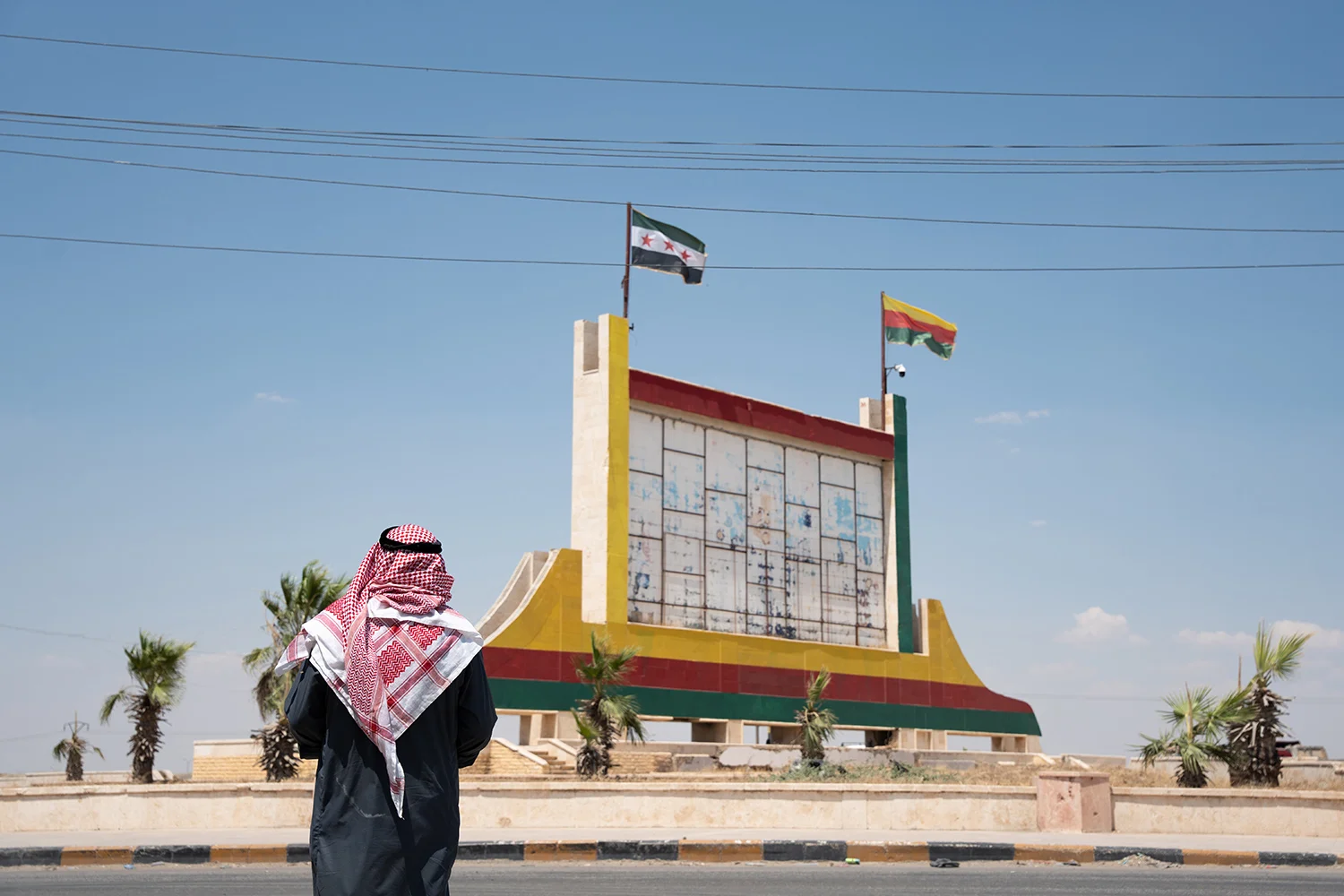
Almost 200 miles east of Kobani is the city of Hasakeh, also formerly under the Kurdish government. During a recent visit, flags of both Rojava and the new Syrian government flew at a roundabout on the city’s edge. In January, Syrian army units, backed by Arab tribal fighters, reached the city’s outskirts but did not initially push further in.
After the January agreement, government forces were allowed only a few kilometers into the city. The agreement also established the commitment that neither side would deploy military forces into cities or towns, according to the International Crisis Group.
In the city center, a sign reading “Hasakeh Palace of Justice”—in Arabic only—announced the courthouse. In front of the sign hung a massive Syrian flag, next to it a large poster of Abdullah Ocalan, founder of the Kurdistan Workers’ Party, or PKK. Graffiti covered nearby buildings, reading “PKK,” “Rojava,” and “Rojava will not fall.” The all-Arabic sign has sparked protests from those demanding the continued use of Kurdish as the city’s language of government.
In late July, tensions flared after armed members of nearby Arab tribes gathered in protest on the outskirts of the city. The demonstrations were initially demanding better services but escalated into calls for ending Rojava’s administration and bringing government forces into the region. A delegation from Damascus has since sought to calm tensions.
Hasakeh was the military capital of the Kurdish administration, where U.S. forces were based alongside their local partners. A slew of empty bases are visible from the highway into the city, their gated fronts still adorned with YPG and YPJ insignia, and more murals of Ocalan.

Sipan Hamo, the newly appointed deputy defense minister for the eastern region, at a former U.S. military base on the outskirts of Hasakeh on July 6.
It was at one of these bases that I met Sipan Hamo. Hamo, like many of his SDF comrades, trained with the PKK guerillas in the mountains of Iraqi Kurdistan. He expressed frustration that the West was “playing with the Kurds”—refusing to extend them the same support it had to Ankara and Damascus, despite their sacrifices in the war against the Islamic State.
After Sharaa’s forces toppled the Assad regime in December 2024, Washington moved quickly to align itself with the new government, a shift many Kurds saw as abandonment. Hamo said that about a year after the regime’s fall, in December 2025, the United States cut all of its funding to the SDF. On Jan. 20, 2026, the U.S. envoy to Syria, Tom Barrack, announced on X that “the original purpose of the SDF as the primary anti-ISIS force on the ground has largely expired,” saying this role would now be filled by Damascus. In April, the United States evacuated its last remaining base in Syria’s northeast.
Hamo also acknowledged Turkey’s grip on Syria, and its heavy hand in pushing for Rojava’s integration into the new government. “[Ankara] considers us, Kurdish people, as a threat to its national security,” Hamo said. Reuters has reported that Turkish intelligence played an intensive role in backing the government’s offensive in January, while Hamo noted that Turkish attacks in the region had halted since the January integration deal.

A bullet hole in a window next to the Kobani mayor’s office frames a Turkish military position a few hundred meters away on June 28. The window was struck by gunfire from the position.
Hamo confirmed the integration of four former SDF brigades into the Syrian army. The Hasakeh, Qamishli, and Derik brigades are now operating under the Syrian army’s 60th division, and the Kobani (or Ayn al-Arab) brigade is operating under the 72nd division, in Aleppo. He said that each brigade has 1,300 soldiers, plus 500 to 750 members from specialty units operating equipment like drones and defense systems. They all began receiving their salaries about three months ago.
However, those integrated represent only a fraction of the SDF’s force, with tens of thousands still left out. Previously, the SDF numbered roughly 60,000 soldiers, which leaves more than 50,000 whose status, including their future salaries, remains unresolved. A particularly contentious subject in the negotiations has been the status of the all-women’s unit, the YPJ. The government, Hamo explained, “won’t accept women into the army; their principles and beliefs do not accept that.”
The YPJ formed an integral component of the SDF, but the government has only offered to integrate them into the local security forces. This, according to Hamo, would significantly degrade their fighting capabilities. “They shouldn’t budge on their position to join the military,” he said, “because joining the [security forces] is a step down.”
-

A group of people wearing camouflage military fatigues sit together outside against a wall; one person in the foreground carries a rifle. - Members of a YPJ battalion gather on the main terrace of their base on the outskirts of Hasakeh on July 5.
-

A group of 11 women in camouflage uniforms and tactical vests pose together outdoors under trees; several in the front row are crouching and holding rifles, while some in the back row hold up two fingers. - Fighters from the Martyr Kocerin battalion pose with their commander, Revan Kobani (center, back row), at their base outside Hasakeh on July 5. The battalion is named for a former commander, who was killed during January clashes.
Down a windy road through the desert in Hasakeh I visited a small YPJ base where roughly 150 fighters trained, lived, and studied Ocalan’s teachings. It is called Martyr Kocerin in honor of its former commander who was killed in the January clashes. Revan Kobani, the current commander of the battalion, is just 26 years old but appeared older, her skin thickened by over a decade of fighting. She left her home in Raqqa after the Islamic State took over in 2014, joining the YPJ’s fight in Kobani at the age of 14. She has a large scar around her elbow, which she said was the result of a Turkish drone strike in 2019, when she was fighting in Ras al-Ayn (or Sere Kaniye in Kurdish) on the northern border with Turkey.

Kobani, the 26-year-old commander of the Martyr Kocerin battalion, at the base near Hasakeh on July 5.
“Sharaa offered to integrate us into the police, but this would cause us to let down our identities,” Kobani said. “Imagine, you built a nice house, and someone came and destroyed it. They are destroying the YPJ project by creating a women’s police.” Women have already been integrated into the region’s police force for over a decade, she noted.
“As YPJ, we will not give up our identity. Let our name be anything, but in the Syrian constitution, we want to be accepted as an army.” Kobani insisted she and her battalion will not stop their fight: “We want the issue to be solved through dialogue, but if the issue is not solved, it will end in war. We are not afraid of death. We have given many martyrs. If we are to die, let us die with our honor. We don’t want to live in dishonor.”

Perwin Yousef, co-chair of the Democratic Union Party, at the party’s offices in Qamishli, Syria, on July 6.
Farther east, in Qamishli, the former capital of the Kurdish administration, Perwin Yousef spoke about her involvement in the integration negotiations. Yousef, 40, is co-chair of the Democratic Union Party (PYD), the Kurdish political group that dominated the Rojava government.
Key among the PYD’s demands is renaming the country the Syrian Republic, rather than the Syrian Arab Republic. The party also boycotted the country’s recent parliamentary elections over what it called inadequate Kurdish representation. Just 11 of 210 seats were reserved for Kurds, Yousef said, despite Kurds making up 20 percent of the country’s population. “Within the integration, not everything that is imposed we should accept,” she said. “This is the duty of the PYD.”

A mural of the Kurdish flag in Kobani on June 28 bears the Kurdish phrase “Zimane me, Hebuna me ye” (“Our language is our existence”). Below it, another inscription reads “1=2+2,” a symbolic reference to the four parts of Kurdistan and Kurdish unity.
Still, Yousef remained hopeful the party could sustain its role despite the obstacles. She said that for the first time, the party is able to operate in Damascus and introduce itself to the Syrian public, something never allowed under Assad, when Kurdish parties were banned outright. “Now, at least, we can get a license to operate properly,” she said.
“[In Damascus,] we met with many political circles. They didn’t know the Kurds before. So we see an opportunity has opened in this integration [to show] that we are Syrian citizens,” she continued. “Our struggle, our work, has become even more important.”
