


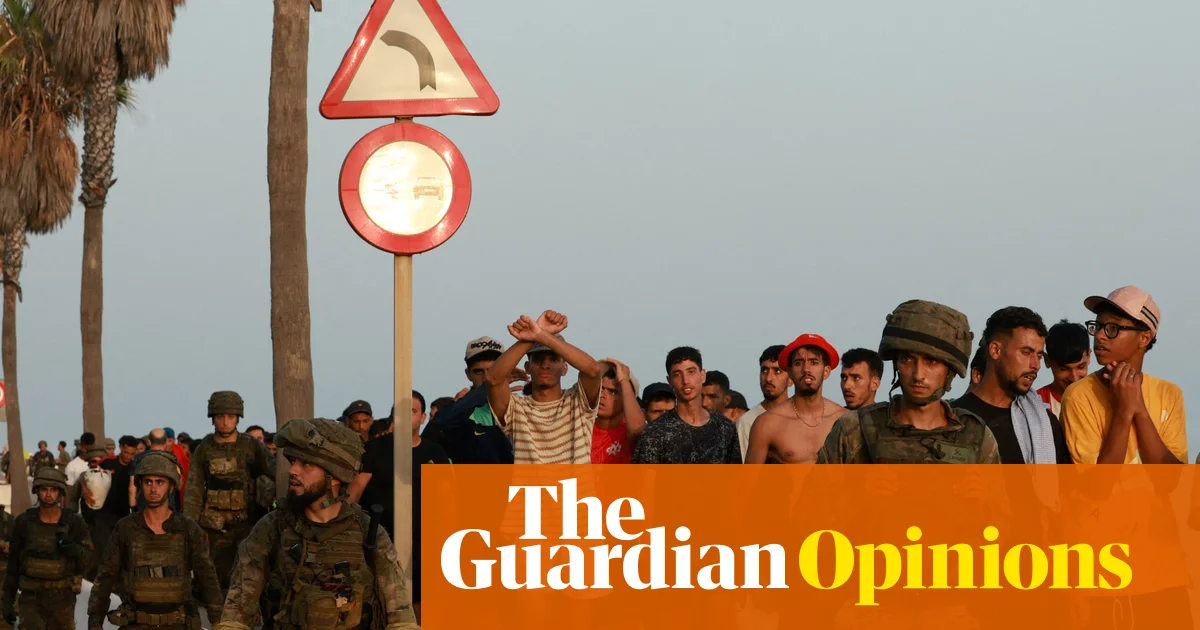
The live streams are still running, training their cameras on the beach at Ceuta, where nothing is happening. The self-styled citizen journalists are still pounding the streets, capturing their shaky smartphone footage. Zia Yusuf of Reform UK was out there at the weekend, wearing a crisp white shirt and smart tailored trousers, lest anyone confuse him with the other brown people there. The bad brown people.
Why was the migrant incursion at Ceuta, on the Spanish-Moroccan border, such a big story across the world? How did it manage to pique the interest of Donald Trump and Elon Musk, to feature on NBC’s Nightly News, not – shall we say – a programme massively predisposed to spotlighting news stories from continental Africa? What about it so exercised Europe’s heads of government? What made it an irresistible front-page story in the Daily Mail, the Daily Express and the Daily Telegraph?
Certainly not any kind of urgent or imminent threat to our own borders, much less the borders of the United States. The Spanish enclaves of Ceuta and Melilla operate under special exemptions from the Schengen area, rendering it almost impossible for an undocumented migrant to reach mainland Spain, about 12 miles away across the Mediterranean. Once many of the migrants realised this, they duly left.
Nor any kind of humanitarian concern for those who drowned or were killed in the crowd crush. “About 48,000 of the up to 60,000 people who came into Ceuta from Morocco returned within a day. Still, the sudden influx created a crisis for Spain’s pro-immigration government. Nearly three dozen died.” So read a New York Times subheading on Friday. And once you fight your way past the tortured syntax, did you notice anything unusual there? First the integrity of the border, then the political ramifications, then the people who died: the hierarchy of rightwing immigration discourse expressed in three perfect sentences. The death toll has since risen to either 72 or 88 – authorities disagree on the number – and nobody seems over-fussed either way.
Rather, Ceuta functions as a kind of border porn for the global far right: a locus upon which to project their most vivid and apocalyptic fantasies. If the historian Mike Davis once described the US-Mexico border wall as “a political stage set”, then in the age of the deepfake and the troll-farm, Ceuta has proved a similarly fertile source of content: the border interface reimagined as digital theatre, mass migration as primetime television.
The rich irony here is that from a securitisation standpoint, Ceuta functions almost exactly as it was intended. A six metre-high barbed-wire fence, reinforced by watchtowers and a network of video cameras, separates it from Morocco. From Ceuta, an internal checkpoint guards the only ferry route to mainland Spain. The European Union has spent years, and hundreds of millions of euros, on developing partnerships with Morocco on border management.
None of which seemed to matter in the slightest as European leaders queued up to give the Pedro Sánchez government a ritual horse-whipping. Italy reintroduced air and sea border controls with Spain. Emmanuel Macron deployed mobile units to the Spanish border to strengthen controls. Giorgia Meloni – backed by Finland, Denmark and Czechia – has argued that Spain’s membership of the Schengen area should be suspended.
And of course these are primarily domestic politicians catering to a domestic market, ahead of an electoral cycle in which incumbents in France, Italy and Poland are being outflanked by nativist insurgents to their right. Sánchez himself faces the ballot box in 2027, an election in which his government can boast strong economic growth and which his rightwing opponents will therefore be desperate to turn into a referendum on immigration.
So that’s the political angle. But really the spectacle of Ceuta represents a more primal and guttural need, particularly in the English-speaking world, for the inflammatory anti-immigration crusade to be seen as well as spoken. The photos and footage coming out of the enclave in recent days, all shot from distance and almost never in closeup, are all geared towards a single end: to encourage the viewer to see these brown bodies as a single mass, each indistinguishable from the other, the accountants and surgeons from the bomb-makers and rapists, the living from the dead.
And so, by small degrees, the line between nationalism and pure-blood white supremacy blurs a little more. Indeed, the very idea that a single border crossing 1,000 miles and two seas away from us is somehow our urgent problem, only really makes sense in a worldview whose real distinction is not between “Britain” and “abroad” but between an imagined white Christian Europe and a savage brown other.
For all this, the right does not act alone. The palpable relief on many parts of the left as most of the original 60,000 migrants returned to Morocco spoke of a worrying acquiescence: a tacit acceptance of the dangerous trope of migration as a prima facie problem. Here’s a radical thought: what if migration is only a problem to those who want it to be? What if we started seeing the mass movement of people less as an existential threat and more as a simple inevitability of human existence? Nine years ago the great Gary Younge set out in the Guardian a utopian vision of open borders and no immigration controls. What happened to that sense of vision and idealism? When did border discourse, the conversation on why and how we move, become something to be feared and not embraced?
after newsletter promotion
Whether Ceuta was an accidental security lapse or a deliberately engineered event is actually beside the point. The point is that as the global right grows in confidence, as the migration industrial complex thirsts for new content, new border porn, there will be more Ceutas in the future. People will keep migrating and die trying, and because this is good telly it will keep happening. “Today more than ever,” writes the sociologist Mimi Sheller in her book Mobility Justice, “these borderlands are soaked in the blood of white nationalism, ethnic profiling, and enforced death in the no man’s land.”
The endgame here is massacres, vigilante violence, not “stop the boats” but shoot the boats, the border reimagined as a computer-game war zone. The endgame is what the likes of Musk and his far-right meat puppets are already depicting: a world where zombie armies of “military-age males” invade our virgin turf, and the problem is not the forces that drove them from their homes, but your “suicidal empathy”, because these are not equal humans deserving equal treatment. These are the stakes. And frankly, when the next Ceuta happens, the left needs to think of a better response than simply being thankful they went home again.
-
Jonathan Liew is a Guardian columnist
-
Do you have an opinion on the issues raised in this article? If you would like to submit a response of up to 300 words by email to be considered for publication in our letters section, please click here.
