


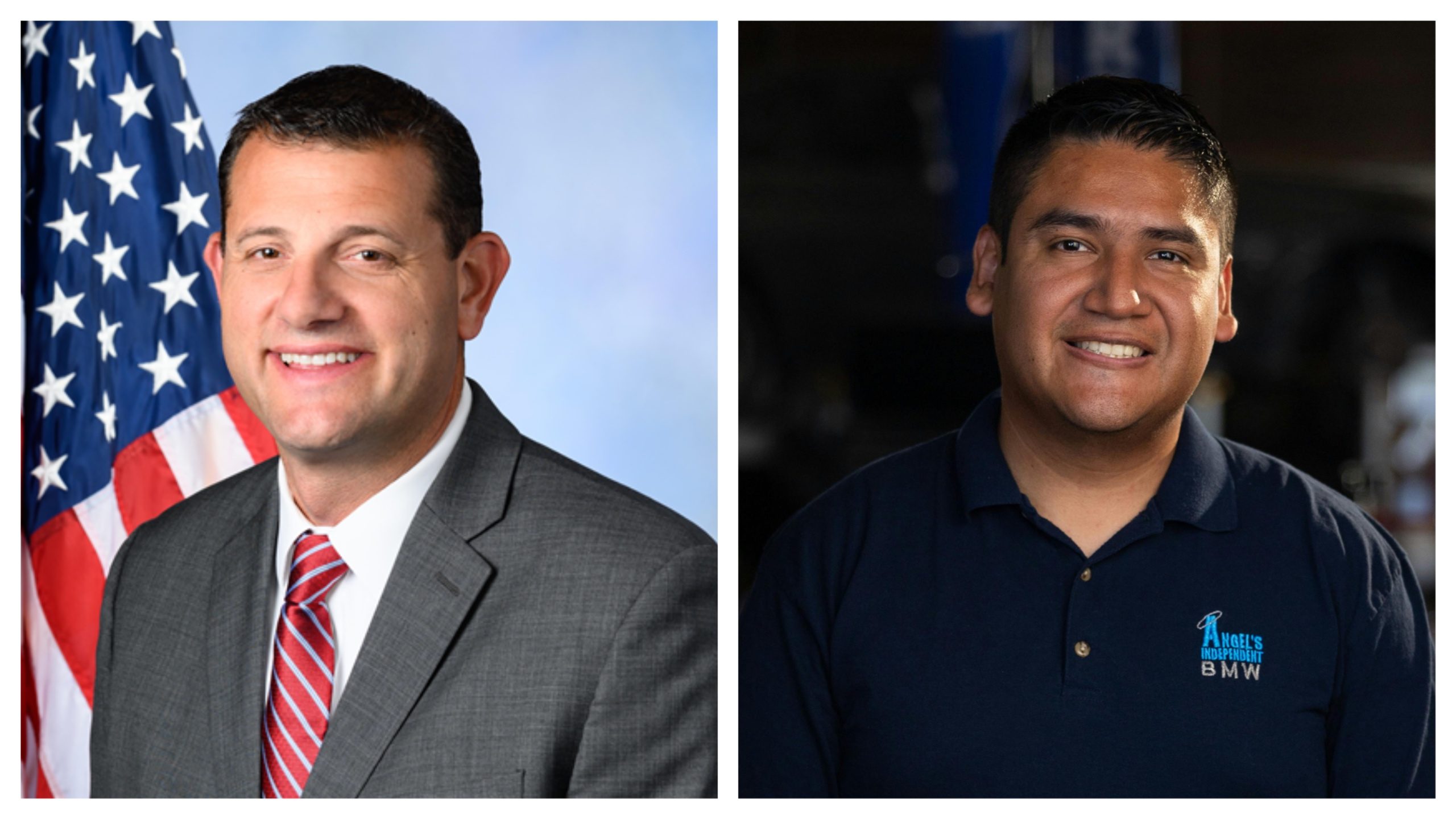
A House race in rural California has become one of the most competitive and expensive in the country – and it’s being defined largely by its candidates’ opposing stances toward corporate money.
The battle for the Golden State’s 22nd district is one of 21 House contests rated a “toss-up” by the nonpartisan Cook Political Report. It’s one of the most closely watched races in the midterms, not only because it could determine control of the House, but also because it will test California’s redrawn maps and the viability of progressive candidates in swing districts.
After beating an establishment-backed, moderate opponent in the primary, Democratic nominee Randy Villegas has made pro-worker, anti-corporation messaging a cornerstone of his campaign. The community college professor has vowed not to take corporate PAC money – a departure from the strategies of previous Democratic candidates in the district and a stark contrast to the Republican incumbent, Rep. David Valadao.
A Latino, working-class district built on agriculture
Valadao and Villegas have both positioned themselves as advocates for voters in a district that is predominantly Latino, agricultural and working class.
The 22nd is in the heart of California’s San Joaquin Valley, which accounts for over half of the state’s agricultural output and produces more than $24 billion in annual revenue. The district also includes parts of Kern County, one of the largest oil-producing regions in the United States and home to 40,480 of California’s 53,120 active wells.
Cathy Abernathy, a Republican political consultant based in the valley, attributed Valadao’s success to his resonance with farmers, ranchers and the district’s working class.
“Valadao is from a very rural county, Kings County, and he’s been a dairyman, so he knows people in that industry,” Abernathy said. “He’s been effective, particularly, because he understands the industry, understands the people. ‘He’s one of us,’ I think would be the term for most voters.”
In his campaign messaging, Valadao emphasizes the region’s agricultural base and his own upbringing as the son of dairy farmers. On his House website, he touts the family’s agricultural business, noting it includes two dairies and more than 1,000 acres of farmland, on which Valadao and his family grow almonds, corn and wheat as dairy feed stock.
The dairy, poultry, and fruit and vegetable industries have been very generous to Valadao during the 2025-26 election cycle – donating totals of $88,601, $34,800 and $68,627, respectively – making him the second largest beneficiary of their campaign contributions. His ties to the industry are apparent in his legislative priorities – in June, he announced he would be relaunching a Congressional Dairy Caucus.
As of June 30, the most recent filing deadline, Valadao has received a total of $2 million from PACs – 210% more than the average House candidate. The majority of those dollars came from corporate PACs, though ideological PACs (committees associated with political advocacy groups) have also contributed hundreds of thousands.
Villegas, though he doesn’t take money from corporate agricultural PACs, often references the agricultural identity of the district in his messaging. The agricultural workers’ movement was born in the 22nd, providing a base of activism that Villegas elevates. He’s received an endorsement from the United Farm Workers – the largest farmerworkers’ union in the nation – and ranks as the sixth-most-donated-to congressional candidate by agricultural labor unions.
Agribusiness, oil and defense PACs fuel Valadao’s campaign — and his committee seats
Among the corporate PACs powering Valadao’s campaign, agribusiness accounts for the largest share of contributions at 13%.
“Valadao sits on the Agriculture Committee, so he’s in a very powerful position to influence these decisions,” Michael Ault, a political science professor at California State University, Bakersfield, said. “All these agricultural interests know the value of him, and what’s interesting is we also have the defense industry, and then, of course, there’s the oil. So, it is a unique district.”
(function(){function e(){window.addEventListener(`message`,function(e){if(e.data[`datawrapper-height`]!==void 0){var t=document.querySelectorAll(`iframe`);for(var n in e.data[`datawrapper-height`])for(var r=0,i;i=t[r];r++)if(i.contentWindow===e.source){var a=e.data[`datawrapper-height`][n]+`px`;i.style.height=a}}})}e()})();
Valadao has received tens of thousands of dollars from energy and fuel companies such as the Pacific Gas and Electric Corporation, Valero and Chevron – the oil interests Ault referenced.
Valadao also sits on the Appropriations Committee, including spots on the agriculture and defense subcommittees, giving him additional influence over funding for those industries.
Defense contractors such as General Atomics, Lockheed Martin and Northrop Grumman have also contributed tens of thousands of dollars to Valadao’s campaign. The defense and aerospace industry is actively expanding its presence in Kern County through millions of dollars in recently awarded state grants.
Valadao historically touts his support for defense industry interests and in July voted against a resolution directing the president to remove U.S. military forces from the Iran war.
Villegas has criticized the war and Valadao’s support for it. The agricultural industry, Valadao’s typical base, has expressed concerns about the war’s impact on the fertilizer supply, and voters from both parties are dissatisfied with the war’s ongoing inflation of gas prices.
Villegas chases individual donors and left-leaning PACs
Since Valadao was first elected to the House in 2012, he’s had to fight to hang on to the swing seat. Democrat T.J. Cox unseated him in 2018, but Valadao reclaimed the district in 2020.
Democrat Rudy Salas challenged Valadao in 2022 and 2024. Salas was heavily supported by establishment Democrats, who spent millions of dollars to ensure his victory in the primary. Salas skipped the 2026 election and the Democratic establishment threw its support behind state Assemblymember Jasmeet Bains, contributing hundreds of thousands of dollars to her campaign.
Villegas, who ran to the left of Bains, benefited from criticism that she took money from oil and gas companies while voting in line with their interests. California uses an open primary system, in which all candidates run on one ballot with the top two vote-getters advancing to the general election. The race became a focus for outside spending groups. Valadao (40.7% of primary votes) and Villegas (32.4%) advanced in the June 2 primary, with Bains finishing third (26.9%).
Ault said Villegas’s progressive politics are a “stark contrast” to Valadao’s past Democratic challengers, including Rudy Salas.
“Rudy Salas had a lot of PAC money,” Ault said. “The ads in the Central Valley were just nonstop from both sides on that one. And I think Randy is spending his money, as well, differently, sort of trying to get to voters one on one. He’s held a number of town halls, not just here in Bakersfield, but throughout the district.”
Despite spending against Villegas in the primary, Democratic forces have thrown their money behind their nominee. According to data from AdImpact, an ad-tracking firm, the Democratic super PAC tasked with taking control of the House plans to spend more than $8 million on ads supporting Villegas. The race has already become a top target for outside spending groups.
The Democratic Congressional Campaign Committee added Villegas to its “Red to Blue” program, which provides fundraising and organizational support to candidates seeking to flip Republican seats. But Villegas’s fundraising success has come almost entirely from individual donors, as well as labor unions and ideological PACs.
Villegas has raised a total of $2.6 million as of June 30, but after his expensive primary race he had only $571,794 on hand at the midpoint of the year. Valadao, meanwhile, has brought in $4.9 million and still has $3.4 million on hand. In the most recent campaign filing period, Villegas outraised Valadao.
“We’re coming out of the primary stronger than ever and ready to deliver for working people across the Central Valley,” Villegas said in a statement after the most recent numbers were released. “I’m proud that our campaign is powered by the people of this community – not corporate PACs or special interests.”
Neel Sannappa, chair of the California Democratic Party’s Progressive Caucus, attributed Villegas’ success to his rejection of corporate PAC money, and said he expects his momentum from the primary to continue into the general election.
“I think what’s gonna be different this year is that Randy actually has something to stand on, whereas previous Democratic candidates didn’t have the ability to stand on saying that they’re not gonna take corporate money,” Sannappa said. “People in this district are excited about Randy because he’s bringing something different to the table, and it actually tangibly feels different.”
