


China is an electric vehicle giant, with companies such as BYD and Geely dominating global markets. But a lesser-known technology is also part of that clean transport story: methanol-powered flexible-fuel vehicles. That story begins with an almost forgotten collaboration, one powered by the U.S. motor giant Ford, that began in 1995.
The partnership never produced a commercial breakthrough. Ford eventually abandoned methanol, while China moved on to other technologies. Yet nearly three decades later, methanol vehicles have reappeared in China, where Geely now operates one of the world’s largest fleets of methanol-powered commercial vehicles.
Tech leadership, especially in Big Tech forms of innovation, involves more than the technology itself. As the Ford story shows, a critical element is whether governments, firms, and local institutions are willing to sustain multiple technological pathways long enough for one of them to mature.
Ford’s interest in methanol long predated its push into China. Methanol is a relatively convenient alternative fuel for conventional internal combustion engines. Existing gasoline engines can be modified to run on methanol blends or even pure methanol, and it can be produced from a wide range of feedstocks, from coal to biomass.
The flexibility makes it particularly attractive for countries seeking greater energy security. Yet methanol has faced significant technical and commercial challenges as it has a lower energy density than gasoline, requiring larger fuel tanks for the same driving range; corrodes engines; and doesn’t perform well off a cold start.
Ford had experimented with alternative fuels since the Model T, which could run on gasoline, ethanol, or kerosene. After the oil shocks of the 1970s, the company renewed its investment in flexible-fuel vehicles as the United States searched for ways to reduce oil dependence and urban air pollution. By the early 1990s, it had accumulated significant expertise in cars capable of running on high blends of ethanol or methanol.
China approached the technology from a different direction. Its concern was energy security. The country had abundant coal reserves but relatively limited oil supplies, and Chinese researchers saw methanol made from coal as a potential substitute for petroleum. Coal-producing provinces, especially Shanxi, also viewed it as a way to create new industries from existing resource advantages.
Those complementary interests created the basis for cooperation. In 1995, Ford began working with China’s State Science and Technology Commission, the predecessor of today’s Ministry of Science and Technology, on a flexible-fuel vehicle program. The broader initiative eventually involved the U.S. Energy Department, the U.S. National Science Foundation, the Massachusetts Institute of Technology, Tsinghua University, Shanxi province, and several industrial partners. It was a coalition of governmental and nongovernmental, central and local, and technology and industry partners across the Pacific that would be politically unthinkable today in an era of far tenser U.S.-China relations.
For Ford, the project was part of a broader effort to establish a foothold in China after the company lost a major contest to General Motors for Shanghai’s second passenger-car joint venture. While expanding its commercial vehicle and auto components footprint, Ford also sought to establish deeper partnerships, hoping to leverage China’s emerging automotive agenda while building relationships with Chinese political stakeholders. The methanol program fit that strategy. The partners studied the “three Es” of methanol—energy, economy, and environment—and found particular promise in coal-rich regions.
It all sounded like a marriage made in heaven, but the partnership crumbled as the brutal realities of commercial logic shifted.
By the late 1990s, U.S. oil companies had largely stopped expanding public methanol fueling infrastructure. Without filling stations, methanol vehicles had little chance of achieving scale. Ford ended development around 1998 and redirected its efforts toward ethanol, which enjoyed stronger political support and a more favorable agricultural coalition in the United States and Brazil. Rising natural gas prices, falling oil prices, and concerns over methanol’s toxicity and corrosiveness further weakened the business case.
In the United States, the technology largely disappeared. In China, it survived—because provincial governments and entrepreneurial firms saw their own reasons to keep it alive.
Geely emerged as the most important corporate backer. Back in 2005, the company recognized that methanol vehicles could serve several goals at once: industrial development, energy security, cleaner transport, and demand for local coal resources. Geely then spent years addressing the technology’s practical weaknesses, including corrosion, cold starts, durability, and safety.
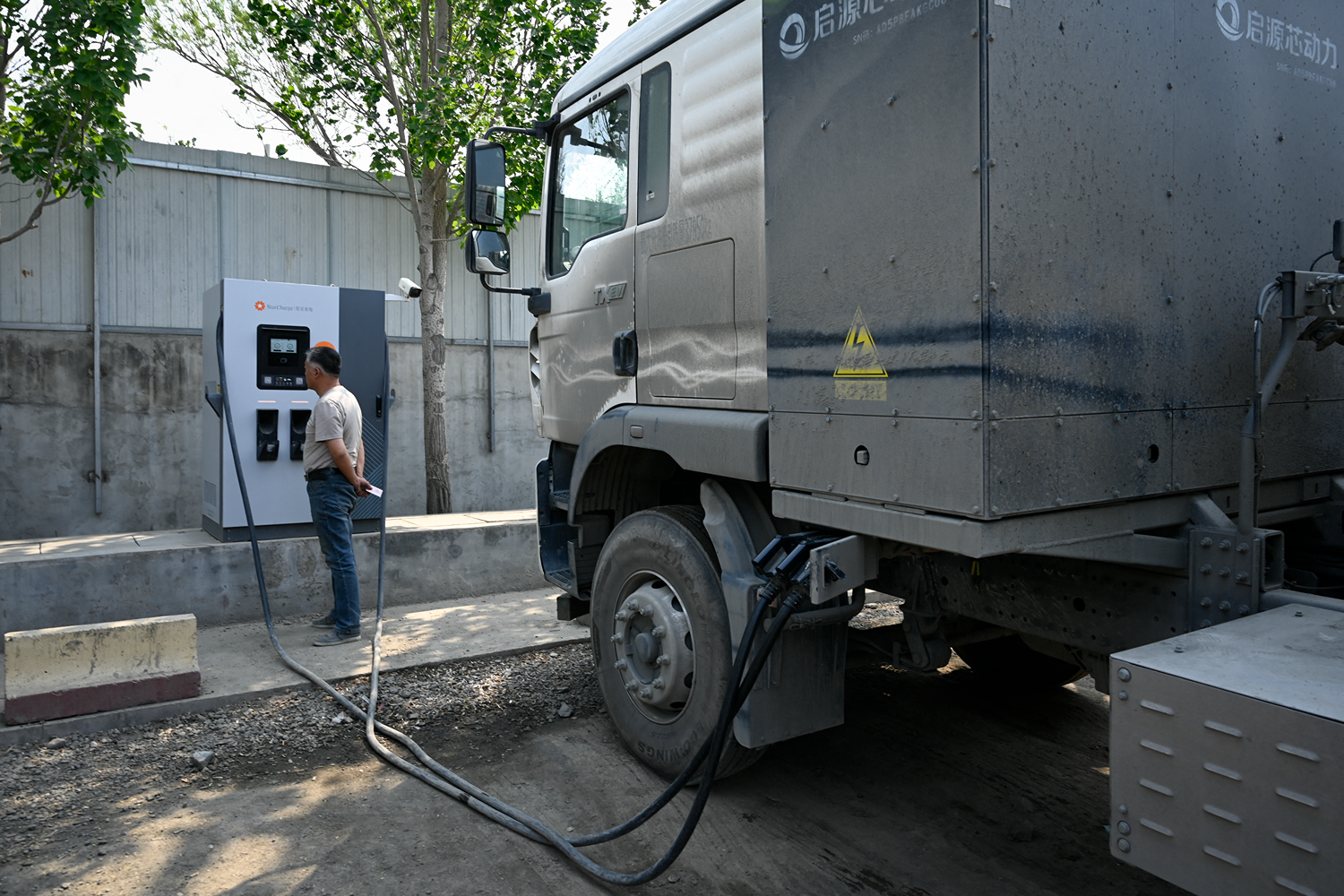
During fieldwork at one of Geely’s principal methanol truck facilities in Sichuan, one of us (Lu) saw how far the technology had advanced in both engineering and production scale. Since 2019, Geely’s commercial vehicle subsidiary Farizon has manufactured and sold more than 10,000 methanol-powered trucks and buses annually.
These vehicles either use methanol-fueled internal combustion engines as their primary power source or employ methanol-powered range extenders to recharge onboard batteries. These methanol vehicles deliver power output comparable to diesel-powered counterparts while offering cleaner emission, similar upfront purchase costs, and running costs that are 20-40 percent lower. As a result, they have become an increasingly attractive option for commercial fleet operators, particularly in China’s coal- and methanol-producing provinces.
Provincial governments helped create a market. Geely’s methanol program was sustained not by national policy alone but by a coalition of provincial governments, including Shanxi, Guizhou, Henan, and Sichuan, that saw methanol as advancing their own developmental priorities. Their support extended well beyond research funding to include operational subsidies, public bus fleet replacement, incentives for methanol-powered commercial vehicles, and investment in fueling infrastructure.
For coal-producing provinces seeking industrial upgrading, methanol offered a rare opportunity to transform an existing resource advantage into a new industrial ecosystem, linking coal, clean fuels, advanced vehicle manufacturing, low-carbon and low-emission transport, and energy security. In this sense, local governments were not merely implementing national strategy; they were active participants in shaping the technological trajectory of the industry.
The contrast with the United States is instructive. Energy firms and researchers have periodically argued that methanol could provide new opportunities for historically coal-dependent states. Yet no comparable coalition of state governments, firms, and sustained federal industrial policy emerged to commercialize the technology over the long term.
China’s approach was also more technologically inclusive than is often assumed. The Chinese government certainly prioritized battery EVs. Yet it rarely relied on a single technological pathway.
Around the same time that China launched its celebrated “Ten Cities, Thousand Vehicles” EV demonstration program, the Ministry of Industry and Information Technology also initiated a nationwide methanol vehicle pilot program across several coal- and methanol-producing provinces in 2012.
Rather than forcing an immediate technological winner, policymakers allowed multiple pathways—including battery EVs, fuel cells, plug-in hybrids, and methanol—to develop simultaneously under different regional conditions.
As the technology continued to improve, policy gradually adapted. In 2024, China formally incorporated methanol-powered shipping and green-methanol production into green-transition policy framework.
More recently, the 15th Five-Year Plan (2026-30) called for further development of methanol fueling infrastructure and industrial ecosystems.
Part of the reason is that the technological landscape itself has changed dramatically. The rapid decline in the cost of wind and solar power, driven by advances in wind turbines and photovoltaic technologies, has opened new possibilities for methanol production. Increasingly, methanol is being viewed not simply as an alternative transport fuel but also as an efficient carrier of hydrogen. Renewable electricity can be used to produce low-cost hydrogen through electrolysis, which can then react with captured carbon dioxide to synthesize methanol. In this way, methanol offers a promising pathway for simultaneously addressing hydrogen storage and transportation challenges while contributing to carbon capture and utilization.
China’s industrial policy has also produced duplication, overinvestment, failures, and corruption, in this story as in many others. Yet this evolution illustrates an important principle of industrial policy. Technologies should not be judged solely on the basis of their current commercial viability. Engineering advances can fundamentally reshape economic possibilities, altering cost structures, infrastructure requirements, and even the role a technology plays within a broader energy system. What once appeared to be a niche alternative fuel may later emerge as part of an integrated renewable energy ecosystem.
In July, Ford and Geely announced plans to establish a Europe-focused joint venture at Ford’s Valencia plant in Spain. The venture, owned two-thirds by Ford and one-third by Geely, is expected to produce three Ford-branded multi-energy vehicles and two Geely electric models beginning in 2028.
The arrangement reflects a striking reversal of roles. In the 1990s, Ford brought technological and engineering expertise to China while seeking relationships and access to an emerging market. Today, Geely arrives with capabilities developed through China’s mature EV ecosystem, including competitive vehicle technologies built on long-established manufacturing efficiency and sophisticated supply chains. Ford, in turn, contributes a major production facility, distribution networks, and access to the European market.
The United States and Europe may well be unable to reproduce the industrial ecosystems that China has built through decades of policy investment. Carefully structured technology partnerships can offer another path, allowing U.S. and European firms to draw on capabilities created by Chinese industrial policy while fast-tracking technological learning at home.
The crucial question is how such partnerships are designed. Political stakeholders demand partnerships tied to local production, workforce development, domestic suppliers, and shared research, rather than straightforward import-and-assembly arrangements, so that the gradual absorption of technological capabilities can strengthen the host country’s industrial competitiveness. This is easier said than done, and the political sensitivity is high. But at least in principle, it represents a form of industrial policy through negotiated integration rather than an attempt to reinvent the entire wheel from scratch.
The immediate benefits of the Ford-Geely partnership in Spain are readily apparent: higher utilization of Ford’s existing manufacturing assets, lower costs and reduced execution risks for Geely compared with building a greenfield plant in Europe, and positive economic spillovers for Spain, Europe’s second-largest automobile producer. The partnership’s greater significance, however, lies in its long-term strategic potential. At its heart is a new multi-energy family crossover scheduled for launch in 2028, which Ford describes a being “designed by Ford and jointly developed with Geely.”
More importantly, the commitment of co-development creates opportunities for genuine technological exchange. Geely’s diversified portfolio of technology can eventually empower a U.S. automaker’s product development and manufacturing, with technological know-hows transferring through day-to-day collaboration of engineers, technicians, and manufacturing workers. China’s cost-effective electrical/electronic architectures, a core strength of Chinese EVs, can also be used in U.S.-brand vehicles after rigorous tests, verification, and validation from Ford’s engineers.
Clear guardrails and carefully negotiated terms are mandatory for any such arrangement. Yet the historical episode illustrates the enormous potential of technological collaboration between the United States and China when complementary strengths and interests align.
The new Ford-Geely venture suggests that the direction of technological advantage may have changed: In the 1990s, China deepened its understanding of methanol vehicles by building on Ford’s decades of research into alternative fuels. Today, Ford stands to benefit from Geely’s sustained investment in electrification and advanced powertrain technologies over the past two decades. But the underlying logic of collaboration remains relevant: Each side can achieve outcomes that would be much harder, slower, and more expensive to pursue alone.
