


- In 2015, environmentalist Raimundo dos Santos Rodrigues was murdered in an ambush inside the Gurupi Biological Reserve in Brazil’s Maranhão state, where he served as a member of the advisory board.
- A local rancher, who was illegally logging inside the reserve, orchestrated the killing.
- Rodrigues’ wife Maria survived the attack but has spent more than 10 years living in another state in a government protection program.
- Maria experiences a contradiction in her new life: She had to be made invisible by the state to survive the state’s failure to investigate and prosecute socio-environmental crimes.
At around 1 a.m. on April 29, 2026, in a courtroom in Maranhão’s Bom Jardim district, Judge Philipe Silveira da Cunha publicly decided the fate of former military police officer Francisco da Silva Sousa.
“The defendant is sentenced to 35 years and four months in prison, to be served initially in a closed facility,” he announced into the microphone. Judge Cunha stood before the defendant, jurors, prosecutors and defense and prosecution lawyers under the white lights of the courtroom, ending a trial that had lasted more than 16 hours since it began the previous morning. The 66-year-old former police officer went straight from the courtroom to prison.
A jury found Da Silva, as he is known, guilty of orchestrating the murder of 54-year-old environmentalist and peasant farmer Raimundo dos Santos Rodrigues and the attempted murder of his wife Maria*, who was 37 at the time. The crime took place on Aug. 25, 2015, in the Bom Jardim district, inside the Gurupi Biological Reserve in northeastern Brazil. The reserve is a federally protected area and managed by the Chico Mendes Institute for Biodiversity Conservation (ICMBio), the federal agency overseeing protected areas.
Since 2009, Raimundo, Maria, their six children and about 38 other peasant families had been living in the Brejinho Rio da Onça II community encampment inside the reserve. They were waiting for the National Institute for Colonization and Agrarian Reform (INCRA) to regularize their status as formal settlers, either on that site or on another plot of land where they could live and farm.
On the day of the crime, Raimundo and Maria traveled to run errands in Buriticupu, a neighboring town. On their way back after 5 p.m., with Raimundo riding a motorcycle with Maria on the back, two men on another motorcycle shot them on a dirt road near their home.
One bullet hit Maria in her right elbow and another pierced her abdomen. She fell from the motorcycle and ran for cover. Raimundo was shot seven times. Looking back as she fled, Maria saw one of the killers hitting her husband with a machete — the same machete the farmer carried on his belt and had tried to use to defend himself after being knocked down by the gunmen.
After the killers fled, Maria walked as best she could to seek help from acquaintances about 500 meters (1,640 feet) away. From there, she was taken to the Municipal Hospital of Açailândia, more than 350 kilometers (217 miles) from Bom Jardim. She has never returned home.
According to the Maranhão State Prosecution Service, one of the suspected gunmen was killed the following day to silence him. The second shooter was never found.
The self-confessed mastermind of the attack and Raimundo’s murder was José Escórcio de Cerqueira, a rancher who grabbed federal land inside the reserve and logged there illegally, according to prosecutors. In a police statement, Cerqueira said he paid R$ 10,000 ($1,962) to Da Silva to hire gunmen to murder Raimundo. The environmentalist had served as a member of the advisory board of the Gurupi Biological Reserve since 2013, reporting illegal logging by Cerqueira and other ranchers to state and federal law enforcement agencies.
Cerqueira, who was more than 80 years old in 2015, died of natural causes in 2017 while the case was underway. He never stood trial. His son and right-hand man on the ranch, José Escórcio de Cerqueira Filho, was investigated but the prosecutor determined there was not enough evidence to charge him.
Maria’s journey
On the day of the trial, Maria was the first to testify. Wearing a long, straight, dark wig, sunglasses, clothing that covered her entire body and a white disposable surgical mask, she spoke as a prosecution witness under the protection of police officers armed with rifles. During the identity verification procedure, the judge asked the officers to form a barrier in front of her so the jurors and audience could not see her face when she removed her mask to confirm her identity against her ID photo.
Since the attack, Maria, now 48, has had to establish a completely different life from the one she knew until she was 37. After being discharged from the hospital 12 days after the 2105 shooting, she spent weeks fleeing, staying in unsafe hideouts in the Maranhão cities of Açailândia, Imperatriz and the state capital São Luís. Her two youngest children, then aged 10 and 11, fled with her to stay safe from Raimundo’s killers, who remained at large. To survive, they relied on help from the Maranhão-based organization Justiça nos Trilhos, the Pastoral Land Commission and the local Catholic Church.
In October 2015, Maria and her two children enrolled in the Protection Program for Threatened Victims and Witnesses (PROVITA), managed by the Maranhão Society for Human Rights (SMDH). From their final safehouse in São Luís, they were transferred to an undisclosed location in another state. Only some members of the program’s monitoring team know where Maria lives today.
To leave Maranhão, Maria had to sever all ties with family and friends to comply with the program’s rules. She could no longer communicate in person with her other four adult children, relatives or friends. She had to abandon the crops that were already bearing fruit on the day of the attack: rice, black beans, fava beans, mangoes, bananas, cupuassu, cashews, coconuts and tangerines. She also lost her daily routine in the Gurupi Biological Reserve, where she had lived with her family and neighbors in a thatched-roof mud house they built themselves in the encampment, surrounded by trees and a backyard stream.
Maria was unable to attend her husband’s wake or burial. Amid so much loss and trauma, she rejected PROVITA’s suggestion to change her name when starting over. Throughout her exile, which continues to this day — making her the longest-serving participant in Maranhão’s PROVITA program — Maria has chosen to remain Maria.
Raimundo’s murder made immediate national headlines and the NGO Justiça Global reported it to the Organization of American States, an international body that promotes human rights.
The contradiction — or tragedy — of Raimundo’s death lies in the fact that the public outcry was born from official silence. He had repeatedly reported the death threats he received to public safety agencies, including federal and state police.
Supported by the Federation of Rural Workers and Family Farmers of the State of Maranhão (FETAEMA), which was monitoring the situation, Raimundo also appealed to the National Agrarian Ombudsman’s Office. Four months before his murder, he filed a report at the Bom Jardim police station warning that Cerqueira was planning to hire gunmen to kill him. None of these complaints were investigated and, according to sources spoken to by Mongabay, the state’s inaction paved the way for his death.
In exile and under government protection, Maria embodies the Brazilian state’s ultimate contradiction: It had to erase her existence so she could survive its own failure to investigate and prosecute socio-environmental crimes.

Tom and Jerry against barbarism
“At night, everyone would sleep, but I couldn’t,” Maria said, recalling her post-traumatic insomnia during an interview at the headquarters of the Maranhão Public Defender’s Office in São Luís, two days after Da Silva’s trial. “As long as I was talking to the people around me, it was fine. But then night would come, which was my moment of silence, the kids slept and I’d walk around the house. I was like the watchman in the dead of night. Everyone was quiet while I was awake.
“I used to think a lot about the scene of the crime that happened to me. It was like being at a roundabout where you only exit in one place. It was very distressing because my emotions flowed so much. I cried a lot.”
During her first year in exile, Maria had to adapt to a new routine while recovering from her gunshot wounds. She received — and still receives — psychological support from PROVITA, but she was not yet working outside the home. There was little to entertain her in the apartment rented by the program, a stark contrast to the lush Amazonian landscape she and her husband had helped protect in the Gurupi Biological Reserve.
During that first year, she found relief in cartoons and comedy movies. “I didn’t like to watch anything violent,” she says. “When I had too much on my mind, when I couldn’t take it, I’d put on cartoons. I used to watch Tom and Jerry a lot because they were very funny. I’d start to smile at those things and clear my head. I spent a long time in this struggle so I wouldn’t waste away in depression.”
After a year, she moved to a different home and found work. She started by cleaning houses, then cared for the elderly, and eventually found jobs in restaurants cooking, working the cash register, preparing takeaway orders and washing dishes. Wherever she went, no one knew her story.
As she slowly resumed her routine, the constant crying gave way to what she calls “neutrality”: “For me, it was as if I had been broken. I was ground into crumbs. I was left without emotions, neutral. It seems like everything just stops inside you.”
Today, she says she can feel and express emotion again. During the interview with Mongabay, she remembers those who helped her during the years after the crime. “I’m grateful to everyone I know and those I don’t know, who also helped me,” she says. “I thank the lawyers, the people from the beginning who are no longer present. I thank the prosecution service in general and I make a point of having this appreciation published.”
Maria pauses during the interview to wipe her eyes behind her sunglasses. After a brief silence, she says: “Sometimes I get emotional right away, sometimes I get emotional later. I’m like that, a bit slow to react.” She adds that she no longer dreams, but is sleeping better, “And tonight I’m going to sleep even better, knowing that Da Silva is in jail.”

A major state failure
Lawyer Danilo Chammas has worked on Raimundo and Maria’s case since 2014, when Raimundo first spoke of death threats. “I saw him reporting the threats,” he says. “You can’t wait for a threat to materialize to investigate it. He could have been admitted to the protection program. There were several things that the state could have done, which were already available, but they were not done; it was a major failure.”
Chammas served as an assistant prosecutor for the Maranhão Prosecution Service during Da Silva’s trial, alongside lawyers Fernanda Souto from Justiça nos Trilhos and Valdênia Paulino Lanfranchi, who specializes in protecting threatened human rights defenders.
PROVITA has operated in Maranhão since 2003 “The program started receiving funding again because of the repercussions of the case,” Chammas says. Threatening people has been a crime under Article 147 of the Brazilian Penal Code since 1940.
Pedro*, 56, was the head of the Gurupi Biological Reserve at the time of the murder and helped draft several of Raimundo’s threat reports. “He would come to the [Açailândia ICMBio] office, I would write it down and he would sign it,” Pedro says. “I drafted several reports myself for the federal and civil police, and the Prosecution Service. He sought protection for himself and his family, and he didn’t get it.”
Pedro managed the reserve from 2006 to 2022 and testified at the trial in Bom Jardim as a witness for the prosecution.
Immediately after the murder, Chammas helped find safehouses for Maria, her two young children and André*, a child protective services counselor in Buriticupu who also served on the reserve’s advisory board. Like Raimundo, André was on a hit list because of his reports on illegal logging in the municipalities surrounding the reserve. Buriticupu is notorious for the illegal trade of timber extracted from local Indigenous territories and the Gurupi reserve.
A companion in silence
During their exile, Maria says she would ask André: “Why did you come? You’re young, you had your job, your family, and you could’ve gone somewhere else.” André says his decision to leave Maranhão with Maria and her children in 2015 stemmed from their friendship and his respect for her, as well as her physical condition: “When I met her in the hospital, with her arm injured, she cried and said, ‘I lost my husband.’ I thought, ‘My God, how am I going to help in this situation?’ The plan was for me to go one way [with PROVITA] and her to go another. But I said: since I have to go, I’ll go with her as long as I can.”
Their first home under the protection program was a small two-bedroom apartment. André did all the housework because Maria was still recovering the use of her right arm. “She was embarrassed because I washed her clothes,” André says. “I felt useful there.”.
As they rebuilt their lives, André, Maria and the children occasionally went for walks to get to know their new neighborhood. André also taught the children to read and write. Preparing meals became a way to escape their homesickness and the trauma of the violence that kept them there. “We cooked every day,” he says. “I used the spices she asked for. I learned a lot from Maria, both about household chores and about her simplicity, ethics, wisdom and resilience.” He remained in the program for 14 months before asking to leave.

Profiting from state land
Created by a decree in 1988, the Gurupi Biological Reserve is one of the last preserved portions of the Amazon Rainforest in Maranhão, a state increasingly devastated by export agribusinesses’s monoculture crops and cattle pastures. Spanning about 341,000 hectares (776,000 acres), the reserve covers parts of the municipalities of Bom Jardim, São João do Caru and Centro Novo do Maranhão. It is a fully protected federal conservation unit intended solely for research and preservation. Housing and resource extraction are prohibited.
When Raimundo arrived in 2009 with other families looking for land to farm, Cerqueira invited them to camp on the borders of the Santa Bárbara Ranch, which he claimed to own. According to prosecutors, Cerqueira planned to have the National Institute for Colonization and Agrarian Reform (INCRA) compensate him for the land he would lend to the families for settlement.
Case files from the prosecution service contain a document signed by Cerqueira, his wife, his son, Raimundo and Maria, who served as treasurer and president, respectively, of the Association of Small Rural Workers of the Brejinho Rio da Onça II Village, and a representative of a second association. In the document, Cerqueira agreed to sell two ranches to the associations “for a total of 980 alqueires at R$ 3,500 per alqueire [a unit of land area that may vary from 2.42 to 4.84 hectares (6 to 12 acres), depending on the region].”
According to the case files, when INCRA inspected the area, it found that the farm lay within the Gurupi Biological Reserve and was therefore federal land subject to restricted use. Cerqueria was attempting to sell state land to the state itself. Seeing his plan thwarted, the rancher instigated a conflict with Raimundo, attempting to evict the families from the site.
The conflict continued to escalate. In 2011, Cerqueira filed a repossession lawsuit against the families. In June 2013, following a hearing at the INCRA office in Imperatriz, the agency promised to inspect the area the following month to consider a settlement. The inspection never took place, leaving the families without state support as tensions mounted.
In June 2014, Cerqueira Filho set fire to the community’s homes, forcing the families to relocate further away. Testifying at Da Silva’s trial, he admitted to starting the fire, claiming the military police had authorized it during the execution of a repossession order.
INCRA did not respond to Mongabay’s requests for comments regarding measures taken to settle the families. The ombudsman’s office said it had no record of actions taken following Raimundo’s complaints. “Unfortunately, the archives from that time were not provided to this department, which only has files on cases dating from 2023 to the present date,” said Nayara Ayres, the Ministry of Agrarian Development’s general coordinator for conflict mapping.
Criminal record
The Cerqueira family’s criminal history predates Raimundo’s murder. In 2007, the Ministry of Labor and Employment added José Escórcio Cerqueira to its “dirty list” of slave labor after inspectors rescued 31 workers from modern slavery at his Santa Bárbara and Bom Jesus ranches in Monção, Maranhão.
ICMBio records show that Cerqueira was sanctioned twice after Raimundo’s murder. The first time, in September 2016, was for deforesting more than 2,300 hectares (5,690 acres) inside the Gurupi Biological Reserve. Authorities embargoed the area, destroyed two tractors and fined him nearly R$ 28 million (almost $5.5 million). Public records do not show whether the embargo remains active or if the fine has ever been paid.
The second fine was issued in August 2017 against Jotae Peças Ltda, an auto parts company registered to Cerqueira and his wife, Clenir Rodrigues de Cerqueira. Based in Imperatriz, the company was caught transporting 22.85 cubic meters (807 cubic feet) of illegal native timber from the Gurupi Biological Reserve. Authorities seized it and the company was fined R$ 13,800 ($2,705). ICMBio records do not indicate whether this fine was paid.
When contacted by Mongabay, ICMBio declined to provide details on the current status of the fines and the embargo. It did not provide data on deforestation, fires, illegal logging or irregular ranches inside the reserve, and did not comment on the trial of the former military police officer, Da Silva.

A crime in the dark
For over a decade, defendant Francisco da Silva Sousa used darkness and fear to evade his responsibility for the murder of Raimundo and the attempted murder of Maria. “It was a crime committed in a remote, hard-to-reach location, without surveillance cameras, without the ordinary recording mechanisms that exist in urban areas and with extreme violence that could intimidate witnesses and silence community members,” said prosecutor Francisco de Assis Carvalho Júnior.
Carvalho said Da Silva’s background as a former police officer posed an extra challenge for the Federal Police investigation. “He knew the police from the inside. Those who know the ways of investigation also often know how to hinder it, build alibis and create obstacles to reestablishing the facts,” the prosecutor said during the trial.
According to Federal Police reports, Da Silva allegedly instructed funeral home
employees handling the body of the dead gunman to discard a cell phone found in his pocket. The device, visible in photos of the crime scene, was never recovered for forensic analysis.
Investigators also reported that three days after the murder, Da Silva visited the home of the man who had helped Maria on the day of the attack. They spoke for about half an hour in the dark, out of sight of another witness. The man, a hand on Cerqueira’s ranch, was also Maria’s compadre — she was godmother to one of his children. He was a witness for the defense at Da Silva’s trial.
“The challenge was to transform complex evidence built over years into an objective and understandable narrative for the jurors, truthful to the case files,” Carvalho said to Mongabay.
April’s court decision can still be appealed and Da Silva’s defense has already requested an annulment of the trial, alleging juror bias. This appeal was denied. “The appellate judge based his decision on the information provided by the trial judge: security was guaranteed during the session, which was conducted objectively and, above all, that the act itself occurred without any incident that would justify annulment,” said Fernanda Souto, a lawyer with Justiça nos Trilhos.
The Prosecution Service highlighted the legal, symbolic and institutional value of the sentence. “It honors the memory of Raimundo dos Santos Rodrigues, recognizes Maria’s resistance and reaffirms that defenders of life, land and the environment are not alone,” Carvalho said.
The future
The verdict returned Raimundo’s death to national television news in Brazil, as broadcasters reported the former military police officer’s 35-year prison sentence. That same week, the news also featured the Pastoral Land Commission’s Conflitos no Campo Brasil (Land Conflicts in Brazil) report showing that murders linked to land conflicts in the country doubled in 2025, rising to 26 from 13 the previous year. Maranhão recorded 190, the highest number of land conflicts. Globally, Brazil remains the fourth-deadliest country for environmental advocates.
Given this reality and her own memories, Maria’s unwillingness to join land and territory struggles is understandable. Having been “ground into crumbs”, it was difficult to face the trial when it began on April 28. “It meant cleansing for my soul, for my long wait and anguish, for my family, for the other families who were waiting,” she says.
Maria is expected to remain in PROVITA for some time. Transitioning out of the program is a gradual, collaborative process, according to Graziela Martins Nunes, a social worker with the Maranhão Society for Human Rights. “When I leave [the protection program], my dream is to build my house,” Maria says. “And what I really want is to work with food. This is a dream I won’t give up. I’ll start with snacks, coffee, and build things up. I want to open a home-style restaurant.”
In 2026, she will finish her seventh-grade education. She has plans to finish eighth grade in 2027 and then ninth grade, alongside entrepreneurship courses to help start her restaurant.
“When I’m free to be in other places, I want to go to [Raimundo’s] land to give an explanation to his daughters, who always welcomed me and received me very well,” she says. “They called me, but I was in the hospital. They even invited me to go there because they were going to take care of me, but when I left the hospital, I didn’t go to anyone’s house; I left under escort.”
Mongabay asked Maria what kind of explanation she would give to Raimundo’s daughters: “I’d like to say ‘Look, I didn’t come at the time because I couldn’t, because I was waiting for the trial. That’s how it happened, but justice was served. I didn’t give up; the crime did not go unpunished.’”
*For security reasons, Maria’s full name will not be disclosed and the names of the prosecution witnesses have been changed.
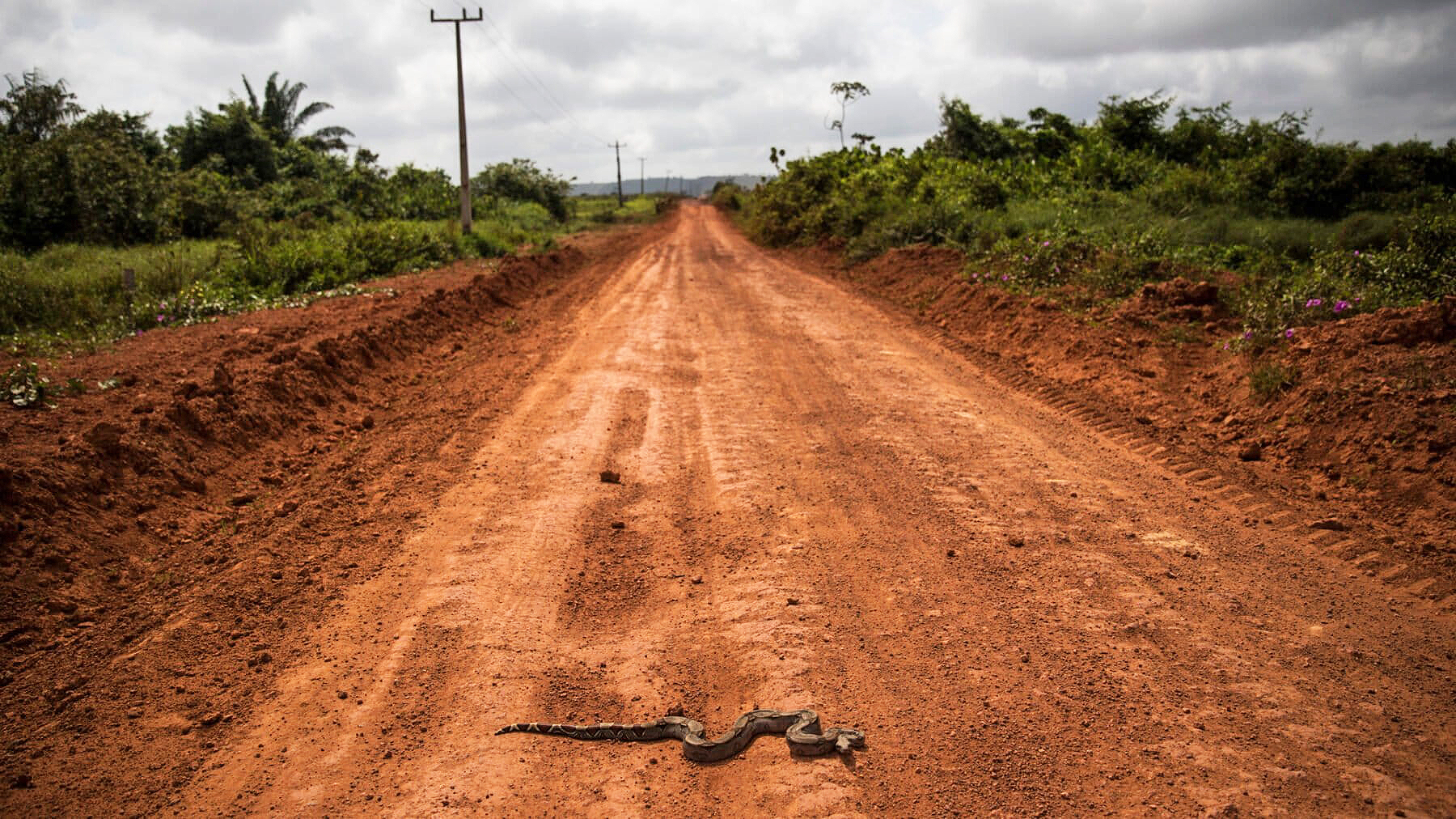
Banner image: A road in the Alto Rio Guamá Indigenous Territory on the border between Pará and Maranhão states. Image by AP Photo/Rodrigo Abd.
This article was first published in Portuguese here on Aug. 3, 2026.

