


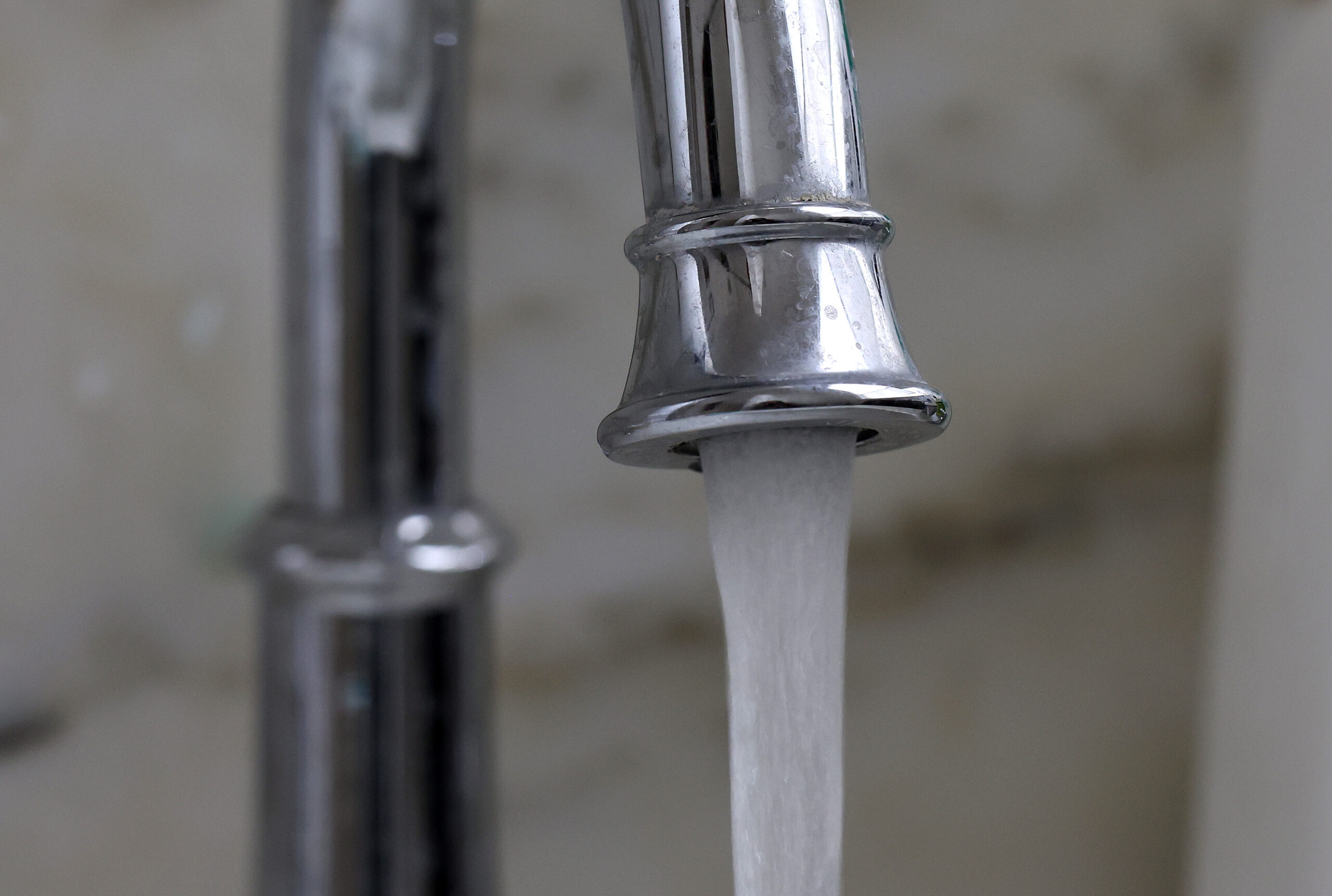
When PFAS concentrations in drinking water fall below laboratory reporting limits, they are sometimes treated as “zero” in statistical analyses. But a new study published in Cell Reports Sustainability, which reanalyzed federal monitoring data, found that estimated PFAS concentrations in U.S. drinking water could be more than twice as high as calculations that treat results below laboratory reporting limits as zero suggest.
PFAS are a group of thousands of synthetic chemicals used for decades in products ranging from nonstick cookware to waterproof clothing. Often called “forever chemicals,” they break down very slowly in the environment and have contaminated drinking water supplies across the United States.
“About 98 percent of the roughly 1.86 million individual PFAS test results in EPA’s January 2026 dataset were below reporting limits,” said the study’s author, Gehendra Kharel, an associate professor of environmental and sustainability sciences at Texas Christian University.
But even without an exact concentration, he said, “those records still tell us something”—that PFAS contamination of drinking water is far more prevalent than generally acknowledged.
For PFOA and PFOS, two of the most widely studied forever chemicals, the EPA sets a maximum allowable concentration of 4 parts per trillion.
By using statistical models to estimate concentrations below laboratory reporting limits, the researchers found that more sampling locations could reach or exceed the study’s comparison threshold of 4.05 parts per trillion, just above the EPA’s drinking water limit of 4 parts per trillion. Depending on the model, an additional 16 to 33 locations crossed that threshold for PFOA, and 4 to 25 for PFOS, said Kharel.
None of the newly identified sampling locations crossed the threshold for both chemicals simultaneously.
For Laurel Schaider, an environmental chemistry and engineering scientist at the Silent Spring Institute, who was not involved in the study, the findings highlight a broader problem with how scientists interpret measurements that fall below detection or reporting limits. “I think the paper raises an important point about how we think about results when we find that a chemical is not detected,” she said.
Schaider offered an analogy: Imagine you’re moving and packing all your belongings into boxes. Before shipping them, you might want to weigh each box to figure out how heavy the entire shipment will be. Some boxes might be heavy, while others might be pretty light. But assuming the lighter ones weigh nothing would underestimate the total weight of your belongings. “You don’t want to call those all zero,” she said.
Under the EPA’s Fifth Unregulated Contaminant Monitoring Rule (UCMR 5), public water systems across the U.S. are required to test their drinking water for 29 PFAS chemicals. Water suppliers collect samples and send them to EPA-approved laboratories, which use specialized equipment to measure the concentrations of these chemicals.
The EPA then receives the results, which help it assess how widespread PFAS contamination is in the nation’s drinking water. But the tests have limits. When a concentration falls below the reporting limit, the result is reported as below that threshold rather than a precise number. That does not necessarily mean the chemical is absent from the water. “Simply substituting zero is not the best way to handle a non-detect,” said Schaider.
How low a concentration a laboratory can measure reliably depends in part on its equipment and methods. “There are differences in the type of instruments. The instruments that can measure lower concentrations probably cost more,” said Schaider.
But as chemistry techniques improve, “we can be more sensitive across the board, and then we don’t have to make so many guesses anymore,” said Shelly Liu, associate professor of population health at the Icahn School of Medicine at Mount Sinai, who was not involved in the study.
Still, finding higher concentrations in drinking water samples does not necessarily mean people are exposed to more PFAS than previously thought. While the researchers’ statistical models produced a higher estimate of combined low, under-the-limit PFAS concentrations, it did not measure individual exposure.
“That’s not the same as demonstrating underestimated exposure,” said Kharel. “We studied water entering distribution systems, not the water people actually drank,” he said.
The findings also raise questions about whether current reporting practices provide enough information about low levels of PFAS contamination, and whether more sensitive testing, where labs can reliably achieve it, could help close those gaps.
Agencies could clearly report the limits used and how often results fell below them, show estimates that account for below-limit results alongside zero-substitution averages, and explain the uncertainty of those estimates, said Kharel.
The EPA acknowledged the request for comment but did not provide a statement in time for publication.
Understanding how much PFAS is present in drinking water matters because exposure to these chemicals is already widespread. “Over 99 percent of people have PFAS in their blood,” said Schaider.
This story is funded by readers like you.
Our nonprofit newsroom provides award-winning climate coverage free of charge and advertising. We rely on donations from readers like you to keep going. Please donate now to support our work.
Although the new study did not examine health effects, previous studies in laboratory animals have shown that exposure to certain PFAS can suppress the immune system, impair antibody responses and alter thyroid hormone levels.
Other research has linked PFAS exposure to thyroid disease, reproductive problems and an increased risk of certain cancers, particularly kidney and testicular cancer, Schaider said.
“Determining the health implications would require information about what people actually consumed, for how long, other exposure sources and health outcomes,” said Kharel.
Liu said the EPA “sort of makes an assumption that drinking water only accounts for about 20 percent of PFAS exposure. But for some people, it would be the primary source, and therefore they often have very high exposure to one specific PFAS compound.”
About This Story
Perhaps you noticed: This story, like all the news we publish, is free to read. That’s because Inside Climate News is a 501c3 nonprofit organization. We do not charge a subscription fee, lock our news behind a paywall, or clutter our website with ads. We make our news on climate and the environment freely available to you and anyone who wants it.
That’s not all. We also share our news for free with scores of other media organizations around the country. Many of them can’t afford to do environmental journalism of their own. We’ve built bureaus from coast to coast to report local stories, collaborate with local newsrooms and co-publish articles so that this vital work is shared as widely as possible.
Two of us launched ICN in 2007. Six years later we earned a Pulitzer Prize for National Reporting, and now we run the oldest and largest dedicated climate newsroom in the nation. We tell the story in all its complexity. We hold polluters accountable. We expose environmental injustice. We debunk misinformation. We scrutinize solutions and inspire action.
Donations from readers like you fund every aspect of what we do. If you don’t already, will you support our ongoing work, our reporting on the biggest crisis facing our planet, and help us reach even more readers in more places?
Please take a moment to make a tax-deductible donation. Every one of them makes a difference.
Thank you,
