


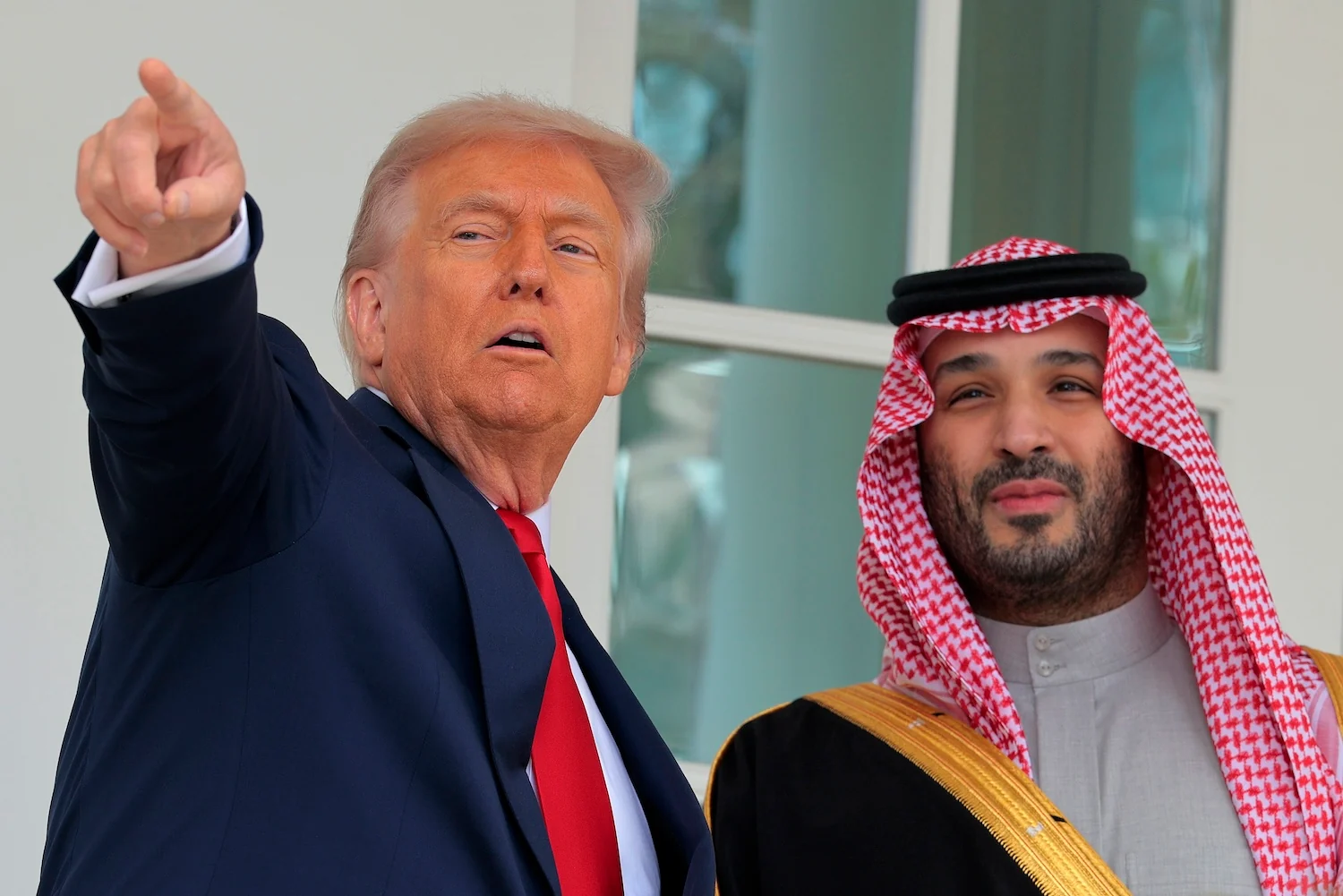
The Trump administration has been on a dealmaking spree in the Middle East. Over just the past few months, the administration has signed a new trade agreement with Jordan, granted the United Arab Emirates access to the most advanced American artificial intelligence chips, lifted sanctions on Syria, approved F-35 sales to Saudi Arabia (and said it would consider selling them to Turkey), approved a major arms package for Israel, and signed a landmark civil nuclear cooperation agreement with Saudi Arabia.
Each U.S.-stamped deal may make sense on its own terms, and many create huge opportunities for American companies. But as the United States’ partners are increasingly one another’s rivals, this means that Washington is arming and equipping all sides of the region’s many rifts. So do these deals add up to a larger strategy to support the United States’ long-term interests in the region? Not quite.
In fact, Washington seems to have no theory of how (or whether) to weigh its many deals against one another. That puts the administration’s own policy goals at risk: Expanding the Abraham Accords, building trade and energy corridors that are insulated from external shocks, and enabling regional partners to carry more of the security burden all depend on these partners not working against one another.
The United States does not necessarily need a grand geoeconomic vision for a region that is notoriously unkind to sweeping plans. But it should have a modest plan to ensure that its various policy moves do not directly undercut one another.
The Iran war has broadened and deepened many of the rifts among U.S. partners. Normalization between Saudi Arabia and Israel also seemed within reach before Hamas’s Oct. 7, 2023, attack, but is now frozen. Instead, Saudi Arabia has joined Pakistan and Turkey in the Mecca defense pact, against the backdrop of growing cooperation between Israel and the UAE. Once aligned on many issues, Saudi Arabia and the UAE are now openly competing for regional leadership in economics and technology. Israel and Turkey, in turn, have grown increasingly antagonistic, including over Syria, which is untangling itself from Washington’s decades-old web of sanctions. This summer, Israel and Greece’s joint desire to check Turkish influence culminated in the signing a historic defense deal.
So how has Washington managed this increasing fractured landscape? In August, the Trump administration approved a multibillion-dollar civilian nuclear deal with Saudi Arabia, and in September, it approved the sale of F-35 jets to the kingdom (both deals are still pending congressional approval). Ahead of the July NATO Summit in Ankara, Turkey, U.S. President Donald Trump said he would consider allowing Turkey to buy the F-35, although it remains banned by U.S. law from doing so until it gives up its Russian S-400 air defense system.
Since Israel, Turkey, the UAE, and Saudi Arabia all have advanced fighters and nuclear know-how but remain acute geopolitical competitors, these deals could fuel a regional arms race and erode Israel’s qualitative military edge, long a cornerstone of U.S. defense and foreign policy.
AI is only accelerating this dynamic. Stargate UAE—part of a planned 5-gigawatt campus in Abu Dhabi built around the Emirati AI champion G42 alongside OpenAI, Cisco, Nvidia, SoftBank, and Oracle—is the anchor of the country’s ambition to be a regional and global AI hub. Meanwhile, a few hundred miles away, Saudi Arabia’s HUMAIN, backed by the kingdom’s Public Investment Fund, is pursuing a similar goal with the same U.S. chipmaker (Nvidia) and a competing cloud provider (Amazon Web Services). The result is two national AI stacks built on the same U.S. technology, each under its own bilateral terms. In short, U.S. deals are creating duplication rather than synergy on a critical emerging technology.
Of course, bilateral dealmaking with allies and partners that benefits a country’s own companies is not inherently flawed. China and India have each used this playbook in the Middle East. Through its Belt and Road Initiative, China has signed tens of billions of dollars a year in construction contracts across the Middle East, many with regional rivals. In 2021, China signed a 25-year economic framework with Iran, even as it remains the Gulf Cooperation Council’s largest trading partner. India, for its part, has inked comprehensive economic partnership agreements with the UAE and Oman. Its government and private sector have financed major transportation corridors across the region and operate ports in Iran and Israel.
Crucially, though, unlike the United States, neither China nor India has been a security guarantor in the region. This means that even though U.S. companies are getting big contracts, Washington has much more to lose. A clash between Israel and Turkey, or an open break between Saudi Arabia and the UAE, would leave Washington on both sides of a fight that it helped finance, with key alliances hanging in the balance.
Administration officials say that bilateral deals are themselves the strategy and that managing rivalries among partners isn’t Washington’s job. This week, U.S. Ambassador to Turkey Tom Barrack told the Global Security Forum in Doha, Qatar, “America as the guarantor to the world, for the last 80 years, it is no longer there. …We don’t have a playbook. We’re all on audibles. We can go one play at a time.”
Barrack isn’t entirely wrong: U.S. partners will not (and should not) be dictated to, and the United States has historically overstated its ability to smooth over the region’s many thorny geopolitical rivalries. It is also natural for countries in the region to compete and court the same U.S. firms and for Wall Street financiers to realize their own ambitions. But this doesn’t mean that the United States should be aggravating fault lines in ways that will ultimately hurt it.
Washington can do better. The administration already plans to screen outbound investment, focused on protecting U.S. national security and preventing technology transfers to adversaries. The White House should establish a similar review process for multistakeholder deals, so that before major bilateral agreements are finalized, the entire U.S. government can assess how it impacts regionwide interests.
There is also the newly formed U.S. Economic Diplomacy Action Group, a committee now chaired by Secretary of State Marco Rubio that brings together officials across more than a dozen federal agencies to coordinate commercial diplomacy. This could serve as a useful interagency platform to reconcile U.S. deals with U.S. policy priorities. Moreover, the UAE, Qatar, and Israel are already members of Pax Silica, an initiative intended to build a global coalition around AI infrastructure and supply chains. This organization could also help promote shared security and technology standards in the region.
It would also help if economic deals were used to incentivize cooperative behavior. For example, expanded foreign military sales to Turkey could be tied to deconfliction in Syria with Israel. Saudi civil nuclear cooperation could be linked to investment in Syria’s reconstruction. And U.S. export licenses for cutting-edge AI chips could be used to promote common security and technology standards among Saudi Arabia, the UAE, and other partners eager for access to American frontier technology.
The Trump administration should also deploy its economic tools to back helpful cross-border projects without insisting that countries first sign on to the Abraham Accords. These could include rail corridors connecting the Arab Gulf states to Turkey through the Levant, major infrastructure and electricity projects that would make energy flows more reliable, and regional desalination and water projects that could make the region’s population more secure.
Finally, someone in the administration needs to own all of this. An ambassador-level regional coordinator could help make sure these deals add up to more than the sum of their parts. And a new focus on strategic coherence would ensure that American economic dealmaking in the region advances U.S. interests, rather than inadvertently leaving Washington on both sides of the next conflict.
All statements of fact, opinion, or analysis expressed are those of the authors and do not reflect the official positions or views of the U.S. government. Nothing in the contents should be construed as asserting or implying U.S. government authentication of information or endorsement of the authors’ views.
