

Close Menu
NCIJ Network NCIJ Network
    What's Hot

    SonicWall and Splunk Patch Critical Vulnerabilities

    October 8, 2026

    Top Democrat among Senate investigators probes ties between Cantor Fitzgerald, Tether

    October 8, 2026

    Why are more roofs not made of solar tiles?

    October 8, 2026
    Facebook X (Twitter) Instagram
    Trending
    • SonicWall and Splunk Patch Critical Vulnerabilities
    • Top Democrat among Senate investigators probes ties between Cantor Fitzgerald, Tether
    • Why are more roofs not made of solar tiles?
    • ADHD and autism at risk of over-diagnosis, says government review
    • Mecca Pact Triggers Pakistan, Turkey Fight Against Houthis with Saudi Arabia
    • Video doesn’t show Arkansas farmers praying for ‘more Mexicans.’ Here’s the truth
    • Curtis Flowers, US man wrongfully imprisoned for 22 years, dies aged 56 | Mississippi
    • At least five arrested over Renoir museum theft
    • About
      • Our Team
      • Editorial Policy
      • Editorial Independence
      • International Support
    • Trust & Standards
      • AI Usage Policy
      • Conflict of Interest Policy
      • Corrections Policy
      • Ethics Policy
      • Fact-Checking Policy
      • Source Protection
    • Get Involved
      • Guide for Sources
      • Support Independent Journalism
    • Legal
      • Cookie Policy
      • Privacy Policy
      • Terms of Use
    Facebook X (Twitter) Instagram
    NCIJ Network NCIJ Network
    Thursday, October 8
    • Home
    • World
    • Ai
    • Business
    • Politics
    • Health
    • Crypto
    • Science
    • Technology
    • Cybersecurity
    • Defense & Security
    • Economy
    • Energy
    • Europe
    • More
      • Fact Check
      • Investigations
      • Opinion & Analysis
      • Environment
    NCIJ Network NCIJ Network
    Home»Science

    This frozen fiber makes light and sound interact 1,000x more strongly

    NCIJ NETWNCIJ NETWORKBy NCIJ NETWNCIJ NETWORKAugust 22, 2026 Science No Comments3 Mins Read
    Share
    Facebook Twitter LinkedIn Pinterest Email

    The transformation of a liquid into a solid is familiar in nature. Lava flowing from a volcano eventually cools and hardens into rock, while water in a lake can freeze into ice during a cold winter. When materials undergo these phase changes, important physical properties can change as well, including density and refractive index, which affect how sound and light travel through them.

    A related process plays an important role in manufacturing optical fibers. Glass preforms are heated until their structure becomes loose enough to be drawn into extremely thin fibers. Light travels through the fiber core, allowing information to move rapidly across long distances. This ability has made optical fibers essential to modern telecommunications.

    Scientists have also developed specialized optical fibers for technologies including fiber lasers, fiber endoscopes, and fiber sensors. Some hollow core fibers can be filled with gases or liquids, allowing them to map temperature distributions or even function as tiny laboratories for chemical experiments.

    Freezing a Liquid Core at Extreme Temperatures

    Researchers from the Max Planck Institute of the Science of Light (MPL) in Erlangen, the Leibniz University Hannover (LUH) and the Leibniz Institute for Photonic Technologies (IPHT) in Jena have now taken liquid core optical fibers (LiCOF) in a new direction.

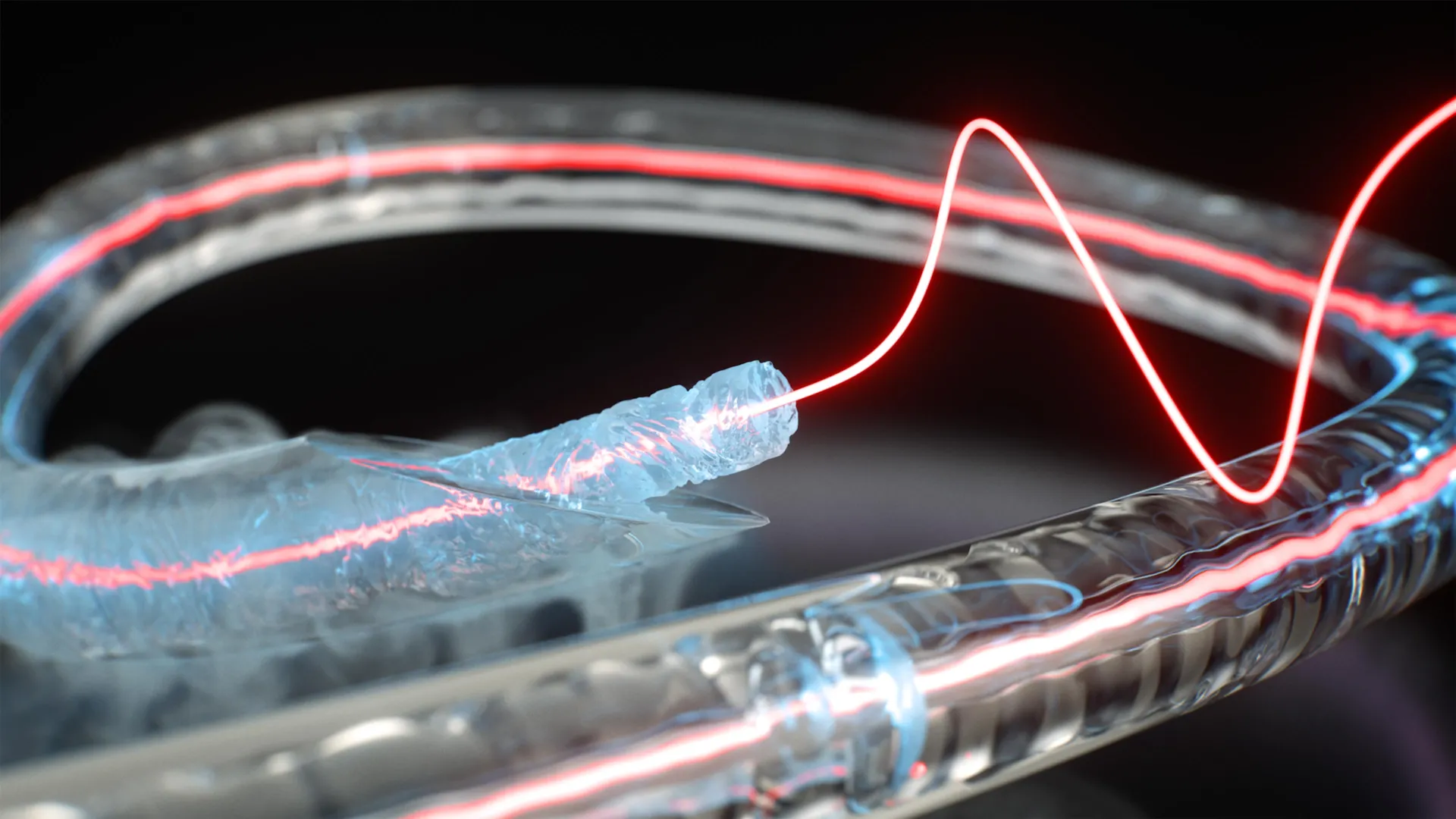
    The team cooled the liquid inside the fibers with nitrogen at -196 °C, causing the material in the core to change from a liquid into a solid. Surprisingly, freezing the core did not prevent the fiber from carrying light.

    “The key point is, that the frozen section of the LiCOF retains its ability to guide light. Not only that, but both the liquid and the frozen section of the fiber also guide hypersonic sound waves,” says Simon Seiderer, one of the three lead authors of the article and a researcher in the “Quantum Optoacoustics” research group of Prof. Dr. Birgit Stiller, who leads the project.

    Light and Sound Interact More Than 1,000 Times More Strongly

    The researchers took advantage of the unusually strong interaction between light and sound inside the frozen fiber. This phenomenon, called Brillouin-Mandelstam scattering, is already known from conventional optical fibers.

    Freezing the liquid core, however, creates an exceptionally dense and tightly confined environment. Under these conditions, the interaction between light and sound becomes more than 1000 times stronger than it is in standard optical fibers.

    That dramatic increase allowed the team to demonstrate optoacoustic memory, a key component that could be used in photonic neuromorphic computing inside fibers.

    The approach relies on the enormous difference between the speeds of light and sound. Information carried by a rapidly moving light wave can be transferred to much slower sound waves, where it is temporarily retained, and then converted back into light.

    Because the frozen LiCOF enables such efficient interaction between light and sound, the technology could provide new ways to sharply reduce the amount of energy required by future photonic computing systems.

    A New Platform for Photonic and Quantum Technology

    The work builds on a long-standing collaboration with Prof. Markus Schmidt and Prof. Mario Chemnitz from the IPHT Jena, who pioneered research involving liquid core optical fibers. Adding the freezing step allowed the researchers to achieve much greater nonlinear effects inside the fiber.

    “By freezing the liquid core, we have created an entirely new physical platform that provides extreme nonlinearities while being easy to handle,” says Stiller. “While demonstrating a highly efficient optoacoustic memory is a fantastic first step, this level of light-sound coupling not only opens up exciting new possibilities for neuromorphic computing, but also for quantum information processing, microwave photonics and high-precision sensing.”

    1000x fiber frozen interact light sound strongly
    NCIJ NETWNCIJ NETWORK
    • Website

    Keep Reading

    Why are more roofs not made of solar tiles?

    This “golden tree” coral was too strange for any known family

    NASA Briefing to Highlight Contributions to Martian Moons Mission

    NASA Announces Bold Science Initiatives for America’s Golden Age Summit

    Kilauea’s display is revealing why volcanoes spew like a fountain show

    NASA’s SpaceX Crew‑12 Splashes Down, Sets Briefing to Discuss Mission

    Add A Comment
    Leave A Reply Cancel Reply

    Editors Picks

    SonicWall and Splunk Patch Critical Vulnerabilities

    October 8, 2026

    Top Democrat among Senate investigators probes ties between Cantor Fitzgerald, Tether

    October 8, 2026

    Why are more roofs not made of solar tiles?

    October 8, 2026

    ADHD and autism at risk of over-diagnosis, says government review

    October 8, 2026
    Latest Posts

    Wisconsin’s partisan primary election is Tuesday. Learn more about who’s on your ballot.

    August 10, 2026

    Gabon ends fisheries partnership agreement with EU

    August 10, 2026

    Science backs calls for limiting screens in schools

    August 10, 2026

    Subscribe to News

    Get the latest sports news from NewsSite about world, sports and politics.

    NCIJ Network is an independent digital news platform delivering trusted investigative journalism, European and global news, in-depth analysis, and fact-based reporting with accuracy, transparency, and integrity.

    Facebook X (Twitter) Instagram Pinterest YouTube

    SonicWall and Splunk Patch Critical Vulnerabilities

    October 8, 2026

    Top Democrat among Senate investigators probes ties between Cantor Fitzgerald, Tether

    October 8, 2026

    Why are more roofs not made of solar tiles?

    October 8, 2026

    Subscribe to Updates

    Get the latest creative news from FooBar about art, design and business.

    Type above and press Enter to search. Press Esc to cancel.