


Welcome back to Foreign Policy’s Situation Report, where I’m flying solo once more until John returns to our inboxes next week.
Here’s what’s on tap for the day: The Mecca pact draws Pakistan and Turkey into the Saudi-Houthi conflict, Trumpworld figures come under fire, and Germany grapples with a major spy scandal.
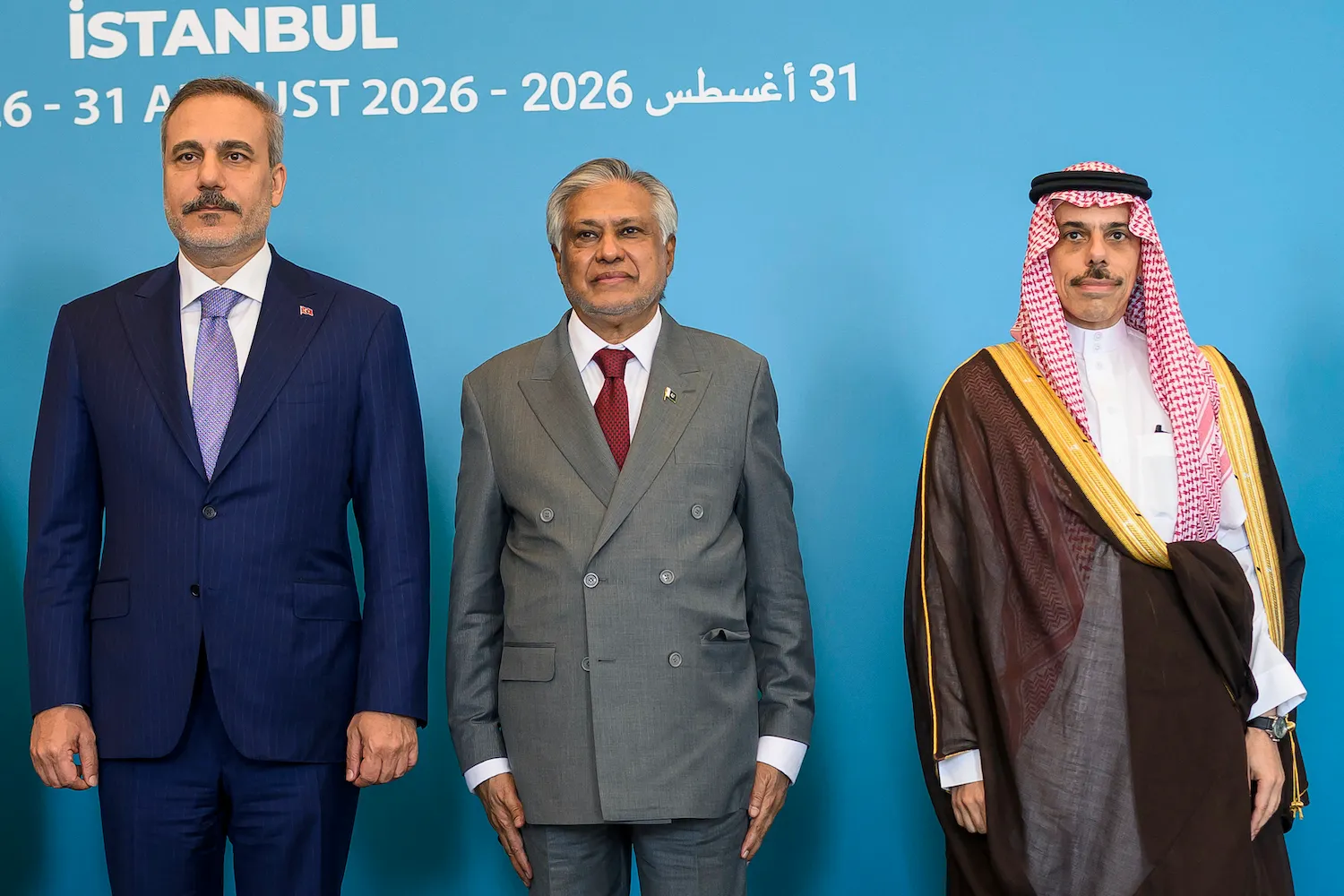
How soon is too soon to trigger a mutual defense pact? Saudi Arabia, Pakistan, and Turkey made it two months, triggering the Mecca Joint Defense Agreement on Monday that the three countries had signed in early August.
The move is a significant escalation toward the defense of Saudi Arabia in its battle against the Yemen-based Houthi militant group, which continues to strike the Saudi capital, Riyadh, and attacked multiple airports in the region this week. Saudi-backed coalition forces supporting the Yemeni government continue to retaliate against the strikes.
So where do Pakistan and Turkey come in? Both countries have thus far been circumspect about the form and extent of their military support to Saudi Arabia. Turkish Foreign Minister Hakan Fidan said on Thursday that the country was still assessing how best to assist the Saudis, but he firmly ruled out participation in any offensive operations. There’s also the matter of Turkey’s parliament still not having officially ratified the Mecca agreement, which means any support would likely continue to be part of Turkey and Saudi Arabia’s long-standing bilateral relationship.
“The bylaws have barely been agreed to, so I’m sure this is probably an earlier test than any of these countries would have wanted for this mutual defense agreement,” said April Longley Alley, a senior fellow at the Washington Institute for Near East Policy who previously served as senior political advisor to the United Nations’ special envoy to Yemen. But “the Houthis pose an existential threat to Saudi Arabia” and are a “much more formidable opponent than they were when the war first started,” she added. The Saudi government’s push to activate the agreement “is also signaling that this is not just an agreement on paper, that it has some meaning to it.”
Pakistani perspective. Pakistan also has a long-standing bilateral relationship with Saudi Arabia but has also taken on a leadership role within the Mecca pact. Retired Pakistani Lt. Gen. Nauman Mahmood was appointed as the defense collective’s first secretary-general, according to a joint statement by the three countries that was published by the Pakistani Foreign Ministry. The statement also announced “necessary measures to provide the agreed military forces and capabilities and ensure their rapid deployment in the Kingdom [of Saudi Arabia].”
But the Pakistani government pushed back against a New York Times report that said Pakistan Air Force fighter jets were being used in strikes against the Houthis, calling the report “fake and fabricated.” The Times report cited an unnamed senior Pakistani military official as the source for the fighter jet claim.
Like Turkey, Pakistan’s position is that “defense of the kingdom, with or without the Mecca pact, is going to happen,” said Uzair Younus, a partner at The Asia Group, a geopolitical consulting firm in Washington, D.C. Younus cited sources he had spoken to in Islamabad as saying that Pakistan stepped up its air force, naval, and ground support to Saudi Arabia in Yemen even before the triggering of the Mecca pact.
Pakistan sees escalation by the Houthis as a core national security threat, Younus said, given the critical role of the Bab el-Mandeb strait—which the Houthi conflict has turned into a chokepoint—in transporting oil from the region to Pakistan. “The Houthis cannot be allowed to do what they’re doing because it would mean an economic and political crisis in Pakistan,” he said. A secondary reason for Pakistan’s participation in the defense pact, he added, is simply shoring up Saudi support and goodwill. “They view this as an in-kind early payment to Saudi Arabia” in case of a future conflict with neighboring India, he said, though he stressed that that is only a “small part of the calculus.”
Publicly, however, Turkey and Pakistan are likely to continue to emphasize the defensive nature of their support to Saudi Arabia, Alley said.
It’s been a scandal-plagued week for some of U.S. President Donald Trump’s top aides.
U.S. Ambassador to Greece Kimberly Guilfoyle, who was previously engaged to Trump’s son Donald Trump Jr., asked a Trump campaign donor to pay American Express $100,000 on her behalf to pay down her credit card balance, the Wall Street Journal reported on Wednesday. The donor, Eric Deters, reportedly did not end up making the payment, which Guilfoyle requested days before her July 9 Senate confirmation hearing to become ambassador.
Trump was also forced to respond to a report by the New York Times that two top advisors whom he had tasked with helping Republicans win in the upcoming midterm elections recently spent several days visiting the self-governing territory in Bosnia and Herzegovina known as Republika Srpska. James Blair and Chris LaCivita were reportedly advising the territory’s pro-Russian government ahead of the Balkan country’s election last Sunday. In a Truth Social post on Wednesday, Trump described the pair as “outside consultants” who had several clients other than him. “I do not have any idea who else they work for but will, on reflection, ask them and, if there’s a conflict, I will terminate them, immediately!” he wrote.
What should be high on your radar, if it isn’t already.
German spy scandal. Authorities in Germany arrested the country’s 80-year-old former spy chief, August Hanning, on Tuesday, accusing him of “treasonous espionage” and passing state secrets to foreign governments after he had left office. Hanning, who led the German intelligence agency BND from 1998 to 2005, allegedly received more than 2,000 classified documents from a former aide for more than a decade after Hanning had left the agency, which he then used in his private consulting work. Hanning’s lawyer acknowledged to the Financial Times that his client “was in possession of confidential documents” but denied that he had passed on that information to any foreign governments and received payment for it.
Trump’s private-dollar deluge. Trump on Tuesday announced that private defense firm Anduril would invest $3.7 billion of its own capital to build new submarine components for the U.S. Navy, which also awarded the company a contract for an additional $2.9 billion. The company will take over a shipyard in Baltimore County, Maryland, building a manufacturing facility there that is expected to begin production by 2030. “This is going to be some big yard,” Trump said.
The Trump administration on Thursday also announced investment commitments worth $2.4 billion from a host of big tech companies including Nvidia, AMD, OpenAI, Anthropic, Google, and Amazon Web Services to shore up science and technology research across multiple federal agencies. Part of the money will go toward “compute credits” for those agencies, the administration said, referring to the computing power required to run advanced artificial intelligence models.
A protester sitting atop a statue waves the flag of the Soviet Union during a student demonstration, part of a nationwide protest movement over learning, in Montpellier, southern France, on Oct. 8. Gabriel Bouys/AFP via Getty Images
Friday, Oct. 9: The winner of the Nobel Peace Prize is announced.
Sunday, Oct. 11: Saudi Arabia hosts the International Energy Forum.
The World Health Summit begins in Berlin.
Monday, Oct. 12: Ethiopia hosts the 65th session of the Intergovernmental Panel on Climate Change.
The annual meetings of the International Monetary Fund and World Bank Group begin in Bangkok.
Wednesday, Oct. 14: FBI director Kash Patel is reportedly expected to visit Russia.
Ireland hosts the International AI Summit in Dublin.
Thursday, Oct. 15: The European Council hosts a two-day leaders’ summit in Brussels.
I recently reported that Trump’s rebranding of AI as “super intelligence” led to a spike in demand for Slovenia’s “.si” domain names. We now know just how dramatic that spike was. New data from Slovenia’s official domain registrar showed tens of thousands of registrations after Trump’s speech, hitting a single-day peak of nearly 22,000 on Oct. 5.
Private domain registrar Hostinger confirmed to SitRep that its highest number of registrations during that period came from the United States, followed by India and Morocco.
“Voting to confirm Pete Hegseth is the biggest regret of my career.”
—Sen. Thom Tillis in his new book, referring to the U.S. secretary of defense.
Lawmakers coming into work at the European Parliament in Strasbourg, France, will now have to walk past a statue of a naked Trump. The gold-plated copper statue, created by Danish artist Jens Galschiot and sponsored by Danish politician Per Clausen, is titled “The Orange Plague” and depicts a nude Trump holding a golf club and the scales of justice while seated on the shoulders of a smaller man. Galschiot’s placement of the statue on European Parliament grounds required approval from a parliamentary committee, which confirmed to CNN that it had granted the approval.
