


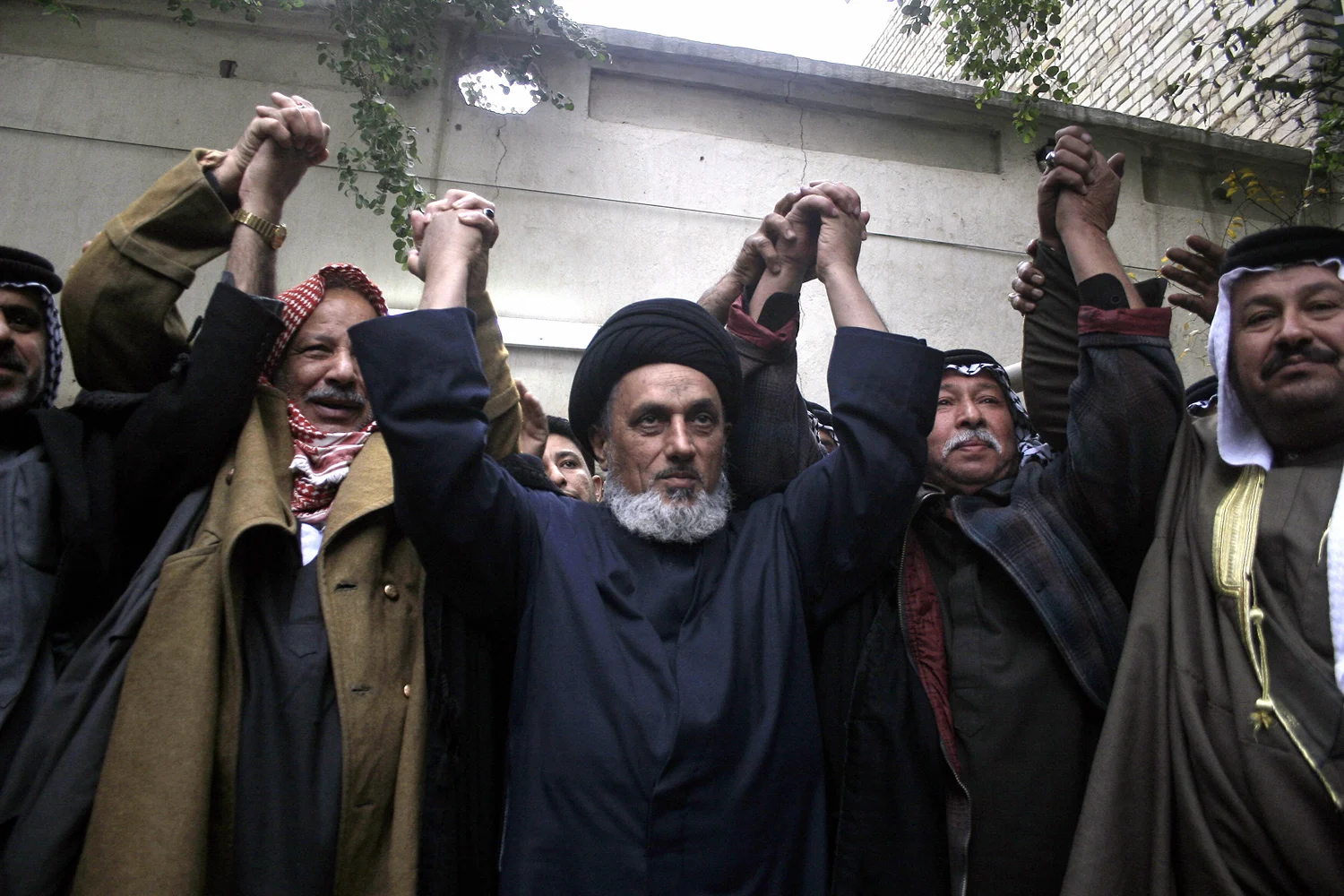
The violent sectarian era that followed the U.S. invasion of Iraq and peaked with the rise of the Islamic State more than a decade ago may feel distant in Washington, but in the Middle East the wounds remain fresh. Just this past spring, Iraqi forensic teams uncovered the remains of more than 30 Kurdish Peshmerga fighters, Iraqi security personnel, and Yazidi women and children in an Islamic State mass grave near Mosul. A week earlier, across the Syrian border in eastern Deir Ezzor, another mass grave was uncovered, one of at least 18 such sites documented in Syria this year.
Last year’s massacre of more than 1,400 Syrian Alawites, a religious minority to which Assad belonged, in March, and sectarian killings of Druze in Suwayda in July threatened to unravel the new Syrian state. From Lebanon, still living in the long shadow of its civil war, to Syria and Iraq with more recent civil wars of their own, sectarian tensions permeate the region.
Eminent Syrianist Joshua Landis calls it the “Great Sorting-Out,” the violent unwinding of the post-Sykes-Picot order, where Sunni transnational tribes, pockets of Abrahamic and non-Abrahamic religious minorities, and orphaned ethnonationalists were folded into newly drawn states across the Levant. This order, established by the Western powers at the end of World War I, is coming to a violent end as communities across the region retreat into rigid ethnic and sectarian enclaves. Few places have paid a higher price for that unwinding than Iraq, Syria, and Lebanon.
Enter U.S. President Donald Trump. Fresh from firing Nate Swanson, one of the few officials in his administration who deeply understood Iran and Shiite politics, his White House has rolled out a set of policies that invite a new unraveling. By proposing that Syria’s president, and former al Qaeda commander, Ahmed al-Sharaa’s forces could “take care of Hezbollah,” while simultaneously pushing to disarm Shiite armed factions that helped lead the campaign against the Islamic State in Iraq, Washington is playing fast and loose with forces it does not understand, with potentially catastrophic consequences.
In 2003, Washington invaded Iraq knowing so little about the sectarian fault lines involved that some of its top policymakers seriously floated installing a Sunni Hashemite king to smooth the transition. The last Hashemite ruler of Iraq was shot and dragged through the streets in 1958. The new U.S.-led regime also disenfranchised a sizable and armed Sunni minority, which had held positions of power under Saddam Hussein, almost overnight.
A decade of gruesome sectarian civil war later, Iraq had gone from a country where Sunni and Shiite neighborhoods blurred into one another to a patchwork of hardened cantons and governorates, enclaves that functioned, depending on which sect you belonged to, as either haven or sundown town.
Sectarian resentment, compounded by American and Gulf support for poorly vetted Sunni extremist factions in the Syrian civil war, helped incubate the Islamic State. The caliphate swallowed a third of Iraq within months, taking Mosul and most of Anbar province, before the Popular Mobilization Forces (PMF) and other ground troops, backed by U.S.-led coalition air power, clawed the territory back and dismantled the Islamic State’s territorial state.
Washington’s long campaign against post-revolutionary Iran has done little to dispel the regional image of the U.S. as an engine of regional sectarianism. In the 1980s the United States backed Saddam through his eight-year war against Iran. Decades later, Washington stood by as Saudi troops helped crush a Shiite uprising in Bahrain before backing Riyadh again in 2015 with bombs, intelligence, and midair refueling as it launched its war against the Zaydi Shiite Houthi movement in Yemen. Each of these conflicts had drivers that went well beyond sect. But time and again, Washington chose partners and policies that reinforced a single regional narrative: a U.S.-backed Sunni order squaring off against Shiite challengers.
Washington is now leaning on Ali al-Zaidi, Iraq’s new, Trump-favored prime minister, to disarm the very forces that grew out of the last round of sectarian violence with an initial deadline of the 30th of September. That day has come and gone, and the militias refused to disarm. Zaidi is himself Shiite, but Iraqi Shiite politics is deeply divided between Iran-aligned factions and more nationalist currents that are suspicious of Tehran and willing to work with Washington. He belongs to the latter, and although has pushed the disarmament deadline to June 2027, he has also stated that disarmament is non-negotiable. Now the factions have entered what amounts to a standoff: the disarmament of militias that answer more to Iran than Iraq and don’t trust Washington’s ties with the current Iraqi government or the consolidation of state security control under the authority of an al-Zaidi-lead Iraqi state.
The PMF—an umbrella organization that includes Iran-aligned factions such as Badr, Kataib Hezbollah, and Harakat al-Nujaba, alongside Iraqi state-aligned units—was formed in 2014, after Grand Ayatollah Ali al-Sistani, a powerful Iraqi Shiite figure, issued a “defensive jihad” fatwa calling on all Iraqis to defend against the Islamic State. The PMF was formally folded into Iraq’s security forces two years later.
Sistani, who turned 96 in August, has never rescinded that fatwa, but he has also never said what becomes of it once he is gone or what it should mean politically, a succession question that hangs over the entire disarmament debate.
PMF leaders point to that founding history as proof of both the organization’s legitimacy and the state’s limits. As spokesperson Mouhanad al-Oqabi put it, Iraq’s security would “crumble in an instant” if the group abandoned the thousands of positions it held across Iraq.
The militias have plenty of reasons for their skepticism, and most of them predate Trump. They point to the likelihood that U.S. personnel will simply be rebranded as trainers consultants and contractors and return in one form or another. They point to Turkey’s footprint in the north, to a persistent Islamic State threat, and to Damascus, now led by Sharaa. Finally, militia leaders also have material reasons to resist disarmament: Their weapons sustain patronage networks, salaries, contracts, and political leverage that would shrink if they demobilized.
That distrust stems from something deeper than regional power politics that’s restricted to the modern era. Shiite political culture carries with it a powerful sense of mazlumiyah, the memory and consciousness of the Shiite having been wronged, ranging in time from the martyrdom of Hussein ibn Ali, the Prophet Muhammad’s grandson, in 680 to the brutal repression of the Saddam regime and the massacres committed by the Islamic State. Recognizing that is not to reduce Shiite politics to culture, any more than Confucianism explains every Chinese state policy. But this mazlumiyah still helps explain why images of Shiite under attack in Iran or Lebanon resonate so strongly in Iraq, and why a demand to disarm, arriving at precisely this moment, rings differently in Baghdad than it does in Washington.
In July, U.S. and Saudi aircraft struck PMF positions across Iraq, claiming the attack responded to drones launched from Iraqi territory against Saudi oil facilities. Several factions prepared retaliatory strikes on Saudi Arabia and U.S. bases before Hadi al-Amiri, leader of the Badr Organization, one of Iraq’s largest and oldest Shiite political-military movements, talked them down.
Weeks later, Iraqi authorities arrested Abbas al-Yaqoubi, a senior militia leader who held a PMF intelligence post, as the disarmament push intensified. Iraqi leaders, former Prime Minister Nouri al-Maliki among them, have repeatedly warned that forcing the issue could trigger an internal confrontation that spills into neighboring countries.
The situation is even more combustible in Lebanon, where political power is formally divided among 18 recognized religious communities. Few states can function indefinitely with an armed movement, answerable to no one, running a parallel government a few miles from Beirut’s center. Hezbollah’s secretary-general, Naim Qassem, has repeatedly insisted that the fate of the group’s weapons cannot be dictated by Washington or Israel. “Nobody outside Lebanon has anything to do with the weapons,” he said in May, calling them an “internal Lebanese matter.”
He has also said Hezbollah is prepared to discuss folding its arsenal into Lebanon’s national defense once an agreement exists and the south is genuinely protected from further Israeli incursions—which seems a long way off. Hezbollah was born out of Israel’s 1982 invasion and occupation of southern Lebanon, and its pitch to Lebanese Shiite has barely changed in four decades: It remains the only thing standing between the south and the next invasion, whenever the state cannot.
Qassem has turned that argument directly against Lebanese President Joseph Aoun’s government, accusing it of “serving Israel” rather than Lebanese sovereignty. He called the U.S.-brokered framework tying Israeli withdrawal first to Hezbollah’s disarmament a surrender dressed up as diplomacy. Aoun and Prime Minister Nawaf Salam retort that there can be no real sovereignty while Hezbollah independently controls questions of war and peace. Israeli forces still occupy large parts of southern Lebanon, which makes the government’s promise that the Lebanese state can replace Hezbollah as protector of the south a considerably harder sell.
Across the border, Washington has pushed Sharaa’s Sunni Islamist-led government to “take care of Hezbollah” in Lebanon, despite Syrian officials reportedly fearing that such a move could ignite sectarian tensions in both countries. In northern Lebanon’s Sunni-majority city of Tripoli, Sharaa’s government has received a hero’s welcome, with many Sunnis seeing Damascus as a potential counterweight to Hezbollah’s power.
Over the other border, Iran-aligned Iraqi Shiite factions warned Sharaa that any move against Hezbollah or Lebanon’s Shiite “resistance environment” would amount to a declaration of war and could draw a military response from Iraq. A Syrian intervention would therefore risk mobilizing Lebanese Sunnis behind Damascus while pulling Iraqi Shiite factions into the fight.
Across the Gulf, the war in Iran has destabilized fragile Sunni-Shiite ties. Bahrain, whose Sunni monarchy rules over a large Shiite population, imposed new restrictions on Shiite religious observances, arrested clerics, and barred public mourning of Iran’s late supreme leader. Kuwait has also tightened restrictions around Shiite religious gatherings, revoked thousands of citizenships, and prosecuted people accused of “inciting sectarian strife.”
And now Yemen’s hitherto frozen civil war has reignited. A four-year truce between the Houthis and the Saudi-backed southern government has broken. In the last few weeks, the Iran-backed group has taken most of the country’s western coast and now fully controls the Bab el-Mandeb strait.
Verified footage from the Saudi-backed Giants Brigades showed fighters running over Houthi fighters with armored vehicles while calling them “dogs” and rawafidh, a sectarian slur for Shiites. The force itself grew out of ultra-conservative Sunni religious networks in Saudi Arabia. Earlier this month, Sunni clerics accused the Houthis of attacking Mecca, even though the group said it had targeted Aramco facilities instead.
The consequences of another sectarian conflagration would fall first on people with the least control over any of it. Shiite civilians would again risk being treated as Iranian proxies, Sunnis as jihadis or Gulf clients, Alawites as extensions of a fallen regime. Smaller communities, Yazidis, Christians, Druze, would again find themselves squeezed between larger armed camps.
This fire has already been lit. In the first weeks of the latest regional war, roughly a million people fled their homes in Lebanon; more than 200,000 crossed into Syria in March alone, according to the U.N. Refugee Agency. Another round of communal violence across Iraq, Syria, and Lebanon would mean more mass graves, more room for the Islamic State and other opportunistic extremists to rebuild, and another wave of refugees moving through Jordan and Turkey, and eventually toward Europe.
Washington should start by rebuilding the expertise it has stripped. More officials who understand Iraqi Shiite politics, Lebanese sectarian dynamics, Syrian minorities, and the region’s religious institutions might better identify the multitude of trip wires this administration is now barreling toward. That expertise should inform a more restrained policy: Stop treating disarmament as something that can be imposed on a deadline from Washington, avoid using one regional actor to coerce another, even as a threat, and give Iraqi and Lebanese institutions the space to negotiate coherent, sustainable arrangements that their own communities can actually sustain.
