


Unlock the Editor’s Digest for free
Roula Khalaf, Editor of the FT, selects her favourite stories in this weekly newsletter.
We are doing this again, are we? Very well.
A hated leader makes way for someone else. That person in turn sets new records of unpopularity. Speculation begins about still another switch at the top, as it is easier to change the individual than to question the basic doability of the job. The place under discussion here is, of course, Germany, but also Britain and America and elsewhere.
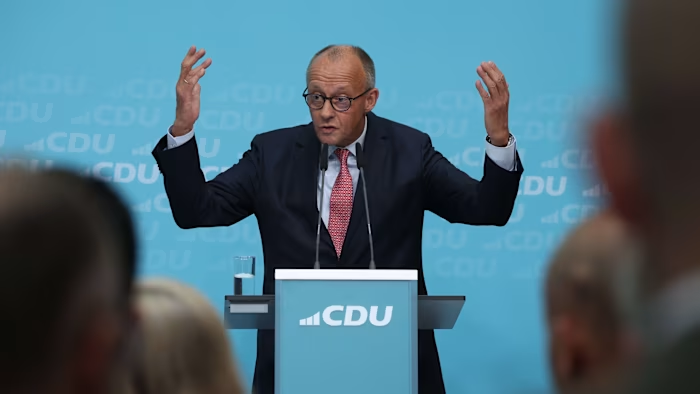
German Chancellor Friedrich Merz can console himself that his peer in Paris is also despised. So were the previous two French presidents, who failed to even win a second term. None of the last five US leaders — counting Trump twice — have managed an average approval rating of 50 per cent. The previous three cleared that mark.
Britain, inclusive to the end, has hated white, Asian, male, female, young, old, Conservative, Labour, southern and northern prime ministers since 2016. Before that, it was not unheard of for one to rule for a decade. Between 1975 and 2007, Australia had four heads of government. It has had seven since, including the brief return of Kevin Rudd. The Italian leader Giorgia Meloni is what passes for popular and long-serving. She has lost a constitutional referendum. She has also had EU funds to cushion her domestic reforms (such as they are).
There are two possibilities here. The big rich countries suffered a drop in the quality of leaders at around the same time. Or voters became harder to please. Neither suggestion is absurd but it should be clear which is more plausible.
The west does not have a leadership problem. The idea that heads of government, as a whole, are inferior to their 20th-century forebears is, at the very least, hard to stand up. Some outcomes have got worse, such as control of immigration, and some better, such as crime rates. None of the recent cohort of leaders has presided over a losing conscript war, unlike Lyndon Johnson, or a devaluation, unlike Harold Wilson. It is possible that experience of world wars conferred on past leaders a seriousness that is missing today, but that also applies to voters, and voters are the point.
What the west has is a followership problem. Voters reject policies — however objectively necessary — that cost them anything. One result is huge levels of government debt, which investors are now demanding higher yields to finance. Another is the flaying alive of almost any leader who tries to fix this or almost anything else. In this decade alone, policies from which heads of government never really recovered include, in France, an increase in the state pension age to all of 64 and, in Britain, a cut to winter fuel subsidies amounting to £1.4bn annually. It isn’t a Greece-style adjustment that people are rebelling against, but modest and apologetic savings.
The quickest, surest way to save Merz’s chancellorship is to give up the reforms to healthcare, pensions and the like. It would also be unconscionable. Likewise, Andy Burnham’s best chance of winning the next UK election is to attempt no fiscal tightening, which would be negligent of him. These are so often the choices: self-immolation or dereliction. The idea of a third path, in which leaders pursue reform but explain it better — “bring people on board” — is podcast-level hogwash. Outside of crises, when fear makes them pliable, voters are determinedly off board.
In 2026, as it became clear that Britain would have its seventh prime minister in a decade, people asked if the nation had become “ungovernable”. The immediate answer from all respectable quarters was no. It had just had a string of bad governments, that’s all. This is possible, just as it is possible that Manchester United really have appointed seven or more consecutive duds since Alex Ferguson. But the reflex rejection of the ungovernability thesis was interesting. What explains it? A terror of coming across as snobbish?
Well, let it go. There is no insult to the public in suggesting that its expectations have grown. If there was a flaw in the ungovernability argument, it was a certain parochialism. Not only is Britain hard to satisfy, but so are its peer nations.
Perhaps Merz was always the wrong chancellor: high-handed, steeped in corporate wealth. But Olaf Scholz, who had a different background, manner and political affiliation, was also wrong. Angela Merkel seemed the right one, but in retrospect owed much of her success to the studious ducking of reforms, and so now stands out for her epic wrongness. Gerhard Schröder was bolder, making economic changes without strictly having to, and paid with his own job. Which is likelier: the Federal Republic has been run by fools since Helmut Kohl or the demands on the office have heightened?
The current Charles de Gaulle revivalism is fun. It is also problematic, insofar as it feeds the idea that leaders used to be better. Ubi sunt — or “where are they?” — is an ancient wail for the supposedly better people of yesteryear. Perhaps, in his case, it is warranted. But he had a far more deferent electorate to work with, forged in world wars and the material hardship that followed. Universal suffrage for both sexes was itself fairly new. Imagine the predicament of the modern leader, having to please an electorate that is three or four generations into the welfare state and global peace. Don’t expend too much energy on Merz’s ordeal. We will be doing this again soon.
