


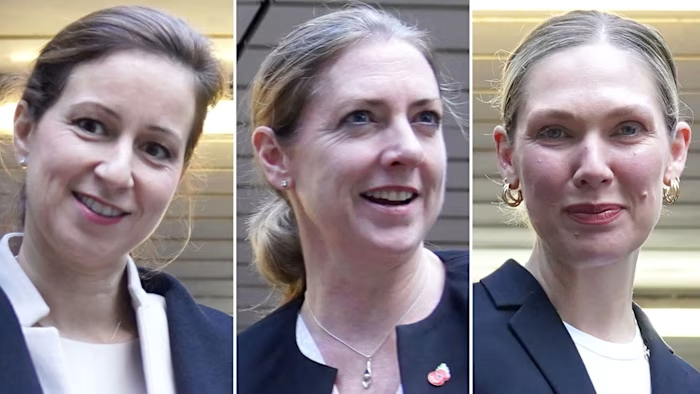
Three of Britain’s top corruption prosecutors started working for Alejandro Betancourt, the Venezuelan billionaire who recently signed a major oil deal with Donald Trump, when Swiss authorities were seeking his extradition on suspicion of money-laundering.
Sara Chouraqui, Elizabeth Collery and Victoria Jacobson all moved from the UK’s Serious Fraud Office to Betancourt’s North American Blue Energy Partners (NABEP) in March.
At the time, their counterparts in Zurich were still requesting Betancourt’s extradition from the UK, where he was bound by bail conditions.
Betancourt, 46, was barred in late 2025 by a London magistrates’ court from international travel, limiting him to shuttling between his Chelsea townhouse and Oxfordshire mansion.
Since then, Betancourt’s fortunes have rapidly improved. NABEP signed what Trump dubbed the “deal of the century” with the US last month, winning contracts to administer 65bn barrels of Venezuelan oil.
The Zurich Public Prosecutors’ Office dropped its extradition request in May. Last month the office told the FT its investigation was still continuing and that the request had been withdrawn because of “specific aspects” of UK law. It did not respond to requests seeking the status of its investigation.
Switzerland and the UK are close allies in the battle against financial crime. Chouraqui last October represented the SFO alongside her Swiss counterpart at a conference to promote a new task force to increase co-operation between the two countries, along with France.
Typically the UK National Crime Agency, not the SFO, acts as a gateway for extradition requests from overseas jurisdictions.
The prosecutors’ move to NABEP has left the SFO without three of its top anti-bribery lawyers just as one of the beleaguered agency’s most significant cases is moving to a jury trial.
Chouraqui, Collery and Jacobson led the prosecution of former traders at Glencore, the commodities trading house, who stand accused of corruption. The defendants deny the charges and the trial is scheduled for next year.
“I’m flabbergasted that the SFO let them go all at the same time with a case as big as Glencore coming down the line,” said one former colleague.
Betancourt is a controversial figure in his native Venezuela. He is part of the “Bolichico” generation of well-connected entrepreneurs who made fortunes under the late president Hugo Chávez during his so-called Bolivarian Revolution. One of Betancourt’s companies, Derwick Associates, won contracts to build power projects.
But investigations followed in Spain and Switzerland. They scrutinised whether billions of dollars in public funds gleaned from alleged embezzlement or corruption were then moved into the international banking system.
Betancourt has consistently denied wrongdoing. A US law firm representing NABEP, the trio of lawyers and Betancourt told the FT that Betancourt had complied fully with the London court’s orders. It said the Zurich Prosecutor’s Office dropped its extradition request because “it could not meet the evidentiary burden the English court would have applied”.
Betancourt is being investigated by a judge at Spain’s National High Court over allegations of money laundering and tax fraud, according to a court official. The investigating judge, Santiago Pedraz, decided to close the case earlier this year, but anti-corruption prosecutors appealed against his decision and forced it to be reopened.
An earlier extradition request from the Spanish authorities to the UK was withdrawn in October.
Since a US military raid captured former Venezuelan president Nicolás Maduro in January, the Trump administration has been working with Maduro’s vice-president, Delcy Rodríguez, to kick-start the economy. Key among that effort has been a push to increase investment in the country’s oilfields.
The August deal will give NABEP the chance to develop around one-fifth of Venezuela’s oil reserves, the largest in the world. At the same time, the Pentagon will take a 35 per cent stake in the company.
The deal thrust Betancourt’s name back into the headlines. Chouraqui, by then Barbados-based NABEP’s general counsel, noted — correctly — that her boss had “never been charged in any jurisdiction”.
The company had only announced her arrival and those of her former SFO colleagues the week before. But according to their LinkedIn posts, they had been at the company as early as March, as well as consultants at O’Hara, which is Betancourt’s family office.
Their last day of paid employment at the SFO was February 12. They were subject to business appointment rules that civil servants must adhere to when leaving their roles and which are designed to uphold integrity, honesty, objectivity and impartiality.
There is no suggestion that the three breached the rules or failed to alert the SFO of their intention to move to NABEP.
“Every employee is made aware of their responsibilities under the Business Appointment Rules for Crown Servants when they resign,” the SFO said. “It is not appropriate for us to comment on the actions of individuals once they have left the organisation.”
A US law firm acting for NABEP told the FT that it had “conducted due diligence on the Zurich matter before hiring the three lawyers and determined there were no ethical or legal issues with doing so.”
It added: “There is no suggestion that Ms Chouraqui discussed Mr Betancourt with any Swiss official or had any role in any Swiss matter concerning him.” It added that NABEP hired the trio “because it hires experienced and talented lawyers to run its legal function”.
Susan Hawley, founder of advocacy group Spotlight on Corruption, said: “The seamless move of a trio of top SFO lawyers to a company whose CEO remains under investigation by the agency’s close international partners raises serious questions about the safeguards around senior officials moving into the private sector.”
Hawley added: “While no rules appear to have been broken, the timing of their move — coming between Betancourt’s arrest in London and the Swiss dropping their bid to extradite him from the UK — does little to inspire public confidence.” The government should examine whether the current rules are robust enough for the SFO, she said.
Media reports in January said that the three SFO lawyers — all well regarded and considered the next generation of leadership for the agency — were expected to join Alvarez & Marsal, the consultancy.
However, while A&M held talks about hiring the trio earlier this year, the discussions did not prove fruitful according to a person briefed on the matter.
The three former SFO officials were looking to move as a team, with the person involved in the talks about a potential move to A&M describing it as “a package deal”.
While it is normal for departing SFO officials to join big law firms where they often end up on the other side of the table to the prosecutor and can cash in on their market value, the trio’s decision to join Betancourt’s company appeared “non-traditional”, the person said.
The “revolving door” between prosecutors and private practice has never become as established in the UK as in the US. This is partly because British agencies are not seen as being as effective as their US counterparts.
Meanwhile, the SFO’s own future has been questioned by white-collar lawyers. It was left without a permanent boss when its director, Nick Ephgrave, stepped down suddenly in January for personal reasons.
The agency has also closed a number of high-profile investigations this year, including into London Mining and Signature Group, while the prosecution of former executives from the failed bakery chain Patisserie Valerie has been delayed.
Additional reporting by Barney Jopson in Madrid
