


This week on the Newscast, we’re joined by Dilafruz Khonikboyeva, the founder of the Home Planet Fund, an independent, Indigenous-led nonprofit that provides funding for local and Indigenous communities and conservation projects around the world.
Khonikboyeva, who is also the organization’s executive director, speaks about the ethos of the Home Planet Fund and how it works. But I must emphasize that in my conversation with Khonikboyeva, what stands out most to me isn’t just the fund’s focus on Indigenous-led conversation and investing in local knowledge. It’s the well of experience Khonikboyeva brings to it that, growing up in Tajikistan under Soviet occupation and having firsthand experience of a community making do under extremely difficult circumstances, I believe, is rare among philanthropic efforts.
In a sector that runs on reports, restrictions, and guarantees, Khonikboyeva encourages funders to work differently, which often might come in an answer they don’t want to hear.
“If you’re getting a satisfying answer in this space, something isn’t right,” she says.
She explains: “I think sometimes people wanna hear, ‘Yes, we’ll take your money. Yes, we’ll do what you want in the timeline that you want. Yes, everything is possible.” And it’s just not true, right? That is actually not how life works, and anybody who tells you otherwise is certainly selling you something.”
She points to the nuance and the truth of projects that run into disasters on the ground, shifting needs, and, of course, making sure people are taken care of and provided for amid environmental impacts and political shifts. This doesn’t mean due diligence and risk assessments aren’t in place, but it does require unrestricted trust-based philanthropy. Khonikboyeva demystifies unrestricted funding.
“One of the false narratives that people have around unrestricted giving: ‘It’s like you just hand someone a check, and they disappear, and you disappear.’ That’s not the case. It just means that you sit in enough trust that [they can] come back to you and say, ‘Hey, the three-month metric is not gonna hit this because of this, but we wanna adapt to this,’” she says. Instead of “Well, if it doesn’t fit the Excel, it’s all over, and we’ve done a terrible job.”
The Home Planet Fund chooses to focus on four distinct ecologies that “researchers have pinpointed around the world [as] critical from a climate and biodiversity angle,” Khonikboyeva says.
These are the Tongass Rainforest of Alaska; the glaciers around Kyrgyzstan, Tajikistan, Afghanistan, Pakistan, and India — sometimes referred to as “the third pole”; the grasslands of East Africa; and the South Pacific. Through trusted networks, Khoniboyeva and her team identify and build relationships with local communities in these areas who are already engaged in conservation efforts and provide them with funding.
“Making sure we have elders, making sure we have whole communities, making sure we have women’s groups, making sure we have youth groups involved and co-building with them is really, really important,” she says.
“We wanna go deep. We want it to be durable. We want it to be sustainable long after we’ve stopped funding,” Khonikboyeva says.
But I would be remiss not to highlight one of the more poignant philosophies behind Khonikboyeva’s work, which she describes to me as healing trauma.
“Pain has a transformational aspect, but you have to lean into it,” she says.
“What I find in myself, because of the community I come from and in a lot of the communities we work, is trauma and pain is held the same way all of your other emotions and feelings are held, right?
“And so one of the things I talk about a lot is we’re not just here to heal the planet … we’re here to understand what works — what works in every single village, every single ecology. Let the local people do that. Let them continue to learn and grow. But in healing that land, there is something in people that we can also heal. So can we invest in the healing of ourselves?”
Mike DiGirolamo is the host & producer for the Mongabay Newscast based in Sydney. Find him on LinkedIn and Bluesky.
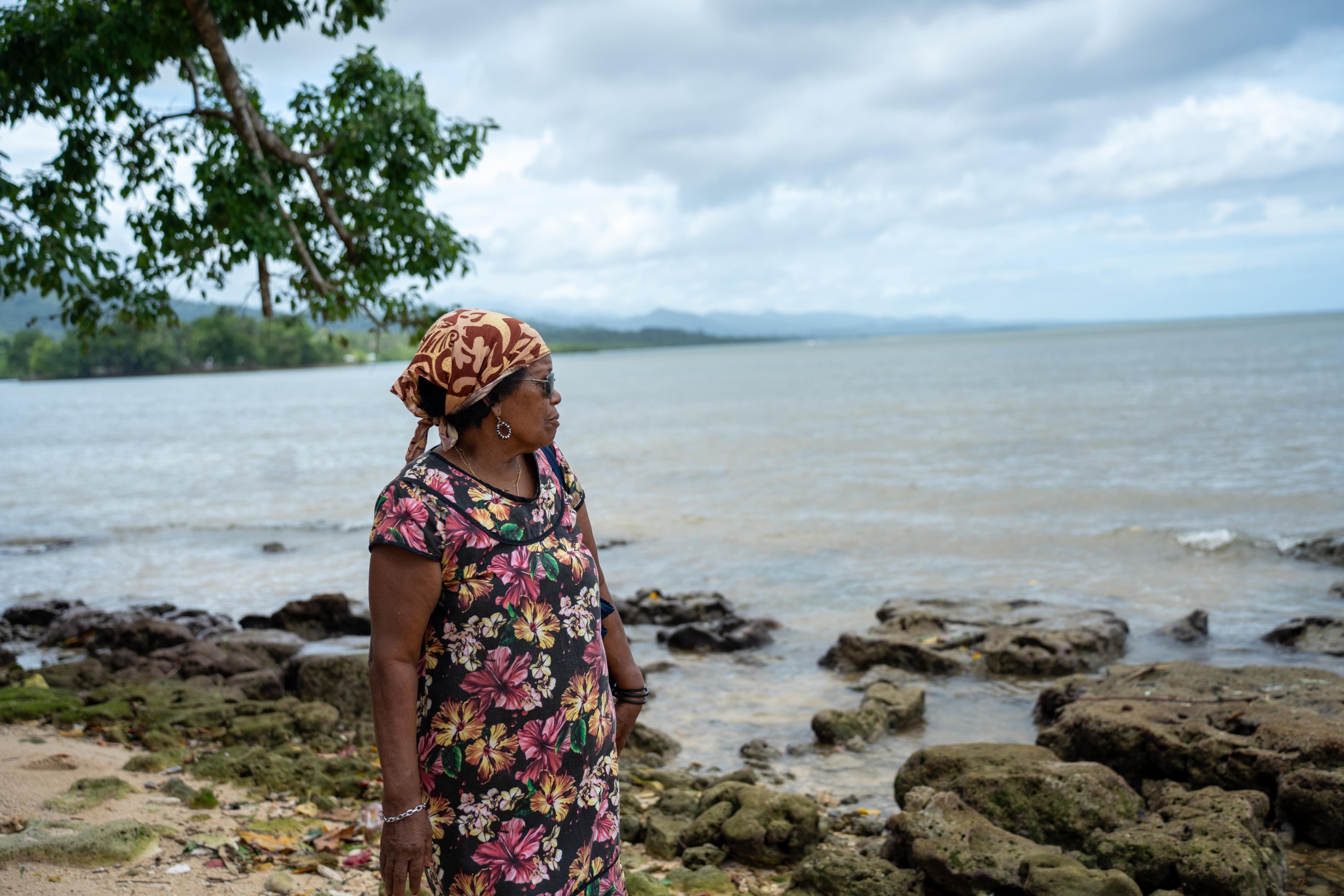
Banner image: Faye Saemala, whose family has lived in the village of Lilisiana, in the Solomon Islands, for generations. Image courtesy of Jason Gagame.
Notice: Transcripts are machine and human generated and lightly edited for accuracy. They may contain errors.
“The Hardest of Humanity That I’ve Seen”
Dilafruz: The hardest of humanity that I’ve seen, like the hardest issues around not having food, not having access, being worried that they were gonna be bombed or killed any day, I actually in those hardest contexts saw the most beautiful parts of community come out, because it really pushes aside the fallacies of wanting to be monetized for doing this for others. The human condition is such, for the most part, that we do things because we’re grateful for each other, because we believe in the future, because we believe in the now. And if one little ounce of us trying will make somebody else’s life easier, I fundamentally believe, again, for the most part, that when push comes to shove, people try the best they can.
Mike: Welcome to the Mongabay Newscast. I’m your host, Mike DiGirolamo, bringing you weekly conversations with experts, authors, scientists, and activists working on the front lines of conservation, shining a light on some of the most pressing issues facing our planet and holding people in power to account. This podcast is edited on Gadigal Land. Today on the Newscast, we speak with Dilafruz Khonikboyeva, the founding executive director of the Home Planet Fund, an Indigenous and women-led nonprofit organization that provides funding to Indigenous peoples and local communities around the world working on conservation. I speak with Khonikboyeva about how the organization selects projects and communities to work with, which she describes as being in four distinct ecologies. She explains that these locations are selected for their potential to protect some of the most ecologically significant parts of our planet. She says these projects are also human-centered, investing in specific local and Indigenous knowledge, and in some areas that have experienced ongoing or historical conflict and resource scarcity. Khonikboyeva is from the Pamir Mountains of Tajikistan. She grew up there under the Soviet Union, and she tells a story about how her upbringing and her community and the work ethic of her mother and father performing essential tasks for their community without pay informs the work that she does today. In researching this episode, I was very struck by Khonikboyeva’s ethos and philosophy in philanthropic funding, which is arguably a space that traditionally functions on guarantees, promises, and tight deadlines. But in this episode, Khonikboyeva explains that if you’re getting a satisfying answer in this space, something isn’t right, pointing to the realities of shifting needs and priorities and uncontrollable factors that affect people in the regions where she works. She demystifies the concept of unrestricted funding, which is necessary for the work she supports, describing exactly how this works in a real-world application where local community needs are considered and built into the funding relationship. Flexibility is the default, and trust is the currency. But I think of any piece of this philanthropic puzzle, the most striking is the notion that we don’t fight for a better world because we’re afraid of a collapsing one, but because we should want something better for ourselves. And I think she describes it best when she says, “In healing that land, there is something in people that we can also heal.” So can we invest in the healing of ourselves?
Hi, Dilafruz. Welcome to the Mongabay Newscast. It’s a pleasure to have you with us.
Dilafruz: Thank you, Mike. I’m thrilled to be here. I’m a big Mongabay fan, so I’m stoked.
Dilafruz Khonikboyeva Explains the Home Planet Fund
Mike: Well, glad to hear it. I have a lot of questions about Home Planet Fund, but first, can you explain in a nutshell what is the Home Planet Fund exactly, and the kind of work that it supports?
Dilafruz: Yeah, the Home Planet Fund, depending on where in the world you live, it’s either a nonprofit, it’s a public charity, it’s an Indigenous collective, et cetera. But basically we’re, we’ve– we’re in our fifth year now, actually, as of this month. The Home Planet Fund is something that I started. I, the board, the staff, are either of Indigenous community or, or local communities. The idea really was is there are parts of the… I, I guess maybe to kind of explain what makes us different, right? And why, why another charity when there are so many is in my work, and I think in others’ work, we saw that there was organizations that existed that were headquartered in Western countries, so the US or the EU or other places, and they were raising a lot of money and bringing a lot of attention, but only to like one or two places around the world, right? So like for example, in Amazon, in, in South America, and then they would get donations, and by the time it got to the local communities, right, the, the headquarters office was taking some money. The, the regional office was taking some money, and by the time it got to the communities, frequently it was cents on the dollar, one. But two, there were so many decisions that had already been taken at other levels about exactly what the work would look like, how it would get done, where it would get done, what is the timeline. And so there was an imposition on local people of what they needed to do, but no one had really asked them and no one gave them flexibility. So Home Planet Fund really exists to counter three of these things, right, that, that cause these issues. One is we’re really keen on places that the UNFCCC, so, um, the researcher science, uh, science nature biodiversity researchers have pinpointed to around the world that says these are critical from a climate and biodiversity angle. So that, that’s public data. We want to get funding into these places, not just places where it’s easy, but places maybe that feel exotic, that feel difficult, that feel rural, that feel, uh, inaccessible. We think it’s important that we don’t just focus on one thing in the climate crisis. We really focus on a plethora of things because it’s a monolith, monothe- like it was a…it’s a single-minded way that got us into the climate crisis. We need to have kind of a plethora of different approaches to get us out. So we work in places, for example, called the Third Pole, like where I’m from. This is the highest mountains of the world that people will remember, like the Himalayas, the Hindu Kush, or the Pamirs, where I’m from. On these mountains sit the largest glaciers outside of the two poles. They control global weather patterns. They are the reason we have the monsoons that are critical in life-giving and food-giving in South and Southeast Asia, and they also have an incredible amount of biodiversity, right? Not only in plants, but actually in animals like the snow leopard and many other animals. So that’s one. We’re really interested in working where the science says we need to work and, and, and a diversity of that, so we work in four ecologies Two is we fund directly into whatever community system exists. So in some of our contexts, that is tribal structures, right? The tribes are quite strong. They manage money, they manage resources. We fund into that. In other contexts, like the South Pacific, their Polynesian groups tend to be matrilineal. So we fund into women’s collectives because that is where power decision-making already sit. So that just makes sure that everything that we do goes to the field directly. And three, we’re really interested in trust-based philanthropy. So instead of dictating what the next three or five years will look like, we understand that things happen. Certainly, natural disasters are increasing because of the climate crisis, but also political changes are happening, regional changes are happening, community changes are happening. So we really work with the community to say, “Here’s our overall vision together,” right? Like between the community and us and everybody. Here are some metrics of success, right? Whether that’s related to forests, that’s related to oceans, that’s relation to coral restoration, whatever is specific to that ecology, we come up with, with impact that we wanna get to, and then how do we work backwards? But if, for example, there’s an earthquake or there’s a landslide, the community has the full authority to shift their focus, shift resources, so that they can deal with the things at hand, so that they can continue the work long term. So maybe I’ll stop there, but I think that that to me was the gap that I saw and many other people voiced to us in our research and why Home Planet Fund exists, but also why it exists in a very particular way.
Growing Up in Tajikistan
Mike: I know you’ve talked about this before, but I think it’s worth covering because it’s clear that it informs the work that you do. So you grew up in Tajikistan, which at the time was the USSR until the fall of the Soviet Union in 1991. And, and you, you have spoken about the most significant things living in your community gave you in your life and the lessons your, your parents taught you. I was wondering if you could recount what those significant experiences were and how it has informed your life and your work.
Dilafruz: Yeah. So I did grow up in Tajikistan, what was then the Soviet Union. About 80% of Tajikistan is mountainous. and those mountains are called the Pamir Mountains. And so I and my community call ourselves Pamiri, Pamiri, named for our mountains. There are Pamiri people actually in Afghanistan, in Pakistan and China because the Pamir Mountains extend. But of course, artificial borders were created by nations, and so we’ve been split up in the last, I’d say, 120 to 40 years. I think what’s interesting about that experience is even though there were Russian scientists coming in and out, or even though maybe there were Tajiks coming in and out of, of our region, for the most part, we were living on our ancestral land, speaking our languages, living our cultures. Like the Soviet Union did make massive changes in the world, but I would say that because we were so– we were at, at the edge of the empire, frankly, they just didn’t have the authority, the time, the effort, the resources Or maybe the interest to change us fully the way, for example, um, Russia proper was changed, and some of the Indigenous communities that live in East Russia really had their, their culture, their language, their way of life fully eradicated. That didn’t happen to us. So I grew up in a fully intact Pomirī culture. Like, my first language still is Pomirī, right? One of the Pomirīn languages is called Khughnani. I grew up with my grandparents and my great-grandparents, which is such a privilege. I grew up on the land, which means knowing everything from grafting fruit trees to when is the right time to plant and how do you co-plant. Certainly, our spirituality, we had to be quieter ’cause it was the Soviet Union. But again, I think we have the privilege of really being so isolated and by ourselves that I grew up in a spiritual practice. And so to me, having then moved to the West, specifically to the United States of America and doing my education here, I had such a strong upbringing in what it looked like to me as myself, not be separate from my family or my ancestors or other people, and then us as people not being separate from the land. Like, if the land is healthy, we can be healthy. If the land gives us something, there’s a reciprocity there. We have to take care of the land, right? If we notice issues with the water, that means that something is wrong, and we have a responsibility to caretake. And so that really informs my worldview even now, right? Because it’s quite different to the, the predominant worldview that we hold on Earth, and it’s certainly very different to a very extractive mentality around we are owed resources from, from the Earth. We are owed certain things, and we’ll keep taking it until we no longer can
Community Works Over Monetary Incentive
Mike: You told a story about the work that your, your mother and father did, and I was, I was wondering if you could, uh, recount the two lessons you learned from both of them that also inform your work.
Dilafruz: My mom was the first radio anchor and then television anchor of Television Badakhshan, which is Badakhshan is another name for Pamir that we, we call it historically. And once the Soviet Union fell and the civil war came to Tajikistan from nineteen ninety-one to nineteen ninety-seven, she was giving all of these updates on what was happening. And my dad is an engineer by training, and they had been working on an electric power station, right? Because as you can imagine, this is area of the world that has snow for half of the year, despite climate change and everything else. And so they really were– no one was paying them, but in order to take care of the land and to take care of people and make sure that it was not extractive and, and that people were going to stay alive, they kept working on this power plant without being paid. They would walk there in the snow, they would work on it and come back. And I think it was just, it was really powerful to see that. And they were both so dedicated, and they continued to be dedicated to the idea of our culture and keeping our traditional ways of life. And so part of the civil war was that Pamir wanted to be independent. And my dad worked on that, that front and thinking about what does a constitution, what does a democratic constitution look like for a Pamir that is separate, that is independent, that is taking care of its resources from people to water to earth to, to animals and plants. And once they did that, my mom actually declared Pamir as an independent entity on the news. I don’t know if this is the story you’re talking about or if it was related to anything-
Mike: This is exactly the story
Dilafruz:… in particular. Okay. Yeah.
Mike: This is– And the reason why, the reason why it stuck out to me is because it, it sort of dispels the notion that there must be monetary incentives for people to do the necessary things for our ways of living. It’s a common argument I hear, and I’d never bought it, and there’s real-world proof of that. And the fact that your parents continued providing critical services amidst the most difficult of circumstances because simply it needed to be done, I think is a testament to that.
Dilafruz: Yeah. The other thing I like to, I think in relation to my mom working at, at the news station is there’s this thing called Koloboyka Novy Rok, which is like a leftover Soviet relic where you celebrate New Year’s. And she called everyone and she said, “Who has beautiful glasses? Who has beautiful flowers?” And they basically crowdsourced. This is what community mean. They crowdsourced this beautiful setting, and if– in the video you can still see on YouTube now, but if you look at the video, you see these people who are immaculately dressed, and there’s like crystal on the table, and there’s food everywhere. But it’s because everybody called relatives and community and said, “Who has, like, clothes that are not threadbare or won’t look threadbare? Like, can I borrow this? Can I borrow that? Who has enough flour to make these many loaves of bread so we can put it on the table?” And it seems very showy, and some people might say, “Oh, that– what’s the point?” But actually, when that was televised back to the community, it gave them hope to say like, “Oh, this is continuing.” And then for the people who knew the story, they felt like they were part of something, right? Like, I see my, my earrings up there, or actually th- those were the three carats that my family had, and we contributed. And so I think to your point, so many people do things without monetary incentive. It is why we have so much of the beautiful art and music and just really cultural progress across the world. But two, I think it’s also a fundamental misunderstanding of how humans and our communities work is, for me, having lived through that, but also having continued to work in civil war contexts, and that’s, that’s actually my academic background, is the, the hardest of humanity that I’ve seen, like the hardest issues around not having food, not having access, being worried that they were gonna be bombed or killed any day. I actually, in those hardest contexts, saw the most beautiful parts of community come out because it really pushes aside the fallacies of we need to be monetized. We’re doing this for others. The human condition is such, for the most part, that we do things because we’re grateful for each other, because we believe in the future, because we believe in the now. And if one little ounce of us trying will make somebody else’s life easier, I fundamentally believe, again, for the most part, that when push comes to shove, people try the best they can.
How the Fund Built Relationships
Mike: I want to switch gears just for a little bit to talk about the fund itself, and you state that you weren’t publicly visible for a while. Why?
Dilafruz: Yeah. Again, I think it’s important just to understand that there are so many public charities. There are so many nonprofits. There are so many things, and I don’t doubt that they do good. But to me We had these things that our research and communities and donors and everyone was telling us, and they were aligning to these three thoughts, right? Is fund where others aren’t funding, support communities where others aren’t supporting, support directly into community structures, right? Engage in trust and long-term thinking. But I think it’s really important that you don’t just tell people, you show people. So for us, it was about now reaching out to those communities through our trusted networks, through our board, through other people, through our own kind of activism networks and say, “Are you interested in engaging with us?” Right? Because, like, we wanted to be invited into community. We wanna be invited into the land. We wanted to take our time to understand the community dynamics, the land, the people, what their visions are. So a lot of it is just building and building those relationships, building the vision for two years, five years, 10 years. And then I think sometimes when people hear trust-based or they think community or they think Indigenous, they think it’s a kind of a nice fluffy thing that happens off on the periphery of actual hard-nosed impact. But the reality is you can do both of those things. You just have to do it carefully and thoughtfully. And so for us, we didn’t come in and say, “Hi, here’s a list of metrics and a timeline. Do this.” It was very much understanding the realities of those communities and then the lands and waters through them and then co-building something. And sometimes it actually went much faster than we thought because they were ready, because they were already doing the vast majority of the work. That’s the thing is we didn’t enter a single ecology where people weren’t already doing the work. They left the land. They’re of the land. And so it was about helping them scale, helping them resource, and helping them get the tools, the academic research, whatever else they needed to do it well. So for us, again, it was like a… It was all the scientific research that we wanted to do well, so we took our time with it, meeting all those researchers. Two, it was about sitting in community, making sure we were invited, making sure we were co-building something with them. And then three, it was making sure we had baseline and at least a year or two of data. So by 2024, which was two years ago when we went public, I felt that Home Planet Fund was something I could defend, not because it was something I had created or thought up, but because we had impact data, we had good relationships, and we had a model that we thought others might be interested in and might want to emulate or be a part of
Identifying the Four Ecologies
Mike: I wanna get into a little bit more about how you go about identifying a community or project to give to. Now you’ve sort of– you’ve given a high level overview of that, but please feel free to go into detail about how that process works.
Dilafruz: Yeah. So when we first started Home Planet Fund, like I said, it was looking at UNFCCC data, right? And so in that, there are many, many hotspots actually. You’d be surprised when you think about both climate and our biodiversity in that. Then we overlaid where was funding already going. So that is multilateral funding like UN bilaterals, like the Australian government, the, the US government, which they no longer do, but they did back then. And then also what philanthropy data was public about where their funding was going. So we were interested in the parts that weren’t being funded but were critical. And so that got us into the four ecologies that we work in now. So one is the Tongass Rainforest in Alaska. That is the largest temperate rainforest, really critical for not only the old growth forests, but actually the bay that’s right off of it. Two, of course, the third pole that I just mentioned where I’m from and the glaciers. That starts in the Kyrgyz Republic, goes down into Tajikistan, Afghanistan, Pakistan, India, and then of course, the, the tragedy that we all saw last month in Nepal. It’s all essentially one- Mm-hmm … ecological system, right? The third is the grasslands of East Africa. So that’s Kenya, Tanzania, Uganda. These grasslands are critical from carbon sequestration, but of course actually large game migrations, very, very critical. And then last but not least is the Pacific, right? Not only from an oceans and deep oceans and, and coral reef perspective, but actually the land is really critical, especially when you think about places like Papua New Guinea, where you have some of the most intact old growth forests. And so that’s where we started, right? And then as I mentioned, the next portion is working through our networks of Indigenous folks, of communities to say, “Who’s already doing this work? Which community members, which community leaders, which villages are doing this work? How is it working?” So just understanding, being invited into the fold, then slowly building out the relationships to bring in others, right? So making sure we have elders, making sure we have whole communities, making sure we have women’s groups, making sure we have youth groups involved. And co-building with them is really, really important like We, we are not in the game of trying to bring in an intervention or trying to teach people how to do things. We wanna support people who already have been doing it, and again, helping them scale and fine-tune the impact and, and get resourcing. So I think that that is really, really important. Uh, that’s how we do it. Once we spend time with communities, right, it’s about understanding not only organizations that the communities themselves trust and would like to be recipients of money, ’cause that’s also the very pragmatic part of Home Planet Fund and why we exist as a US-based 501[c][3], a public charity, is because we wanted to de-risk it for individuals or donors or organizations who wanted to support these communities but didn’t know how to get money into, for example, a Samburu village in northern Kenya or, like, where I’m from- Khorog in Tajikistan. We wanted to de-risk it, make it easy, be very transparent, et cetera. So finding organizations that the community trusts that we can use for reporting, for due diligence, right, for risk assessments, for getting financial audits in place, et cetera, and then really thinking about financial systems, governance, implementation risks. What are the impact metrics over a quarter or over a year or several years? And then you do your due diligence, right? You– After you talk to these communities, and then you then start asking governments or neighboring communities or others who are– well, may have worked in this community, say, “What worked? What didn’t? What are learnings like?” Just making sure you’re, you’re trusting but also verifying. And I think what’s most important is, like, we learn as we go, and every context is so very different that we find we’re constantly learning, and we’re constantly adapting, and we hope we’re becoming better partners to these communities. But we also hope through our storytelling that we’re being really honest about the challenges and also the successes that we face so others can learn along with us. We, we don’t want to be a black box. We would love if more people also chose to fund alongside us in these communities or also thought community-based work is really important.
Support Mongabay on Patreon
Mike: Hello, listeners, and thank you for tuning in. As I always like to mention, Mongabay is a nonprofit news organization. We rely on the funding from listeners like you. So if you’d like to support this podcast, I encourage you to go to patreon.com/mongabay. There, you can pledge to become a monthly sponsor of the show. Now, I must emphasize even a dollar a month or five dollars a month makes a very big difference to us. So if you’d like to support us, go to patreon.com/mongabay. If you’d like to learn more about the Home Planet Fund, you can find links in the show notes.
‘We Don’t Accept Grant Proposals’
Mike: I’ve heard you say that it’s important that the Home Planet Fund doesn’t accept grant proposals, and I think this is interesting. Why is that?
Dilafruz: That’s right. I think, I think that there has been There has been a push to say that true transparency and equity is when you have an open call for proposals, right? And anybody and everybody can apply. But the reality is coming from certainly the community that I’m from, but actually coming from my own work in communities and in activism and, and in war zones, the reality is, is it’s assuming a level of knowledge, of philanthropy, of English, of report writing, even of knowledge of open grant processes or philanthropy that just isn’t there, right? And so I think that when those open calls happen, it is true that they are transparent because… and that they are in a way more open because everybody can apply. But actually, those– that everybody in the global sense is a very, very small privileged few who again know about philanthropy, have access to it, have access to English, have access to internet, have access to knowing how and when and what ways to write something that is pleasing to a philanthropic eye, right? So for us, we don’t– we’re not interested in working at that level. We’re really interested in working with people who, for the most part, don’t speak English, but they’re really busy doing the actual work in their communities, right? They’re not based in capital cities. They’re not based in Western countries. They, they are doing the work in their communities. And so by taking the pressure of putting everything you know, everything you dream of, everything you hope to accomplish for yourself, your community, your land and water into like a two-page document, we’re able to sit with you, we’re able to understand the context, we’re able to co-build. And I think it provides opportunities through a longer timeline to understand each other, as opposed to one high-pressure touch point that may or may not really capture the essence. And so for us, this is the way we’ve moved forward. We recognize that this means we aren’t gonna work with everyone. But to be honest, Home Planet Fund was never meant to work with everybody, right? We’ve been very careful about the locations we wanna work, why we wanna work in them, who we’re trying to work with. And even as we look to the future and what success looks for us or what expansion looks for us, it’s not in the traditional sense of expansion where we now work in four ecologies, but if we’re able to fundraise what we hope to fundraise, we’re gonna expand into twenty ecologies. That’s, that, that’s counter to our, our whole reason for existence. We wanna do good work. We wanna do it well. And even if it’s in four ecologies, I think we’re at somewhere around twenty something countries, then that’s what we wanna do. We wanna go deep. We want it to be durable. We want it to be sustainable long after we’ve stopped funding
Women’s Collectives in the South Pacific
Mike: Now there’s a region of the world in which you work which I think doesn’t get a, a ton of coverage really, in my opinion, and that’s the South Pacific. And you s- you specifically fund women’s collectives in the South Pacific. Can you talk about these projects and what that looks like?
Dilafruz: Absolutely. And I actually really agree with you. I think that vaguely people will gesture to the oceans and be like, “Oceans are important.” But when you look at that data, the numbers, people really are not supporting this in any meaningful way, right? Certainly external activism or external resources, but the Pacific collectives that exist are doing an incredible job of their activism, of pushing, of getting the Pacific on, on global radar as they should, right? Because not only is it critical as we think about deep ocean work and coral restoration, and of course the old growth forests from a mitigation perspective, but actually the South Pacific has been for many decades already in the adaptation world, right? We’re seeing a lot of them face the consequences of the heating ocean, of the increased hurricanes, and, and it’s having a massive toll on them. So yes, for us, because the Pacific for the most part is Polynesian societies, Polynesian societies are matrilineal, so it felt very natural to work with women’s collectives, right, as holders of power, as holders of knowledge, and also because these are highly active societies anyway. They have been for quite a long time, not only on the international stage, but most importantly at home on their various islands. And so we started there for those very reasons. Another part of this that I think is really important is there’s a intergenerational knowledge transfer, right? And this isn’t just for as a nice to have, it is actually critical to the culture, and it is critical to very practical things like planting food garden, understanding how to read the water, right, about mangroves, about coral restoration, and even things like disaster response and community planning. So we, we actually are launching right now our annual report for the last year, and this goes into a lot of partnership about how we’ve been supporting this. One part of it we’re really proud of is there was this cohort of young women who went through this intergenerational knowledge transfer, who went through a lot of trainings, and they were given funding to do nature-based solutions on their independent islands, so there were three hundred and twenty-five young women across the Pacific. And it’s just been incredible to see the knowledge that they take into their own communities, but actually the responses, like how they took decisions. Some of them took decisions about food gardens, and that helped, one, diversify healthy food on the island. One of the biggest issues in, in, in the Pacific is health issues around unhealthy food and actually the cost of shipping in food. And so to create food sovereignty and to create food health, that was really beautiful. As I mentioned, there were others who were doing coral restoration. There were others who were doing community planning. I think one really beautiful story that, that I, I get emotional honestly when I think about, is in Vanuatu. They’re one of the many islands that we’ve been working with, and in December twenty twenty-four there was an earthquake- And what was amazing is our local partner has an early warning network that they were able to activate. And because we sit in trust with them, because they have existing community networks, but because our funding is trust-based and flexible, they were able to immediately create an, an emergency structure, rely on the early warning networks. They didn’t have to get in contact with us, right? They were just able to do the work, and they would update us as they went. But just the idea that you can go from doing something very long-term planning, right, of like a food garden or a mangrove restoration versus being able to shift to meet the people’s needs and the land’s needs immediately, I’m incredibly proud of, and I think it’s a great example of why you have to be flexible in your giving if you truly care about the longevity of the land.
The Case for Unrestricted Funding
Mike: This is a critical point because when people are giving charitably, I, I feel like sometimes there’s this desire to control how the money is used. And, and I think it’s important for people to understand the necessity of unrestricted funding, which i-it sounds like that’s what you do. Can you explain, can you explain why that’s so critical for the work that you do?
Dilafruz: Yeah. I think that as, as that example from Vanuatu comes in, is communities are working in changing conditions. So you may have a one-year plan, a five-year plan, a 10-year plan, right? A lot of Indigenous communities like mine don’t really think in short timelines like that. They really are thinking like seven generations, 100 years, right? Like the, the timelines are different, one. But within your scope of work, within kind of what you wanna work on, droughts happen, floods happen, governments change, conflict happens, right? And so- An earthquake is not gonna wait until a donor approves a revised budget. So I understand the impulse to give restricted funding and to say, “I’m really worried about people misusing my money,” or, “I’m really worried about being made a fool of,” right? ‘Cause I think that’s the underlying emotion, is I don’t wanna be made a fool of. I don’t wanna be taken advantage of, right? And so the response then is for us to sit in our fear and say, “Okay, if I tighten the reins, if I have a lot of control, if I ask for a lot of reporting, if I make sure that I get three reports for every cent that they spend, it’s gonna make me feel better.” But that’s actually not how fear works, right? And so for us, it’s the opposite. We spend a lot of time, a lot of effort, a lot of resources investing in communities initially to build that trust so that if there is a problem, right, natural disaster or just something isn’t working, we can sit in honesty to say, “You know what? The budget isn’t working right now,” or, “You know what? Actually, we didn’t have the crop yield we thought we were gonna have this year. We don’t know what’s going on,” right? “Can we work together?” And I think what it allows, it allows that shift from saying we’re adversaries and we don’t really trust each other, and so we have to kind of have a lot of documentation and paperwork to say we’re on the same side. We want the same thing. How do we work together on that? And so that’s really the thought process behind unrestricted funding. It’s not to say that there aren’t reporting. It’s not to say that there aren’t very clear impact measurements that we co-agree on, right? I think that’s, that, to me, is one of the false narratives that people have around unrestricted giving. It’s like you just hand someone a check, and you, they disappear, and you disappear. That’s not the case. It just means that you sit in enough trust that if they come back to you and say, “Hey, the three-month metric is not gonna hit this because of this, but we wanna adapt to this,” it just allows for real-world flexibility and allows people to plan for themselves as a holistic community, as an holistic ecosystem, instead of really trying to ignore the realities of unexpected changes in life and try to say, “Well, if it doesn’t fit the Excel, it’s all over, and we’ve, we’ve-done a terrible job.”
Towards a Collaborative Fund
Mike: Now, on the flip side of this, you say your vision is to build a collaborative fund which would allow multiple funders to contribute but while giving them the flexibility to use the resources in the way they believe will make the most impact. So what does that mean exactly? What does that entail?
Dilafruz: Yeah. I’ll let you know how it goes, Mike. But yes, this is what we’re trying to build. Mm-hmm. So the idea here is that a lot of donors right now will give you money for a project, right? So they’re interested in a two-year project that works exclusively with female farmers in Afghanistan on planting apricot trees, right? And they want- they don’t really care about anything else that touches that, right? And for us, that’s a really big challenge because we really care about that woman’s human health. We care about her economic health. We care about her nutrition. We care about her family. We care about her community. We care that you probably shouldn’t just plant apricot trees. You should co-plant. We care about is the apricot appropriate in every single one of these villages, right? Like, how do we think about what’s best for everything? And so for us, we’re interested in partnering with people, with donors specifically, who are also interested in a holistic approach to the land and her people, right? And so can you come in, can we all dedicate ourselves to learning, to growing, both from the scientific perspective and increasing the body of work around these communities and these ecologies that there’s really not a lot of accessible academic research, right? But can you also commit to handing over power, right? You come into the network to hold Planet Fund, and again, there’s some basics that are true. We work in four ecologies. We’re really interested in these impact measurements. Here’s the, the metrics for success in terms of tree planting or economic livelihoods or whatever you have it in each of the ecologies. But within that framework and agreeing to that, right, with both other donors who come in, but also the communities, is allowing the communities then to lead and come back to us with successes, with challenges, with innovative ideas. We already have had this happen in… as donors have come in, is our initial anchor funding came from Patagonia, from Yvon Chouinard and his family who started Patagonia. And we’ve had other donors come in and who are sitting in a place of curiosity and who do wanna share power. But I think we’ve also had some donors come in and they, they want to take that traditional approach and dictate, and it’s really difficult because we have to We have to decide, do we take money? Because a lot of these communities really are struggling. They’re doing this work because it’s part of how they view themselves in the land, but frequently they are struggling for very simple resources. Do we take this and then impose restrictions that the community may or may not even be able to meet? Or do we turn it down because we know realistically that this is going to cause maybe more headache, more harm for the communities? And I think that’s a really big part of something I struggle with daily is, is how important is it to get money into the communities no matter what. When– And part of that is just going back to the communities and being honest with them and saying, “Look, this donor wants to do this. Is this feasible for you? Does this make sense? Is this gonna cause harm? Is this, is this actually something that you’re interested in?” So that’s, that’s another dynamic quite at play every day.
“If You’re Getting a Satisfying Answer, Something Isn’t Right”
Mike: Yeah, that sounds like it would be difficult to, uh, to manage. You have said before, and it– and I’m slightly paraphrasing you here, you’ve said, “If you’re getting a satisfying answer in this space, something isn’t right.” And I have to say, I really like this phrase. Can you elaborate on that?
Dilafruz: Yeah. I mean, I think this probably feels uncomfortable for most people, so I’m glad you like it. I think this is also the Central Asian in me, is we’re very frank, right? And, and I think sometimes people wanna hear, “Yes, we’ll take your money. Yes, we’ll do what you want in the timeline that you want. Yes, everything is possible.” And it’s just not true, right? It’s, it’s… That is actually not how life works, and anybody who tells you otherwise is certainly selling you something, not just in this world, but like, or in this, in this space, but in others. But two, especially in this space, especially with the ongoing climate crisis, polycrisis, migration crisis, the, the, the lot of political fragility in much of the world is to guarantee you something. It’s just not true, right? Because at some point, somebody somewhere is going to have to suffer, is gonna have to shift, is gonna have to go without to make sure they meet your metrics of success despite, right? Despite the earthquake that’s going on, despite the political issues, despite maybe a death in the family, despite community issues, right? Maybe despite what the community wants. And so I think that I said this not just to be edgy, but because I really believe it, is if someone guarantees you, yes, this amount by this date with this impact, it’s really important to push back on that because there’s an incredible amount of nuance in this work. Even with very high academic and scientific rigor is we’re frequently surprised at some of the carbon yields that come out. Sometimes it’s really high, sometimes it’s really low. And I think the honesty and the trust is really important here, not just with the communities, but actually with donors, is to trust a donor enough to say, “I know you understand nuance. I know you understand that things are complicated. I’m gonna share enough with you so that you can sit in this with me and be on the side of solutions with me and the community.”
Working in Conflict Zones
Mike: There’s another aspect to your work that I wanted to point out, and it’s that I think it’s fair to say that you, you work in areas that are traditionally, traditionally underfunded, and often these can be in areas that have experienced war or conflict. And I think it’s important to explain why working in these areas is important, both from a human perspective and from a, a biodiversity and ecological health perspective.
Dilafruz: Thank you. Yeah. I think that the, the easiest answer is from an ecological and biodiversity perspective is the data is very, very clear on what parts of the earth we need to maintain. I mean, we should maintain all of it. We should take care of all of it. But as humans, we’ve decided that that is not our priority. So if we had to pick and choose, right, with limited resources, limited time, the data is very, very clear on some of these ecologies, and some of these ecologies do fall into war zone, into unstable places, into hard to reach places, right? So that’s that. Two, what’s really interesting is when you dig in, you find that it seems counterintuitive, but actually it’s not surprising, is a lot of these places that are considered, quote-unquote, “unstable”, they have central governments that have changed a lot, that don’t have a lot of authority outside of maybe a capital city, et cetera. So where that central government is weak, that means community infrastructures have been allowed to be strong for generations, for decades, for centuries, and in some cases for millennia, right? And so it means that these communities, while they haven’t had the support economically, socially, politically of like a strong central government, the upside of that is that their community infrastructure is incredibly strong, and their autonomy over their own land, their own culture, et cetera, is incredibly strong. Where it’s limited is, of course, the resources, the stability, et cetera, but these infrastructures are so strong. So I’m actually not surprised anymore when you learn that some very healthy and beautiful parts of the world that we need to retain are actually in conflict zones or are actually in these, these high-risk areas. And then two, I think that I really appreciate that you included the human in this because I think for a lot of the climate movement for so long, we blamed humanity as a whole for what we’re doing to the planet.
Mike: Mm-hmm.
Dilafruz: And so that meant a wholesale rejection of humanity and a really what ended up being a kicking people off land because we thought land without people is how the land would survive and take care. What we now know, right? And this is why I love in, in the academic sense, it’s called nature-based solutions, but we at Home Planet Fund tend to call them Indigenous or local solutions, is the research that has increased for nature-based solutions studies, it’s actually the human hand, right? It’s the human impact on the land that actually helps it flourish in some of these contexts. And so from, even if you don’t believe in the human rights or the, the human affection for one another and for dignity and for the ability to work on your own land and have your own self-autonomy, even if you put all that aside Actually, the human touch and the human impact on land has been proven to create better biodiversity and carbon sequestration impact. So I think about that a lot, and I’m really proud of the work we do in Afghanistan because one, it’s not just Afghanistan, but it’s actually some of the poorest parts, some of the most rural parts in Badakhshan province, in the high north in the mountains, and we work with women’s farmers, right? So again, a group that has been heavily disenfranchised. And not only does it give these farmers and their families and their communities and villages access to healthy, local, organic, regenerative food, it’s also healing their land. Also, by planting alongside glacial watershed, it controlling weather– like the water and preventing issues of flooding and other things, not just for themselves, but also the downs- downstream effects. It’s also giving a sense of economic freedom and dignity to a group of people that I wholeheartedly believe deserve it the way every human on Earth deserves it.
Mindset Shifts for Philanthropists
Mike: Not to put you on the spot, but if you had any key asks or takeaways or maybe mindset shifts that you wish more philanthropists or anyone listening would adopt, what would those be?
Dilafruz: Gosh, I think it’s, I think it’s being uncomfortable, right? It’s like if you’re donating to the big giant organizations that everybody knows, that’s fine, but your work could have a lot more impact if you were a little bit more uncomfortable and took a little bit more time and tried to invest in the community level, right? If you are investing in some of the bigger areas of the world that everybody knows for climate, maybe again, feeling a little bit uncomfortable and curious and expanding your scope, right? And thinking, “Well, what about this part of the world? What about these communities?” I think that that’s, that’s what I ask. And I recognize that a lot of philanthropists have day jobs, right? Have businesses that actually have nothing to do with the machinery of philanthropy, have nothing to do with the machinery of climate or biodiversity or Indigenous peoples. And so I think what I’m asking is that they take a little bit more time. Maybe they hire more staff that are of the communities in which they wanna work. Maybe they’re interested in funding outside of the general status quo. And I, and I… And of course, like One Planet Fund is here to receive funding, but it’s not just us, right? There are amazing people who are doing amazing work, but they’re busy with their head down doing the work, right? They’re maybe not at the COP meetings. They’re maybe not at New York Climate Week or Bangkok Climate Week. And so stepping outside of your comfort zone, being uncomfortable, being curious, that’s, that would be my ask.
‘Investing in Healing Ourselves’
Mike: There is something that you said in a previous interview which I can’t stop thinking about, and it’s pain has a transformational aspect, but you have to lean into it. And I suppose this might be a, a great place to close the conversation. Can you elaborate on that for our listeners and how that informs the work you do?
Dilafruz: Absolutely. I mean, I, I, I saw one whole monolith, you know, in terms of the Soviet Union fall apart. I saw what was relative stability fall into civil war. I saw shifting to the US where I had to learn a whole new culture and way of life and language and other things. And then just to continue that work and see some of the things that have happened in, in Syria or Ukraine or other parts of the world. We can wallow in pain, right? It is brutal, and what we know about trauma is trauma does not just stay with you as an individual. We can inherit trauma, right? It sits in our blood. It sits in our bones. The way our heart reacts, the way our blood pressure reacts, and people who have inherited trauma acts the way it would as someone who’s immediately faced that trauma of civil war, of something else, right? So there is a real world in which you sit in trauma ’cause you’ve experienced it, and then your children or your grandchildren, your whole community face it, right? There’s a lot of literature around this in psychology, conflict resolution, et cetera, sociology. So I won’t get into that. But I’m saying that I understand that, right, personally and professionally. And what I find in myself, because of the community I come from and in a lot of the communities we work, is trauma and pain is held the same way all of your other emotions and feelings are held, right? So there is a lot of space for joy. There’s a lot of space for healing. And it takes, I would say, a lot of personal courage, a lot of community courage. I’m always deeply overwhelmed when I sit in communities who, when I read about them, when I engage with them, I hold so much of their pain as I hear about it, and yet I see just a lot of joy. I see a lot of laughter. I see a lot of hope for the future. I see a lot of defiance in that, and it’s a beautiful artistic defiance, right? It’s a defiance in healing. And so one of the things I, I talk about a lot is we’re not just here to heal the planet. We’re not here to just fix the… You know, uh, uh, this idea of like, “We’re gonna fix it. We’re gonna do it. We’re gonna impose our will on it.” That’s not what we’re here for. We’re here to understand what works, what works in every single village, every single ecology. Let the local people do that. Let them continue to learn and grow. But in healing that land, there is something in people that we can also heal. So can we invest in the healing of ourselves? Because if we are able to do what we want, which is to save this beautiful planet and allow it to continue to grow and flourish, if we have populations that are traumatized, that are so fear-based, and that the only reason they save this planet is just for fear of dying or fear of the collapse, that’s not good enough. Like, we should want something more for ourselves because- Good– bad things happen to good people all the time, right? I can say that, and I truly believe that. And we also have to make a choice at any moment to decide if we can build a hope together, not from a place of naivete or ignoring. Like, you have to process, you have to metabolize the trauma. But there are community ways to do that through storytelling, through ritual, through taking care of the planet. And so I know a lot of this might feel really outlandish for a very individualistic globalized society, but there are pathways to healing through the trauma and building a beautiful world, not because we fear a collapse, but because we want something better for ourselves and, and the planet
Closing
Mike: Well, Dilafruz Khonikboyeva, it has been a pleasure speaking with you today, and I’ll be sure to link information in the show notes about where people can learn more about your work and the Home Planet Fund. And thank you so much for speaking with me today.
Dilafruz: Mike, thank you for having me. It’s been a real pleasure.
Mike: As always, if you are enjoying the Mongabay Newscast and you want to help us out, we encourage you to spread the word about the work we’re doing by telling a friend and leaving a review. But I also encourage you to read our news and inspiration from nature’s frontline at mongabay.com, or you can follow us on social media. Find Mongabay on LinkedIn at Mongabay News and on Instagram, Threads, Blue Sky, Mastodon, Facebook, and TikTok, where our handle is @mongabay, and on YouTube at MongabayTV. Thank you as always for listening
