


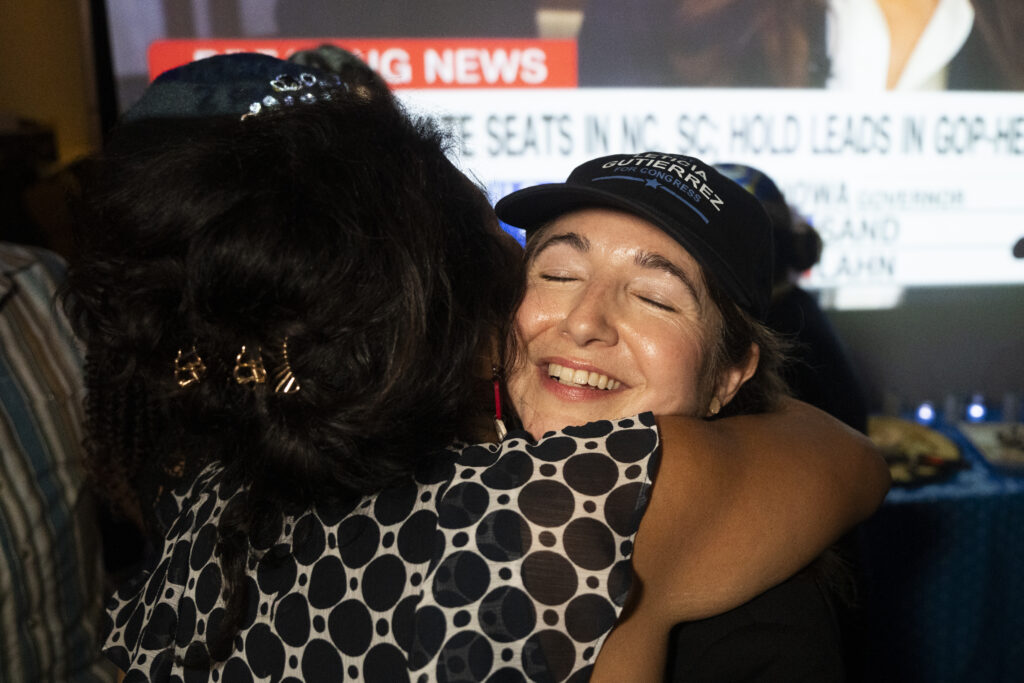
Leticia Gutierrez’s upset victory in a Houston-area congressional district means an environmental-health advocate will represent part of the country’s oil capital, and environmental groups say that could help communities choked for years by petrochemical pollution.
Gutierrez, who spent more than a decade as Air Alliance Houston’s government relations director, pledged to support policies to improve air quality and regulate AI data centers’ water consumption and electricity usage. The Democrat beat a vastly better-funded former oil-industry executive whose contributors included petrochemical companies and Elon Musk.
“There is now, dare I say it, a green Houston congressional contingent,” said Jennifer Hadayia, executive director of Air Alliance Houston. She counts Reps. Christian Menefee, Sylvia Garcia and Lizzie Fletcher, all of whom won re-election in their Houston-area districts, among that group.
“We know that they understand Houston is the energy capital of the world,” Hadayia said. “That also means we’re the pollution capital of the world, and I feel very confident that that group together is going to advocate for our best interests when it comes to things like efforts by the current EPA, [which] has been stripping the community of its rights to weigh in on pollution decisions.”
Gutierrez’s 9th Congressional District was among those redrawn by Texas Republicans in 2025 in an unsuccessful effort to maintain the party’s control of the U.S. House of Representatives. Instead, the blue-wave election last week swept numerous Republicans out of office in Texas and nationwide.
The redrawn district includes parts of Harris County and the Houston Ship Channel, a major source of pollution lined with hundreds of petrochemical facilities. During the campaign, Gutierrez pointed to the health consequences of living near those facilities. The Texas Department of State Health Services, studying part of east Harris County near the ship channel and other pollution sources, found higher-than-expected rates of certain cancers in 2015, and a 2025 update still found notably higher rates.
Advocates were heartened by her election because they say people in the region need representatives pushing for pollution control.
“I think a really big issue for Harris County and for District 9 is how we’re treating our national emission standards for hazardous air pollutants,” said Clara Goodwin, staff attorney at the Environmental Integrity Project.
Last year, the Trump administration invited companies to email requests for “presidential exemptions” to a number of rules designed to reduce Americans’ exposure to air pollution hazards, including cancer-causing chemicals. Goodwin estimated that 30 facilities in the district have sought such exemptions.
Hazardous material dredged from the Houston Ship Channel and moved to dump sites in the region also pose risks to residents in parts of Gutierrez’s district. In 2024, sample testing of dredge material from part of a channel expansion that began in 2022 found toxic substances, including high levels of cancer-causing arsenic. Despite this finding, current U.S. Environmental Protection Agency policy does not treat dredge material from ship channel expansions as dangerous, Goodwin said.
Gutierrez will join a Congress in January newly under Democratic control. New laws controlling pollution may be impossible for the next two years—President Donald Trump can veto them—but Hadayia said there will still be opportunities to act. The major rollbacks of EPA rules that began last year are an environmental injustice, because the harms fall unequally across the country, she added.
Democrats “can hold ethics investigations and expose some of the corruption that’s going on, including the destruction of the Environmental Protection Agency by the Trump administration,” said Josiah Rector, an associate professor and urban environmental historian at the University of Houston.
This story is funded by readers like you.
Our nonprofit newsroom provides award-winning climate coverage free of charge and advertising. We rely on donations from readers like you to keep going. Please donate now to support our work.
He also thinks there’s room for action on tax breaks for petrochemical companies along the Houston Ship Channel that contribute to local air pollution. Rector said those policies have left school districts and other public entities with inadequate funding while people, many of them lower income, pay with their health.
“Now with the defeat of [Gov.] Greg Abbott and the GOP in Texas, there’s a real opportunity for Democrats, both in the congressional delegation representing Harris County but also in the Texas state Legislature, to start phasing out these tax breaks for corporate polluters to incentivize renewable energy,” he said.
Some advocates are tempering their expectations about how quickly Gutierrez can act on her campaign promises.
“Obviously, she’ll be a freshman,” said Luke Metzger, executive director of Environment Texas, “and it’s difficult to be able to immediately have an impact when you’re a freshman, but I think I’m excited to see what committee she gets appointed to and what she does to hold the EPA’s feet to the fire.”
About This Story
Perhaps you noticed: This story, like all the news we publish, is free to read. That’s because Inside Climate News is a 501c3 nonprofit organization. We do not charge a subscription fee, lock our news behind a paywall, or clutter our website with ads. We make our news on climate and the environment freely available to you and anyone who wants it.
That’s not all. We also share our news for free with scores of other media organizations around the country. Many of them can’t afford to do environmental journalism of their own. We’ve built bureaus from coast to coast to report local stories, collaborate with local newsrooms and co-publish articles so that this vital work is shared as widely as possible.
Two of us launched ICN in 2007. Six years later we earned a Pulitzer Prize for National Reporting, and now we run the oldest and largest dedicated climate newsroom in the nation. We tell the story in all its complexity. We hold polluters accountable. We expose environmental injustice. We debunk misinformation. We scrutinize solutions and inspire action.
Donations from readers like you fund every aspect of what we do. If you don’t already, will you support our ongoing work, our reporting on the biggest crisis facing our planet, and help us reach even more readers in more places?
Please take a moment to make a tax-deductible donation. Every one of them makes a difference.
Thank you,
