


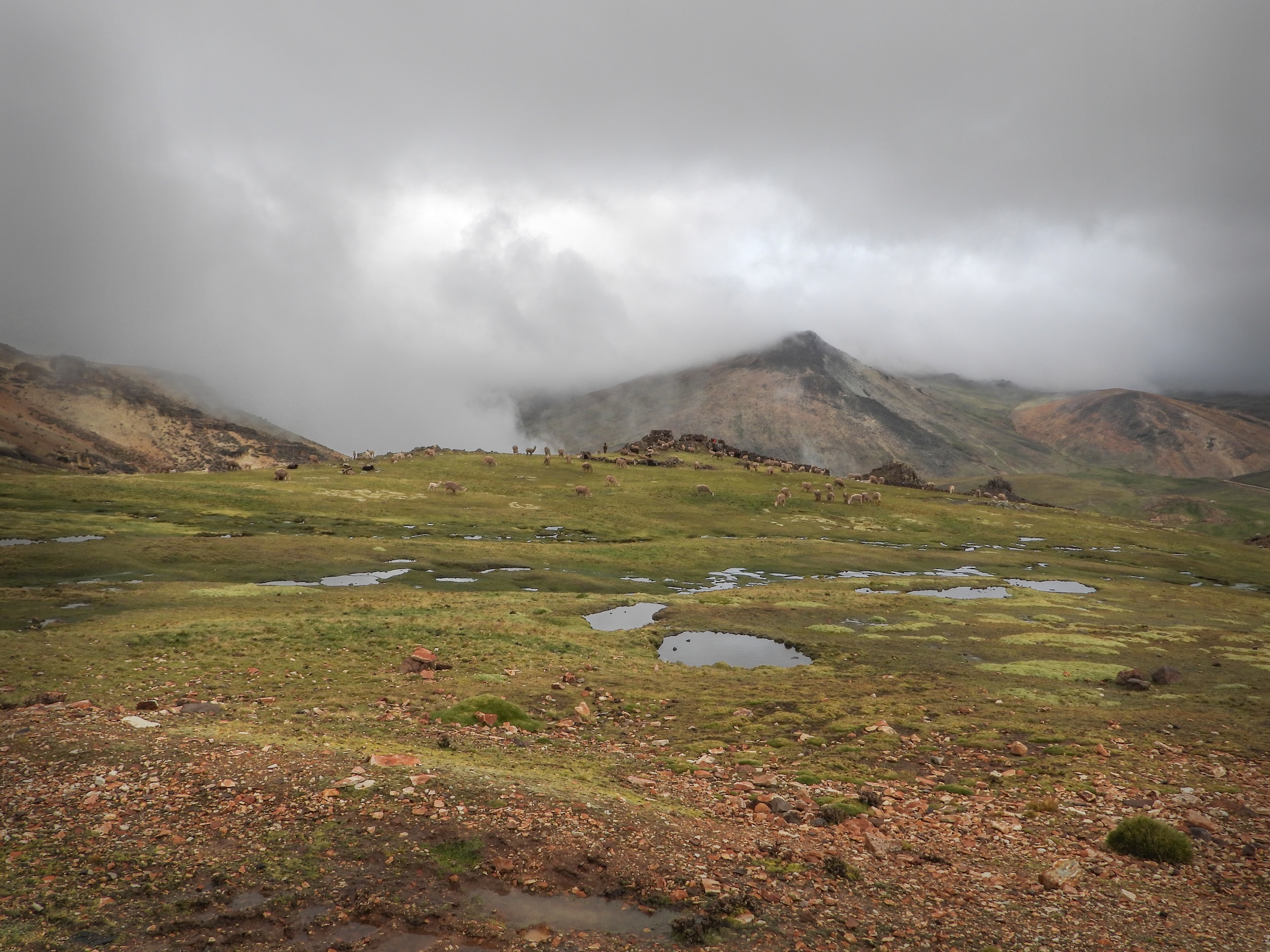
- In Peru’s high Andes, water security is under threat as glaciers retreat and changing weather patterns threaten natural reservoirs.
- At 3,200 meters (10,500 feet) altitude, in the community of Villa de Arma, Huancavelica, a conservation initiative that started in 2025 aims to secure water resources in the Chincha watershed, helping to supply water to the arid coast below.
- The project uses nature-based solutions such as wetland conservation and native forest regeneration to combat water security issues in the region.
- Some scientists caution that the benefits of nature-based solutions are hard to predict and that they are “not a panacea”.
In the highlands above Villa de Arma, community leaders once walked through ice and snow. They still remember the stories told by their grandparents of the Apus, high-mountain spirits that guard the Andean landscape. Locals in this central-Andean community, which sits around 3,200 meters (10,500 feet) above sea level in central-southern Peru’s Huancavelica region, say that much of the ice has since given way to rock.
In the last six decades, climate change has erased about 56% of Peru’s glacier mass, a critical water reservoir that feeds the country’s cities and arid regions. Locals fear the changing landscape of the Peruvian Andes heralds a broader pattern of climate change that threatens to tip the country’s high-altitude regions into a water security crisis.
“Their worry is that later on they could be left without water,” Edison Sánchez Toscano, a field technician working in Villa de Arma for Peruvian NGO Asociación Ecosistemas Andinos (ECOAN) and a local of the Huancavelica region, tells Mongabay in a video call. “If they are left without water, they are left with nothing.”
According to ECOAN, Villa de Arma sits at a critical watershed feeding the Chincha Valley, which runs from the high Andes to Peru’s arid Pacific coast and depends largely on water descending from the mountains. With glacial ice rapidly disappearing across the country, conservationists are increasingly looking to ancient Andean ecosystems, such as wetlands and native forests, that can store and release water.
In 2025, ECOAN partnered with a new project designed to secure these water resources in the Chincha region. Led by international NGO Global Forest Generation, the Yaku Pacha(meaning “land of water” in Quechua) project aims to use nature-based solutions to tackle water security issues.
The project’s primary goal is to bolster the watershed’s capacity as a reservoir, combining the restoration of two ecosystems: a natural wetland, and forests of polylepis, a high-altitude tree genus native to the Andes.
“We have to start learning to see these ecosystems not just as nature, but also from a human, utilitarian perspective,” Florent Kaiser, CEO of Global Forest Generation, tells Mongabay in a video call. “They will feed water into whatever other infrastructure, dams and reservoirs are further down below.”
Scientists including Wouter Buytaert, professor in hydrology and water resources at Imperial College London, continue to debate the effectiveness of nature-based solutions as a catch-all approach, questioning their applicability across different regional and ecological contexts. But Buytaert says uncertainty is no excuse for inaction, “Doing nothing is certainly not an option.”
A changing landscape
The roughly 600 inhabitants of Villa de Arma are already witnessing the effects of a changing climate.
ECOAN reports that changing precipitation patterns in the area have affected the community, with longer dry seasons affecting livestock and agriculture.
“In the rainy season everyone is fine because all the pastures are green, but in the dry season everyone suffers,” Alan Chamorro Cuestas, a biologist and regional director for ECOAN, tells Mongabay over video call. “The dominant economic activity in the highlands is livestock or agriculture. And without water you can do nothing.”
According to Chamorro Cuestas, the community’s primary water source is a 16-hectare (39.5-acre) wetland that stores and releases water much like a glacier.

But agriculture, shifting weather patterns and deforestation have degraded Villa de Arma’s natural water infrastructure.
“Many forests are being fragmented by the introduction of cattle,” Chamorro Cuestas says, adding that livestock decreases the ecosystem’s capacity to retain water. He says that logging for firewood poses another risk to the environment, with erosion being observed at the site of the wetland.
“The most direct [threat] is human interference, for example, overgrazing,” says Buytaert in a video call with Mongabay. While he hasn’t observed a clear link between climate change and wetland degradation, he says shifting weather patterns could also contribute to ecosystem damage.
“The increase in temperature will tend to lead to increased evaporation from those wetlands,” he says. “They might actually shrink simply because evaporation happens faster.” Extended dry seasons may also lead to irreversible degradation, he adds.
“The worst-case scenario is where precipitation decreases and evaporation increases,” he says. “That will have the most dramatic effect.”

According to members of the initiative, the area not only supplies water to Villa de Arma, but also to the arid coast at the far end of the valley. Here, water-dependent businesses have begun to express concern at the potential risks facing their high Andean water supply.
“Almost the whole Peruvian coast has this problem of water stress,” says José Benites Colan, head of sustainability at Textil del Valle, a Peruvian textiles company based at the arid lower end of the Chincha Valley.
A co-funder of the project, Textil del Valle sees watershed restoration as a way to protect its water-intensive fabric dyeing operations.
“This water serves as compensation for all the water we use in the textile plant, all of it, or at least a significant percentage,” Benites Colan tells Mongabay over video call.
Restoring the watershed
In 2025, the project’s first year of operation, community members from Villa de Arma worked with project members to plant 30,000 polylepis seedlings.
“[Polylepis trees] are the sponges that trap that humidity,” Chamorro Cuestas says. “If these forests weren’t there, the air masses would simply cross over.”
The project combines polylepis planting with restoration of the 16-hectare wetland that serves as the community’s water reservoir, digging irrigation ditches and fortifying it with soil and rocks to stop degradation.
Polylepis reforestation can take around 10 years to yield results, according to Global Forest Generation, but the project claims that wetland restoration can deliver faster gains for the community.
“Communities need help now, not in five years,” Chamorro Cuestas says. “People have to feed their children now.”

Community engagement is positioned as a core tenet of the project’s approach, with local families participating in both the planting and the ongoing care of the 30,000 seedlings. The organization says it pays a per-sapling amount into a community fund, which goes towards expenses such as infrastructure repairs and solar panels.
“The fact that community members now see us permanently in the place, they feel more confident with us,” says Sánchez Toscano, who speaks the local Quechua language and has participated in consultation processes with local leaders.
“To strengthen this involvement, we run environmental education and training workshops in which we build up their knowledge about the importance of forests and wetlands,” says Maribel Astopillo Pocco, ECOAN’s communications officer over video call. “They are part of the whole process.”
The project hopes new opportunities will help offset the migration of young people away from the community, where work is reportedly scarce. Alongside the community fund, some local people are being trained as project staff, such as nursery or restoration technicians.
“A large part of this work is recovering this knowledge, generating opportunities locally so that young people come back to these places,” Chamorro Cuestas says.
Can nature-based solutions deliver?
Scientists remain divided on the effectiveness of nature-based solutions as a response to water insecurity.
“Very few of the water supply issues that I’ve seen in Peru and elsewhere can be solved simply with nature-based solutions,” Buytaert says. “To what extent do [wetlands] effectively contribute to downstream water supply that’s really hard to predict.”
For Buytaert, that unpredictability could make these projects hard to replicate, as success depends heavily on local geology and rainfall patterns. “It’s certainly not a panacea,” he says.

Even so, he says he believe that nature-based solutions can be valuable and flexible interventions under the right circumstances, adding that they provide greater adaptability than traditional hard infrastructure such as dams and reservoirs. For him, they are most effective when applied in combination with this traditional infrastructure. “It’s easy to criticize any intervention,” he says. “The weakness of some of the evidence should not be an excuse for inaction.”
Despite uncertainty from some scientists, the team at Global Forest Generation believes in the Yaku Pacha Project as a potential blueprint for further nature-based interventions elsewhere.
“We need to go into hundreds of watersheds,” CEO Kaiser says.
The project is already part of Global Forest Generation’s wider Acción Andina initiative, which currently involves more than 50,000 community members across 27 projects in five countries.

According to Kaiser, the project’s future as a blueprint will depend on the results it yields. “[We need] proof that it actually works for money to start flowing, and for both communities and the private sector to actually be interested,” he says.
To achieve this, the project is currently developing monitoring frameworks which will allow to assess its impact on the watershed. “[With this data] we could go and say to both the government and the private sector: ‘Let’s replicate this project here. It works,’” says Kaiser. He says that the project has already begun setting up instrumentation to achieve this.
The impact of the project’s polylepis reforestation may take years to materialize. “We always say this upfront: This will take years and decades to actually make a real difference,” he says.
But while some of the project’s hydrological payoff remains distant, its effect on the community is already apparent. Neighboring communities, ECOAN says, have expressed interest in joining the project, and residents in Villa de Arma continue to conserve the wetland themselves.
“People see the benefits on the ground, and they say: ‘I believe in this, because it’s helping me now, and will continue to help my children and grandchildren when I’m gone,’” Chamorro Cuestas says.
Banner image: Wetlands of Huancavelica in the Yaku Pacha project, Peru. April 2026. Image by Alan Chamorro, courtesy of Global Forest Generation.
FEEDBACK: Use this form to send a message to the author of this post. If you want to post a public comment, you can do that at the bottom of the page.
Cite this article
Euan Wallace (2026). In Peru’s high Andes, restoring ancient ecosystems could help protect water security. Mongabay Conservation news. DOI: https://doi.org/10.66709/news-330474

