


Stay informed with free updates
Simply sign up to the Energy sector myFT Digest — delivered directly to your inbox.
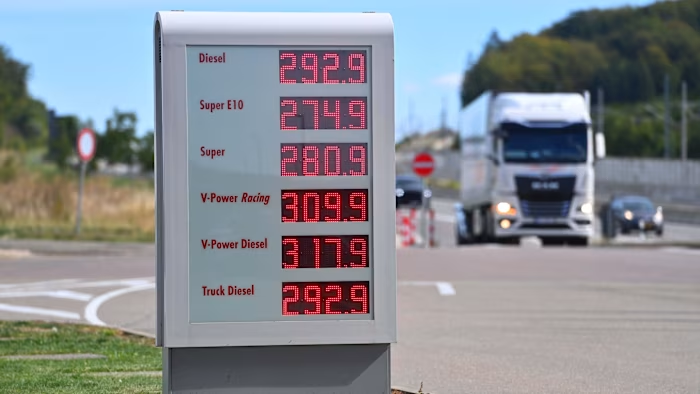
Europeans are spending an extra €30 on diesel each time they fill up, as the continent endures the biggest impact from high prices for the fuel of any major economy, new analysis shows.
Diesel prices have reached record highs across the world as a result of disruption in the Strait of Hormuz and to supplies from Russian refineries. US President Donald Trump has urged Ukraine to stop bombing refineries in Russia as high prices pile pressure on the Republican Party ahead of US midterm elections.
Analysis of European Commission data by European NGO Transport & Environment has found that drivers are paying 40 per cent more than at the start of the year, a premium of about €30 for a 50-litre tank. By comparison, petrol prices have risen 28 per cent in 2026.
Across the continent, this amounts to a premium of €203mn per day in additional diesel costs since the start of the conflict. That estimate did not include tax cuts on fuel, which must ultimately be compensated for through other tax measures or more borrowing, the NGO said.
Diesel accounts for more than 40 per cent of petroleum consumption in the European economy, more than any other region and twice the share of the US, making it more vulnerable to price rises.
“As we are running our road transport on internal combustion engines, we’re reliant on a very volatile commodity that we have no control over. Electrification can make us more resilient in crises,” said Juliette Egal, principal data analyst at T&E.
The EU has set a target of doubling its electrification rate by 2040 to 46 per cent of demand. Greater electrification could cut global energy import bills by more than $400bn, according to a report by the International Energy Agency published on Tuesday.
Commission President Ursula von der Leyen said last week that imported fossil fuels had cost an additional €90bn since the beginning of the Iran war, ‘‘without a single molecule of energy added’’.
However, governments in Europe also want more EU action to lower the costs of diesel and petrol at the pump.
French President Emmanuel Macron has called on Brussels to “temporarily and exceptionally” weaken specifications on fuel quality in a letter sent to von der Leyen. France has almost a fifth of all diesel cars in Europe, according to data from car trade body ACEA.
Macron said this would increase output of European refineries by 5 to 20 per cent, based on consultations from French refineries, and noted that the EU previously loosened restrictions during the Covid-19 pandemic.
He also called on the EU to remove restrictions on the use of biodiesel, enabling distributors to make use of the B10 mix, which contains 10 per cent biodiesel, instead of the standard B7.
The European Commission declined to comment on Macron’s demands but spokesperson Anna-Kaisa Itkonen said: “The main point is that as long as we are dependent on imported fossil fuels, our energy prices continue to be volatile . . . We are ready to consider other measures.”
Europe’s vulnerability to diesel prices is a legacy of policies that encouraged the fuel’s use in the 1990s and 2000s, as its greater efficiency led to fewer carbon emissions and lower costs for motorists than petrol.
This trend was slowly abandoned as air pollution linked to diesel became clearer, particularly after the Dieselgate crisis that underlined that real-world nitrous oxide emissions from cars running on diesel were far greater than those recorded in testing situations.
However, many diesel cars remain on the roads and four in 10 cars in Europe run on the fuel, T&E’s data shows.
The NGO points to short-term measures recommended by the International Energy Agency that could reduce diesel demand, including reducing speed limits on motorways by 10km/h and encouraging the use of remote working where possible.
It also calls on Brussels to stick with ambitions to progressively phase out combustion engines despite lobbying from the embattled European car industry.
Additional reporting by Attracta Mooney in London. Data visualisation by John Nelzon Chan.
