


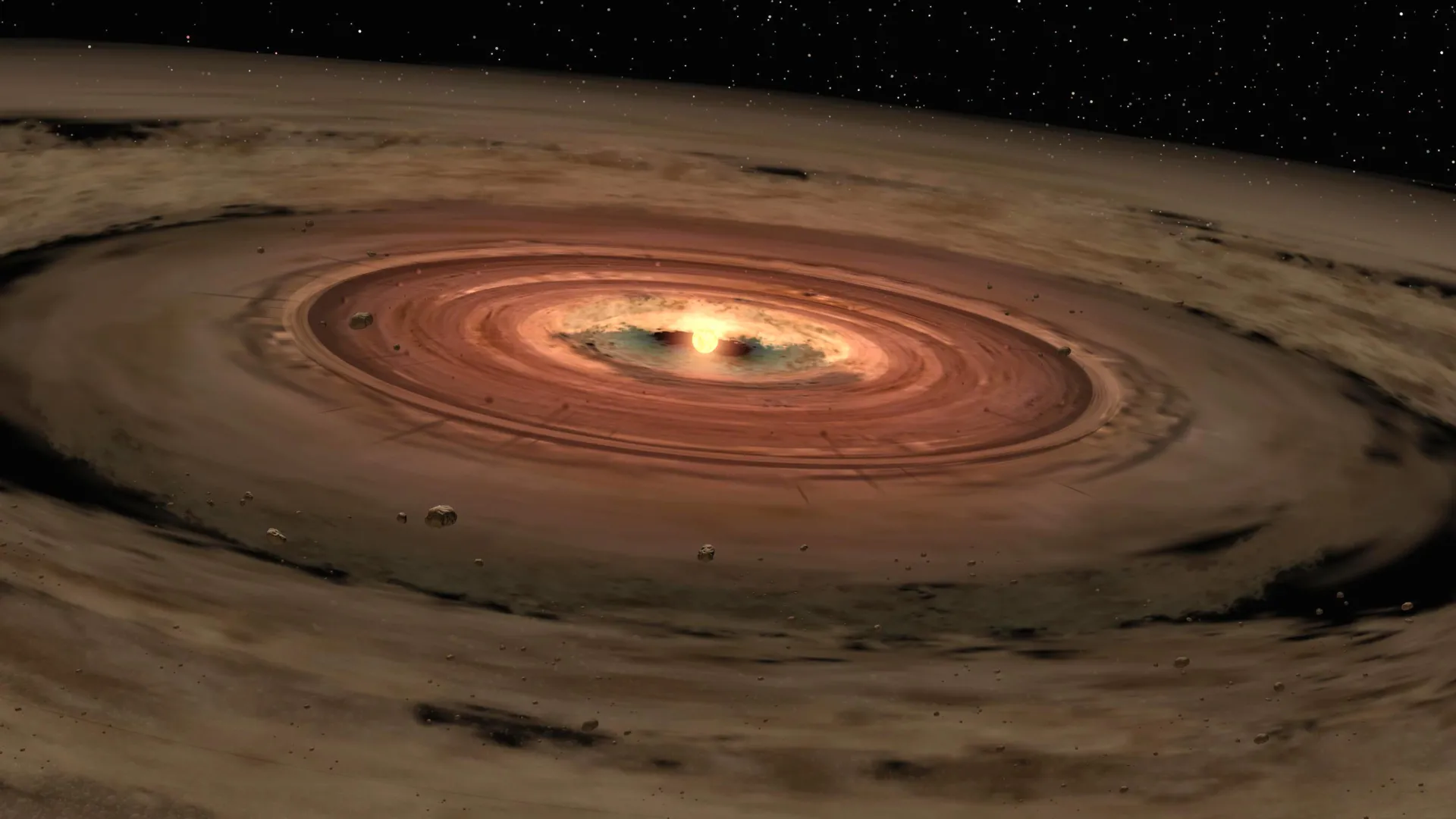
The earliest stages of planet formation may have been far more selective than scientists once realized. As the young Solar System began assembling solid objects such as planets, moons, and protoplanets, two major types of material were available. One was chondrules, millimeter-sized pieces of rock formed at high temperatures. The other was matrix, a cold, fine-grained dust rich in water ice and organic material.
New research led by Yale University suggests that the Solar System strongly favored the heat-formed material almost immediately.
Researchers have found the first geochemical evidence showing that chondrules were already being preferentially incorporated into solid bodies during the Solar System’s first million years. Until now, scientists had only been able to document this type of sorting in objects that formed 2 to 4 million years after the Solar System began.
The study was published Sept. 18 in Nature Astronomy.
The Solar System Was Selective From the Start
“Our work shows that this assembly process was remarkably selective from the very beginning,” said Damanveer Grewal, an assistant professor of Earth and planetary sciences in Yale’s Faculty of Arts and Sciences, and first author of the study. “The earliest bodies in the outer Solar System were built from 83% to 92% chondrules, with very little of the icy, volatile-rich dust that dominates later-forming objects.”
Chondrules are small rocky spheres found inside chondrites, which are among the most primitive meteorites preserved in geological collections. These tiny structures offer scientists a direct physical connection to the earliest stages of the Solar System.
“You can hold them in your hand and know that they began as part of a process that started billions of years ago,” Grewal said. “It’s a timescale that’s hard to wrap your head around.”
Scientists have long known that carbonaceous chondrites (primitive, stony meteorites that contain organic compounds and water among their silicate minerals) from the outer Solar System show a pattern related to age. Older examples tend to contain a greater proportion of chondrules and less matrix, while younger ones contain more of the cold, volatile-rich material.
That pattern suggested that the regions where the first solid objects, known as planetesimals, were forming were already favoring heat-formed chondrules while excluding much of the icy dust.
Searching for Evidence From the First Million Years
Confirming what happened during the Solar System’s first million years has been difficult because no preserved undifferentiated bodies from that period remain. Scientists therefore lacked a direct way to determine the original balance between chondrules and matrix in those earliest objects.
Grewal and his colleagues approached the problem by examining chemical clues preserved in iron meteorites from the outer Solar System.
The parent bodies represented by these meteorites contained so much radioactive aluminum-26 that they eventually melted completely. That process erased the physical structures that could have revealed what those bodies originally contained.
However, their chemistry still preserved useful information.
The researchers identified two independent chemical tracers associated with matrix. One was sulfur, which is highly concentrated in matrix. The other was the oxidation state of iron, which can indicate how much water ice and oxidized dust had been incorporated into the original body.
Meteorites Reveal a Chondrule-Rich Beginning
Using these two tracers, the team reconstructed the compositions of the ancient parent bodies. They calculated that matrix accounted for just 8% to 17% of their original material, a smaller proportion than has been measured in any known chondrites.
That means the remaining material was overwhelmingly dominated by chondrules.
“Both tracers independently tell the same story: these early planetesimals were remarkably matrix-poor,” Grewal said. “That convergence is what makes the result robust.”
The findings may also solve another puzzle involving the meteorite record. Very old chondrules are surprisingly uncommon today, even though they appear to have been abundant during the Solar System’s earliest history.
According to Grewal, many of those ancient chondrules were probably incorporated into the first generation of planetesimals. Those bodies subsequently melted, destroying the physical evidence and making the oldest chondrules much harder to find in surviving meteorites.
Reconstructing the Birth of Planetary Bodies
The results indicate that the process of separating and selecting planetary ingredients began almost as soon as solid bodies started forming. Rather than mixing chondrules and icy dust evenly, the young Solar System strongly favored chondrules in some of its earliest planetesimals.
“These ubiquitous little beads of rock are the basic building blocks from which the planets themselves were eventually assembled,” Grewal said. “And now we know they were already being sorted and incorporated into the first generation of solid bodies from the very start.”
Co-authors of the study are Zhongtian Zhang of Princeton University and Joanna Drążkowska of the Max Planck Institute for Solar System Research in Germany.
Funding for the research came from Yale University.
