


By its own account, the U.S. Environmental Protection Agency is doing a fantastic job. In a March report on its performance in the last fiscal year, the agency boasted that it had concluded 2,127 civil enforcement cases, “the highest in nine years.”
That number wasn’t wrong, but it was very misleading, an Inside Climate News analysis of EPA data reveals.
For starters, the 2025 fiscal year included the last three-and-a-half months of Joe Biden’s presidency. Comparing years beginning on Jan. 20 casts the current EPA’s record in a much less forgiving light. New lawsuits filed against the most egregious polluters—one of the strongest weapons in the EPA’s enforcement arsenal—have fallen off a cliff under the second Trump administration.
Meanwhile, the EPA has shifted how it approaches the administrative orders that comprise the vast bulk of its enforcement. It’s imposing fewer monetary penalties in favor of orders that merely require offenders to clean up their act.
Those compliance orders are now dominated by small-scale actions against public water systems, slapping officials on the wrist for failing to file inventories of and inform customers about water service lines made of lead.
While it’s important to address potential contamination of drinking water with a potent neurotoxin, these orders represent an administrative checkpoint in a much longer process of pipe replacement mandated by the Biden administration. They are a far cry from tough action against violators in the oil and gas industry and other major polluters and have allowed President Donald Trump’s EPA to pad its numbers with activities that impose little cost on offenders.
“From the beginning this administration particularly has been on a focused effort to dismantle environmental protection,” said Christine Todd Whitman, who served as EPA administrator under Republican President George W. Bush and is now co-chair of the centrist Forward Party. “Very early on, they got rid of a lot of the enforcement officers and compliance officers so there’s no one there to truly enforce the way they have in the past.”
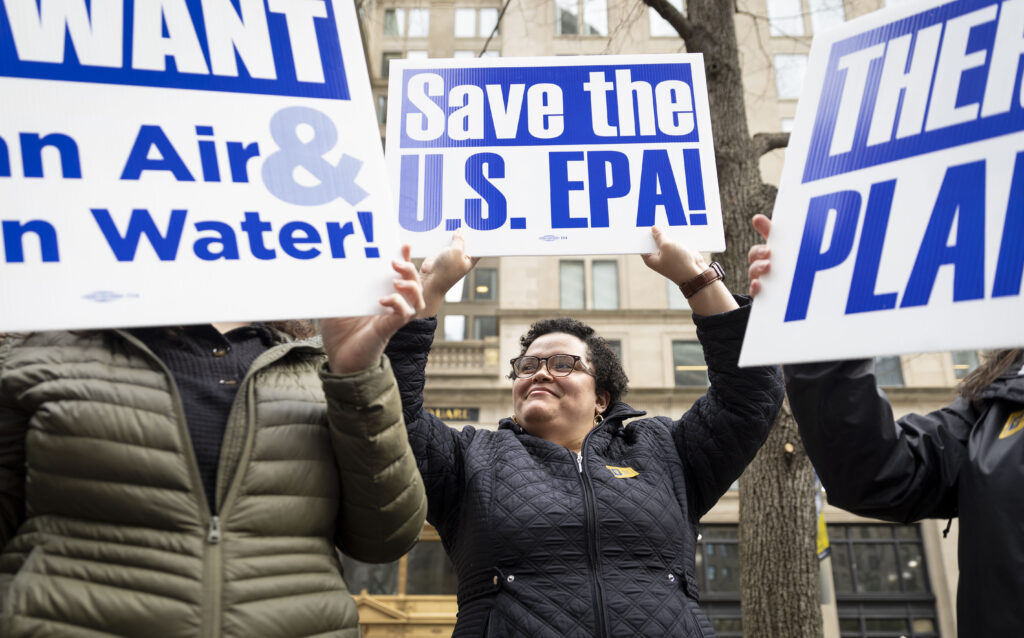
Indeed, an Inside Climate News analysis of federal employment data shows that, by the end of June, the EPA had lost more than a quarter of its workforce since Trump returned to office. Legal and related occupations, including staff responsible for compliance and enforcement, experienced a similar sharp drop.
Inside Climate News shared its findings with the EPA. The agency indicated that it would respond, asking for a deadline extension. After more than 10 days of delay, however, the EPA failed to comment and stopped responding to emails.
Aside from relatively rare criminal prosecutions, civil lawsuits are the strongest way for the EPA to enforce the nation’s environmental laws. They have always been a minority of the agency’s enforcement actions but have included some of the highest-profile cases and account for a vastly disproportionate share of financial penalties imposed on polluters.
Famous examples include the EPA’s lawsuit against BP for the 2010 Deepwater Horizon oil well blowout in the Gulf of Mexico, which led to an unprecedented $5.5 billion federal penalty, and criminal and civil penalties of $4.3 billion against Volkswagen under for installing “defeat devices” designed to cheat on federal emissions tests in diesel vehicles manufactured between 2009 and 2016—including $1.5 billion to settle the EPA’s civil lawsuit.
The Inside Climate News analysis of data from the EPA’s Enforcement and Compliance History Online system shows that the filing of civil lawsuits on behalf of the EPA has been in a long decline ever since the red-wave 2010 midterm elections during President Barack Obama’s first administration. Even so, the dramatic falloff in new civil suits filed in the EPA’s name by the second Trump administration is unprecedented.
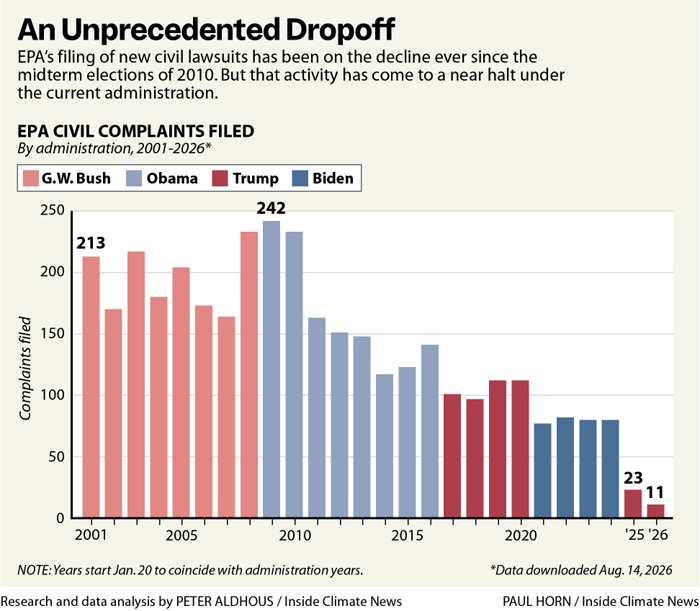
Since the 2010 midterms, Republicans in Congress have targeted the EPA for cuts. The agency’s staffing has fallen, setting in play an enforcement decline that continued even through the Biden administration.
“It’s a difficult ship to turn around once it’s headed in an anti-enforcement direction,” said Christopher Sellers, an environmental historian at Stony Brook University and lead author of a February report from the Environmental Data & Governance Initiative that similarly found a “historic dive” in EPA enforcement under the second Trump administration.
Both the long-term decline in civil lawsuits and the collapse under the current administration reflect changes at the Department of Justice as well as at the EPA itself, since the agency must collaborate with DOJ attorneys to bring civil cases to federal court.
As Inside Climate News has reported, the DOJ’s Environment and Natural Resources Division has been devastated under the second Trump administration. It has lost a significant chunk of its workforce since Trump returned to office and has been recast as the Energy and Natural Resources Division, given a remit of “unleashing American energy.”
This story is funded by readers like you.
Our nonprofit newsroom provides award-winning climate coverage free of charge and advertising. We rely on donations from readers like you to keep going. Please donate now to support our work.
The attorneys that remain now must get explicit political approval to proceed with a case, according to Laura Thoms, director of enforcement at Earthjustice and formerly a senior attorney in the DOJ’s environmental division. Given the division’s new focus, cases against fossil fuel companies are particularly unlikely to proceed.
“The pace of cases has ground to a halt because everything has to be funneled through the political head of the division,” Thoms said. “There is a pretty clear trend of the division—well, of this administration more broadly—not wanting to enforce against political allies and corporations that are aligned with the administration’s priorities.”
If serious pollution violations are addressed through EPA administrative orders rather than lawsuits, offending companies will likely be treated more lightly. Administrative cases typically have smaller penalties and looser compliance requirements.
“Usually, there’s no public input,” Thoms said. “There’s definitely no court that’s saying that the settlement is a reasonable and fair one.”
She added, “The fact that the ratio of administrative to judicial cases has skyrocketed indicates that something’s going wrong.”
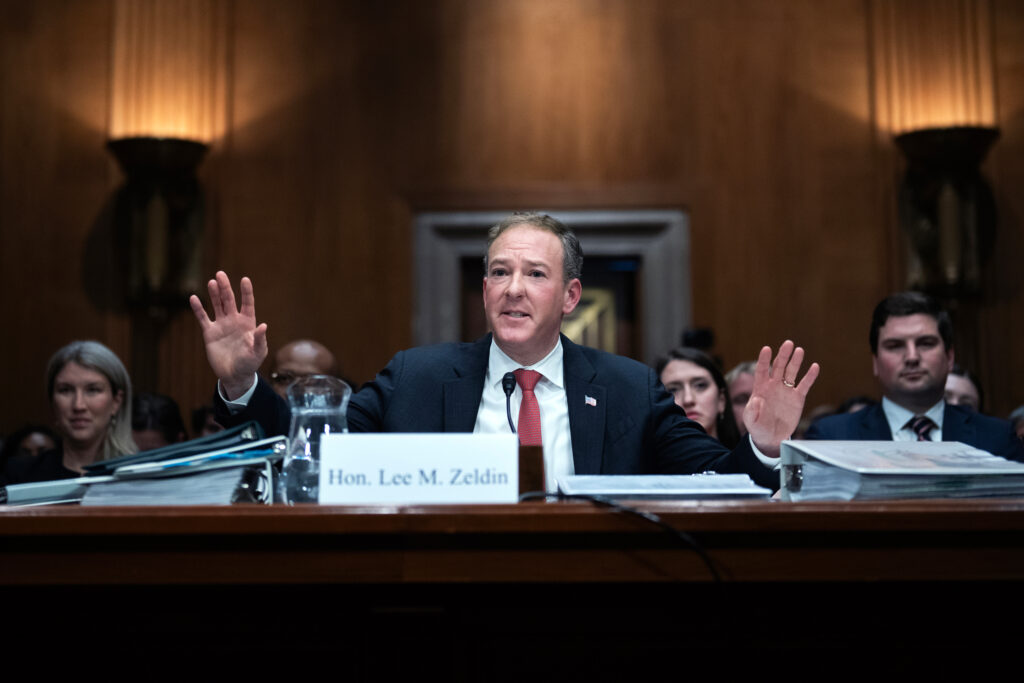
In a high-profile move in March 2025, Trump’s DOJ dismissed a lawsuit brought by the Biden administration against the Japanese chemical company Denka, which had operated a neoprene manufacturing plant in Louisiana that had exposed local residents—many of them people of color—to chloroprene, a likely carcinogen. In doing so, the DOJ said it was targeting a “radical DEI” program and aligning with EPA administrator Lee Zeldin’s pledge to “end the use of ‘environmental justice’ as a tool for advancing ideological priorities.” In June this year, the EPA and Denka agreed to an administrative settlement to clean up the plant, with the company paying a fine of just under $1 million.

Some administrative complaints have also been withdrawn. In one prominent example, the EPA dropped a complaint by the Biden administration that could have resulted in more than $4 million in penalties against the GEO Group for putting staff at risk by using a disinfectant that can cause skin burns and eye damage without appropriate protection at an Immigration and Customs Enforcement detention facility it operates in California. Not only has the GEO Group won contracts worth more than a billion dollars under Trump, it was also a major donor to the president’s 2024 election campaign.
Within administrative actions, the EPA has shifted away from penalty orders that impose fines on violators toward orders that merely set a timeline for offenders to bring themselves into compliance with environmental laws, the Inside Climate News analysis shows.
Under recent administrations, about 60 percent of EPA administrative enforcement actions were penalty orders while around 40 percent were compliance orders. Under the current administration, these proportions have been turned on their head.
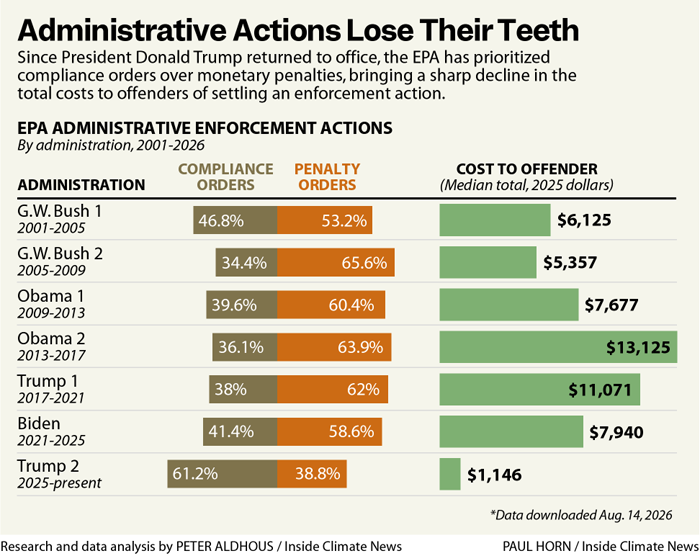
The Inside Climate News analysis also considered the total costs of EPA administrative actions, including federal penalties, associated state penalties, compliance costs and any additional projects an offender may agree to finance to settle an action. By this measure, the median cost to offenders of an EPA administrative action has dropped to a new low since the turn of the millennium.
In a critical February report on the EPA’s enforcement record, the Environmental Integrity Project noted that one area where the current administration was filing large numbers of compliance orders was under provisions of the Safe Drinking Water Act that require public drinking water systems to comply with federal drinking water standards and report violations to the public.
Inside Climate News found that orders requiring public water systems to complete inventories of their service lines to identify lead pipes in need of replacement represented the overwhelming majority. And they account for more than a third of all the administrative orders issued by the EPA since Trump returned to power, with a median total cost to offenders of less than $600.
Removing lead from drinking water is a priority of the Make America Healthy Again movement, an influential constituency among the voters who backed Trump in the 2024 election. So these actions, together with the upbeat tone of the EPA’s report on its enforcement activities in the 2025 fiscal year, suggest that the agency wants to create an impression that it is performing strongly—especially among Trump supporters.
“We’re hearing from staff that they’re being pushed just to issue compliance orders so that they can bump numbers up on the enforcement program,” said Tim Whitehouse, executive director of the watchdog group Public Employees for Environmental Responsibility, which in January released its own damning report on EPA enforcement under the current administration.
The shift toward compliance orders aligns with a December 2025 memo from the EPA’s then-acting assistant administrator, Craig Pritzlaff, which directed staff to adopt a “compliance first” stance as the agency’s “guiding principle” in approaching its regulatory role.
The memo also paused the use of supplemental environmental projects—which allow polluters to fund environmental or public health efforts as part of a settlement with the EPA.
Pritzlaff argued that promoting compliance rather than punishing violations would speed the process of bringing polluters into line with environmental laws. “[A]t times there may have existed a posture of pursuing enforcement that included findings of violation or orders that exceeded statutory or regulatory requirements,” the memo stated. “Such a posture prolongs negotiations and delays actual compliance.”
But critics point out that stressing compliance while avoiding financial penalties sends a disturbing message to companies concerned about their bottom line. If violators are freed from the risk of large fines, compliance orders have few teeth, allowing offenders to continue polluting while those who comply with environmental laws bear the cost of doing so.
“The whole system starts to fall apart,” Whitehouse said. “A system without enforcement allows those that don’t follow the rules to profit.”
Whitman, the former EPA administrator under George W. Bush, fears that lasting damage is being done to the agency’s core mission of protecting environmental and public health—in particular the health of children living near polluting facilities.
“You’re impacting future generations,” she said. “That’s going to go on and live down the line. You don’t reverse that overnight.”
About This Story
Perhaps you noticed: This story, like all the news we publish, is free to read. That’s because Inside Climate News is a 501c3 nonprofit organization. We do not charge a subscription fee, lock our news behind a paywall, or clutter our website with ads. We make our news on climate and the environment freely available to you and anyone who wants it.
That’s not all. We also share our news for free with scores of other media organizations around the country. Many of them can’t afford to do environmental journalism of their own. We’ve built bureaus from coast to coast to report local stories, collaborate with local newsrooms and co-publish articles so that this vital work is shared as widely as possible.
Two of us launched ICN in 2007. Six years later we earned a Pulitzer Prize for National Reporting, and now we run the oldest and largest dedicated climate newsroom in the nation. We tell the story in all its complexity. We hold polluters accountable. We expose environmental injustice. We debunk misinformation. We scrutinize solutions and inspire action.
Donations from readers like you fund every aspect of what we do. If you don’t already, will you support our ongoing work, our reporting on the biggest crisis facing our planet, and help us reach even more readers in more places?
Please take a moment to make a tax-deductible donation. Every one of them makes a difference.
Thank you,

Data Journalist
Peter Aldhous is a science and data reporter based in San Francisco. He got his break in journalism in 1989 as a reporter for Nature in London, fresh from a Ph.D. in animal behavior. Later he worked as European correspondent for Science, news editor for New Scientist and chief news & features editor with Nature, before moving to California in 2005 to become New Scientist’s San Francisco bureau chief. From 2015 to 2022 he worked on the science desk at BuzzFeed News. Peter also teaches investigative and policy reporting, data visualization, and news features writing in the Science Communication Program at the University of California, Santa Cruz. He is a two-time winner in the Global Editors Network Data Journalism Awards. His reporting has also been honored by the Association of British Science Writers, the Association of Health Care Journalists, the Society of Environmental Journalists, and the Royal Statistical Society.
