


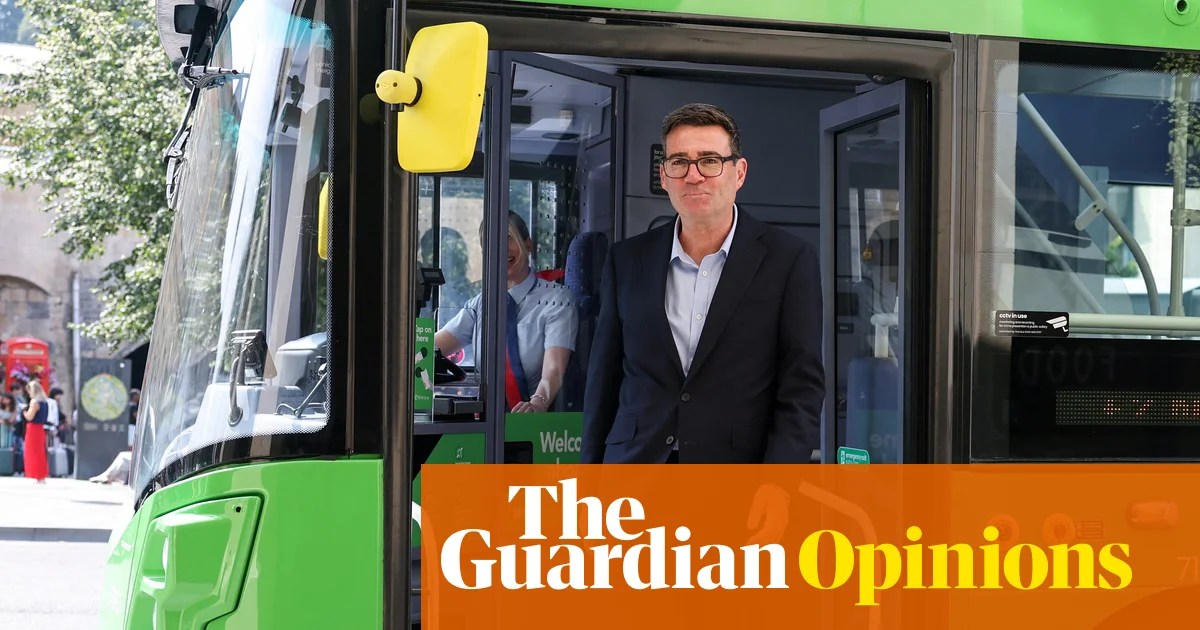
Barely a month into his premiership, Andy Burnham is already taking the lessons of Manchester’s buses national. This week his government backed the West Midlands mayor Richard Parker’s move to bring the region’s main bus operation into public control. In July, he announced that he would reinstate a £2 national bus fare cap from January 2027. He’s also expanding free bus travel for disabled people to all hours. Transport affordability is clearly part of Mr Burnham’s cost of living programme. That is to be applauded, as is the emphasis on public transport, which – importantly for Labour – reduces social exclusion, boosts local economies, and is better for the environment. Yet buses may matter to Mr Burnham for another reason: they offer a blueprint for how he wants to govern.
This is because Mr Burnham seems to have a worked-out model. He told the Times this week that the prescription for services such as water, housing and energy isn’t yet clear, “with the exception of buses”. Public control, Mr Burnham reasons, gives government the power to make provision cheaper and more reliable – and to shape it around the public interest. For buses, that means the government determining the shape of the network even where private companies run the services. Municipal ownership this is not.
Despite that, more money will be needed. Austerity slashed public transport budgets, and consequently bus journeys fell. Outside London, buses clock up about 736m miles a year, nearly a third below 2005. Getting back to a decent service would cost a paltry sum. For £300m a year, England could get buses back into its worst-served communities. For about £1bn, the Campaign for Better Transport calculated, ministers could provide decent, frequent services in towns and rural areas. In 2021, the Campaign to Protect Rural England put the price of a Swiss-style bus network – an hourly service from 6am to midnight for every village of more than 300 people – at £2.7bn a year. Accounting for inflation, that would be £3.4bn today, just 1.5% of the NHS budget.
Public transport isn’t only about moving people around. London’s extensive tube, rail and bus network gave Sir Sadiq Khan the room to introduce Ulez. The scheme charged drivers of older, more polluting vehicles and brought measurable health benefits. A study has shown that children’s lungs grew bigger and stronger after Ulez was introduced. It is worth noting that Mr Burnham abandoned Manchester’s clean-air charging zone when the post-pandemic cost of replacing dirty vehicles threatened to fall heavily on businesses. He instead pressed ahead with the Bee Network, giving Manchester a more affordable public-transport alternative, while simultaneously spending public money cleaning up the city’s bus fleet. It was a politically shrewd sequence: improve the alternative so that you could persuade people to use their cars less.
Both Theresa May and Sir John Major have tried to diminish Mr Burnham’s mayoral experience by contrasting “running Manchester” and “dealing with buses” with being in Downing Street. Yet the prime minister appears to regard buses not as an incidental part of his record but as an exemplar for his government. The Centre for Cities thinktank argues that poor transport makes big English urban centres outside London effectively smaller in economic terms, by cutting workers off from opportunities. Perhaps his critics have it backwards: buses are not a distraction from governing Britain; connecting people to cities is part of the job.
-
Do you have an opinion on the issues raised in this article? If you would like to submit a response of up to 300 words by email to be considered for publication in our letters section, please click here.
