


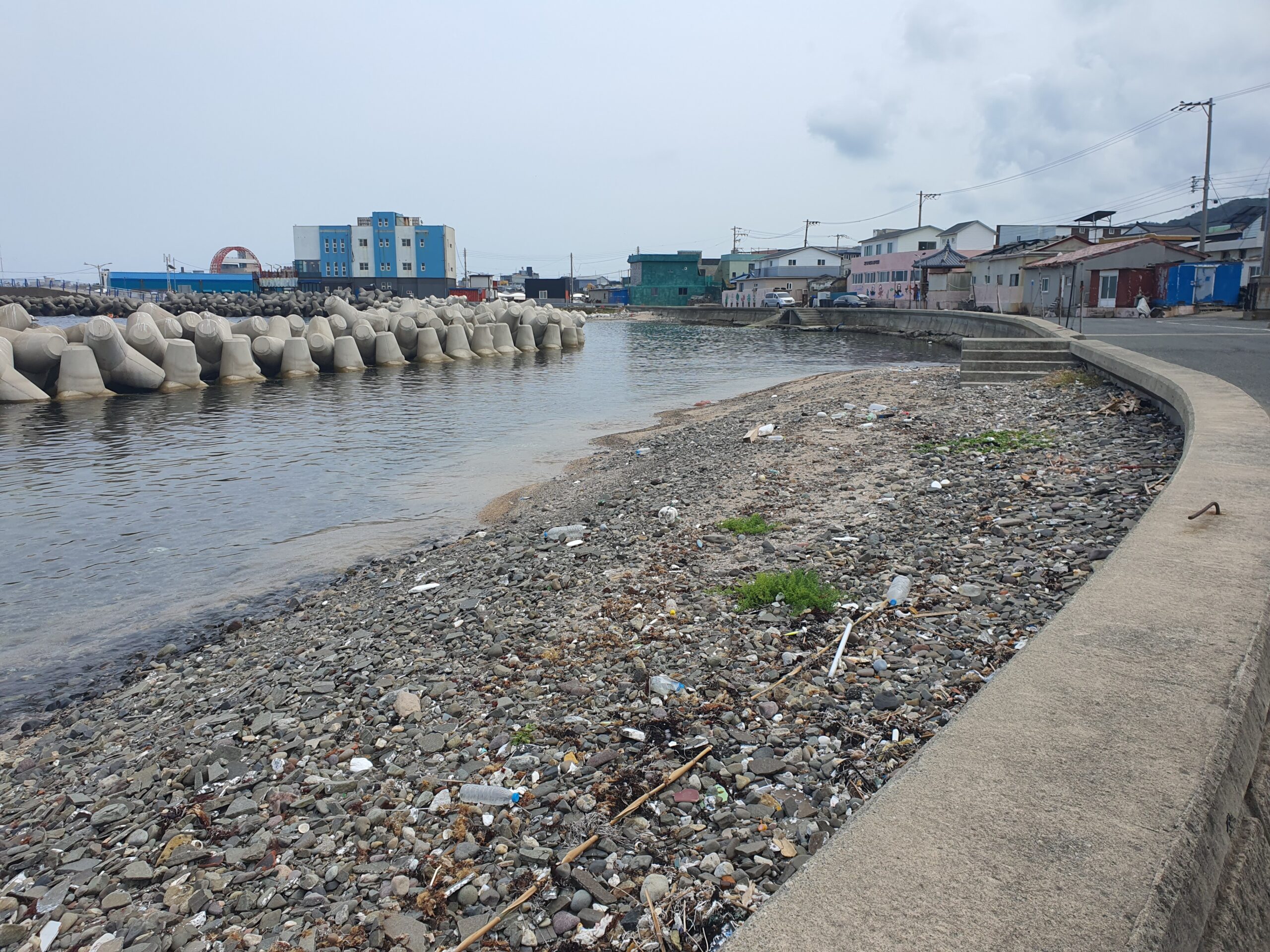
- A community of hanyeo, South Korea’s free-diving women fishers, accuse a harbor project in their village of devastating the local marine habitat they’ve depended on for decades for their livelihoods.
- The women are demanding compensation from construction giant Ssangyong, taking their fight to Seoul after the loss of their traditional fishing grounds.
- They are considering a lawsuit against either the company or the government, but face a costly, years-long legal battle requiring scientific evidence linking the construction activity to the habitat’s destruction.
- With many of the haenyeo now in their 70s and 80s, time is not on their side — and some say the settlement on offer would barely cover the cost of their fight.
GUMAN-RI, South Korea — This fishing village, on the eastern coast of the Korean Peninsula, is filled with scars. Every summer, typhoons rumble in from the Pacific Ocean to snap trees and flip fishing boats. Huge ships, including a 4,000-ton cargo vessel in 2005, have sunk or run aground on the rocky coast, sullying marine food sources. In the 1950-1953 Korean War, dozens of villagers were massacred.
Time and time again, however, the resilient residents of Guman-ri have figured out a way to soldier on. But their latest setback has stupefied them.
In 2021, South Korean construction giant Ssangyong Engineering & Construction Co. began work to expand and repair the breakwaters at the local harbor. Since then, the surrounding marine habitat has slowly withered away. By early 2025, the lush seabed had become a graveyard for dead marine plants and animals.
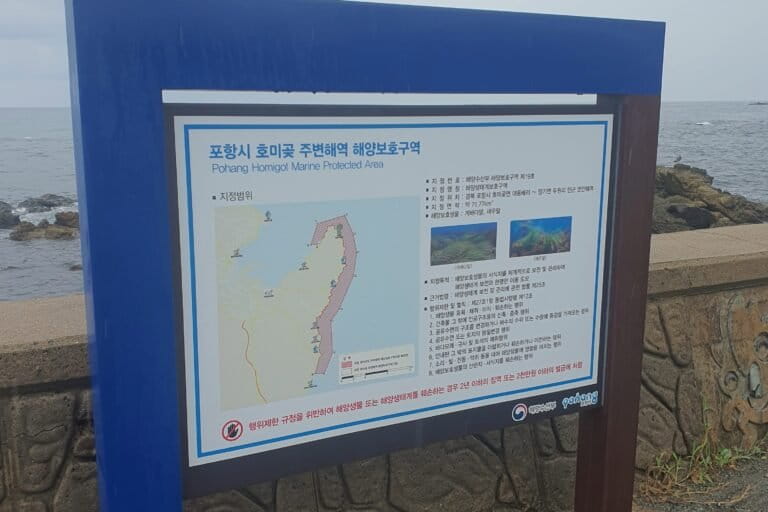
Gone are the glimmering abalones, chunky sea snails, and translucent green seaweed that once populated the waters around the cape, despite its designation as a protected marine area. In their place is white, dusty cement debris, which the villagers have blamed on the construction of the breakwaters.
The habitat’s demise is itself an environmental tragedy. But it has brought an emotional and financial death knell to the village’s nearly two dozen haenyeo, the “sea women,” who go diving to harvest a variety of shellfish and marine plants without oxygen tanks.
Kim Choon-hee, a 78-year-old haenyeo, points to the cement debris covering the gravel of the village beaches. “None of that was there,” she says. “It is now everywhere.”
David versus Goliath
Kim is besties with fellow haenyeo Im Gil-seok and Lee Yeon-oak. The three women, all born in 1947, have swum and dived for more than five decades in the waters off the tight-knit village.
On land, it’s clear that age has caught up with them. Lee can’t sit for more than 10 minutes because of a bad back. Im has been taking pills for years after a stroke. Kim has a stooped posture because of a slightly bent back.

But in the water, it’s as if they’re in their 20s. The septuagenarians gracefully glide through the water to depths of up to 10 meters (33 feet) and can hold their breath for 90 seconds, all without an oxygen tank.
“It almost feels like I’m flying,” Kim says with a chuckle, describing her underwater swim.
Their 12-hour days include swimming for hours in the chilly seas, tugging their 20-kilogram (44-pound) catches to shore, and squatting for several more hours to cut and clean their catch before they sell it at the local market.
For much of the past 50 or so years, the long days would have earned the haenyeo enough to put food on the table and even send their kids to school.
That changed, however, when Ssangyong began construction work at the harbor, which sits between Guman-ri and the neighboring fishing village of Daebo-ri.
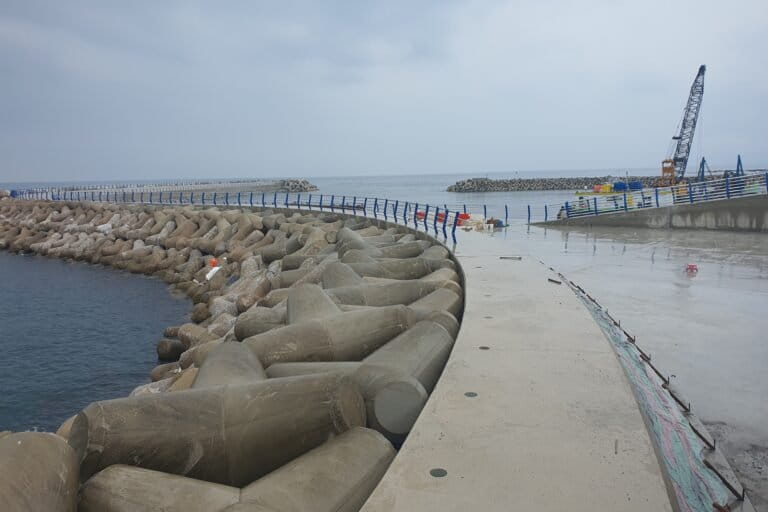
At first, the haenyeo weren’t worried when construction cranes began lifting 5-ton rocks like Lego pieces, throwing gravel and sand everywhere. After all, the underwater marine forest was unaffected.
By 2023, however, the effects of the construction started to show, they say. Abalones, once bigger than their hands, shrank in size, they tell Mongabay. Carcasses of sea cucumbers littered the seafloor. Shrubs of surfgrass disappeared. Within two years, the marine life had completely vanished.
“There is nothing now,” Im says.
The loss of the fishing grounds has affected 53 haenyeo in the two villages: 23 in Guman-ri and 30 in Daebo-ri.
Unbeknownst to them, it was the local office of the South Korean Ministry of Oceans and Fisheries that proposed the construction work in 2017. The office, located in Pohang, the biggest city in North Gyeongsang province, touted the need to expand breakwaters to better protect the villagers’ fishing boats from typhoons.

The proposal was endorsed by seven elderly fishers who represented the two villages. When the haenyeo found out what had happened in 2025, they confronted the men for not consulting them before accepting the government’s plan. However, the fishers told them that they didn’t know what could happen to the coastal habitat or the livelihoods of the haenyeo.
The men apologized. But by then, it was too late. The local ecosystem, which Kim describes as “a gold mine of seafood,” had collapsed.
In June this year, all the haenyeo from Guman-ri and Daebo-ri, in their 60s to 80s, went to Seoul to stage a protest. They hired two buses to drive them five hours to the headquarters of Ssangyong E&C.
For two days, on June 29 and 30, they staged a sit-in under the scorching sun outside the high-rise building that houses the construction firm.
Clad in black rubber diving suits and carrying tewak, floating devices that double up as baskets to carry their catch, the women wore red headbands that read, “Compensation for the damage.”
As they yelled chants, they waved banners that also read, “We’ve lost our livelihoods. Compensate our neighborhoods!”

The haenyeo demanded Ssangyong, which earned a net profit of 154.2 billion won ($112 million) last year, compensate them after allegedly destroying their livelihoods and the sea they depend on.
Unable to afford hotel rooms, they slept on the streets. “It was a tearful experience because it was demeaning,” Lee recalls.
Their protest, however, attracted attention from national media and lawmaker Lee Sang-hwi, who represents their district.
After the sit-in, Ssangyong offered an out-of-court settlement. The divers decline to disclose the proposed settlement sum, but Jeong Mi-ja, 77, the unofficial leader of the haenyeo, says it amounted to little. “After we pay for the costs of [going to] Seoul, it’s finished,” she says.
Ssangyong did not reply to Mongabay’s request for comment by the time this story was published.
Between a rock and a hard place
The haenyeo are leaning toward signing the settlement, although they say they realize the money offered by Ssangyong is far from enough.
The alternative is going through a costly years-long lawsuit, with no guarantee of winning.

They will also have to hire outside experts to collect enough scientific data to establish a causal relationship between the construction work at the harbor and the destruction of Guman-ri’s coastal habitat.
The haenyeo say they’re also aware that the alternative to a settlement, a lawsuit, could last a decade or even more. And by the time it ends, regardless of the outcome, some of them would be over 90. They might even be dead, Im tells Mongabay.
Choi Jae-hong, a lawyer in Seoul who specializes in environmental cases, says the haenyeo are fighting an uphill battle.
They will have to prove that the debris from the construction either “destroyed the food sources of the marine life in the area and starved them to death, or that [the debris] clogged the breathing organs and suffocated the marine life,” he tells Mongabay by phone.
“That’s really hard to prove,” Choi continues. “And expensive.”
The fact that the waters off Guman-ri aren’t private property further undermines their case, he adds.
Research, however, has shown how coastal construction can adversely affect nearby marine habitats.
“The diffusion of suspended sediment resulting from construction clouds the water, undermines marine animals’ ability to breathe and feed, and destroys spawning grounds and habitats,” Yoon Han-sam, a professor of marine and harbor engineering at Pukyong National University in Busan, writes in a paper published in the Journal of the Korean Society for Marine Environment and Energy. “This is the most common cause of damage to fishing grounds.”
For now, some of the haenyeo hire buses two to three times a week to travel three hours north to coastal towns like Yeongdeok to earn a living.

Instead of the usual dawn wake-up time, their day now starts at 2 a.m. It takes them two hours to get ready, including getting suited up, and another three hours to reach their new diving grounds.
The 16-hour day ends at 6 p.m. Even the indefatigable haenyeo say the work is unsustainable.
A bleak future
The women are also contemplating a lawsuit against the Ministry of Oceans and Fisheries, which they accuse of proceeding with the construction project without their consent.
The Pohang Regional Office of Oceans and Fisheries has denied accusations of wrongdoing. An official tells Mongabay that the office notified Guman-ri’s representatives about the construction multiple times between 2017 and 2020.
It was the responsibility of those representatives, and not the government, to then inform the haenyeo, the official says.
Choi, the lawyer, says the haenyeo are likely to face a steeper uphill battle to sue the authorities because under South Korean law, the government doesn’t need to directly apprise them about the construction plan. “If they want to go [to] court, it might be actually better to file a lawsuit against Ssangyong.”

The haenyeo don’t necessarily expect to win any hypothetical lawsuit against the government. But if they do, some of the reparation money could be used to clean up the harbor, says Seo In-mahn, Jeong’s nephew.
“The marine habitat in front of Guman-ri and Daebo-ri isn’t the sole possession of the haenyeo grandmothers,” says Seo, 67.
“It is the community’s,” he says. “If you think about it, the habitat is also that of the entire country, and the world.
“So shouldn’t the entire world care about what’s happening here?”
Banner image: Debris that villagers suspect of coming from the harbor construction lies on the seabed and on the beach of Guman-ri, a fishing village in South Korea, on Aug. 15, 2026. Image by Andrew Jeong for Mongabay.
Citation:
Yoon, H.-S. (2026). A study on estimation of weighted suspended sediment concentration as an indicator in environmental impact assessment for marine construction projects. Journal of the Korean Society for Marine Environment & Energy, 29(2), 201-210. doi:10.7846/JKOSMEE.2026.29.2.201
Aceh’s community fishers struggle to preserve tradition amid blooms of plastic pollution

