


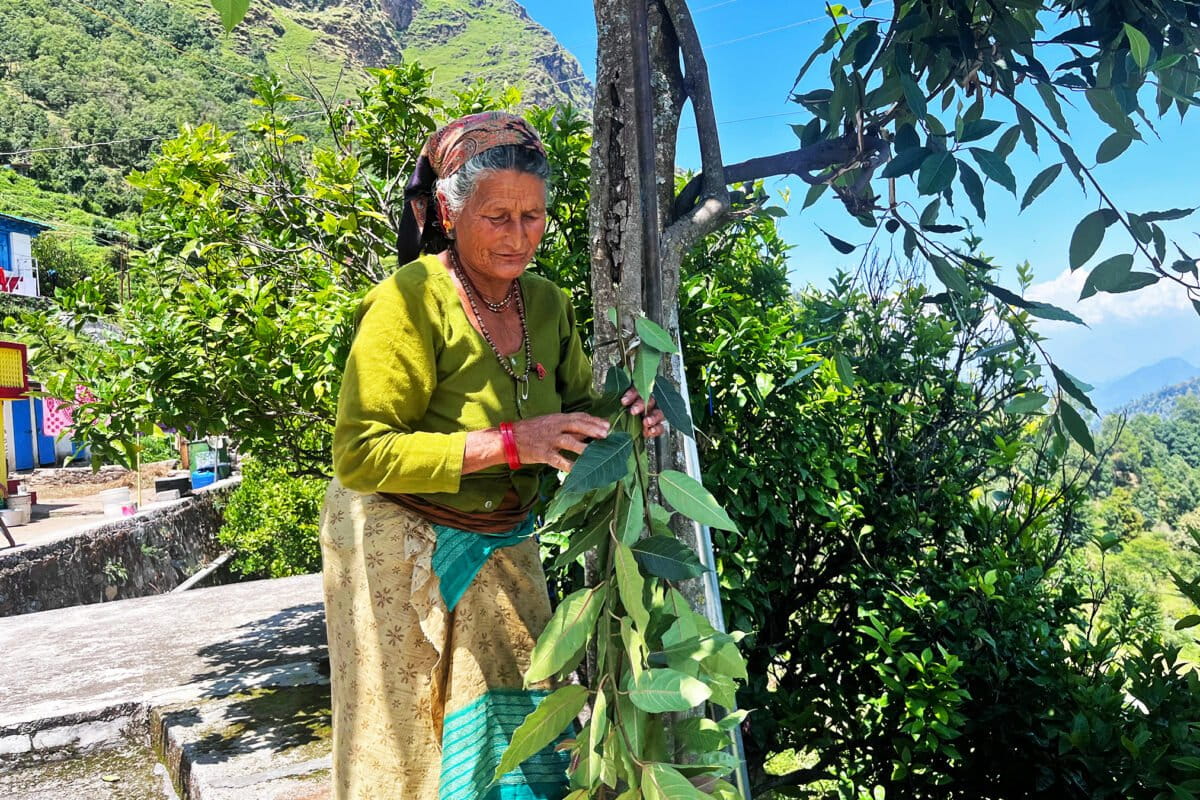
- Uttarakhand is the most fire-prone state in the Indian Western Himalayas, where wildfire seasons are expanding — and women are taking the lead on fighting fires in their communities.
- Traditional gender roles assigning household and caregiving work to women is a reason why women are first responders to fire.
- In addition, many men have left rural villages in Uttarakhand to search for opportunities elsewhere; women often stay behind for agriculture and feel obliged to protect their land and animals.
- Despite a lack of formal employment, equipment and support for their firefighting work, Uttarakhand women successfully work to stop fires at their source, protecting their villages from hazard.
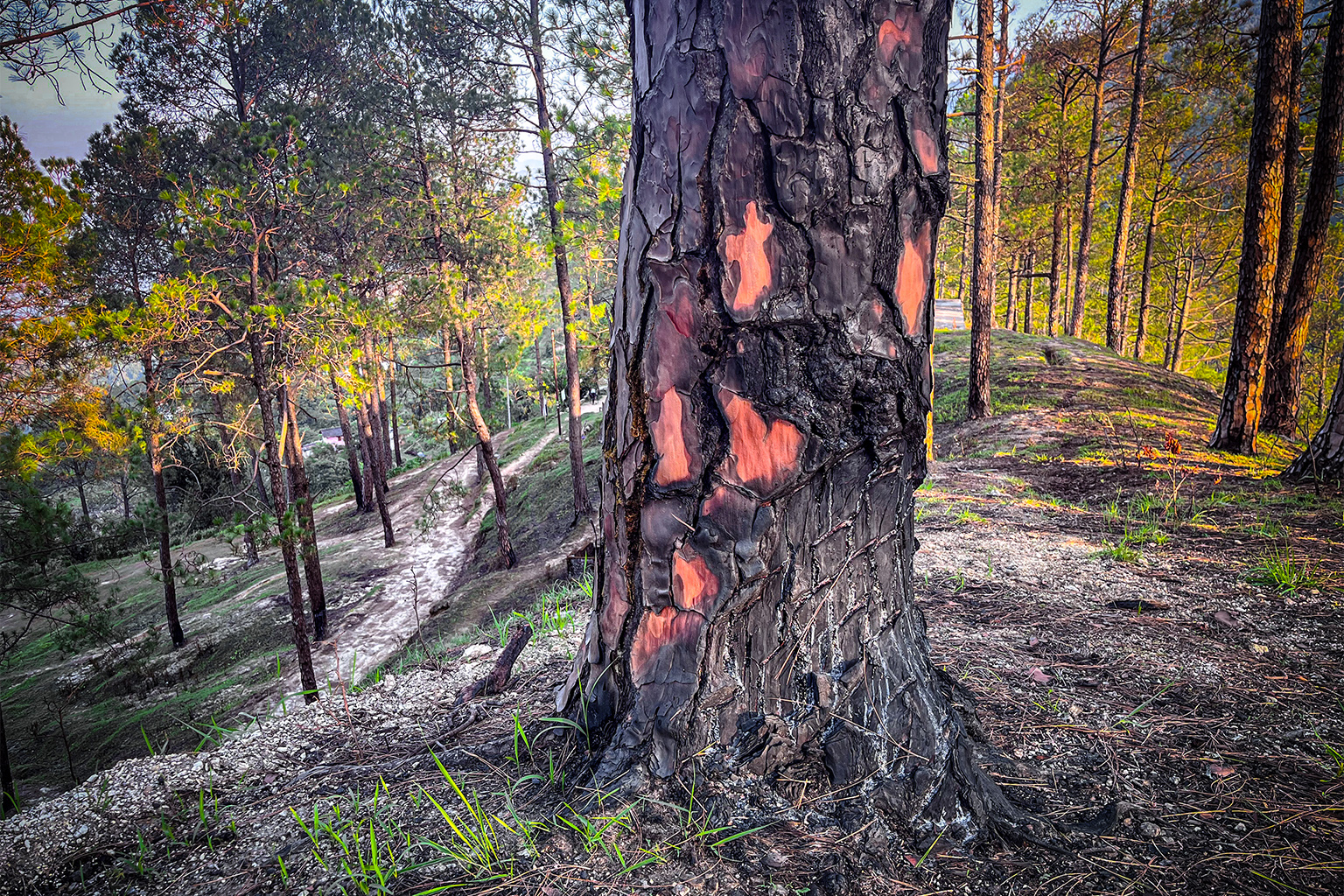
In the village forests of Uttarakhand, in the Himalayan region of northern India, a tree can be charred at its base while maintaining a green canopy at its peak. The distinct separation between burnt and unburnt wood is a physical marker of how high the flames reached. For the local women who rely on these woods for survival, the aftermath of wildfire means their daily chores take twice as long, forcing them deeper into the forest just to gather basic fodder and firewood when those closer to home are unusable.
Uttarakhand is the most fire-prone state in the Indian Western Himalayas, with increased fire incidence in the region coinciding with high-altitude warming that exceeds the global rate. Beyond individual fire events, the fire season itself is expanding. While the season usually lasts for about 12 weeks starting in mid-March, Uttarakhand now experiences winter fires, an alarming shift from what was previously snow season, hinting at a deeper ecosystem-level impact. This trend has only escalated, with the state recording a sharp spike in forest fire activity during the first four months of 2026.
This period is not just witnessed but experienced through each of the human senses. Trails of grey smoke engulf the bright blue sky. Along with the fog-like situation, the air carries soot, sometimes covering the roofs of houses with snow-like ash.
“We are all coughing our lungs out; during that time, our eyes are bloodshot, irritated by all the smoke, and it’s hard to breathe in the thick air. Even after days of fire, the firewood smell lingers,” said Tulsi Devi of Ayarpani village in Almora district.
While everyone endures the season, women predominate at the frontlines, fighting fires in Uttarakhand.

First responders born out of convention
Kavya Pandey, a researcher at the Centre for Wildlife Studies in Bangalore who has worked extensively on the relationship between women in Uttarakhand and forest fires, notes that traditional gender roles assigning household and caregiving work to women are why women are usually the first responders to wildfire. Since women’s daily labor keeps them in the forest for hours collecting firewood and fodder, they become, by default, the first line of defense.
Fighting fires can differ for both genders. To combat fires, the state forest department hires seasonal fire watchers, who are mostly men. Authorities also call women to help, but unlike men, they are rarely paid. Other than that, if fires occur at night, men often accompany women because of the danger from wild animals; but even in a group, the number of women is typically higher than that of men.
“If a woman sees fire anywhere, and she does not have a phone, she calls out to others by ululating or whistling, and all the women go together to snuff the fire,” said Kamla Devi, head of the Marhmanley village van panchayat, a community-managed village forest council that is unique to Uttarakhand.
Large-scale male migration compounds women’s role as firefighters. As climate change impacts agriculture with erratic rainfall, cloudbursts and drying water sources, men out-migrate in search of better opportunities. Research reveals that hundreds of villages in Uttarakhand are now depopulated, with many considered “ghost villages,” while hundreds more have lost half their population – mostly men, while women often stay behind for farming. Marhmanley reflects this pattern: Most of its men have left for the cities, leaving behind women, elders and children.
“With many migrating, fewer people are left to protect the village. The women who remain often have young children to look after, so they cannot leave,” Kamla said.

Deeply ingrained gender expectations also enforce these firefighting duties. Pandey argues that narratives framing women as natural protectors driven by “maternal instinct” have conditioned them to feel solely responsible.
“Even if there is a man when a fire breaks out, the man would scream, ‘Oh Basanti ki Ijja [Hey Basanti’s mother], there’s a fire,’ but what else would they do? How else will they tend their cattle?” said Kavya, explaining that it still remains a woman’s role to deal with fire.
This has always been the case, but firefighting is growing more difficult and more dangerous as fires expand with a shifting climate.
Higher stakes for women
Forest fires disrupt nearly every aspect of women’s lives. Around 71% of the total geographical area of Uttarakhand is forest area, supplying basic needs like drinking water, firewood and fodder for cattle grazing. With men working in cities, cattle rearing is one of the few ways rural women generate income.
“Forests are our everything. With active fires, we cannot even take our animals to graze. They stay tied in their sheds for days,” said Asha Devi of Bhetuli village.
Beyond daily chores, fires threaten homes and property. Most villages sit in close proximity to the forest. Marhmanley is one example, where houses are scattered along the hill’s incline. This positioning makes vigilance essential.
“We always keep a lookout for fires. We are afraid that if rocks roll down from the hill or if trees burn and fall downwards to the village, we have to protect trees and plants even if they are a distance away,” Kamla said.

Destruction and physical expense
Irrespective of age, when the forests burn, women run to extinguish them. Lila Devi, 70, still picks up her sickle to join the effort. “Amma [Granny] might look old, but she still runs like a goat on a hil,” Kamla laughed.
Women head out in groups, spacing themselves along the fire’s path in a chain to curb the flames faster and prevent embers or falling pine cones from spreading the blaze. Their main tool is a simple household sickle. Asha explained that they use sickles to cut green branches to make makeshift firebrooms (jhapa) to smother ground fires.
“When the flames are not too high, we use jhapa to beat back the fire. If they are [high], we clear a fireline instead; some of us push the fire back toward the already-burnt ground, while others use their sickle to pull away dry grass and twigs so it has nothing left to catch on,” Asha said.
A team of 10 can take an hour to tamp out a small fire, while a large fire means fighting flames all day. Long hours with limited tools and no protection leave many injured. Burnt hands, singed eyebrows and eyelashes are common.
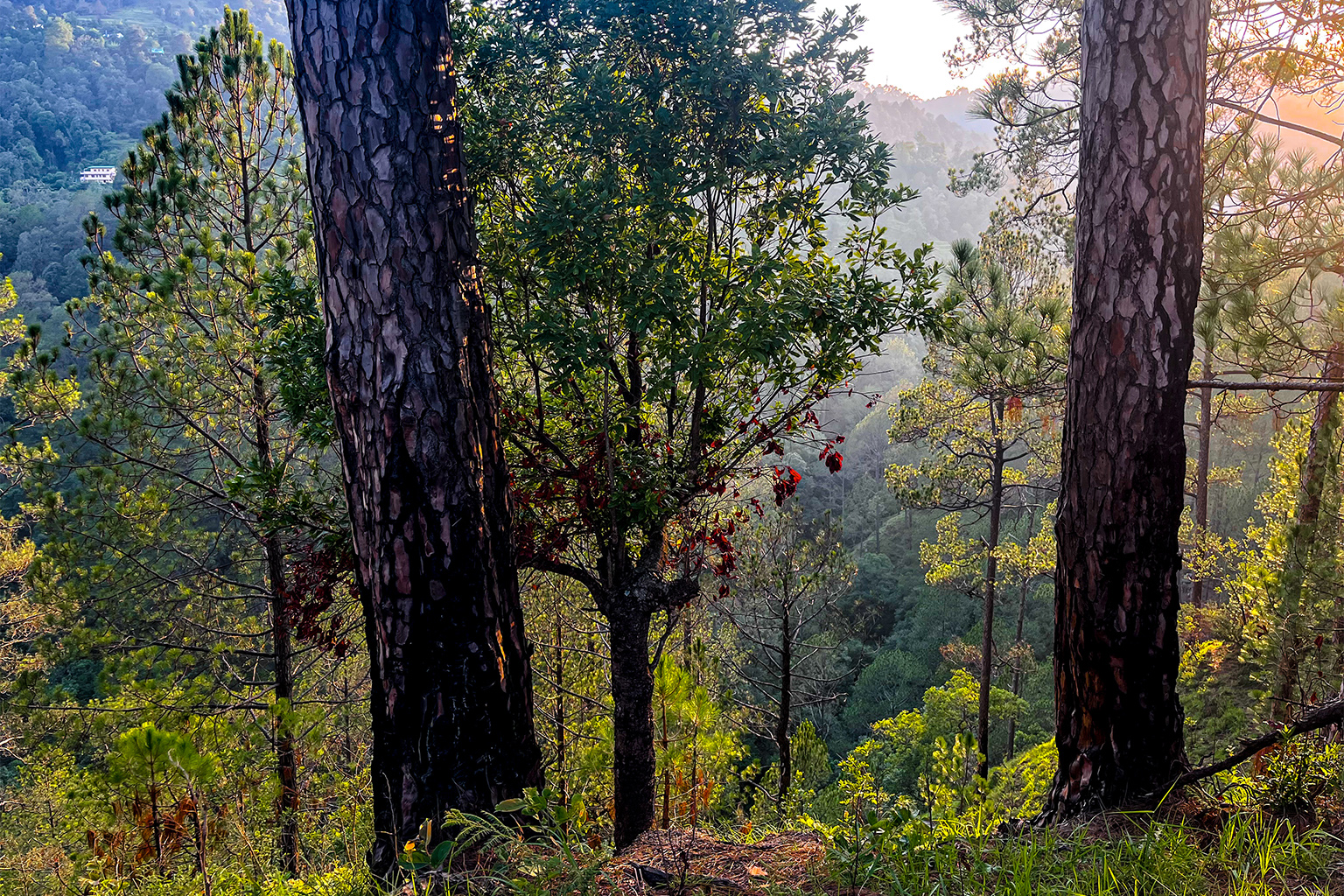
“We fall and hit ourselves against rocks, but we don’t care for our well-being in that minute — all we care about is the forest. If it burns, what will our cattle eat?” Kamla said.
Safety guidelines recommend protective equipment, but local women rarely have access to it, and highly flammable synthetic nylon sarees remain common. Although Kamla advises wearing cotton clothes and proper shoes, the urgency leaves no time to change.
“We just run to the forest as we are. One year, my feet got severely burnt because we sometimes even found ourselves running with no slippers on. At the end of a shift, many of us are pricked by thorns,” Kamla said.
The danger escalates at night. Women lose sleep to keep watch over their homes and property, especially since many store stacks of dry hay near their houses. Asha, who lives half a kilometer from forests, has to guard the jungle at night.
“We’re scared for ourselves and our belongings. Last year, in November, a fire broke out at night. My son fell asleep, so I had to put it out alone. Two of my grass stacks burnt down,” Asha said.

Lifelong battles
Meena Bhoj sits on her bed, hands clasped tightly in her lap, her mind elsewhere. Her youngest of the three keeps popping up at the window beside her, calling out ‘mummy’ then ducking away again, giggling, waiting for her to look. Each time she does, Meena smiles back with her lips closed, careful not to show the tooth she chipped two years ago, on a firefighting run.
In June 2024, Meena spotted a fire across her home at 10 p.m. To save harvested pine needles meant for animal bedding, she and three other women, along with her brother-in-law, headed up the dark hill. After hours of work, the fire was put out. With only one flashlight between them, Meena navigated the steep descent alone.
“I was running down because there are leopards in the forest. I wanted to reach safety as quickly as I could. But I tripped,” Meena recalled.
She fell face-forward into a ditch, hitting her chest, cutting it and chipping her tooth.
“I was bleeding and in pain, but all I could do was go home and sleep it off,” Meena said.
She woke up with a swollen face and could not eat for days. Later, she had to undergo minor surgery on her chest. However, this was the least of her concerns.
Meena’s husband, Bhuvan Bhoj, was working as a fire watcher with the forest department. The day after Meena’s injury, Bhuvan was among the few who survived the Binsar fire tragedy, where six people died. Bhuvan still works with the forest department as a driver. “I am now disabled because of my injury; with these injuries, I cannot take up any job either,” Bhuvan said.
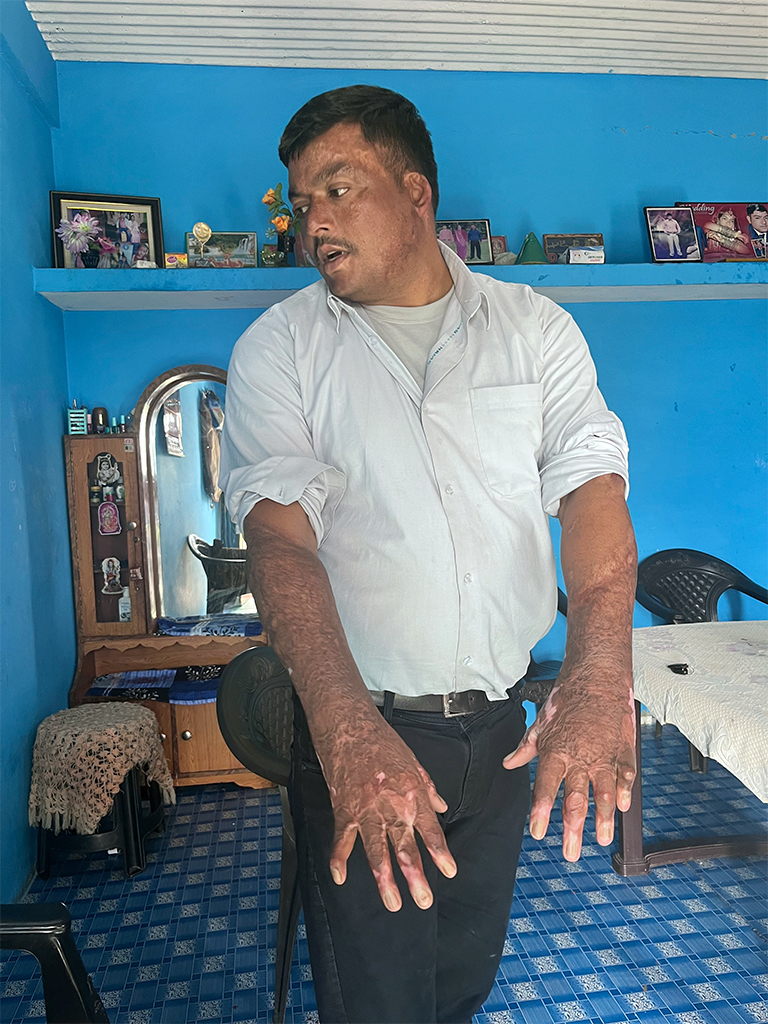
Meena is still haunted by bad dreams. Anytime she talks about the incident, her heart starts pounding. Despite the trauma, the couple still works against forest fires.
“I am scared of fire, but I am not scared for me; I am scared for him. I am constantly anxious when he goes to work. I call him multiple times a day to remind him not to get close to the fire,” Meena said as she looked down at her hands, trying to calm herself.
Policy disconnect
The trauma and lack of support have shifted perspectives for some.
“Now we just [extinguish] fires near our house, and we let the forest burn. Why should we risk our lives? Look what happened to Bhuvan and his family; did they get any compensation?” Chameli Devi, a 60-year-old living a few houses away from Meena, said angrily.
Bhuvan has yet to receive the 10 lakh rupees ($10,500) in compensation announced by Uttarakhand’s chief minister, a delay that has shaken villagers’ trust.
Binsar forest ranger Manoj Sanwal acknowledged the fire crisis, but stressed that the department is overburdened and underfunded. Though national policies allow support from police and disaster response forces, in practice, liability falls on forest staff, leaving unpaid local women to shoulder the burden.
Ironically, in regions where women perform the bulk of physical labor of firefighting, in practice, few are formally employed — unlike men. Seasonal fire watchers hired by the department are typically men; as reasons, officials cite safety and terrain, commenting that sarees make fieldwork risky. Despite being on the frontlines, women remain largely invisible in policy, rarely compensated, equipped or included in decision-making bodies.

Under the Forest Fire Prevention & Management Scheme, India introduced the National Action Plan on Forest Fire that incorporated a satellite-based system for timely detection and monitoring of forest fires. During peak fire seasons, operations rely on interdepartmental support from police and fire departments to national disaster response forces. They also lean on local communities, for hiring seasonal fire watchers. Despite provisions like mandated female representation on van panchayat boards, women remain excluded due to systemic awareness gaps. Laxmi Kharayat, a field trainer with The Hunger Project explained how many women were not even aware that they were van panchayat heads of their villages.
“Even though the women were not aware, we still found documents that were signed under their name; proxy leadership by husbands of the women is a common theme,” Laxmi said.
Globally, the intersection of gender and wildfire management remains underrepresented even in academia, with wildfire considered a “manly” issue and the connection between “gender and wildfires” an under-explored topic in many international forestry forums.
Representation matters
Where women hold real authority, prevention works. Since more than 95% of forest fires in India are human-made, Kamla organized local women to stop fires at the source through vigilance, community dialogue and practical strategy.
“We no longer let anyone start an unsupervised fire. Before, people burned brush haphazardly, but now we insist on planning. We show them where and how to set small, controlled burns,” Kamla said.
By stepping in to hold their community accountable, the women said they have kept the village free of major blazes for three consecutive years — showing that real mitigation starts at the ground level.
“These trees give us everything we need,” Kamla smiled, looking toward the forested hills. “We are here because of them.”
Banner image: Lila Devi uses a traditional sickle to demonstrate how locals craft a jhapa (firebroom). Image by Swati Thapa.
Uttarakhand’s extreme weather wreaks havoc on crops, livelihoods & futures
On a Borneo mountainside, Indigenous Dayak women hold fire and defend forest
The women leading a quiet conservation revolution in a Nigerian gorilla sanctuary
Cite this article
Swati Thapa (2026). Sickles, sarees and smoke: Women on the frontlines of Uttarakhand forest fires. Mongabay Conservation news. DOI: https://doi.org/10.66709/news-329123

