


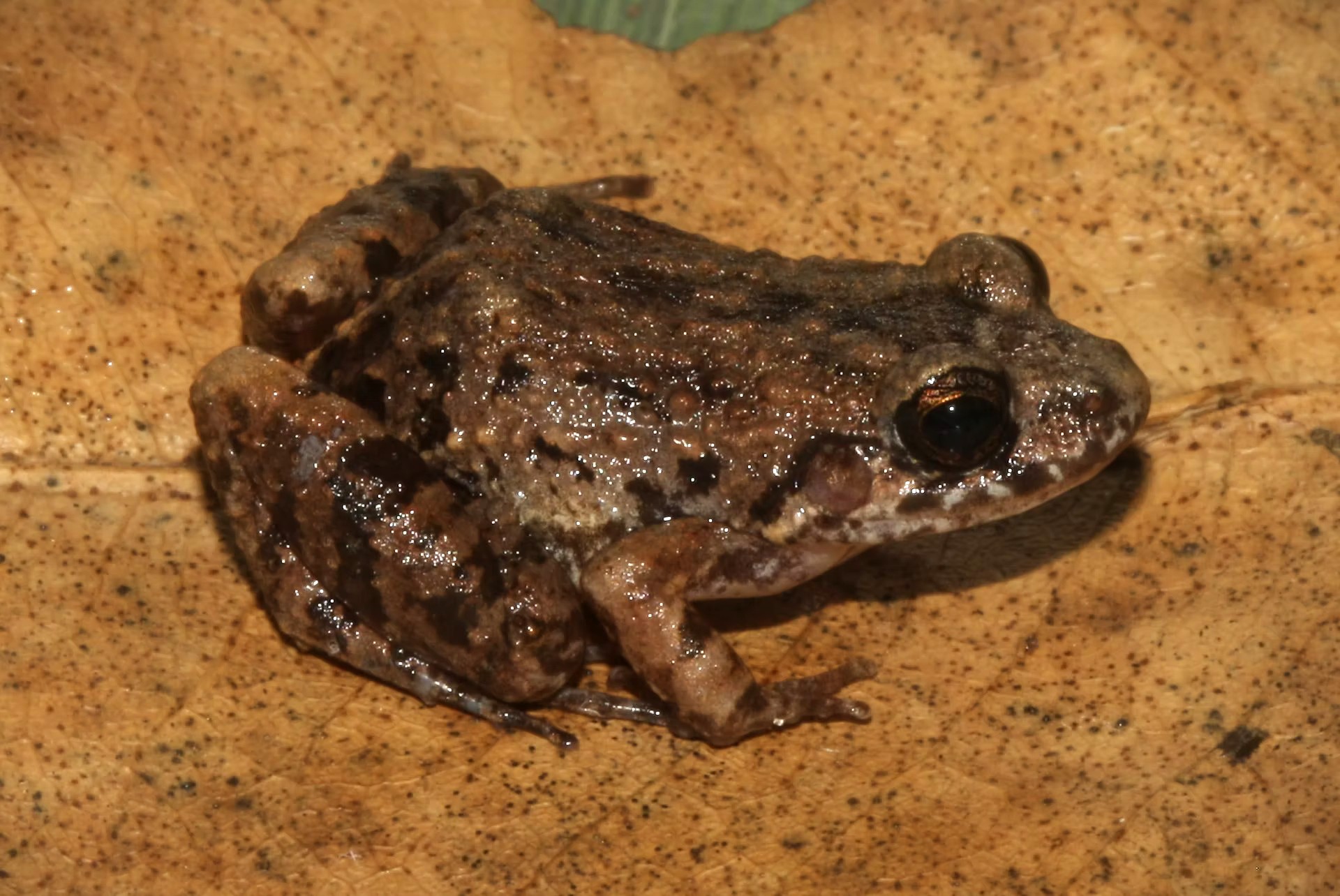
Scientists recently described a new species of a tiny brown frog found in the Amazonian floodplain forests of Ecuador and northwestern Brazil. It looks nearly identical to related species but its slow, widely spaced out call sets it apart, researchers note in a study.
“I’ve had to get into arguments because people said the frog I study is ugly,” lead author Marianna Borburema, who studied the species as an undergraduate student at the Federal University of Minas Gerais and is now a researcher at the University of São Paulo, told Mongabay by phone. “I find it absurd. The frog I study is beautiful! It is super cute.”
Despite dazzling the study’s lead author, the evolution of the frog, named Adenomera varcena, hasn’t been one focused on appearances. Biologists call this a “cryptic species”, a species whose external traits can be very similar to related species. It is roughly 22 to 24 millimeters (0.9 inches) long and has brown skin and dark blotchy patterns.
“Because of natural selection, the pressure isn’t on the frog’s appearance, it’s on the call,” said Borburema, who spent three weeks analyzing the frogs’ sounds. “We understand that evolution happens faster in their call because the song is what interests the female.”
Related species typically call frequently, some up to 70 notes a minute. However, the songs of A. varcenas include just one to five notes a minute, the slowest rate documented in the genus. Each note lasts less than a tenth of a second and lacks the pulsing rhythm found in most frogs of their genus. “It’s as if the frog is feeling lazy,” Borburema said.

Scientists identified A. varcena as one of nine genetically distinct groups within the Adenomera simonstuarti species complex. A. varcena was first flagged by Borburema’s former supervisor, co-author Thiago Carvalho, a herpetologist at the Federal University of Minas Gerais in Brazil. Carvalho and colleagues outlined potential lineages using DNA analysis in 2020, and collected more samples in the seasonally flooded forests near the upper Juruá River in Brazil in 2021.
A. varcena is the only species in the lineage to live in floodplains; all of its closest relatives live in dry land forests.
“Even though it’s a small, brown frog that doesn’t call much, it is worthy of being studied, it is worthy of being known, and more than that, it is worthy of being protected,” Borburema said. “A species can only be protected if it is known.”
Banner image: A female Adenomera varcena. Image courtesy of Borburema et al., (2026).

