


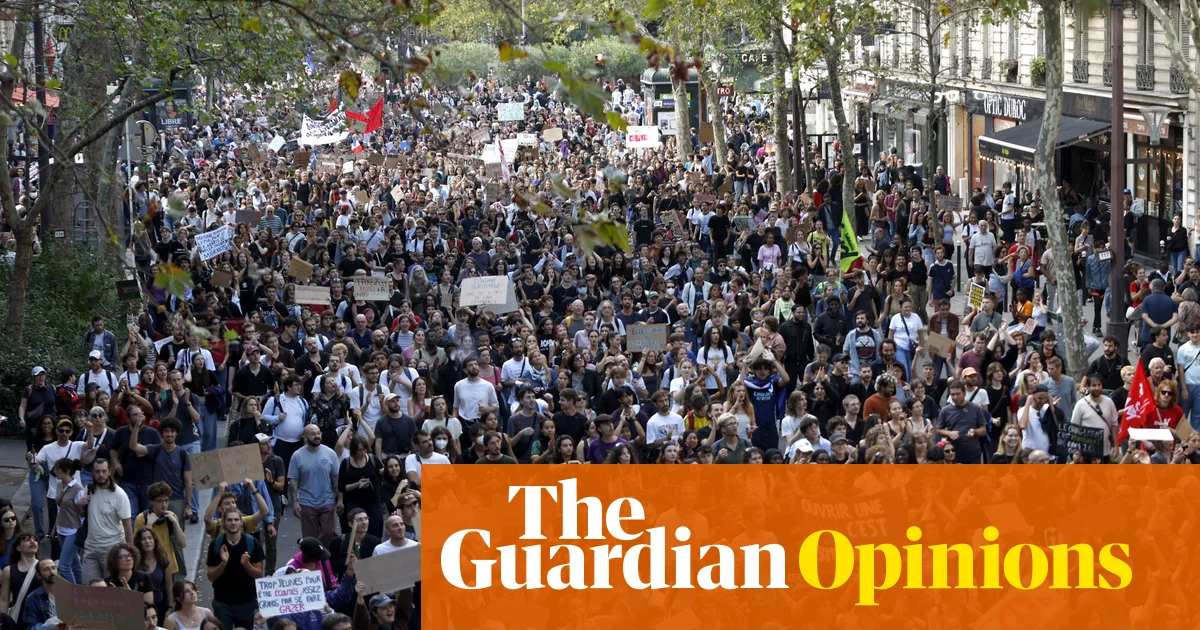
France sneezed, and Europe has again caught the cold. The wave of unrest which began with teenagers at a high school soon drew in hundreds of thousands of people nationwide and then spread across the continent. Protests have filled the streets in Lisbon and Madrid, and have ignited into violence in Milan, Brussels and Tirana as well as in French cities.
French authorities say they are deploying 70,000 officers on Saturday and are allowing only marches organised by unions. They blame hard-left militants as well as opportunistic young perpetrators for last weekend’s destruction and looting, when a minority hijacked largely peaceful protests. But with fuel prices set to rise further over the winter, the demands and participants broadening, and President Macron utterly failing to meet the moment, there is no sign of an end to the wider discontent and no speedy resolution in sight.
Europe is experiencing distinct movements, with distinct causes, demands and actors, which should not be elided. In France, crumbling and overcrowded schools were the touchpaper, with Greek protesters echoing their complaints about educational underfunding this week. In Spain and Portugal, housing is the central issue. German students are angered by the possible reintroduction of compulsory military service. But those involved see the commonalities, with some Italian demonstrators chanting in French.
Underlying all these is the breakdown of the social contract. A generation expect, with reason, to be worse off than their parents. They are understandably angry at inadequate education and job precarity, are struggling to rent places of their own well into their 20s, and are paying for pensions which they don’t believe that they will ever receive themselves, while the climate crisis haunts their futures. They see that governments worried about debt and fearful of the bond markets either cannot or will not offer them solutions. It might be more remarkable if they were happy with their lot, or confident that casting a vote at their next opportunity would fix it.
Meanwhile, increasing inequality means that they watch others grow wealthy, sometimes profiting directly from their misfortune, with flats and houses treated as financial instruments rather than homes.
This unrest also echoes the wave of gen Z protests seen around the world last year – with some of those on the streets in France, Italy and Germany even borrowing emblems used earlier from Morocco to Madagascar. The affordability crisis, heavy-handed security forces and the sense that ordinary people are being left behind while governments have no convincing answers for them were at work in those cases too.
In Europe, far-right parties, egged on by the Trump administration, are seeking to capitalise on the unrest through lies that immigrants and open borders are to blame, and that a strong hand is needed to restore order. Within the next year, four of the biggest states – Spain, France, Poland and Italy – will hold elections, threatening a radical rightwards shift that could fundamentally change the EU. Yet these parties do not have real answers to the questions raised by protesters, and a financial crisis in France might yet highlight Marine Le Pen’s economic weak spot and National Rally’s internal divisions. The future course of the continent is being shaped, for better or worse, on the streets as well as at the ballot box.
