


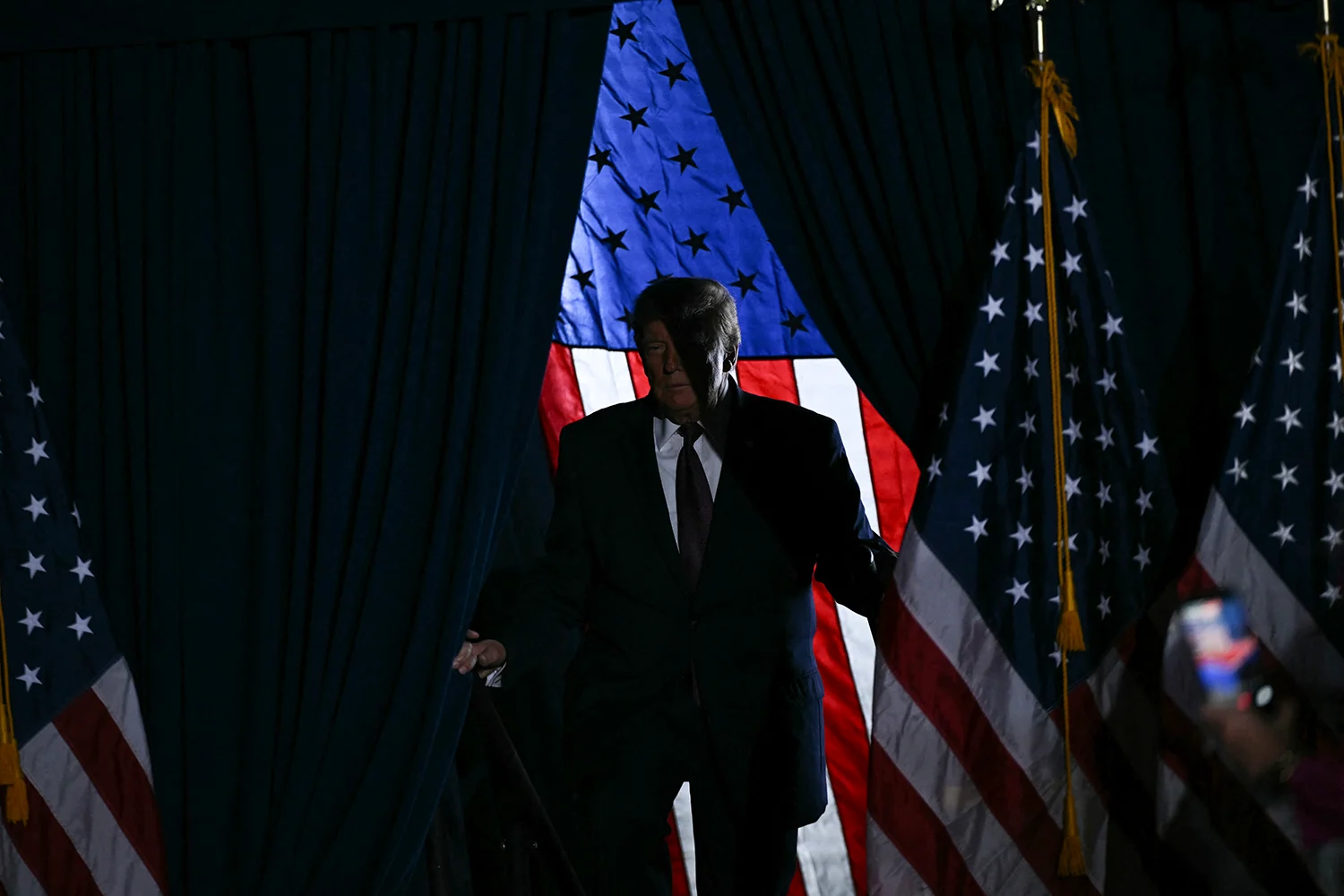
With U.S. President Donald Trump’s approval rating at record lows amid high inflation spiked by an unpopular war, many pundits view the upcoming midterm elections as the only serious emergency brake left for the nation.
But even if, as expected, Democrats win substantial victories in the House and possibly the Senate—and if Trump doesn’t follow through on his threats to call it fraud and somehow nullify the vote—the nation may still be heading into a political morass.
Rather than rallying around a common direction—other than opposition to Trump—the Democratic Party appears to lack anything like a coherent governing philosophy or compelling leadership. On the contrary, even on the verge of victory on Nov. 3, Democrats seem to be coming apart at the seams ideologically, making a party that is fractious in the best of times much more so today. It is racked by deep fissures between moderates and candidates allied with left-wing populist forces such as the Democratic Socialists of America (DSA), including major divisions over taxes, health care, and Israel.
In a bruising Senate primary race in Michigan, for example, most establishment Democrats backed Rep. Haley Stevens, a moderate. The DSA-aligned candidate, Abdul El-Sayed, a public health official who ran on a progressive platform of Medicare for All and major new taxes on the rich, barely squeaked out a win. That costly battle, along with El-Sayed’s controversial criticism of Israel, has dampened his support among centrist voters in a tightening race against former Republican Rep. Mike Rogers. The state’s former Democratic chair, Lon Johnson, even urged Michiganders not to vote for El-Sayed, saying that doing so would surrender “our party to ideological extremism.”
Democratic Senate candidate Abdul El-Sayed holds a campaign town hall event in Ionia, Michigan, on Oct. 11.Chip Somodevilla/Getty Images
“The Democrats have this incredible capacity to snatch defeat from the jaws of victory,” said Sidney Milkis, a political scientist at the University of Virginia. “I’m worried about voters’ reaction to the Democratic socialist insurgency. Michigan’s a really important race for control of the Senate. El-Sayed is a good candidate, but he has a lot of baggage.”
Many younger voters are openly dismissive of those who, in the absence of any other national figure, remain placeholders at the top of the party: Senate Minority Leader Chuck Schumer and House Minority Leader Hakeem Jeffries. (Schumer’s unfavorability ratings have soared since 2025, and Jeffries’s ratings are only slightly better.)
Much of the party’s direction depends on the size of the Democratic victory, if one occurs, especially in the House. “If it’s narrow, then Jeffries is going to be under pressure from those very far left folks, the DSA, but if it’s large, he can tell them to pound sand,” said Matt Bennett of the Third Way, a centrist Democratic think tank. “But either way, the identity of a party is forged by presidential politics not congressional. What will determine what Democrats are is the presidential primary process.”
That quadrennial beauty contest will get underway early next year. But it is difficult to identify a party savior with a centrist, electable national platform on the order of U.S. Presidents Barack Obama or Bill Clinton—or even Joe Biden.
Much of the charisma and star power grabbing headlines today comes from the far left—with new faces like New York Mayor Zohran Mamdani and others affiliated with the DSA—despite the broad mass of Democrats remaining closer to the center.
That could leave the party vulnerable to a 2028 GOP strategy of tarring Democrats as “communists” or too leftist to govern, possibly costing the election for whoever becomes the party standard-bearer. In the last week, Trump and other Republicans lost no time in painting the violent protests in France as a warning of what could happen in the United States at the hands of left-wing ideologues supporting open immigration and infected by Islamist radicalism.
“When you see burning steeples and raging fires in France, just remember that is what the radical Dumocrats want to do to America,” Trump said in Kansas on Oct. 19. (The French government said the demonstrations have more to do with high prices, especially soaring energy costs, driven up by Trump’s war in Iran.)
Still, most political experts would say there’s a long way to go to 2028. “If you’d asked me after the midterms in 1990, I wouldn’t have known Bill Clinton was coming along to save our party,” Bennett said. “Someone is going to emerge.”

U.S. Sen. Jon Ossoff walks onstage to speak during a midterm election rally in Atlanta, Georgia, United States, on Oct. 17. Erik S. Lesser/AFP via Getty Images
Leading moderate Democratic candidates are clearly vying for a national platform. Among them is Georgia Sen. Jon Ossoff, who has made his Senate race a blunt test of whether the country is willing to endure a “crook president and his crook family,” as Ossoff said at a rally on Oct. 19. “They promised to drain the swamp. Instead, it’s the most corrupt administration of all time, and everybody knows it.”
The fierce divisions within the Democratic Party suggest that even a victorious slate on Nov. 3 would likely end up, once again, defaulting to a least common denominator policy of attacking and investigating Trump.
“The problem is that the party overall enjoys such low levels of approval and trust, even among partisan Democrats themselves, and is characterized by a such a collective quality of leaderless and directionless rule … that the party has little capacity to handle internal disagreements,” said Sam Rosenfeld, a professor at Colgate University and co-author of The Hollow Parties: The Many Pasts and Disordered Present of American Party Politics.
“Democrats have spent a decade reacting to Republican provocations instead of building something worth believing in,” Sarah Longwell, a prominent anti-Trump Republican, wrote in her new book, How to Eat an Elephant: One Voter at a Time. “Ask swing voters what they want from the Democratic Party, and you’ll hear a version of this over and over: Tell us what you’re for.”
Hence next month’s midterm election is largely a battle of negative perceptions that will almost certainly be decided by which party’s reputation is less bad.
“It’s definitely true that the Democrats’ commanding position in the midterms does not reflect much in the way of underlying political strength and popularity,” Rosenfeld said.
There have been attempts to bridge the ideological gaps within the party, but none have taken hold. Few any longer tout an “abundance” agenda popularized last year by the pundit Ezra Klein or so-called supply-side progressivism. The movement to eliminate red tape preventing new infrastructure and construction has lost momentum in the face of public resistance to building data centers.
Another big question is whether Democrats will control the Senate, which remains a close-run affair. “That, to me, is really crucial,” Milkis said. “The Senate has a lot more control over the judiciary and appointments. That would make it much more difficult for Trump to appoint a new [U.S. Defense Secretary Pete] Hegseth.”
So, how will it all play out on Nov. 3?

Trump speaks at a midterm campaign rally in Dalton, Georgia, on Oct. 16. Brendan Smialowski/AFP via Getty Images
Many experts see the midterm elections as yet another “fulcrum point” for U.S. democracy. That resurrects an overused phrase popularized by Biden during the Trump era.
“This election offers a choice to voters about whether they want constitutional government or not,” said Justin Levitt, an election expert at Loyola Marymount University and former senior policy advisor for democracy and voting rights in the Biden administration.
In recent weeks, Trump’s poll numbers have been trending steadily down. A poll published on Oct. 21 by the New York Times and Siena University showed that 36 percent of likely voters approved of his performance, a new bottom for that survey, while the latest Reuters/Ipsos poll published on Oct. 19 found that Trump’s approval rating has plunged to a record low of 31 percent.
Those numbers have led some Republicans to fear a blowout like the 2006 midterms that gave Democrats both the House and Senate on the back of U.S. President George W. Bush’s deep unpopularity. As Trump has done in Iran, Bush was mired in a highly criticized and costly war of choice in Iraq, and he was dogged by various Republican political scandals and legislative defeats.
This time, a net gain of just four seats in both the House and Senate would do the trick of shifting power, erasing Republicans’ 218-214 and 53-47 majorities.
Another key question is whether Trump’s plunging numbers—if they precipitate a GOP defeat like what Bush called his “thumping” in 2006—will begin to loosen his decade-long stranglehold on the Republican Party. The president himself has set the stage for his own comeuppance by telling voters to “pretend I’m on the ballot” and relentlessly campaigning across the country. But several establishment Republicans have split from him on Iran and his trade war with Canada. They have also criticized his recent moves to accommodate Russian President Vladimir Putin by waiving sanctions on diesel imports and withdrawing support for Ukraine.
Then there’s the question of whether Trump will even accept the results. “If there’s free and fair election and kind of a transfer of power, it can send a signal to Americans and people around the world that the United States is not destined for a Jan. 6 at every contested election,” said Matthew Dallek, a political scientist at George Washington University, referring to Trump’s attempt to overturn the 2020 election results by calling on his supporters to prevent the certification of Biden’s win (which he failed to do).
“At the same time, there is no single election that can repair the damage to America’s image in the world as a defender of democracy and reliable ally or repair the lost faith of Americans in the ability of government to improve their lives,” Dallek said.
Milkis added: “Right now, I think the country is in the most danger it’s been in since the Civil War, really, given the current polarization.”
Experts are projecting several possible outcomes along a spectrum marked by cautious hopefulness at one end and utter disaster at the other.
The hopeful scenario—call it “back from the brink”—would usher in huge Democratic victories, render Trump a badly weakened and lame-duck president, and perhaps offer a glimmer of a way out of Trumpism and back to constitutionalism.
The other end of the spectrum—call it “into the abyss”—could mean that Trump manages to follow through with plans to conduct massive vote manipulation and fraud, denial of election results, possibly even an attempt to declare a national emergency and send in troops under the Insurrection Act, which permits the use of regular military domestically.
“It seems evident that there are no guardrails erected around him at all,” Bennett said. “The craziest of the crazies are talking to him. Anything is possible, and Trump has proven that, in this term, he’s willing to do basically anything. I think the odds of mischief are high.”

A bicyclist rides past the Supervisor of Elections office, which features a sculptural installation, in Palm Beach, Florida, on Oct. 19.Joe Raedle/Getty Images
But most experts think Trump will not be able to follow through on his worst threats. The courts have already denied his demands to hand over voter rolls, among other setbacks, and his SAVE America Act, which aimed to put new limits on voting, has gone nowhere in Congress. Even the conservative-dominated Supreme Court rejected his efforts to implement new mail-in voting restrictions.
“None of these methods of interference will work,” said Levitt, who has conducted a study on the issue. “The people who run elections are state and local officials, and when he screams about stuff, they’re not going to listen.”
Even if Trump tries to seize ballots, he added, it will be too late: They already will have been counted. Nor is there anything in federal or constitutional law that would allow Trump to declare martial law to prevent the vote.
“The only thing I’m actually afraid of is if we buy the narrative that we the people are not in charge,” Levitt said. “If the environment is so bad that people are scared of the threats and don’t show up at the polls. That’s possible. I don’t think it’s likely.”
