


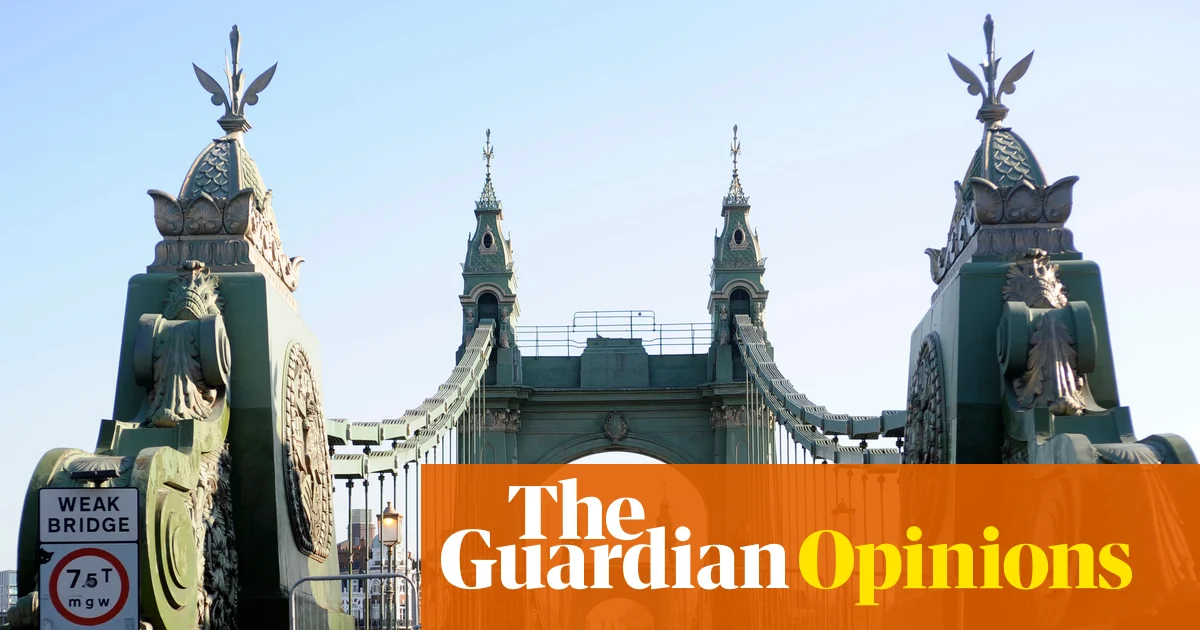
London’s Hammersmith Bridge is a metaphor for all that is wrong with British government. Closed to motor traffic and inert for seven years, it is a victim of the anarchy that seeps into every tier of public administration. The bridge sits today on a sublime bend in the Thames, guarded by what looks like Checkpoint Charlie in iron curtain Berlin. With Albert Bridge also now closed, 37,000 extra vehicles seeking to cross the river have brought south London close to perpetual gridlock. No one cares.
London may be the richest, smartest, coolest place in Britain. Yet it is run like a high street vape shop. Its buses are ever slower, homeless people are ever more prevalent, waiting times in hospitals ever longer. No one can decide if they want an HS2 terminus or a Heathrow runway. A robotic Whitehall algorithm has just declared, ludicrously, that the borough of Kensington’s “housing target” must be 5,107 homes a year, up from a previous target of 1,381.
The first thing you notice about a city is its traffic. In other cities, it moves. In London, it crawls. Its congestion is officially rated the worst of any capital in the world. Efforts to improve the sclerotic traffic lights have failed. The recent installation of computer-assisted “smart” lights – the much-vaunted road time optimisers – has contrived to cut just 27 seconds off individual bus journeys. A Guardian investigation last month timed a series of trips, and found the average speed for a No 22 bus between between Putney Common and Oxford Circus was under 6mph, or 16% slower than a decade ago.
The principal reason for this appears to be London’s epidemic of roadworks. In most cities such infrastructure is subject to intense regulation and coordination. The reason is obvious: that the disruption can restrict movement and thus impose costs on third parties. There is no regulation worthy of the word in London.
In 2017 the Economist published what became a notorious map showing roadworks in Paris and London. The first had a scatter of sparse red dots; London’s map was a sea of blood. Estimates are that vehicles in London navigate 1,300 roadworks every day, with the total for 2024 at 490,893. There is no evidence of the slightest coordination of hold-ups.
The chief reason is that a quarter century of privatising utilities has given water and cabling companies virtually unlimited freedom to dig where and when they please. Streets in the most afflicted inner boroughs now awake each morning to what looks like an overnight blitz. A mass of road closures and detour signs have turned the London street into what looks like a permanent construction site. Seeing any work being done is rare and there is no sense of anyone being in charge.
Hammersmith Bridge is a tough case. It legally belongs to the local Hammersmith and Fulham council – not Richmond on the south bank – but it has decided it “cannot absorb” the cost of restoring its decaying structure, put at £300m. It merely allows pedestrians and cyclists to cross. Yet it claims to have spent £54m on it over seven years. Merely doing next to nothing costs millions of pounds a year.
The bridge’s predicament is serious. Built by Sir Joseph Bazalgette in 1887, it was one of the world’s first iron suspension bridges – and the iron’s life has expired. Repair could only be temporary, or over the longer term astronomical. As architecture it is a noble if rather ungainly structure, compared with graceful Albert Bridge downstream. A growing body of opinion is that it would be common sense to replace it.
Designing a new bridge should be a competitive challenge. It needs to respect the buildings and natural environment of Barnes and Hammersmith on either bank. A work of style and dignity should have nothing to do with the concrete gashes of the 20th century’s London and Waterloo bridges. It needs to be very special.
As for who should take the lead, in any other city a river crossing would be the responsibility of its mayor. British mayors spend their time trying for headlines or Downing Street. London’s Sadiq Khan appears to have no view on Hammersmith Bridge, any more than he does on the capital’s roadworks, building conservation or policy on tall buildings.
after newsletter promotion
As for paying for a new bridge, there is an answer. The so-called City Bridge Foundation was formed in the middle ages to maintain London bridges and later City crossings. Its charter limits its responsibility to just five crossings: Tower, London, Southwark, Millennium, and Blackfriars bridges. However, its trustee, the City of London Corporation, could amend the charter so that it could reinvest in infrastructure. It is one of London’s richest charities – with assets in the order of £1.5bn. The foundation currently spends lavishly on causes that have nothing to do with bridges.
This needs changing. The City of London is an out-of-date relic of medieval local government. The legacy of London’s past wealth should be at the disposal of the whole metropolis. The money is there. A new Hammersmith Bridge should rise across the Thames’s most exquisite western reaches, and soon.
