


Follow ZDNET: Add us as a preferred source on Google.
ZDNET’s key takeaways
- F1 success is about a blend of digital and human skills.
- Experienced professionals must guide AI explorations.
- Human handcraft unlocks value from agentic services.
In a sport defined by small performance differentials on the track, rapid data-powered decisions by professionals off the track can often make the difference between winning and losing in Formula One — and this human expertise is even more critical in the AI age.
While many industry observers are concerned about the long-term impact of generative and agentic technologies on traditional labor markets, the experienced professional is more important than ever in auto racing.
Also: 40% of enterprises will scrap AI agents – 3 ways to ensure yours don’t fail
As IT companies release new systems and services, talented and experienced IT and engineering professionals play a crucial role by tapping into their off-track partners’ innovations to develop data-powered solutions for intractable on-track challenges.
In short, the human in auto racing remains very much at the center of the loop.
“If an idea is good, go through the process as fast as possible, and then get all the data back for the next iteration,” said Fabrizio Pilotti, CIO at Aston Martin Aramco F1, to ZDNET, explaining how his team works with its tech partners to help boost racing performance. “This is where you win, and this is what we’re focusing on.”
Also: Open weights vs. closed: An AI civil war’s afoot, and the stakes are existential
The data-enabled digital transformation that Pilotti, his team, and his technology partners are undergoing right now demonstrates to all professionals that human experiences will be worth their weight in gold in the age of AI.
Putting people first
ZDNET saw Aston Martin F1’s collaborative approach to innovation during a trip to the team’s headquarters near the Silverstone racetrack in the buildup to the recent British Grand Prix.
During a tour of the AMR Technology Campus, we saw the team’s behind-the-scenes professionals working on refining the cars, both digitally and manually.
These professionals included world-renowned aerodynamicist and Aston Martin F1’s managing technical partner, Adrian Newey, who was drawing new designs by hand in his office.
Pilotti said handcraft plays a crucial role in F1 performance. In a marginal gain business, small, tailored modifications by talented specialists like Newey can make all the difference.
Also: AI is causing cognitive fatigue. Here’s how to work with more haste and less speed
In fact, Pilotti said some new joiners to F1 are often surprised by what they discover: “They see what a team is like from the inside and they say, ‘That’s not what I thought it would be like. It involves more detailed handcraft.'”
He described IT in an F1 team as a performance-enhancing function. The role of this department is to provide strong data and digital foundations to help the people on the team make the most of their abilities.
“IT is all about giving people the right tools,” he said.
“Our work is not exactly about the performance of the car, but we are increasing the capability of the engineers to operate. And this is happening continuously via better management of faults and better management of how they understand the performance of the cars.”
Exploring agentic tech
Priority projects for the Aston Martin F1 IT department right now include refining enterprise applications and developing trackside systems.
AI agents are being applied tactically to the software development process, and the team is exploring how AI can improve optimization, including across ERP systems.
Also: Token-maxing is an AI cost sink – how to use agents without busting your budget
Pilotti said the focus is subtle, continual changes, with digital transformation focused on the requirements of the team’s experienced professionals. He explained what data-led change might look like for his F1 team in the agentic era.
“It’s where the end user uses data without any interaction with IT. That’s the end goal — being seamless,” he said. “Whatever resources they need for their rear wing design, for example, they’re immediately available exactly in the format and the density they require, without having to wait three months for new systems. The future is about modular flexibility, so that the infrastructure can adapt to the team’s data requirements.”
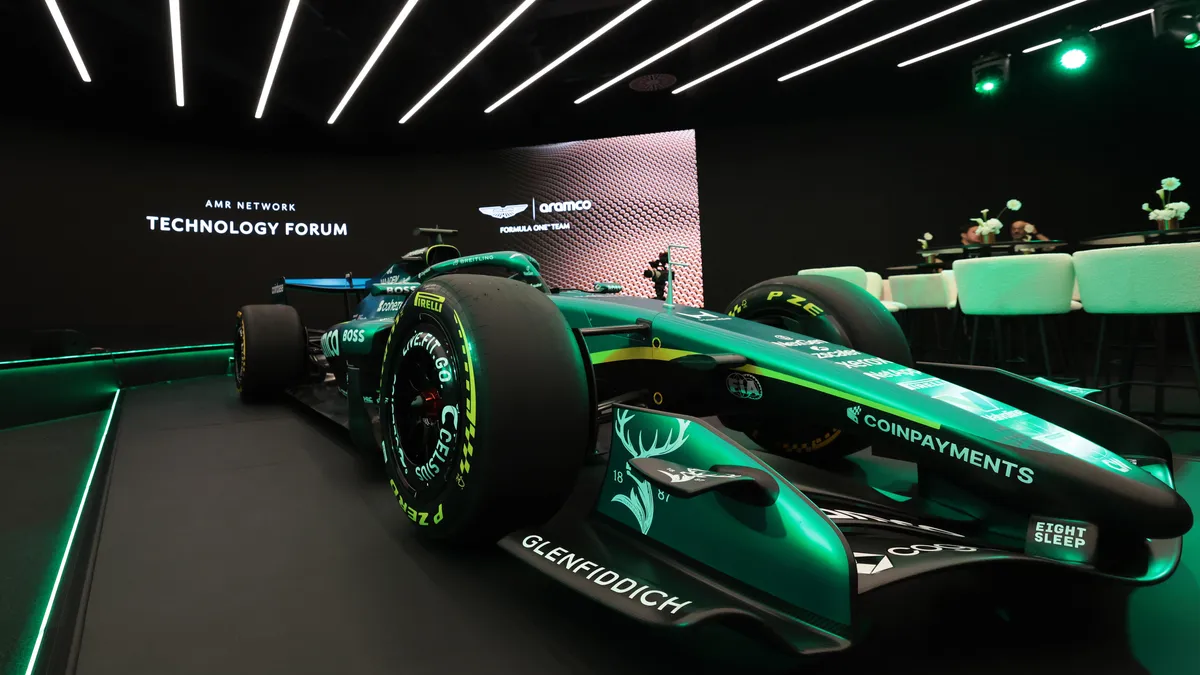
This sentiment was echoed during the Aston Martin Technology Forum, which ran alongside the tour of the facilities, where executives from the team’s partners participated in panel discussions and roundtables to discuss digital transformation in auto racing.
Also: The 3 types of people who will excel in the AI agent era, according to tech leaders
Ryan Lewis, head of UK and Northern Europe at AI specialist Cohere, explained how his company is working with Aston Martin F1 to explore how sovereign AI models and agents can draw timely insights across telemetry, diagnostics, and simulation data. He described how that process might work in a few years.
“It’s about empowerment,” he said. “We want to give people the power to automate the mundane things that are slowing them down from making executive decisions.”
Pilotti told ZDNET that technology partners like Cohere will play a crucial role in helping his professionals explore the next stage in agentic AI, where the team uses models for tailored use cases that work within the firewall and keep token usage in check.
Lewis told the forum audience how Cohere aims to implement emerging technology effectively and securely in sensitive working environments, such as F1.
“When you have data that’s tucked away,” Lewis said, “and people would never even think about putting that information into a model or a system for fear of spillage of trade secrets, that challenge can be solved by building in such a way where you can deploy the technology within the infrastructure, keeping everything together and cohesive to produce results.”
Driving value from AI
However, while technology partners form a crucial element in improving F1 racing performance, they’re far from the only component that’s critical to success.
In fact, in a time of rapid technology advances, Eric Ernst, commercial technology ambassador at Aston Martin F1, told attendees at the forum that trusted in-house expertise is even more crucial.
“With AI, we can’t outsource the experience,” he said. “The experience is still with the team, but AI gives our people the cognitive scalability to do more than they can today.”
Also: How to beat the AI algorithm and get the job of your dreams
Competitive advantages in auto racing come from a tight ecosystem of trusted partners working together to solve the issues that F1 engineers identify.
“It’s about unleashing intelligence and using every partner not to adapt to the future, but to actually architect it — taking complex challenges and providing clarity and momentum at each layer and each line of code at a time,” he said.
Ernst said this relationship is evident in how racing teams explore advances in emerging technology.
F1 organizations are longtime users of machine-learning technologies that analyze car data to identify performance signals.
Also: How Workday and other software providers plan to survive AI
The mix of generative and agentic AI provides new opportunities to work proactively and develop timely, strategic responses to challenging scenarios.
Yet even in the AI era, Ernst said it’s the human in the loop — the F1 engineer with many years of knowledge — that turns data from technological innovations into performance-generating advantages.
“The engineer is the person who’s able to say, ‘OK, I’ve got three options, and my experience tells me that’s the option we should be choosing,'” he said. “It’s that experience that’s crucial to driving value from AI.”
