


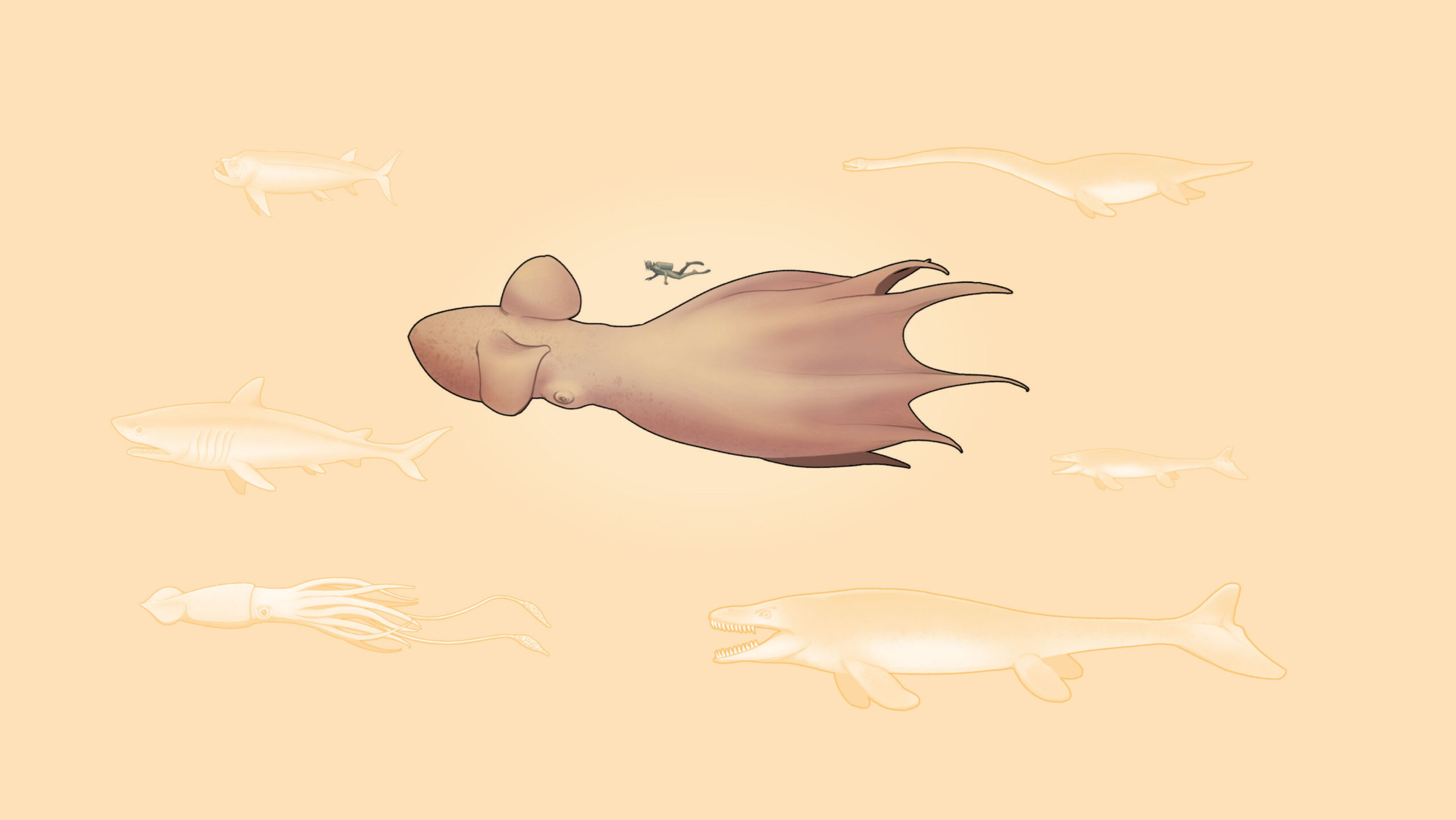
Finned octopus species alive today are all small, deep-sea animals that mostly live in pitch-black darkness thousands of meters beneath the surface of the sea. But a new discovery by a team of researchers in Japan, published in April 2026, found that the ancient octopus relatives were likely gigantic predators that roamed the late Cretaceous seas between 100 million to 72 million years ago.
Huge fossil jaws have been uncovered in Cretaceous deposits near Japan and on Vancouver Island in Canada. Though they were known to be part of the cephalopods class that includes squid, cuttlefish and octopus, not much else was known about them for years.
“It was still unclear whether they were truly octopuses, how large they were, what they ate, and what role they played in the marine ecosystem,” study co-author Yasuhiro Iba, a paleontologist at Hokkaido University in Japan, told Mongabay by email. “[We] showed that they were Cretaceous octopuses … very large and probably powerful predators that processed hard prey.”
The largest species found among the fossils belonged to the now-extinct Nanaimoteuthis haggarti. Estimates from its jaw size suggest that the octopus may have reached 6.6 to 18.6 meters (22 to 61 feet) in length. On the higher end, that’s around two-thirds the size of an adult blue whale, the largest animal to ever exist.
“That is an enormous size for an octopus,” Iba wrote. “It suggests that it may have been among the largest invertebrates ever known.”
The scientists also found evidence of wear, scratches, chips and rounded edges along the fossilized jaws, which suggests that these giant octopuses were consuming prey with hard bodies. That would place them among the upper tier of ocean predators during their time on Earth.
Their modern relatives, which include the dumbo octopus and others of the Cirrata suborder, feed primarily on slow-moving invertebrates.
According to Iba, the current fossil record is strongly biased toward animals with bones or shells, since these are much more likely to be preserved as fossils. Soft-bodied animals like octopuses aren’t as easily preserved for millennia, which Iba said could mean experts have been painting an inaccurate picture of the past.
“It changes how we think about Cretaceous marine ecosystems,” Iba said. “Until now, the upper levels of the Cretaceous marine food web have mainly been imagined as being occupied by vertebrate predators such as mosasaurs, plesiosaurs, sharks, and large fishes.”
“Our study suggests that giant octopuses also belonged to this upper predator tier,” he added.
Banner image: Graphic by Andrés Alegría using images courtesy of Hokkaido University.

