


- The Indonesian archipelago of Raja Ampat is home to some of the world’s richest marine biodiversity.
- A year ago, the Indonesian government suspended mining activities for review and later revoked the permits of four of the five nickel companies operating in Raja Ampat following a public backlash.
- According to a new Greenpeace report, Raja Ampat remains vulnerable to nickel mining, with three companies still pursuing mining rights on its largest island and state-owned PT Gag Nikel continuing to operate.
JAKARTA — Raja Ampat, one of the world’s most biodiverse marine regions, remains under pressure from Indonesia’s expanding nickel industry as three companies continue to seek permission to develop nickel projects in the archipelago, according to a new Greenpeace report.
Located in the heart of the Coral Triangle, in Indonesia’s easternmost Papua region, Raja Ampat hosts some of the planet’s richest marine biodiversity, including around 75% of the world’s known coral species, earning it the nickname “the Amazon of the Seas.”
Public concern over nickel mining in Raja Ampat erupted in 2025 after images showing forest clearing and environmental damage were shared widely on social media. A subsequent backlash prompted the Indonesian government to suspend mining operations and later revoke four of the region’s five nickel mining permits, leaving only the state-owned PT Gag Nikel mining company in operation in the region.
But Raja Ampat remains vulnerable to future mining, according to Greenpeace. Its latest report identifies three companies PT Raja Ampat Nikel Abadi (RANA), PT Waegeo Mineral Mining (WMM), and PT Eka Kurnia Baru (EKB) — pursuing projects on Waigeo Island, the archipelago’s largest island and home to endemic wildlife including Wilson’s bird-of-paradise (Cicinnurus respublica), the Waigeo brushturkey (Aepypodius bruijnii), and the Waigeo spotted cuscus (Spilocuscus papuensis).
In June 2025, Mongabay reported on WMM and EKB, as both companies filed lawsuits contesting the government’s refusal to officially recognize permits they have held for mining on Waigeo Island since 2023.
RANA is the latest company pursuing nickel mining in the area to be identified in Greenpeace’s report. Greenpeace says the company conducted consultations with local communities in 2025 as part of plans to develop a nickel project in eastern Waigeo.
The three companies, however, appear to be at different stages of the licensing process.
Greenpeace notes that WMM won a court case over the government’s refusal to register its mining permit but has yet to complete the administrative process needed to operate. EKB also prevailed in one of its legal challenges but, according to the report, has yet to obtain a production license.
Winning the administrative cases did not, by itself, authorize the resumption of mining, as companies must still obtain or complete other regulatory approvals before operating.
In its report, Greenpeace argues that while none of the three companies currently appears able to begin legally mining, they continue to pursue mining rights, indicating that interest in developing nickel projects in Raja Ampat has not disappeared. According to the report, this scenario has emerged because Indonesia has yet to adopt legal protections that would permanently prohibit mining in the archipelago.
“Although [Energy] Minister Bahlil Lahadalia announced the revocation of four out of five nickel mining permits in Raja Ampat in June last year, there is very little evidence that the Indonesian government is serious about protecting Raja Ampat from the threat of extractive industries or restoring the environment damaged by nickel mining,” Greenpeace Indonesia forest campaigner Belgis Habiba said in a press release.
Responding to Greenpeace’s report, Bahlil rejected suggestions that new mining permits were being issued in Raja Ampat.
“As I’ve said before, the only mining permit still operating in Raja Ampat belongs to the state-owned company Gag Nickel. That operation has existed since before I was born. We have revoked all the other permits,” he told reporters on Aug. 3.
Greenpeace responded that its report does not claim new mining permits have already been issued. Rather, it argues that three companies continue pursuing legal or administrative pathways to develop nickel projects in eastern Waigeo, including two that previously prevailed in court challenges against the energy ministry.
Greenpeace argues that these efforts remain possible because the energy ministry continues to classify parts of Raja Ampat as mining areas, and has yet to remove them from Indonesia’s official mining zoning.
The government’s decision not to issue a permanent protection against nickel mining for Raja Ampat is particularly questionable after the public uproar and after its designation by UNESCO as a biosphere reserve in September 2025, Greenpeace says.
“The ministry should no longer classify Raja Ampat as a mining area. Especially since Raja Ampat was designated a UNESCO Biosphere Reserve last year, adding to its existing Global Geopark status,” Greenpeace Indonesia head of forest campaigns Arie Rompas said in a press release.
UNESCO biosphere reserve
The UNESCO designation means that Raja Ampat is a flagship site of global biodiversity conservation.
Yet, all three of the proposed nickel-mining operations are located inside the buffer zone of the biosphere reserve, according to Greenpeace’s mapping analysis.
While buffer zones aren’t provided with the same strict protection of core zones, under the designation “activities compatible with conservation — such as research, education, and sustainable resource use — are encouraged.”
Before recommending the approval of the biosphere reserve in 2025, UNESCO’s scientific advisory committee also requested additional information from Indonesia on nickel mining in Raja Ampat. The committee sought details on the location of mining concessions, their environmental and social impacts, and any environmental impact assessments carried out.
Environmentalists say they hope the UNESCO designation will strengthen protection for Raja Ampat, but whether such recognition translates into better conservation outcomes remains uncertain.
A 2025 study published in Communications Earth & Environment, which examined 119 UNESCO biosphere reserves worldwide, found that only 15% outperformed surrounding areas across ecosystem functions such as water regulation and habitat connectivity.
Most showed little measurable ecological advantage, suggesting that international recognition alone does not necessarily guarantee stronger environmental protection.

Gag Nikel
Despite the international recognition, mining has not entirely disappeared from the area: There is still one active nickel-mining operation in Raja Ampat: PT Gag Nikel, a subsidiary of state-owned miner PT Aneka Tambang (Antam), which poses an environmental threat, says Greenpeace.
In June 2025, the government suspended the operation of Gag Nikel on Gag Island, a small island, following concerns over environmental damage.
But in September 2025, it lifted the suspension, allowing the company to mine again. According to the Ministry of Energy and Mineral Resources, which issued the mining permit to Gag Nikel, the company had complied with environmental requirements. The ministry reportedly cited the company’s “green” rating on the environment ministry’s annual assessment of companies’ environmental and social performance.
Following an inspection of Gag Nikel’s concession in June 2025, Bahlil, the mining minister, said his ministry had found no evidence of sedimentation or environmental failures, and suggested that images of pollution at Gag Nikel were a hoax.
In a report by Reuters, Antam said an environmental audit ordered by the environment ministry after the suspension didn’t find environmental violations and only recommended improvements to its operations.
However, the audit identified 24 issues not reflected in those public statements, according to Greenpeace’s report.
In a letter from the environment ministry to Gag Nikel dated Feb. 2, 2026, the audit found that the mine’s control of sedimentation, runoff and erosion were not optimal. It also identified ongoing risk of increased sediment loading to the coastal and marine environment, particularly during heavy rainfall.
The audit also reportedly identified risks of mine water overflowing during extreme rainfall, as well as a lack of a closed-system approach, where water is recycled and reused, toward wastewater management.
Gag Nikel also failed to apply biodiversity protection principles when mining, and there were potential hydrogeological and hydrological risks that threaten water resources on a small island, the audit found.
Those findings are broadly consistent with a 2024 study, funded by Gag Nikel itself, which found environmental and health problems linked to dust and erosion from its operations.
In the study, based on interviews with 50 island residents and workers conducted by the Sorong Marine and Fisheries Polytechnic and Gag Nikel, two-thirds of respondents said the company’s operations had polluted the environment, while 44% said the mining had harmed health.
Some respondents reported worsening coughs and flu linked to dust from the mine, while fishermen said sedimentation had driven fish farther out to sea.
“Fishermen who used to catch fish in waters around the villages are now fishing areas further away with a distance of about 2 hours,” the 2024 study said.
Besides sedimentation, marine ecosystems were also damaged by barges ferrying nickel ore to processing facilities, it added.
“Barge boats that dump anchors can drag corals on the anchor disposal area more than 20 meters [66 feet] causing the coral to be damaged,” the study said.
Following the audit, the environment ministry gave Gag Nikel three months to submit an updated environmental approval, including how it has responded to the issues raised. The ministry told Greenpeace in July 2026 that Gag Nikel had met this deadline, but how Gag Nikel has addressed the findings in the audit has not been made public.
Greenpeace also questioned why Energy Minister Bahlil Lahadalia has not publicly responded to the findings of the environment ministry’s audit, noting that he said during a June 2025 inspection that his ministry had found no evidence of environmental violations at Gag Nikel.

Supply chain
Without clear government policy banning mining in Raja Ampat, activists say the archipelago could come under increasing pressure from nickel extraction, driven by global demand for batteries in electric vehicles and renewable energy storage.
In the report, Greenpeace traced nickel supplied from Gag Nikel to an industrial park in North Maluku’s Weda Bay, one of the country’s largest nickel-processing hubs.
The industrial park is operated by PT Indonesia Weda Bay Industrial Park (IWIP), which has also established a joint venture, Youshan Nickel Indonesia, with China’s Huayou Group.
Youshan Nickel produces electric vehicle battery components in Indonesia. Huayou also supplies nickel to battery component supply chains linked to a number of electric vehicle battery manufacturers, including Toyota, Honda, Nissan, Hyundai, BMW, Mercedes, Tesla, and BYD.
It is therefore possible that the supply chains of vehicles produced by those companies are connected to nickel ore originating from Raja Ampat, according to Greenpeace. A lack of supply chain transparency makes it impossible to confirm this, however, the environmental campaign group added in its new report. Supply chain actors, including battery producers, should investigate supply chains and clearly and publicly reject the supply of nickel that originates from any mines in Raja Ampat, it said.

Call for action
Greenpeace has also called for the full protection of Raja Ampat from industrial activity and for the enforcement of existing laws intended to protect small islands and conservation areas on land and at sea.
“Areas that are important for biodiversity and Indigenous Peoples must be kept free from mining,” Greenpeace Indonesia forest campaigner Anggi Putra Prayoga said in the press release accompanying the new report.
It’s also important for the government to protect fragile ecosystems outside of Raja Ampat from mining, Greenpeace said in its report.
To do so, the government and businesses can use a Global Restricted Areas map, developed by Greenpeace International, NGOs the Rainforest Foundation Norway and Fern, and nonprofit Mighty Earth.
The map identifies areas that should be off-limits to mining because of their critical environmental, ecological, cultural, or social significance, or owing to the absence or withdrawal of the free, prior and informed consent (FPIC) of Indigenous peoples or applicable local communities.

Energy transition
In its report, Greenpeace also urged the Indonesian government to be less reliant on nickel for its energy transition policy.
The government has promoted electric vehicle manufacturing as part of a transition away from fossil fuels, helping to drive demand for nickel. But Greenpeace said most Indonesian nickel is still used to produce stainless steel, with only about 4% going into batteries.
“This means Indonesia is neither pursuing nor moving toward a just energy transition—a transition that should restore ecosystems rather than rely primarily on continued mineral extraction,” Greenpeace Indonesia climate and energy campaign manager Iqbal Damanik said.
Instead of expanding mining into biodiversity-rich areas such as Raja Ampat, Greenpeace points to a recent study it commissioned with researchers from the Institute for Sustainable Futures at the University of Technology Sydney, Australia. The study concluded that demand for newly mined nickel could be reduced through more efficient use of materials, battery technologies requiring fewer critical minerals, and greater recycling.
In the end, the future of Raja Ampat depends on the government, whether it decides that biodiversity-rich areas like Raja Ampat should be kept free from mining, Greenpeace said.

To drive this message, Greenpeace activists staged a protest at the opening of GIIAS 2026, the largest annual automotive exhibition in Indonesia, on July 30, 2026, unfurling banners that read “Protect Raja Ampat, Stop Dirty Energy”.
Responding to the protest, Industry Minister Agus Gumiwang Kartasasmita dismissed the controversy as “an old issue.”
“What’s important is that we have policies that move us towards environmentally friendly vehicles,” he said.
Citations:
Gohr, C., Von Wehrden, H., Saatchi, S., Pettorelli, N., & Ibisch, P. L. (2025). Effectiveness of the world network of biosphere reserves in maintaining forest ecosystem functions. Communications Earth & Environment, 6(1). doi:10.1038/s43247-025-02081-y
Ulat, M. A., Handayani, H., Mulya, A., Poltak, H., & Ismail, I. (2024). Analysis of the social, economic, and ecological impact of mining activities of PT. Gag Nickel on society and coral reef ecosystem in Gag Island, Raja Ampat district. Formosa Journal of Multidisciplinary Research, 3(10), 3731-3746. doi:10.55927/fjmr.v3i10.11612
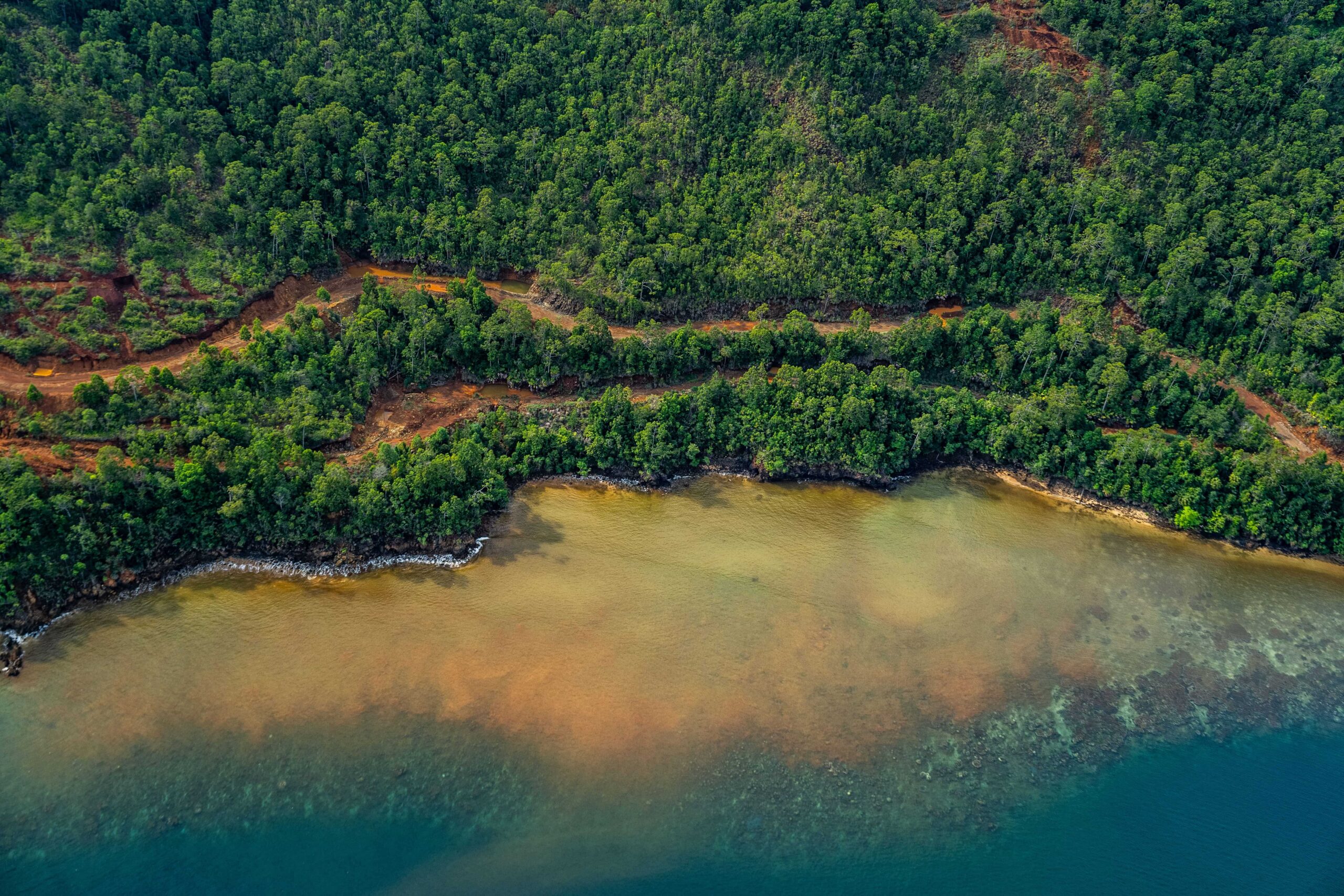
Banner image: An aerial view shows the sediment on the coastal area from tailing PT. Kawei Sejahtera Mining of nickel mining, at Kawe island, Waisilip village, West Waigeo in Raja Ampat islands, Southwest Papua Province. Image courtesy of © Jurnasyanto Sukarno / Greenpeace
FEEDBACK: Use this form to send a message to the author of this post. If you want to post a public comment, you can do that at the bottom of the page.
Cite this article
Hans Nicholas Jong (2026). Mining threat persists in Raja Ampat, Indonesia’s ‘Amazon of the Seas’. Mongabay Conservation news. DOI: https://doi.org/10.66709/news-325289

