


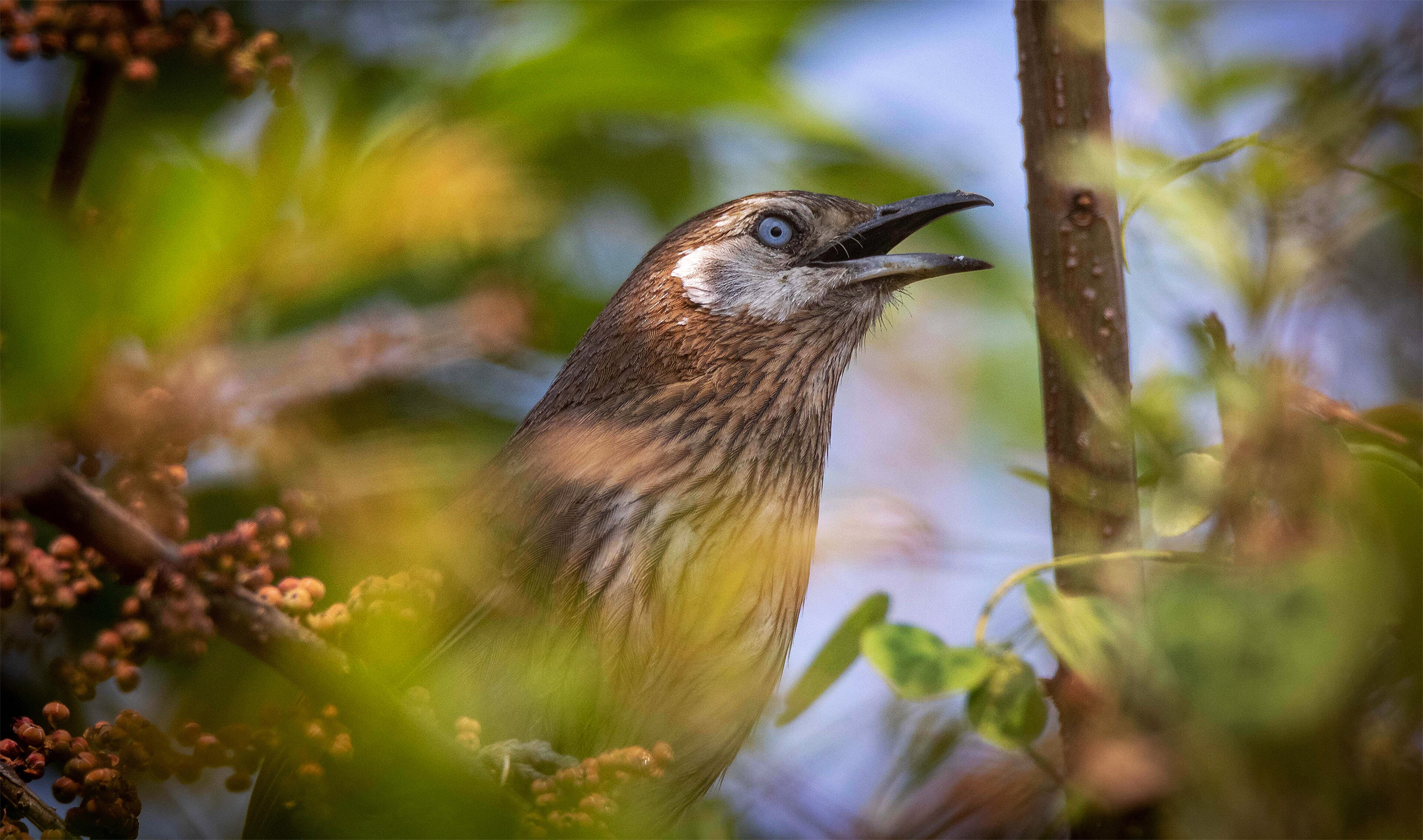
- First scientifically described in 1836, the spiny babbler has only ever been found in Nepal.
- Despite its uniqueness, the species remains poorly understood.
- The bird has typically been spotted in and around Kathmandu and Pokhara, but sightings have now been recorded in shrublands across all seven of Nepal’s provinces.
- Ornithologists have been unable to determine why the bird does not exist outside Nepal or document more information on its habitat and behavior owing to limited research and researchers are calling for more attention for the bird.
Nepal’s shrubby hillsides are home to a medium-sized bird with brownish upperparts, distinctive black streaks from the shafts of its feathers and, sometimes, a chalky white facial patch.
It’s the spiny babbler (Turdoides nipalensis), a mysterious bird, recorded only in Nepal. In June, the bird made headlines with a sighting for the first time in the forests of Madhesh province, in Nepal’s southern lowlands. With this recording, the bird has now been spotted in all of Nepal’s seven provinces.
In Kathmandu, sightings of the bird have been recorded from the fringes of Shivapuri Nagarjun National Park to the foothills of Phulchowki, as well as at various locations in and around Pokhara, usually at an elevation ranging from 915 to 2,135 meters (3,000 to 7,000 feet) above sea level depending on the season. But in June, ornithologists Hathan Chaudhary and Suraj Baral identified the bird in Madhesh for the first time, at an elevation of around 443 m (1,450 ft). This sighting means the spiny babbler has now been documented across all of Nepal’s seven provinces.
Despite its limited known habitat, the spiny babbler remains poorly understood and researchers and ornithologists are calling for greater global attention to study and protect it.
“We still don’t know a lot about the bird and have no scientific data to back its population, movements, exact breeding season/months and the effects of increasing human settlements,” said Kamal Raj Gosai, who heads the department of environmental science at Kathmandu’s Tri-Chandra Multiple Campus. Gosai is researching the distribution of spiny babbler and the impacts of land use and climate change on the species. “There’s more focus on vulnerable and endangered species and megafauna, and little concern and limited research on this endemic species, both nationally and globally,” he added.
British naturalist Brian Houghton Hodgson first scientifically described the spiny babbler, kade bhyakur in Nepali, in 1836 while living in Kathmandu. His encounter with the one-of-a-kind bird remained a one-off for more than a century, until the 1940s, when Desiree Proud, the wife of a British diplomat, spotted them in her Kathmandu garden and American ornithologist Sidney Dillon Ripley sighted the species in far-western Nepal, confirming its existence.
Today, an increasing number of birdwatchers and bird enthusiasts have been instrumental in recording sightings, providing vital information about the elusive species. More than 1,200 sightings have been recorded in online bird observation database eBird, with most concentrated around eastern, western and central regions, including Kathmandu and Pokhara.
Raksha Thakuri, author of a 2024 paper on the spiny babbler habitat in Lwang Ghalel village, located in the foothills of the Annapurna mountain range, said the region is home to an estimated 129 individuals but the species’ national population remains unknown.
The study found that the spiny babbler prefers scrubland and shrub land area. The distance to water bodies and roads, and the presence or absence of grazing cattle significantly influence the likelihood of a sighting. The birds also prefer nesting on slopes and steeper terrain is associated with a higher probability of their occurrence, said Thakuri.
However, an increase in human activities in these areas and a changing climate are altering these habitats, said Thakuri, who has been studying the spiny babbler since 2019.
“When I visited the same locations during a two-year interval, I didn’t spot the birds where I had spotted them earlier,” she said. “There were more roads being constructed and also landslides, which had affected the shrublands.”

Urban expansion has increased pressure on Nepal’s shrublands, prime habitats for spiny babblers. A 2020 study showed that the already scarce shrublands in Kathmandu had virtually disappeared between 1990 and 2010, with researchers warning that it could alter the region’s ecological diversity.
According to Gosai, there is a perception that scrublands and shrublands are wastelands with communities emphasizing expanding forests for their perceived benefits and converting scrublands and shrublands to agricultural lands. This could have long-lasting consequences for many bird species, particularly the spiny babbler, he said.
“The habitat loss will be more specific to the spiny babbler,” he said. “Other birds have a wider habitat range, but spiny babblers tend to have a shorter flight range and usually move from one patch to another nearby patch of scrublands. So, we should be more sensitive about this endemic bird and habitat loss due to scrubland and shrubland loss.”
Thakuri said she agrees that Nepal lacks proper shrubland management practices and that this resulted in the uncontrollable expansion of invasive species in those habitats. At her research site, however, Crofton weed (Ageratina adenophora), known locally as kalo banmara, which is a fast-spreading invasive plant species in Nepal, has helped the spiny babbler habitat owing to its dense bushy nature.
Carol Inskipp, a veteran bird expert, said she first saw the spiny babbler in Pokhara during her first Nepal visit in 1977. She told Mongabay conservationists now know much more about the species’ distribution in Nepal, but information on its habitat and behavior is still reliant on Hodgson’s observations. All these years later, ornithologists have been unable to determine why the bird does not exist outside of Nepal despite similar habitats occurring elsewhere.
“Why spiny only occurs in Nepal and nowhere else is still a mystery,” said Inskipp, who is co-author of the 1985 book, A Guide to the Birds of Nepal. “Spiny babbler is a skulking and secretive species outside the breeding season. It is not only difficult to see outside the breeding season, but its behavior is also very difficult to observe. There is much we do not know about the bird — some details of its breeding, young birds and incubation period, parental care and nest site. We do not know why it is common in some areas and not in others.”
But some bird researchers such as Inskipp say they believe changes in its habitats, along with threats such as forest fires, is pushing the spiny babbler to new territories both in the country and in neighboring India. This move has not yet been reported.

Despite its endemic nature, the spiny babbler is listed as a species of least concern in the IUCN’s Red List of Threatened Species, as its population trend remains stable.
“IUCN red list criteria are based on the status of species,” Narendra Man Babu Pradhan, IUCN’s Nepal representative, told Mongabay. We do not have any information on how many spiny babblers are around Nepal. In my view, the least concern may be the reports that we often see in nature. However, we need to conduct a comprehensive study and determine the actual status.”
Bird researchers said this has further limited the species’ understanding, with Thakuri adding that she even struggled to gather enough literature for her research. Policymakers have yet to prioritize the bird or advocate for its conservation, she said.
Meanwhile, Gosai said he believes there are still misconceptions associated with the bird, as many locals and birdwatchers confuse it with the rusty-cheeked scimitar-babbler (Erythrogenys erythrogenys). Both conservationists and policymakers must do more to upgrade the spiny babbler’s status globally in the IUCN Red list, he said.
“To see an endemic bird as a least concerned species is worrying,” Gosai said. “This means we are lacking in our lobbying and advocacy for the protection of the species. So, the Nepal government must take it seriously. We need to start thinking of how to get the world’s attention on this bird. It’s not just about conservation but will also help promote Nepal and generate revenue through Spiny Babbler (birdwatching) tourism.”
Banner image:A spiny babbler (Turdoides nipalensis). Image by Aditya Pal via Wikimedia Commons (CC BY-SA 4.0).
Nepal’s birdwatchers help monitor wildlife and promote tourism
Bird diversity drops in human-dominated habitats, Nepal study suggests
Citations:
Thakuri, R., Neupane, B., Ghimire, S., Khatri, N., Ghimire, P., & Poudel, M. (2024). Status and habitat occupancy of Nepal’s only endemic bird spiny babbler Turdoides nipalensis in Lwang Ghalel village of mid-hills of Nepal. doi:10.22541/au.172503914.46053113/v1
Wang, S. W., Gebru, B. M., Lamchin, M., Kayastha, R. B., & Lee, W. (2020). Land use and land cover change detection and prediction in the Kathmandu district of Nepal using remote sensing and GIS. Sustainability, 12(9), 3925. doi:10.3390/su12093925

