


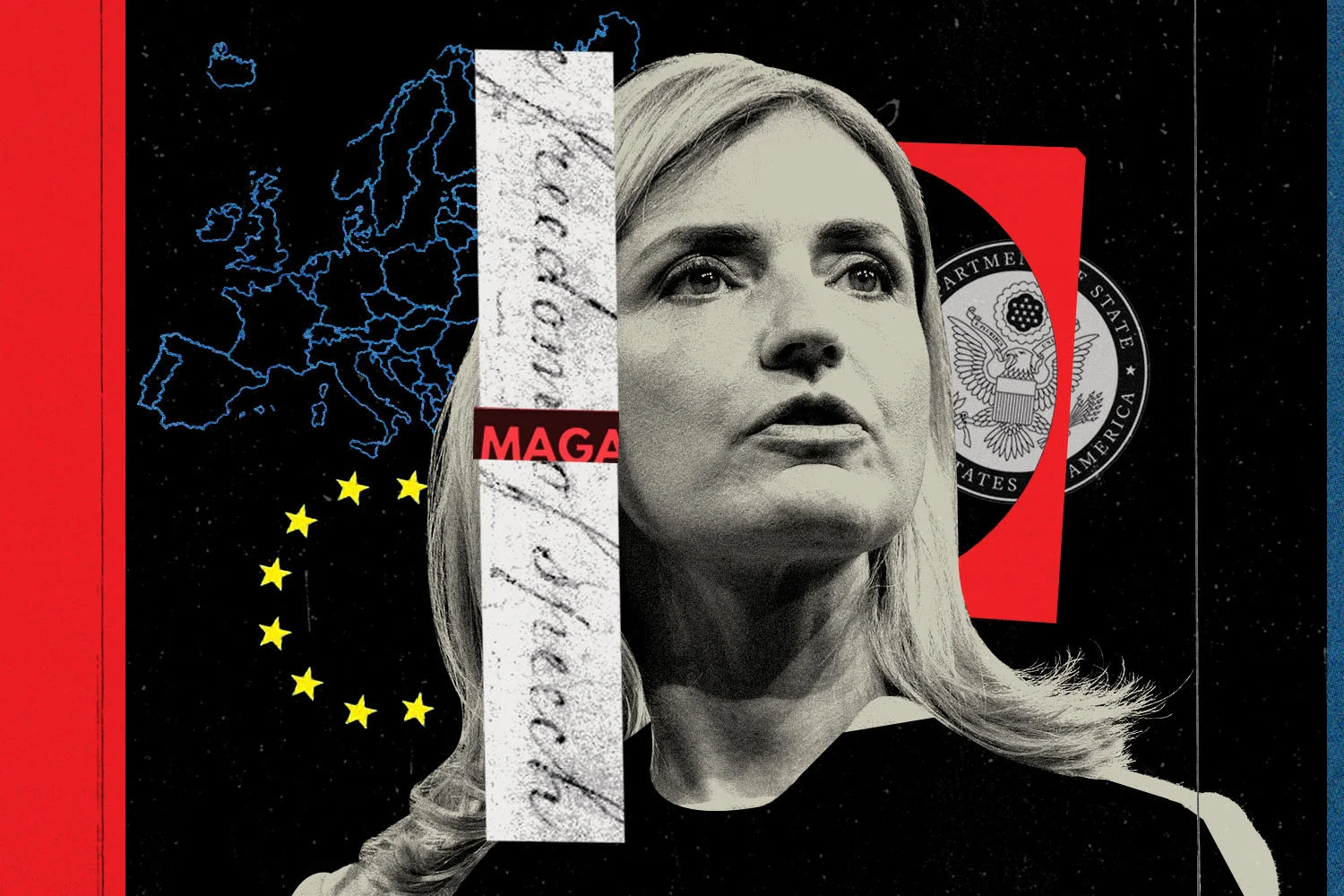
Sarah Rogers, who leads the U.S. State Department’s public diplomacy section, loves to be undiplomatic.
The Biden administration State Department had sought to create maps that were “more gay,” the former elite trial lawyer and free speech activist told Rep. Brian Mast during a congressional hearing in March that covered diversity, equity, and inclusion efforts.
A “civilizational death drive stalks Europe,” she tweeted in December.
In January, she wrote that the perpetrators of 2015 sex attacks in Cologne were “barbarian rapist hordes,” in a deliberately provocative statement she said was aimed at pushing back on how German law regulates similar types of speech.
Rogers, who speaks in full, sharp sentences, is not the sort of person you relax around. She’s the sort of person who, when her acquaintances hear that you interviewed her, ask if “she was nice to you.” The sort of person who once mused about creating fake website profiles so that she could fight anyone who might troll her wedding announcement.
And thanks to her relentlessly provocative online presence, she has achieved a degree of fame rarely if ever earned by her predecessors. Her primary target: America’s Western European allies.
It’s a focus that puts her at the center of a sweeping Trump administration policy to remake Europe in MAGA’s image. U.S. Vice President J.D. Vance first articulated the push at the 2025 Munich Security Conference, where he shocked European leaders by painting a picture of a continent suffering from mass migration, restricted free speech—and a drift into authoritarianism. The White House expanded on his ideas in the 2025 National Security Strategy, which spoke of “cultivating resistance to Europe’s current trajectory.”
But Rogers is the campaign’s most enduring face and, arguably, one of its best chances for success. In her position as undersecretary for public diplomacy, she controls a budget of around a billion dollars a year aimed at winning over foreign citizens via advertising campaigns, scholarships, and more.
She now stands to also become the CEO of the U.S. Agency for Global Media (USAGM), the parent organization for U.S. government media outlets abroad, including Voice of America, which reaches hundreds of millions of people.
And behind Rogers’s online persona is a mind that is perhaps more careful than her mail-fisted approach online suggests.
“She’s very deliberative,” said Noah Peters, who previously worked with Rogers on freedom-of-speech legal cases and served in the current Trump administration. “She wants to build change that lasts.”
Sarah B. Rogers, undersecretary of state for public diplomacy and public affairs, speaks at the U.S. State Department in Washington, D.C., on June 11, as Ike Lawrence Epstein and Dana White of the Ultimate Fighting Championship and U.S. Secretary of State Marco Rubio listen. The event marked a new partnership promoting sports diplomacy initiatives ahead of a UFC match at the White House. Chip Somodevilla/Getty Images
Besides a short internship at the State Department in college, Rogers has never worked in foreign policy before. She also, unlike many of her predecessors, has never worked professionally in journalism or communications.
Instead, Rogers’s route to her current role is a result of her work as a lawyer—and a confluence of her free speech activism and MAGA politics.
Rogers, a New Jersey native, graduated from Dartmouth in 2005 and Columbia Law School in 2008. Her dream as a teenager was to be a novelist, she told me during an interview this July, but she settled on law. She later worked as in-house counsel for tobacco giant Philip Morris before landing at the Brewer law firm, where she was part of a team that won a landmark case defending the National Rifle Association (NRA) before the Supreme Court.
Shifting from the fast-paced world of blue chip Manhattan law to the slow-moving machinery of government has come with a learning curve, Rogers told me during lunch at Ned’s, a members-only club popular with the MAGA set near the White House.
“When you say jump, the [law] associates are already vying for how high,” Rogers said. “That’s not how bureaucracy works.”
Those who worked with her in that time routinely describe her as intelligent, articulate, and driven—a lawyer to be feared. “We let her kind of be the tank with us crouched behind,” said Will Fleming, a lawyer who partnered with Rogers on the NRA case.
She also had a flair for the way a dramatic story can serve a larger goal, and a willingness to push emotional buttons. In one trial related to the NRA case, she painted a picture of a nighttime attack on her that she implied reframed her thinking about guns.
“Before working on this case, I didn’t really agree with the NRA on the Second Amendment. Then one night walking home I was attacked by two men in the dark. And it didn’t matter that I had taken a kick-boxing class at the gym,” Rogers said, against the protest of an opposing lawyer, according to a court transcript.
But Rogers was not just a highly paid lawyer. She was also a budding free speech activist.
Rogers, a self-described older millennial (she is 43), came of age just as the internet was developing into a platform for the creation and dissemination of mass culture. One of the emblematic features of that era was the flowering of message boards. She participated in one such forum in law school that she described to Semafor as “4chan for lawyers.”
She found some of the board’s anonymous content objectionable—but also wasn’t happy to see it attract lawsuits aimed at unmasking posters, which, according to Rogers, followed scrutiny over people posting pictures of women, including herself.
“Even the practice of posting pictures of yourself on the internet, I didn’t really like, but what I disliked a lot more was the prospect of having my IP address subpoenaed and having my life destroyed,” she said.
In the 2010s, social media companies started to get more serious about self-regulating content, a move that Rogers felt challenged the bedrock of U.S. democracy. “That was when my informal free speech activism began,” she told me. “You don’t want to just disrupt institutions for no reason, but sometimes institutions are wrong and need to be disrupted.”
Fighting for the cause of digital speech linked Rogers to the political right, where conservatives argued that social media companies were unfairly targeting them. She eventually legally represented or assisted a number of high-profile, far-right figures in freedom-of-speech cases, including Trump-supporting playwright David Mamet, far-right activist Douglass Mackey, and Charlie Kirk—the founder of conservative group Turning Point USA and staunch Vance ally who was assassinated in 2025.
“I’m a genuine ideologue on these issues,” she later told the DisInformation Chronicle, a blog.
Free speech is “tremendously important” to Rogers, said Jo-Ellan Dimitrius, a trial consultant who has worked with Rogers.
Gradually, the right won the argument. In 2022, Elon Musk, the billionaire founder of SpaceX and later ally of President Donald Trump, bought Twitter, a move he framed as a blow against the enemies of free speech. In 2023, YouTube unbanned Trump, and in 2024, Facebook lifted some restrictions on Trump’s account. Tech CEOs, once Trump’s adversaries, now courted him.
With the battle won at home, the administration began looking abroad—specifically to Europe. In 2024, the European Union began enforcing the Digital Services Act, a sweeping law that requires social media companies to regulate hate speech and other forms of content. U.S. tech companies—and Trump officials—vigorously oppose it.
That’s where Rogers came in. Following the 2024 election, the Trump administration leaned on Kirk to help identify candidates for positions across the government. Kirk, in turn, turned to his circle, asking people like Rogers’s friend Blake Neff, then working for Kirk, for recommendations.
“Sarah was one of the first two [people] that I sent a resume for,” Neff later recounted in a podcast.

Details from Rogers’s office at the State Department include (clockwise from top left) framed sketches of polo horses; portraits of J.D. Vance, Donald Trump, and Marco Rubio; a Caravaggio exhibition catalogue; and a figurine of Trump.Dermot Tatlow photos
Rogers’s star at the State Department, where she started in October 2025, was launched in December of that year by a blistering attack against the EU bureaucrats that the Trump administration accused of repressing free speech. In a video posted to her X account, she railed from a Brussels hotel room against what she termed the “European censorship bureaucracy.” The video garnered over 7 million views—and opened Rogers’s eyes to the powers of her new platform.
“That video procured more immediate responses and more reputational currency than any paper I could have pushed, no matter how meticulous, no matter how lawyerly,” she told me.
Her X account became a constant stream of activity, garnering hundreds of thousands of views per post, often criticizing Britain and Germany over free speech and other issues.
At times, she uses mockery to make her point: “[P]athetic censorship flailing by foreign bureaucrats directed at American speech, on American platforms, protected by America’s First Amendment gets you sanctioned. Sorry you can’t control the conversation anymore,” she wrote to an account representing the French government in June, referring to European regulations on online speech.
“She’s funny—I think we both appreciate a kind of slightly acidic form of humor,” Neff told me.
Many of the reactions to her posts are negative, with her “barbarian rapist hordes” comment earning criticism from prominent left-wing commentator Hasan Piker and journalist Chris Hayes. But according to one person familiar with her work, who spoke on condition of anonymity, Rogers’s aides measured success by the amount of engagement—good or bad—that her posts got on X.
Rogers has also scored at least one own goal. In August, she sought to release information to a prominent conservative influencer about a disbanded State Department counter-disinformation office, which the Trump administration had accused of censoring Americans. The influencer, Jennica Pounds, mistakenly believed the release to be a trap and posted screenshots of her communications with Rogers, in a public relations blunder.
In addition, Rogers has stayed in the public’s eye through many appearances on panels, speeches, and interviews, where her critical statements have sometimes prompted pushback from foreign officials.
In June, Rogers spoke at an event in Britain where she commented on arrests over online speech, an issue that has prompted criticism from both left- and right-wing groups.
“Some people look at Britain’s thousands of speech arrests per year and see only tyranny,” she said—prompting an official rejection from the U.K. government: “Our world-renowned justice system operates without fear or favour to protect all our citizens.”
It’s hard to know exactly what the Trump White House, a famously fractious organization, may think of all this. Rogers sought and did not ultimately get a larger role at a Melania Trump-organized summit focused on technology and children, two people familiar with the event told me, speaking on condition of anonymity to avoid professional repercussions. It is unclear why she was rebuffed.
A Politico profile of Rogers claimed that her focus on free speech “has frustrated some,” because it was a distraction from higher priorities, like trade or security, according to a single White House source.
Nevertheless, Rogers’s media blitz won her important supporters. Rogers is “totally committed to free speech,” said Deputy Secretary of State Chris Landau, the no. 2 official at the department. In March, the Trump administration made its biggest pledge of support by nominating her to lead USAGM, taking over from the embattled Kari Lake. It’s also gained her some international clout, with her office recently on the list of high-level visits made by one group of visiting European lawmakers, alongside more powerful officials like the Pentagon’s Elbridge Colby.
But behind the bomb-throwing online persona, there were also signs that Rogers, who built her legal career on long, drawn-out cases like the NRA litigation, was a much more careful political player.
Inside the building, Rogers was doing the normal work expected of a top public diplomacy official, said a State Department official familiar with her work, speaking on condition of anonymity as they were not permitted to speak publicly. “There is more continuity with past chiefs than you would expect,” they said.
As undersecretary of public diplomacy, Rogers oversees public messaging and educational exchanges, the public diplomacy work of over a hundred embassies, and leads interagency messaging collaboration between the State Department and others, and, on occasion, represents the United States’ public diplomacy office at key events abroad—as Rogers did when she visited the U.S. pavilion at the Venice Biennale. In practice, her meetings might extend from counter-China messaging from embassies in Asia to the U.S. government strategy on cultural heritage protection.
In our own meeting, I had expected Rogers to be combative. Instead, she often appeared circumspect and cautious about the risks and benefits of any action taken. Despite her own reputation for being “based”—that is, provocatively bold—she told me she dislikes the desire among some conservatives to be performatively shocking. “I think anti-woke can be cringe sometimes,” she said.
At times, Rogers even seemed hesitant about the role of public attack dog that she’s known for. “Advocacy as a public figure presents different issues than in a courtroom or a negotiation,” Rogers said. “A government official’s tweet can be read by everyone, everywhere, across time. So calibrating a voice for all seasons has been a new challenge.”
Alongside the media storm, she appeared to be making serious moves within the building to use her power practically. Within her first week at the State Department, she met with the small Digital Freedom office, two people familiar with her work said. The office, which was formerly part of the State Department’s Bureau of Cyberspace, works on resisting “authoritarian practices in cyberspace.”
Over the next months, Rogers announced or participated in a slew of new projects focused on internet freedom and free speech, including plans to work with Turning Point USA to “implement multiple international programs dealing with topics like free speech,” a pledge to fund free speech causes in “Western-allied democracies,” and the planned launch of a website—Freedom.gov—to give people in Europe and elsewhere access to content banned by their governments.
Rogers also announced travel bans against Europeans that the State Department accused of censoring Americans, and appeared to suggest that European officials might be next: “None of those sanctioned is a current UK or EU official—however, we know that foreign government officials are actively targeting the United States,” she wrote.
Rogers’s activity sparked a wave of media concern, particularly in Europe. In February, the Financial Times reported that Rogers would operate a “slush fund” in support of right-wing causes, citing an interview with an unnamed British political figure. Rogers later denied the charge. In March, the Guardian reported on a missive reportedly drafted by Rogers’s office that focused on her instructions to embassies to coordinate with military psychological operations units when planning messaging strategies.
Coordinating with the military was “not because I wanted to overthrow some foreign government,” Rogers told me. “Interagency coordination is needed,” she said, citing cases of poorly planned messaging efforts like an instance in which the U.S. military accidentally insulted Muslims by printing the Islamic declaration of faith on soccer balls.

Rogers poses with a framed copy of the U.S. Declaration of Independence in one of the State Department’s diplomatic reception rooms in Washington on Feb. 2. Dermot Tatlow photo
However, more than 10 months into her tenure, Rogers’s office has yet to follow through on much of substance that would give Europeans cause for concern.
It introduced a $500,000 grant meant to fund activities in Britain that educate the public on legal principles, including freedom of speech, as well as a $1 million program that focuses on free speech but does not explicitly call out Europe.
Otherwise, many plans are still in the works. Freedom.gov is still devoid of content. The site is a “very, very long way off,” said two congressional aides familiar with the site, speaking on condition of anonymity. Turning Point USA has not yet announced any programs with the State Department, which two people with knowledge of the discussion said was due to Turning Point, rather than the State Department. Turning Point USA did not respond to a request for comment. The State Department also did not respond to a request for comment.
Perhaps the biggest event so far has been a July gathering of tech leaders, including Musk, in San Francisco to discuss “digital freedom.” In a separate announcement, Rogers announced a plan to bring private-sector employees in to advise the State Department on internet freedom issues.
One easy explanation is that, for all of Rogers’s grand plans, the public diplomacy job isn’t an ideal vehicle for influencing Europe. “There’s a gap between what she wants to be doing in the role and what’s possible to do in the role,” said one congressional staffer.
Of the average $700 million yearly budget for education exchanges, the largest bucket of funding, almost half is wrapped up in the Fulbright exchange program, which has strong congressional support. The average of over $400 million in public diplomacy grants, meanwhile, is typically split across the globe, meaning that concentrating it on Europe could raise concerns for Congress and ambassadors at other U.S. embassies.
The department has even had trouble accessing the money it is already owed, with the White House Office of Management and Budget (OMB) reportedly blocking some $100 million in education awards for fiscal year 2025. OMB has also held up some public diplomacy funds, said the State Department official familiar with Rogers’s work, who said that Rogers had worked to regain access to the funds.
Still, those hurdles are not necessarily insurmountable—many in the Trump administration have attempted to push forward policies that raise objections from Congress and other government bodies. In one of the more recent examples, the Justice Department in May raised the ire of some in Congress by announcing a nearly $2 billion fund to compensate alleged victims of “lawfare,” some of which could go to Jan. 6 rioters. Jeremy Lewin, the State Department’s top human rights official, has clashed with members of Congress and reportedly with OMB over how the State Department spends money.
But the lack of progress may also reflect Rogers’s lawyerly caution.
“She’s frustrated by the pace, but she’s not like some senior Trump appointees—she’s not going to dismantle the system,” said the State Department official familiar with her work. Rogers “is very careful and really thinks things through,” said Peters, the lawyer who worked with her at the Brewer law firm.
Rogers herself told me she prefers to work within established processes. “I’d rather not get sued if I can avoid it,” Rogers said. “Sometimes that means having to wait three months to spend $300,000—there’s some [opportunity] cost to it, but it’s just not significant,” she said.
Rogers doesn’t have to look far for what a more risk-taking approach would look like—as well as its downsides. Sam Samson, a 27-year-old official in the State Department’s democracy promotion office, was initially the government’s most prominent attack dog against Europe. In a May 2025 essay published on the State Department’s Substack, Samson rehashed Vance’s assertions that Europe was in a civilizational decline. “The global liberal project … is trampling democracy, and Western heritage along with it, in the name of a decadent governing class afraid of its own people,” he wrote.
But Samson’s plans to remake Europe have seen mixed results. In July, his office briefed Congress on a number of grants it was mulling. Some of the grants were unusual for their size, the fact that they would be awarded without competition, and would target wealthy countries that do not normally receive assistance. Samson’s office has also announced a number of more typically structured grants in the low millions of dollars that promote MAGA objectives in Europe.
After scrutiny from Democratic lawmakers, according to ProPublica, the State Department decided to axe at least one of the grants, a $7 million disbursal to British think tank 878, a recently created group co-founded by Jacob Rees-Mogg, a former prominent Conservative British politician. It’s unclear whether other mooted grants will go forward.

Rogers testifies during a Senate Committee on Foreign Relations hearing to examine pending presidential nominations in Washington on July 30.Samuel Corum/Sipa USA via AP Images
Rogers’s caution may serve as a guide for what sort of manager she may be at USAGM.
For liberal Europeans, U.S. Democrats, and perhaps some U.S. Republicans, the nightmare scenario would likely be that she would use Voice of America and other outlets to “cultivate resistance” within Europe, as the National Security Strategy put it. In November 2025, Lake, the former USAGM head, did exactly that when she said she was canceling Radio Liberty’s Hungary service because it allegedly opposed then-Prime Minister Viktor Orban, a close Trump ally.
Rogers, speaking with me, defended the Hungary decision on the basis that it was a poor use of money in a media environment that doesn’t suffer the same restrictions as places like China or Cuba.
By that same token, she told me, she had no plans to open up media outlets in places like Germany or Great Britain. “The fact that my tweets are able to cause controversy in Germany means that we don’t need shortwave radio to transmit American foreign-policy perspectives to Germany.”
Rogers, in her confirmation hearing on July 30, likewise gave no sign that she would use USAGM as a political cudgel. In her statement to Congress, she offered a technocratic agenda: “[M]y first priority will be to stabilize the agency, strengthen its leadership, modernize its operations, and restore research capacity.”
In her testimony, she said she signaled that she would bring back some staff, potentially reversing cuts made by her predecessor. Asked if USAGM would pull funding from outlets if their reporting was critical of Trump allies, Rogers, in an answer befitting her past career as a lawyer, referred back to the 1994 law that established the agency’s mandate: “I don’t think that’s what the statute envisions.”
Rogers’s work in public diplomacy and stance on USAGM suggest that, ultimately, her focus on Europe may amount to much less than her critics feared. For the foreseeable future, at least, tens of millions of dollars are unlikely to flood Europe in favor of MAGA causes, nor will U.S. government-funded right-wing propaganda outlets pop up in countries like the United Kingdom or Germany.
Instead, the clearest impact of Rogers’s targeting of Europe may be the way she uses it to garner attention, develop her voice, and perhaps build capital for a future administration under a President Vance or President Marco Rubio.
“If she wants to stay in politics, she can do very well,” said Neff, the Turning Point USA producer. “Any group would be glad to have her help.”
