


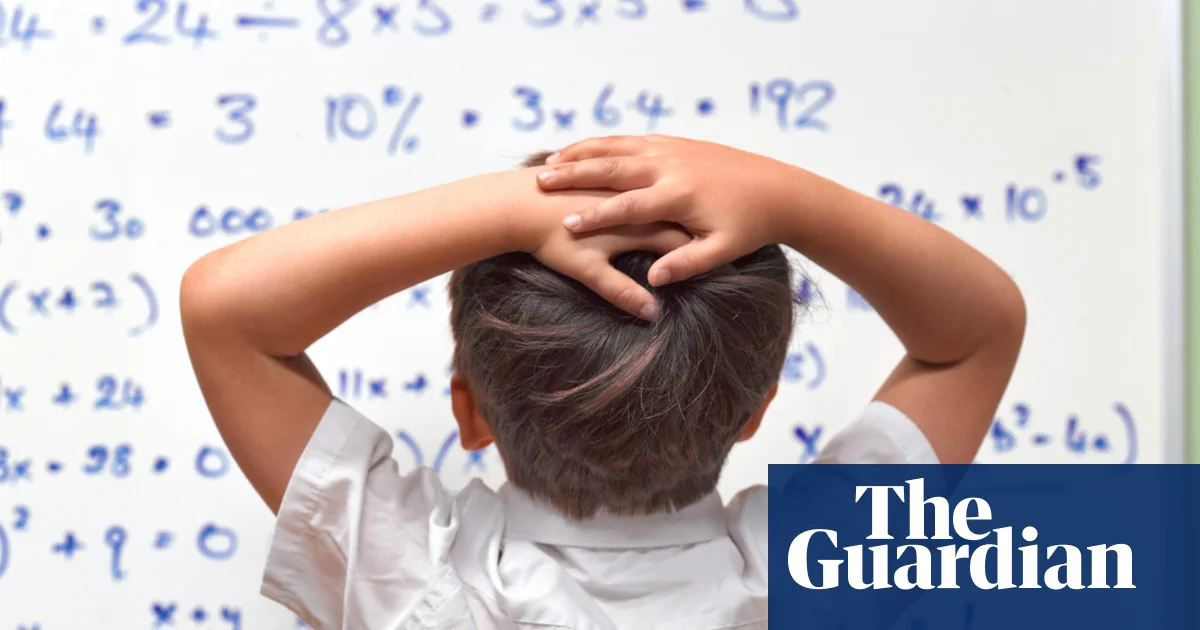
Simon Jenkins must have had a deeply unpleasant experience of learning maths at school because he seems to have a pathological antipathy towards it (We are teaching children maths they will never use. Isn’t it better to help them speak fluently?, 16 October). I have no qualms with his insistence on the importance of oracy. But his argument breaks down with the claim that it is either oracy or maths, but not both. This is nonsense. Oracy and maths skills should exist side by side. Both contribute to a person’s ability to realise their full potential, and to employment opportunities.
Maths drives the understanding of the natural world and contributes vastly to the solutions of problems that humanity needs to solve to exist. It is fundamental to science and technology, health and medicine, communications, the study of the Earth, finance and economics, distribution of resources and supply chains, architecture, warfare, and much else besides.
The negative economic, social and health and wellbeing impacts of poor maths skills in adult life are well known, yet the maths skills gap – the difference between the numbers of mathematically literate people we need and the number we have – remains too large in the UK.
Many young people suffer from maths anxiety, but that is not an argument for not teaching maths and its importance. It is a social problem that needs addressing by improving the quality of schooling and attacking the root causes of social issues that affect how young people engage with society.
Dr Jack Abramsky
London
The idea that calculators and AI reduce the need to learn maths is mistaken. Maths is about far more than calculation. It teaches us to reason, analyse evidence, solve unfamiliar problems and question whether an answer makes sense. These abilities are more important, not less, when technology can produce apparently authoritative answers in seconds. The public need to know when they can trust those answers, and maths underpins that.
The government’s 2025 curriculum and assessment review recognised this, stating that “Being secure in core subjects such as Maths and Science will remain pivotal for young people, now and in the future”. The review also highlighted the growing importance of critical thinking and digital skills in a world increasingly shaped by AI.
Maths is also fundamental to the economy. Analysis by the Academy for the Mathematical Sciences found that more than 5 million people worked in mathematical-science occupations in 2024, contributing £489bn, or 19% of the UK’s total gross value added. Ensuring young people develop strong maths skills is therefore important not only for individuals, but for the UK’s future productivity and prosperity.
We should strengthen young people’s ability to communicate, but not at the expense of their ability to reason mathematically. In the age of AI, both are more important than ever.
Mark Chaplain
President, London Mathematical Society
Heather Tewkesbury
President, Institute of Mathematics and its Applications
Much as I understand the advantages that oracy confers, it is no gift when it is combined with entitlement and dishonesty. It was Boris Johnson’s silver tongue that got him into Downing Street and kept him there, despite outlandish transgressions and fabrications. I would prefer that schools embedded behaviour, integrity and sincerity into the curriculum. These are the building blocks for sound character.
Mona Sood
Southend-on-Sea, Essex
I think Simon Jenkins may be slightly behind the times. My five-year-old child goes to a state foundation primary with two sites in south London. Oracy is a core part of the curriculum. Her professional state-educated parents attended the workshop the school provided on the subject; it was certainly not something familiar to our own education.
Our daughter has flourished in confidence and speech. Previously a naturally shy child, she now regales kind strangers on public transport with stories. Her teacher encourages simple but critical interaction daily – each child says hello and goodbye to their teachers and each other in a way that is comfortable to them and respectful to others. This is in a classroom that has lots of children with education, health and care plans, who qualify for free school meals, and who have English as a second language and parents who do not speak English. The benefits are obvious, but Winchester it is not.
Dr Elaine Seymour
London
All public schools know the answer to Simon Jenkins’ question, hence their debating societies. All state primary schools also know how to develop confidence and ensure that all have the opportunity to take part in community events.
Never overlook the importance of early-years festive productions, class assemblies, concerts, school councils and school plays. These vital aspects of our state curriculum need to be celebrated. Never forget the insignificance and misery of log tables and slide rules.
Sally Bates
Retired primary headteacher, Cotgrave, Nottinghamshire
