


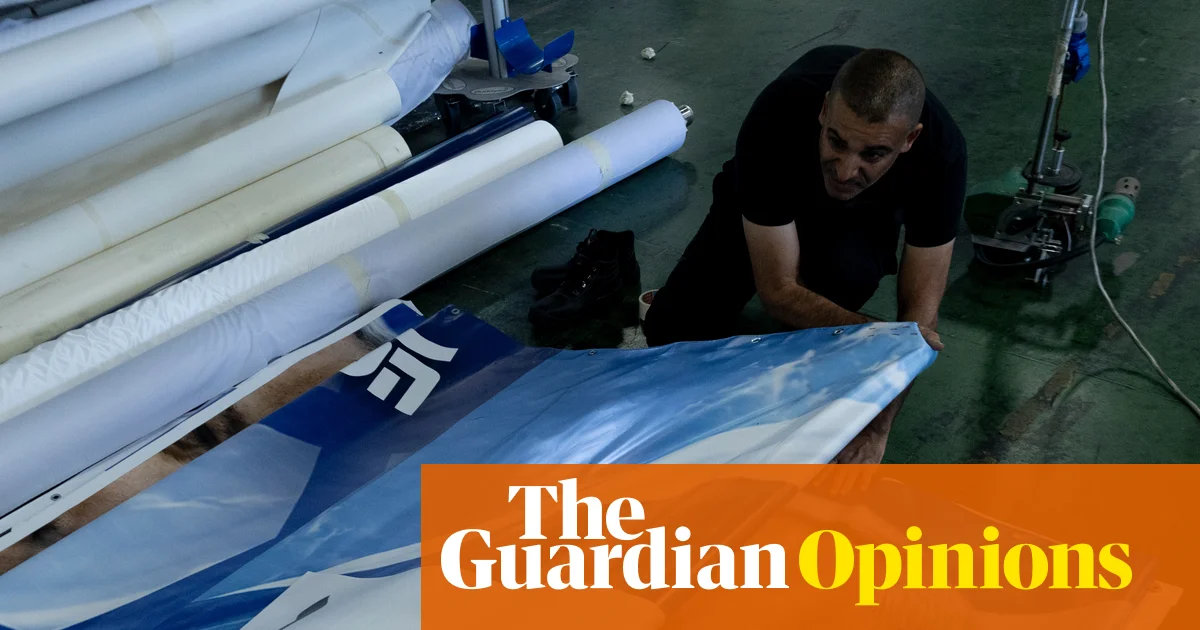
Israel’s 27 October election is fast approaching, with little clarity about who will win. But Benjamin Netanyahu is more likely to lose. His polling is poor, and the fractious opposition parties may yet find a way to form the next government.
What would such a government do? Most of the Zionist opposition parties, the frontrunners to lead such a coalition, have offered bromides about good governance and unifying the country. Others have focused on more specific plans to establish a state commission of inquiry into the government’s failures around the attacks of 7 October 2023, and end the exemption from military service enjoyed by most ultra-Orthodox Jewish men.
But if a new government truly plans to build a better future, Israel needs more profound changes. Simply ousting Netanyahu will not be enough.
The two issues the opposition has highlighted are understandably important to Israelis. For so many citizens, the disaster of 7 October and subsequent two-year hostage crisis became a crisis of faith in the state itself. Without accountability through an independent inquiry, society cannot move on. And even staunch supporters of peace cannot tolerate the rank injustice of some citizens serving and dying in wars while others are systematically let off the hook.
But what then? Israel’s war in response to 7 October has continued to devastate Palestinian society. But the past few years have damaged Israel internally as well.
Social solidarity in Israel is abysmal. Hundreds of thousands of reservists have served for months, interrupting their studies, family life and income. Up to 30,000 people have been wounded, according to Israel’s ministry of defence.
Meanwhile, the current government has slashed social-service budgets in favour of defence spending. The psychological toll is immense, yet Israel had a shortage of psychiatrists even prior to the war. Dr Graciela Cors, a youth and child psychiatrist, told me: “The mental health situation is catastrophic, and so are the social systems that are supposed to support mental health, like outpatient clinics and Kupot Holim [Israel’s state-mandated health funds].”
These problems are urgent, but addressing them would amount to damage limitation. Without deeper change, better-funded services and greater conscription would do little more than help Israel cope with the next round of seemingly endless wars.
Israel desperately needs to confront the factors that brought the country to this point to begin with.
Before Hamas’s attack, 2023 was already the year these long-festering problems burst into full view. Society was torn apart by two unreconciled, deeply interconnected questions: what kind of democracy Israel should be, and what is the future for the Palestinians?
Historically, Israel has demonstrated a flawed, ambiguous commitment to democracy. It avoided writing a constitution, and has no law that explicitly guarantees equality to all citizens. But over roughly the past 15 years, that ambiguity has given way to a full-blown assault on democratic institutions. Attacks on the judiciary came from top governing officials, culminating in Netanyahu’s government’s plans in 2023 to drastically weaken judicial independence.
That top-down assault fell on fertile ground because of a deeper problem: the erosion of democratic values, shaped in part by education. Or Kashti, the former longtime education correspondent for Haaretz (where I also write), told me that the seeds of the judicial assault are found in the new civics textbook adopted in 2016. He has traced a shift from vague treatment of democracy in earlier decades, to what he describes as “indoctrination”, with greater emphasis on Jewish identity and state power. This is a thin and misguided view of democracy, one that risks elevating the will of the majority above all other democratic values.
The curriculum can also be alarmingly parochial. Kashti says that history matriculation exams focus on the second world war and the Holocaust, the wars of modern Israeli history and the establishment of the Zionist movement. “All other topics in history of the world are marginal,” he says. Religion, he adds, infiltrates unrelated subjects. “In geography or weather lessons, children are told to learn the prayer for rain. What’s the connection between prayer for rain and a lesson on geography and climate change?”
This narrow conception of democracy helps explain how, in 2022, half the country elected parties that sought to hobble judicial institutions as part of the coalition government’s programme. And when education gives barely any attention to human rights, civil liberties and the equality of all citizens – it becomes easy to see why Palestinian self-determination has dropped off the Israeli agenda entirely.
after newsletter promotion
For decades, Israeli society has increasingly acted on the assumption that Palestinians could be contained through military force or control. In the years before 7 October, most Israelis saw no contradiction between democracy at home and their active military occupation regime effectively ruling over all Palestinians, without giving them rights or representation.
Netanyahu’s current government has pursued the logical end of occupation – permanent annexation, ever-expanding settlements and ethnic cleansing. To do that, the government had to destroy the final guardrails on its power. The 2023 assault on the judiciary finally galvanised many Israelis, who feared that their own liberties were under threat. Massive protests followed, plunging the country into prolonged social turmoil.
No Israeli government can offer a different future without fundamental and comprehensive change on these deepest issues. What is needed is a fundamental reassessment of the country’s entire social ethos.
The good news is that such change is absolutely possible. Education curriculums can be rewritten to embrace the principles of a modern liberal democracy. Teachers, politicians and even religious leaders can embrace human and civil liberties, minority rights, checks and balances, good governance and the universal values that too many Israelis disdain today. Societies and people can change.
In such a society, it would be the occupation, rather than democracy, that would become an unsustainable affront to the values of Israel. This is a long way off; the current opposition leaders demonstrate no vision leading to such an outcome, and change is needed much more urgently. Israel’s right wing and many ordinary citizens, shaped by years of fear, would fight any change favouring Palestinian independence. But without embarking on the path, the country will never get there; needless to say, Palestinians will never be free.
None of this will transpire if Netanyahu wins or if Israel’s elections yield a stalemate. But an opposition victory should be the day when the hardest, yet most hopeful, work will begin.
-
Dahlia Scheindlin is a Tel Aviv-based political analyst and author of The Crooked Timber of Democracy in Israel
-
Do you have an opinion on the issues raised in this article? If you would like to submit a response of up to 300 words by email to be considered for publication in our letters section, please click here.
