


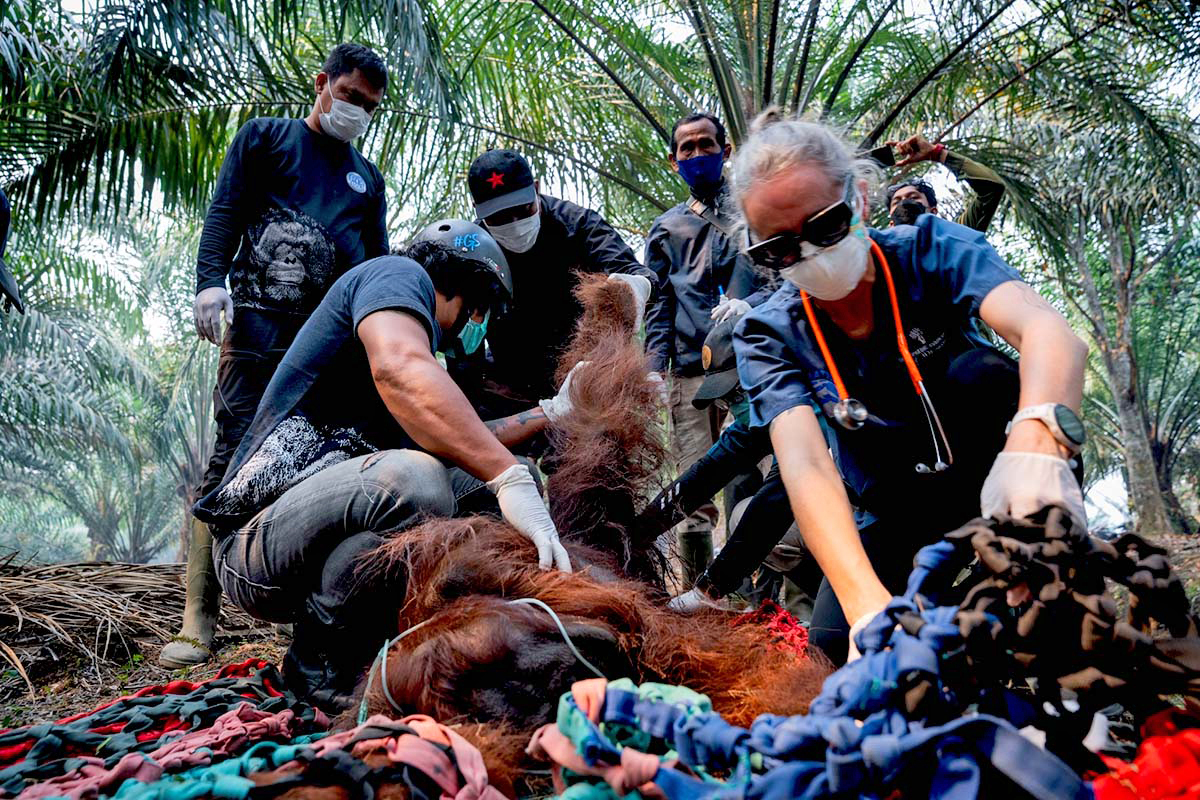
- Through last month, Indonesian wildlife conservation NGO YIARI and government conservation officials recovered seven critically endangered Bornean orangutans from wildfires raging across the island.
- One of the orangutans died from smoke exposure, while others were taken some to YIARI’s rehabilitation center and some released others into a nearby national park.
- A strengthening El Niño threatens to fuel major fires across Indonesia’s peatlands and mineral soils during this year’s dry season.
- YIARI workers in Ketapang district, a low-lying peatland area in Borneo’s West Kalimantan province, remain on high alert for orangutans stranded or injured by wildfires.
BANJARMASIN, Indonesia — As a strengthening El Niño fuels wildfires across much of Indonesia, NGO and government conservationists are at work in forests here trying to save an increasing number of orangutans from burning landscapes.
“Seven individuals were rescued through August,” said Heribertus Suciadi, spokesperson for Yayasan International Animal Rescue Indonesia (YIARI), a Borneo-based NGO working to establish and maintain sustainable orangutan populations.
The Bornean orangutan (Pongo pygmaeus) is one of three orangutan species in the world, and the only one found on the island of Borneo. All three species of orangutan are critically endangered and native to Indonesia. The Sumatran orangutan (Pongo abelii) and Tapanuli orangutan (Pongo tapanuliensis) are both found on the island of Sumatra.
The most recent assessment by the IUCN, the global wildlife conservation authority, estimated just over 100,000 Bornean orangutans remained in the wild. But that survey was conducted in 2016, and conservationists estimated a projected decline in the Bornean species population of around 86% between 1950 and 2025.
Researchers attribute this population collapse over three generations to habitat loss and direct killing. Orangutans also reproduce exceptionally slowly, with Bornean females typically giving birth to a single offspring about every seven to eight years, making populations particularly slow to recover from losses. In addition, major wildfire crises accelerate the decline.
“Recurrent forest fires, especially in peat forests, cause additional sharp declines about once every decade,” the IUCN noted.
Indonesian meteorologists expect an intense fire season through October as climate forecasts point to a strengthening El Niño, a warming of sea surface temperatures in the equatorial Pacific Ocean that disrupts global weather patterns. In Indonesia, El Niño is typically associated with hot, dry conditions, and amplified risk of wildfires.
Wildlife under fire
On Aug. 30, residents of Laman Satong village in Ketapang district, in the Indonesian province of West Kalimantan, found an adult male orangutan that conservationists named Sampurna in a weak condition near an oil palm plantation.
“This morning we received information from the public, and immediately conducted a field inspection,” Sarbandi, a spokesperson for the provincial conservation agency, the BKSDA, wrote in a statement.
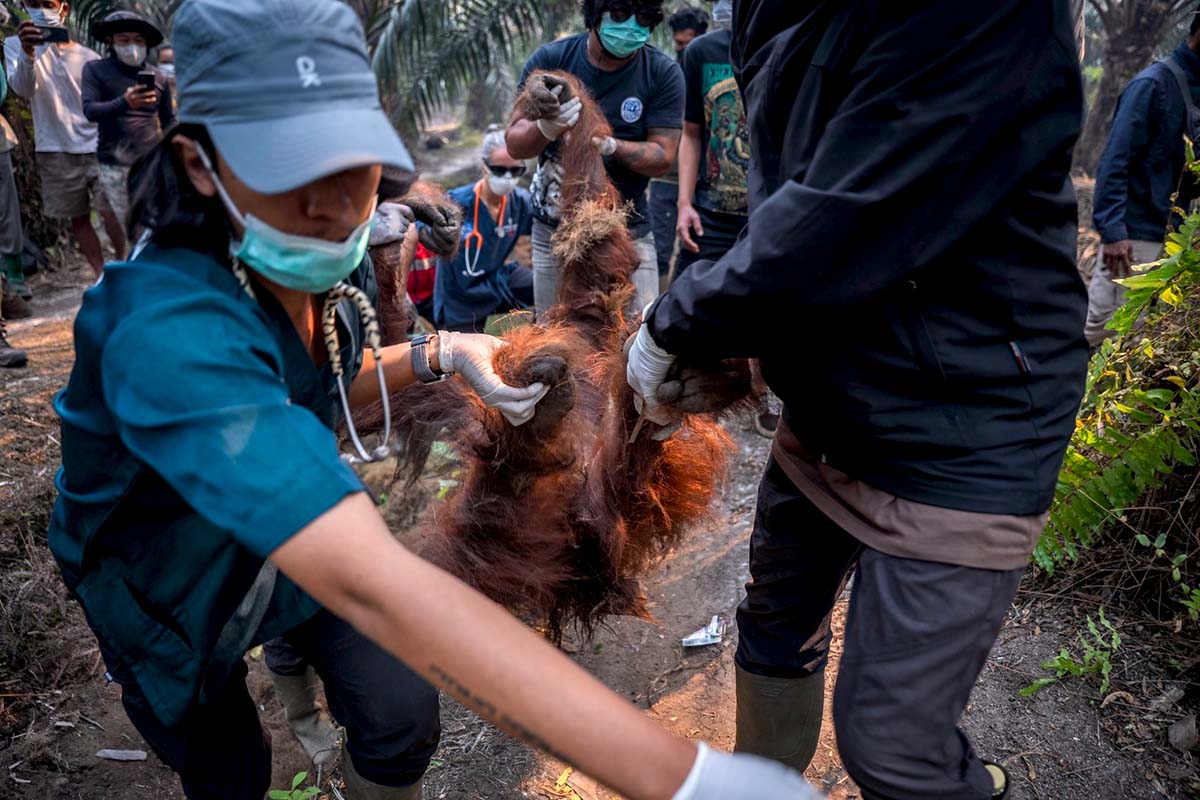
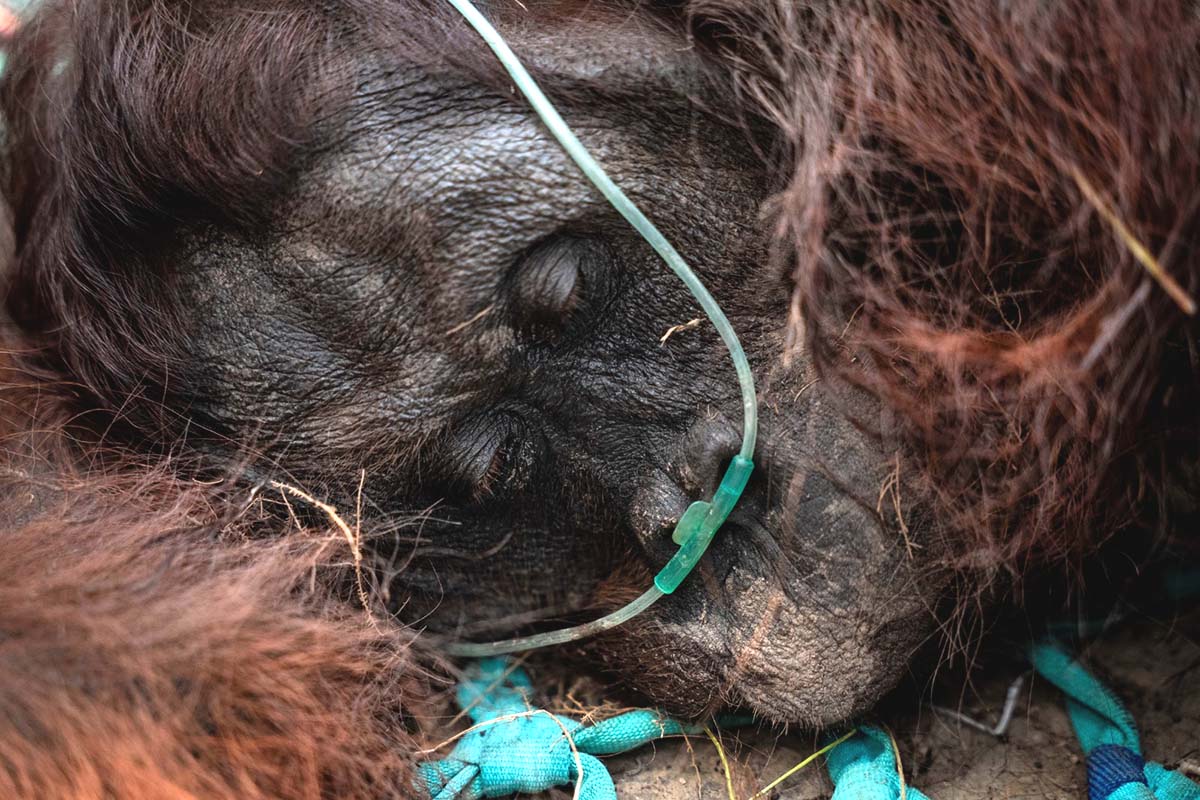
Komara, a veterinarian with YIARI, said the animal was evacuated to the NGO’s rehabilitation center in Sungai Awan Kiri for medical treatment. However, the orangutan died several hours later from symptoms associated with smoke exposure.
“In conditions of severe exposure, especially when the smoke is very thick and lasts for several days, orangutans can experience respiratory distress and oxygen deficiency or hypoxia,” Komara said.
Three days earlier, a team from YIARI, the BKSDA and Gunung Palung National Park rescued a mother and infant orangutan, which they named Mama Yayuk and Yayuk, from an oil palm plantation in Mayak village, also in Ketapang district. The pair were later released into Gunung Palung National Park, a safe habitat with plentiful food sources.
On Aug. 21, YIARI evacuated another mother orangutan and her two offspring — Mama Yuni, Pura, and Yuni — from a community orchard in Tanjungpura village, Ketapang, after the orangutans were found cut off from their habitat by wildfires.
And earlier in the month, on Aug. 6, the YIARI team recovered Wak, a male orangutan, who had wandered into a community orchard in Kuala Tolak village, also in Ketapang.
Murlan Dameria Pane, head of the BKSDA, said the agency was on high alert to attend to wildlife under threat from wildfires.
“We follow up on every report from the public, whether that’s directly or via the call center, about wild animals that need to be evacuated as quickly as possible,” Murlan said.
Argitoe Ranting, operational lead at YIARI, said the spread of wildfires in Ketapang had put the NGO’s staff on high alert, and that the public should call in orangutan sightings, rather than approach the animals themselves.
“The impact of forest and land fires on wildlife doesn’t always involve burns,” Argitoe said. “Exposure to smoke can also cause serious health problems, so any report of an animal in a weak or abnormal condition requires immediate attention.”
West Kalimantan fires surge
Indonesia faces two critical months ahead as a prolonged dry season heightens the risk of drought and wildfires across the archipelago. During previous El Niño events, rains came too late to douse peatland fires, arriving only after October, when the dry season typically transitions to wet.
According to Indonesia’s disaster management agency, the BNPB, 28,680 hectares (70,870 acres) of land had been burned in West Kalimantan through Aug. 9, accounting for more than half of the 48,889 hectares (120,807 acres) of burned land across the six worst-hit provinces: West, Central, and South Kalimantan in Borneo; and Riau, Jambi, and South Sumatra in Sumatra.
Ketapang had more hotspots, indicative of fires, than any other district in West Kalimantan through July 27, said Indra Syahnanda, advocacy and campaign lead the West Kalimantan chapter of the Indonesian Forum for the Environment (Walhi), the country’s largest environmental nonprofit.
From Jan. 1 to July 27, 2026, 17,236 hotspots with moderate to high confidence levels were recorded across West Kalimantan. Ketapang had the highest concentration of hotspots, with 3,715. Hotspots detected by satellites are indicators of possible fires, however, and do not necessarily correspond to individual fires on the ground.
Ketapang is dominated by low-lying coastal plains and river deltas, much of it covered by peatlands. Over thousands of years, waterlogged vegetation has accumulated into deep, carbon-rich soils. When drained for plantations and dried by prolonged drought, however, peat becomes highly flammable.
In 2022, women from Ketapang district together with YIARI formed an all-women firefighting unit called “the Power of Mama” to counter wildfires.
Walhi’s Argitoe said some fires in Ketapang were burning on land that had once been designated as protected, but later redesignated for agricultural use.
“Some of this peatland was previously located in protected areas. Then, due to changes in spatial planning, some protected peatland was converted into cultivated peatland and given to concessions,” Argitoe said. “This change in spatial planning is also a problem.”
Banner image: This orangutan, named Sampurna, was rescued after being exposed to smoke from forest and land fires in Ketapang Regency, West Kalimantan. Image courtesy of YIARI.
This story was first published here in Indonesian on Sept. 3, 2026.
Singkil peat swamp: The embattled orangutan capital of the world
In Borneo, the ‘Power of Mama’ fight Indonesia’s wildfires with all-woman crew

