


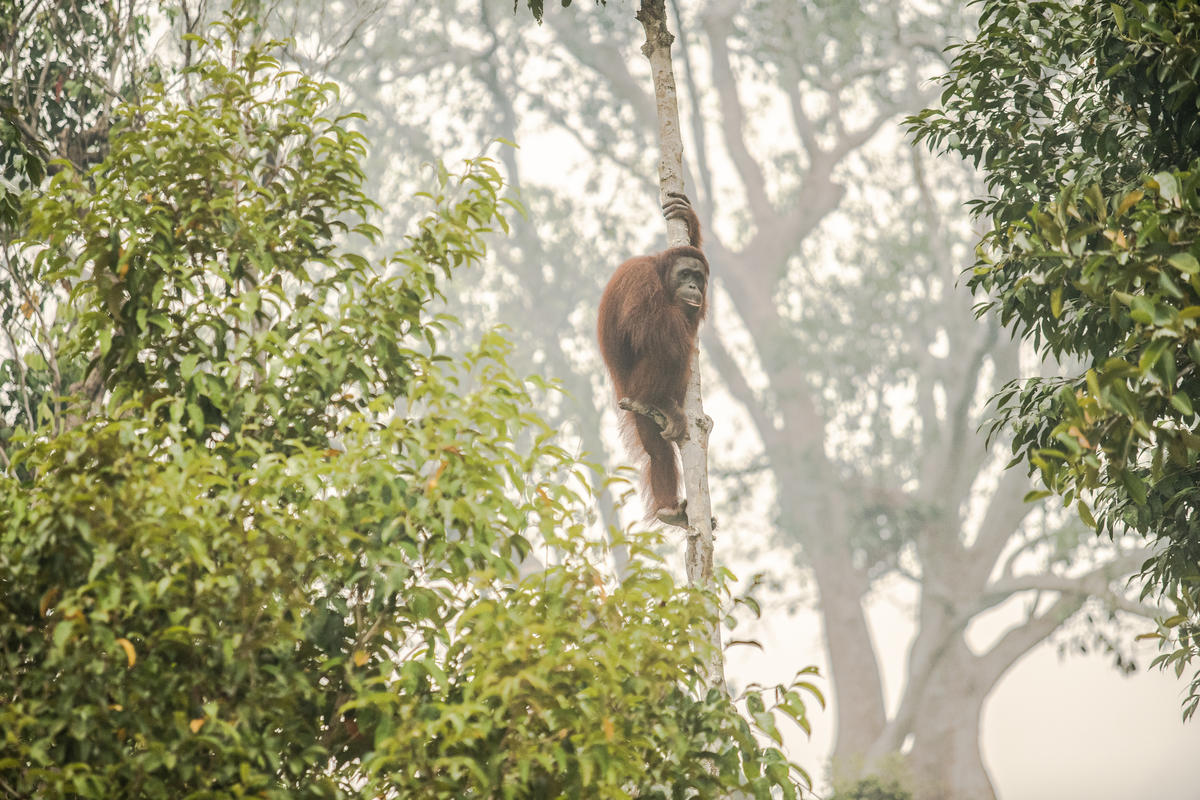
- Conservationists are racing to rescue six orangutans believed to remain in a fire-affected High Conservation Value area inside an oil palm concession in Indonesia.
- At least five orangutans have already been rescued, according to YIARI, an Indonesian conservation NGO.
- First Resources, which owns the concession, says it enforces a strict “zero-burning policy” across all planting activities.
- Another, larger conservation area that once supported an estimated 200 orangutans has also been affected by fire.
JAKARTA — Conservationists are racing to rescue orangutans from a fire-ravaged peat-swamp forest inside an RSPO-certified oil palm concession in West Kalimantan, with smoke still rising and the ground remaining dangerously hot.
The 657-hectare (1,623-acre) forest, designated as a High Conservation Value (HCV) area inside PT Kayung Agro Lestari (KAL), is home to around 60 Bornean orangutans (Pongo pygmaeus), one of three orangutan species in the world and the only one found on the island of Borneo, according to conservationists.
The forest was also used in October 2015 to release four orangutans rescued by the Yayasan International Animal Rescue Indonesia (YIARI), a Borneo-based NGO working to establish and maintain sustainable orangutan populations.
Nearly 11 years after four orangutans were released there, the peat-swamp forest that provided their habitat has itself been almost completely affected by fire, according to satellite analysis by technology consultancy TheTreeMap.
The analysis indicates that one of the major fires began on Aug. 8 along a canal at the edge of the oil palm plantation in Ketapang district, before spreading westward into the HCV forest.
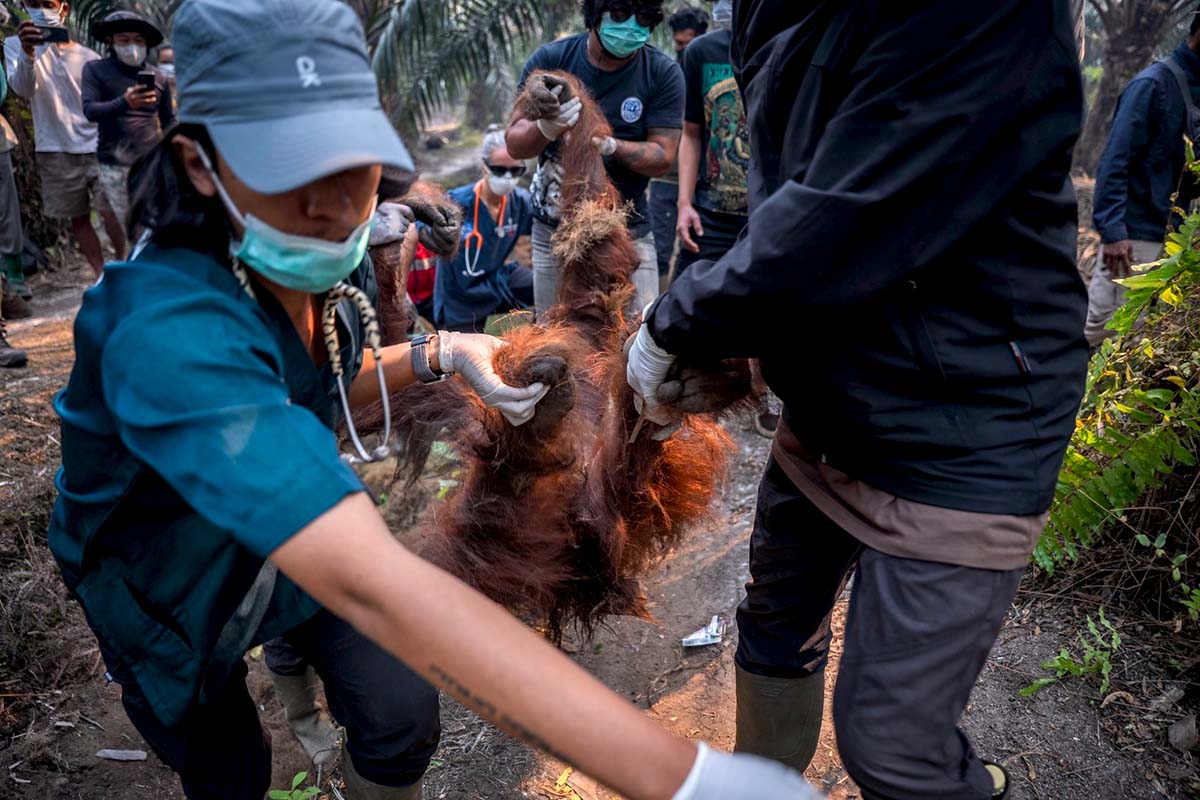
A team of conservationists, including staff from YIARI, is now trying to rescue orangutans still believed to be in the area. Five have been rescued so far, while six others located during the Sept. 16 rescue operation remain in the forest.
Fallen tree trunks, lingering smoke and dangerously hot ground are hampering the operation.
YIARI spokesperson Heribertus Suciadi said the team began searching for the orangutans on Sept. 14 and managed to rescue one young orangutan that day, after locating it in the afternoon.
He said the difficult terrain made it hard for the team to track the orangutans.
The team was initially prevented from entering the concession, Heribertus said.
“We arrived there at 9 a.m., but security held us up outside the company premises and we weren’t allowed to enter. We were only able to get in at around 2 p.m.,” he told Mongabay.
On Sept. 16, the team rescued four more orangutans, and located six others that have yet to be rescued.
“The plan is to rescue all of them because conditions there have become severe. The HCV area has been completely burned,” Heribertus said.
Even when the team manages to locate an orangutan, safely rescuing it remains difficult because of the terrain, he said.
“There are many fallen tree trunks blocking the way because the forest itself has burned, and the area is quite large,” Heribertus said. “The area was still burning, and smoke was still rising. Visibility was poor, and the ground was still dangerously hot, so the team had to be extra careful. With peat, once it has decomposed, there can be embers burning inside, and you can step into them.”
With the HCV forest severely affected by fire, YIARI has focused all its rescue resources on the concession, Heribertus said.
“We’ve assigned all our rescue personnel to the area,” he said.
How many orangutans are left?
While YIARI has rescued five orangutans and located six others that remain awaiting rescue, it is not clear how many orangutans occupied the area before the fires or how many survived.
In addition to the 657-hectare forest, another larger HCV area covering 2,330 hectares (5,758 acres) is located inside KAL and supports an even larger orangutan population, according to biologist Erik Meijaard, managing director of scientific consultancy Borneo Futures, who worked with KAL to protect its orangutan populations beginning in 2011.
That larger HCV area supported an estimated 200 orangutans before the fires, he said.
The HCV areas also supported diverse wildlife, including an estimated 360 species of mammals, birds, reptiles and amphibians.
The 657-hectare area supported an estimated 50 to 60 orangutans in 2019, Meijaard said. Based on satellite imagery, much or nearly all of the area now appears to have been affected by fire.
“I was looking at a Sentinel image of 12 September and it looks like the 657 ha has been fully affected by fire,” he told Mongabay. “It is hard to say whether the forest can recover from this.”
That same Sentinel image indicates that at least half of the larger, 2,330-hectare HCV area has been affected by fire, Meijaard added.
First Resources, which owns the concession, said it enforces a strict “zero burning policy” across all planting activities and regularly reminds employees and contractors of the requirement under its sustainability policy.
Meijaard said fires had been rare in the concession in the past, when the company paid two villages west of the concession to maintain a zero-burning arrangement for six years.
“The system worked very well, and after 2019, when the payment system was initiated, there were almost no fires,” he said.
In March 2025, First Resources announced the acquisition of PT Austindo Nusantara Jaya Tbk’s Indonesian plantation assets, including KAL.
“From what I understand, the company stopped paying the communities for zero burning, and I guess the current fires are the result of this,” Meijaard said.

Orangutans in peril
The rescue effort in KAL is part of a broader effort to protect orangutans from fires affecting their habitat across Indonesia.
Indonesian meteorologists have warned of elevated fire risks through October as climate forecasts point to a strengthening El Niño, a periodic warming of sea-surface temperatures in the central and eastern tropical Pacific Ocean that can alter rainfall patterns globally. In Indonesia, El Niño is commonly associated with hotter and drier conditions, which can increase the risk of forest and peatland fires.
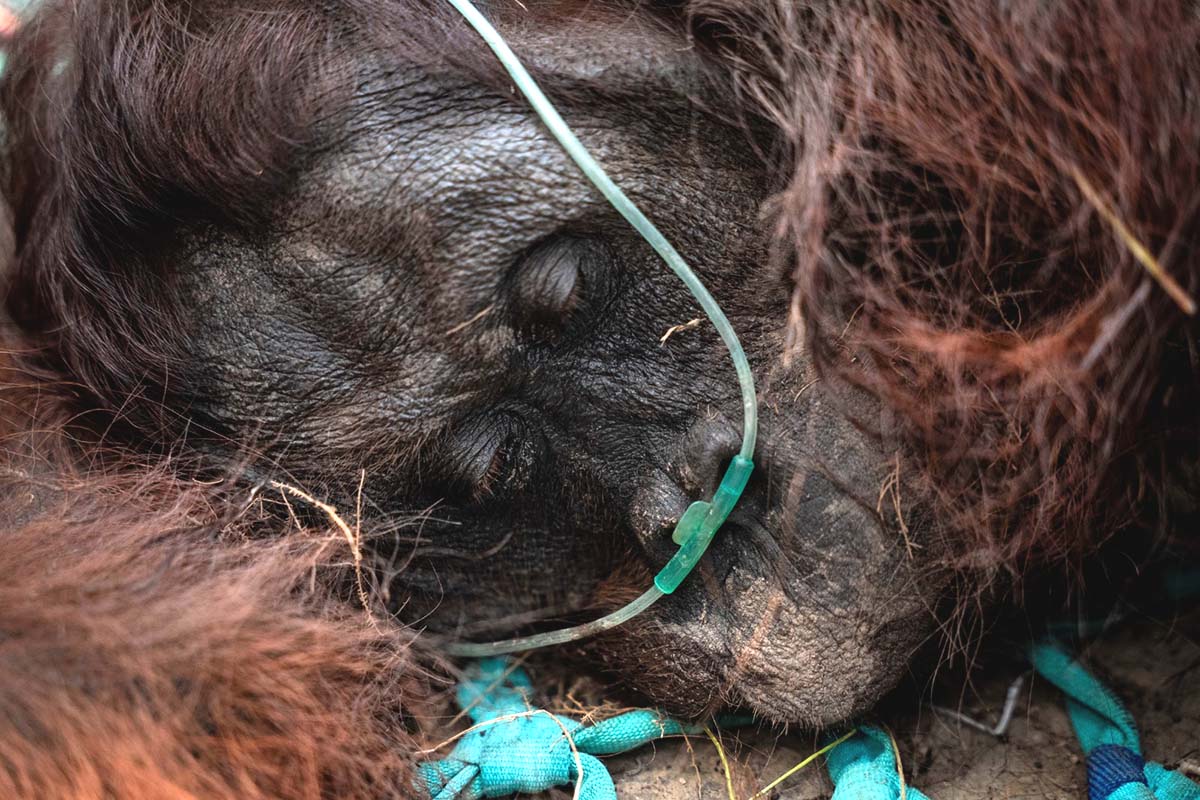
The dangers facing orangutans in fire-affected habitats were highlighted by the recent death of Sampurna, an adult male orangutan found in a weakened condition near an oil palm plantation in Ketapang.
On Aug. 30, residents of Laman Satong village in Ketapang district found Sampurna near an oil palm plantation.
Komara, a YIARI veterinarian, said the animal was evacuated to the NGO’s rehabilitation center in Sungai Awan Kiri for treatment. Sampurna died several hours later after showing symptoms associated with smoke exposure.
“In conditions of severe exposure, especially when the smoke is very thick and lasts for several days, orangutans can experience respiratory distress and oxygen deficiency or hypoxia,” Komara said.
What about the certification?
KAL has been certified by the Roundtable on Sustainable Palm Oil (RSPO), a certification system for sustainable palm oil, since 2019, according to company information.
David Gaveau, the founder of TheTreeMap, which conducted the satellite analysis, said the certification should have protected the orangutan habitat.
“That certification should mean that this orangutan habitat is effectively protected. Yet much of the HCV forest has now burned,” he told Mongabay.
Gaveau said the case warranted an urgent, independent and transparent investigation.
“In my view, PT KAL’s RSPO certification should be suspended pending the outcome of that investigation. If violations are established, the Indonesian authorities should also impose substantial penalties,” he said.
Banner image: An Orangutan climbs a tree as the area is covered by haze from forest fires at Salat island, Palangkaraya, Central Kalimantan. The smoke and flames threaten endangered species like orangutans that can only be found in Kalimantan and Sumatra. Image courtesy of Jurnasyanto Sukarno/Greenpeace
FEEDBACK: Use this form to send a message to the author of this post. If you want to post a public comment, you can do that at the bottom of the page.

