



Perhaps no issue has tested the political agility of Pennsylvania’s popular Gov. Josh Shapiro over the past two years more than data centers.
In about 20 months, Shapiro went from introducing a fast-track permitting process that invited hyper-scale data centers to “move at the speed of business,” to kicking them out of the program and issuing an executive order aimed at slowing down development.
In between, Shapiro’s Republican opponent in this year’s governor’s race, Stacy Garrity, turned his initial embrace of data centers into one of her most pointed attacks on the incumbent, even as she glided past her own political baggage on the topic and utilized AI in attack ads.
According to polls tracking the governor’s race, none of it has moved the needle on Garrity’s electoral prospects. But polling also suggests the issue does remain a lasting vulnerability for Shapiro. This July, a Quinnipiac poll found that 56 percent of Pennsylvania voters approved of Shapiro, against 34 percent who disapproved. The same poll found the governor underwater on his handling of AI data centers: 24 percent approval, 34 percent disapproval and 42 percent unsure.
Other pollsters have registered a decline in Shapiro’s favorability over the past two years, coinciding with the time when data centers took center stage in the state, which companies view as attractive for development in large part because of its natural gas industry. With Shapiro eyeing a possible run for president in 2028, the governor’s handling of the issue in Pennsylvania would likely face heavy scrutiny. It’s worth asking now what voters will make of this record—and if his pivot will be enough to shield him from criticism that he moved too fast to embrace AI without fully considering the risks.
From “All In” to Everyone Out
Shapiro began his term in January 2023, just a few months after the seminal launch of ChatGPT. By September 2023, Shapiro had signed an executive order on generative AI, creating a governing board and standards for his administration’s use of the technology. In statements to the media, Shapiro said his administration was trying to balance AI’s benefits with its risks, a position he would later repeat on the subject of data center buildout.
“If we take the course that other states and countries have taken to completely ban AI for government purposes, we’re going to seriously lose out on the opportunity presented to us to improve government services for Pennsylvanians,” Shapiro said. “At the same time, know that AI will never replace the ingenuity, the creativity, and the lived experience of our outstanding workforce in the commonwealth.”
In November 2024, Shapiro announced a Pennsylvania Permit Fast Track Program, which he said would streamline state permitting for “key economic development and infrastructure projects.”
“We’re proving that government can move at the speed of business,” Shapiro said.
From the start, that business would include data centers. Among the first three Fast Track users announced was Project Hazelnut in the state’s northeast, which the Shapiro administration initially described as a “1,300-acre transformative technology campus featuring advanced infrastructure with server rooms, power distribution, cooling systems, and network connectivity.” Later, public records revealed it was a hyperscale data center campus linked to Amazon Web Services (AWS).
Similar projects would soon follow. Seven months later, in June 2025, Shapiro visited Berwick, Pennsylvania, to announce a $20 billion investment in the state by Amazon at two other proposed data center sites. Shapiro told reporters his administration was “all in on AI” and that the deal’s groundwork dated back to his first year in the governor’s office. However, Shapiro again said Pennsylvanians would be shielded from the harms of the industry.
“We can produce enough power to support the energy-intensive supercomputers and server farms at Amazon’s data centers … while still delivering reliable, affordable energy to our small businesses that line our main streets, to our families,” Shapiro said.
The following month, Shapiro attended an AI industry summit at Carnegie Mellon University, also attended by Republican political leaders, including President Donald Trump and U.S. Sen. Dave McCormick of Pennsylvania. At the summit, Trump touted $90 billion in private investments in AI and related energy-sector projects that he promised would soon flow into the commonwealth. But that seemed to mark the high tide of political support for the state’s data center industry.
By the end of the summer 2025, public opposition began to mount as data center proposals proliferated across Pennsylvania and consumer electricity rates surged. News reports emerged of communities pushing back against development, and environmental groups began scrutinizing the role of the Fast Track program.
In August 2025, as Shapiro visited the site of one of the Amazon projects in the Philadelphia suburbs to promote the jobs it promised to create, the local nonprofit Delaware Riverkeeper Network raised concerns over potential air and water impacts, and released emails it obtained showing a state Department of Environmental Protection air program staffer had referred to the development as a “governor’s priority project” and urged colleagues to “meet/exceed” all regulatory timelines.
Soon, data centers showed up in polling data. A December 2025 poll of Pennsylvanians released by Emerson College showed widespread concern about the economic and environmental impacts of AI, although data center construction fared slightly better: 38 percent in favor, 35 percent opposed, and 27 percent unsure or neutral. By April 2026, a Muhlenberg College poll revealed that concern had appeared to grow, with one in five Pennsylvanians calling data centers a “crisis” and two in five a “problem.”
At that point, six of the eleven projects listed on the state’s Fast Track dashboard were data centers, primarily spread across the eastern half of the state, according to the Pittsburgh Media Partnership. The list included both Project Hazelnut and the Amazon project near Philadelphia.
New Year, New Message
As public opposition to data centers grew heading into an election year, Shapiro appeared to pivot.
During a February budget address, he acknowledged that Pennsylvanians had “raised real concerns about the impact [of] large-scale data center development,” and introduced what his administration called the Governor’s Responsible Infrastructure Development, or GRID, standards. Shapiro’s office said the standards represented a fresh articulation of existing expectations that data center developers should address concerns about resource consumption, community engagement and transparency.
“Not a shift,” Shapiro told a gaggle of reporters. “What we did with GRID … is to make clear to everybody what the rules of the road are going to be in Pennsylvania.”
The administration also said the standards would become a prerequisite for a data center’s entry into the state’s Fast Track permitting program, and in May this year released a white paper detailing specific requirements, such as that developers had to use “clean firm” energy sources for 32 percent of their power by 2035, and pay for “all costs” associated with infrastructure upgrades, which are typically passed onto households via their energy bills. The release of the GRID white paper coincided with Shapiro’s visit to Archbald, Pennsylvania, a flashpoint in the state’s fight over data centers.
Still, data center opponents criticized the Shapiro administration for GRID’s lack of legally binding requirements. That critique sharpened after Shapiro reached a budget deal with legislative leaders this July that did not include measures to regulate data centers in line with the GRID standards (Shapiro’s office notes HB2650, which would codify the standards, sailed through the State House in June but then stalled in the Republican-controlled Senate).
Meanwhile, public opposition to data centers in Pennsylvania continued to grow, as Democratic and Republican lawmakers in the state Senate called for a moratorium on data center development, and groups from around the commonwealth protested Shapiro at the state Capitol in June.
“The only thing I haven’t been able to find yet is where and when [Shapiro] sat down with big tech to make friendship bracelets,” Colby Wesner, a data center opponent from Central Pennsylvania, said at the rally.
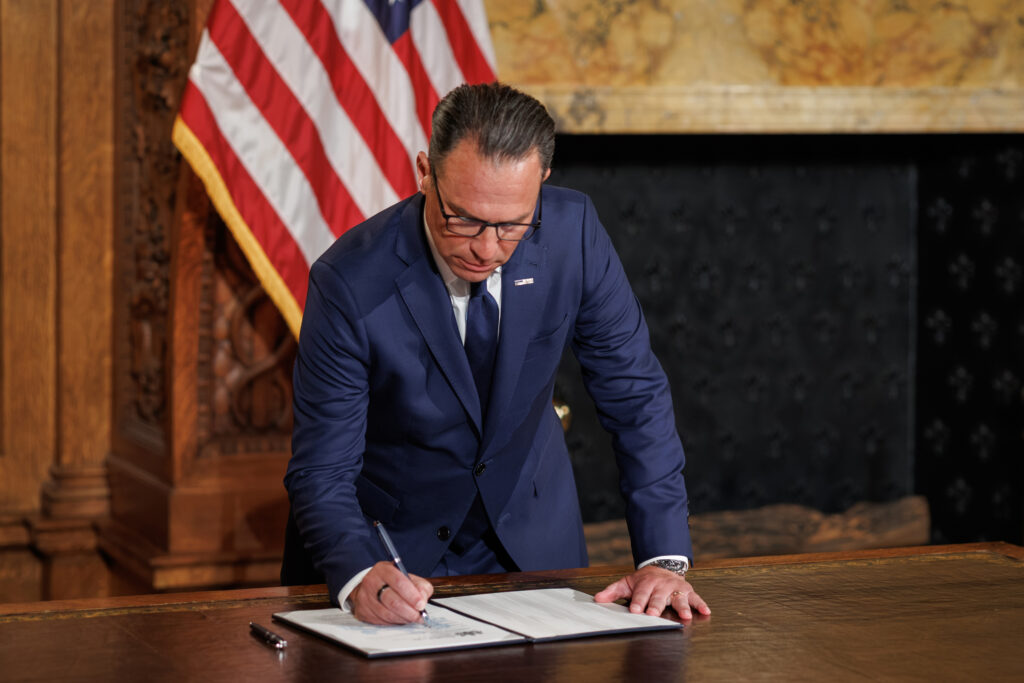
In August, Shapiro released a new executive order on data centers, removing them from the state’s Fast Track program, and using words like “greedy” and “predatory” to describe some industry operators. His office said the order legally requires data center developers to follow GRID standards if they want state regulators to review permit applications before township-level authorities approve them. In effect, that created the potential for data center proposals in the state to be slow-walked below even the normal speed of government in Pennsylvania.
Principle or Political?
To what degree Shapiro has been genuine in his desire to address Pennsylvanians’ data center concerns is in the eye of the beholder—and the full political impact remains to be seen.
In an email to Inside Climate News, Shapiro’s office did not directly answer questions but reiterated that the governor has always sought to balance the benefits of development with protections for Pennsylvanians, and argued that he shifted his approach once the “number and scale” of projects proliferated.
Shapiro’s sharpest critics remain unconvinced.
Megan McDonough, Pennsylvania state director for the nonprofit Food & Water Watch, cites media reports that dug into emails appearing to show the Shapiro administration offering Amazon advance access to the Fast Track program, as well as input on drafts of the GRID principles before they were publicly released.
In late September, her group also released a report detailing what it identified as hundreds of thousands of dollars in campaign contributions from data center interests to Shapiro, at the same time that the governor’s office was crafting and releasing his most recent executive order.
“He’s talking about developers being bullies, but he’s not actually putting out a policy that would stop it,” McDonough said. “He’s trying to present himself to voters as a person who’s going to stand up to industry. Well, you can’t when they’re the ones padding your campaign coffers.”
This story is funded by readers like you.
Our nonprofit newsroom provides award-winning climate coverage free of charge and advertising. We rely on donations from readers like you to keep going. Please donate now to support our work.
McDonough criticized the order itself, noting it still does not formally require data centers to follow any of the GRID standards.
But other groups—including those with missions to protect consumers and the environment— are giving Shapiro more credit. Katie Blume is political and legislative director of the nonprofit advocacy group Conservation Voters of Pennsylvania, and also council president of Millheim, a small borough in Central Pennsylvania. She says Conservation Voters did not endorse a candidate in the governor’s race but she personally understands the need for state politicians to balance economic development with environmental protections.
To her, Shapiro started with the right instinct when it seemed only a handful of major data center projects in the state would bring billions of dollars in investment. Problems really began, she said, when speculative developers inundated the state with dozens of potential proposals, igniting public concern.
“I’m giving these elected officials the benefit of the doubt, because I don’t think any of us actually thought at the time of the [Carnegie Mellon] summit that there would be 80 proposals,” Blume said, adding that she believes Shapiro’s trip to Archbald was a genuine act of contrition. “I respect when people can be honest about how their opinions shift.”
As a borough official familiar with local permitting processes, Blume said she also believes that Shapiro’s executive order will have an impact.
“It’s essentially slow-walking the process for people who don’t follow the rules,” Blume said. “And if you’re a developer, you don’t want anything slow-walked.”
Dan Diorio, vice president of state policy for the trade group Data Center Coalition, says the industry is also taking Shapiro’s shift seriously. He said the whirlwind of activity over the past two years has called into question the wisdom of continuing to invest in the state. Indeed, none of the data center projects previously included in the Fast Track program have received all necessary permits, according to Technical.ly, and several have found themselves bogged down by local opposition, as 74 percent of Pennsylvanians now say they would oppose a data center in their community.
Diorio also lamented the lack of distinction between what he called “legitimate developers,” like the major tech corporations the DCC represents, and small, independent developers crafting speculative proposals in communities across Pennsylvania.
“As the public consciousness has changed, and as lawmakers have reacted to that, what they have done is create significant uncertainty in the marketplace,” Diorio said. “Our members are caught somewhere in the middle of this process.”
Predicting the Political Fallout
Diorio said his group is concerned with the outcome of this year’s midterm elections. He said aspects of the GRID proposals already appear untenable, such as clean energy requirements his group argues are constrained by dynamics outside industry control, including a backlog in siting new energy generation projects by regional grid operator PJM Interconnection. As such, the prospect of such requirements becoming codified by Pennsylvania lawmakers next session looms large.
“I think the governor is really open and focused on how to create the right type of guardrails to get the right type of development,” Diorio said. “I think we differ on the policy mechanisms, and I think that’s where this uncertainty comes into play.”
Observers differ on how Shapiro’s track record on data centers could play out in the years ahead.
Patrick Cicero, an attorney with the Pennsylvania Utility Law Project, a consumer advocacy group, said another term would give Shapiro a chance to continue leading a bipartisan group of governors as they work to address affordability issues at PJM. Shapiro could also strengthen his resume by pushing state regulators and legislators to adopt better policy, Cicero said.
Critics like Pennsylvania state Sen. Katie Muth, an outspoken data center opponent who introduced a moratorium bill this session, think it’s just as likely to go the other way.
“The reality is this is still being proposed everywhere and it’s being approved in all these different places,” Muth said. “He wants to be president, and 80 percent of the country hates this [stuff]. Good luck.”
About This Story
Perhaps you noticed: This story, like all the news we publish, is free to read. That’s because Inside Climate News is a 501c3 nonprofit organization. We do not charge a subscription fee, lock our news behind a paywall, or clutter our website with ads. We make our news on climate and the environment freely available to you and anyone who wants it.
That’s not all. We also share our news for free with scores of other media organizations around the country. Many of them can’t afford to do environmental journalism of their own. We’ve built bureaus from coast to coast to report local stories, collaborate with local newsrooms and co-publish articles so that this vital work is shared as widely as possible.
Two of us launched ICN in 2007. Six years later we earned a Pulitzer Prize for National Reporting, and now we run the oldest and largest dedicated climate newsroom in the nation. We tell the story in all its complexity. We hold polluters accountable. We expose environmental injustice. We debunk misinformation. We scrutinize solutions and inspire action.
Donations from readers like you fund every aspect of what we do. If you don’t already, will you support our ongoing work, our reporting on the biggest crisis facing our planet, and help us reach even more readers in more places?
Please take a moment to make a tax-deductible donation. Every one of them makes a difference.
Thank you,
