


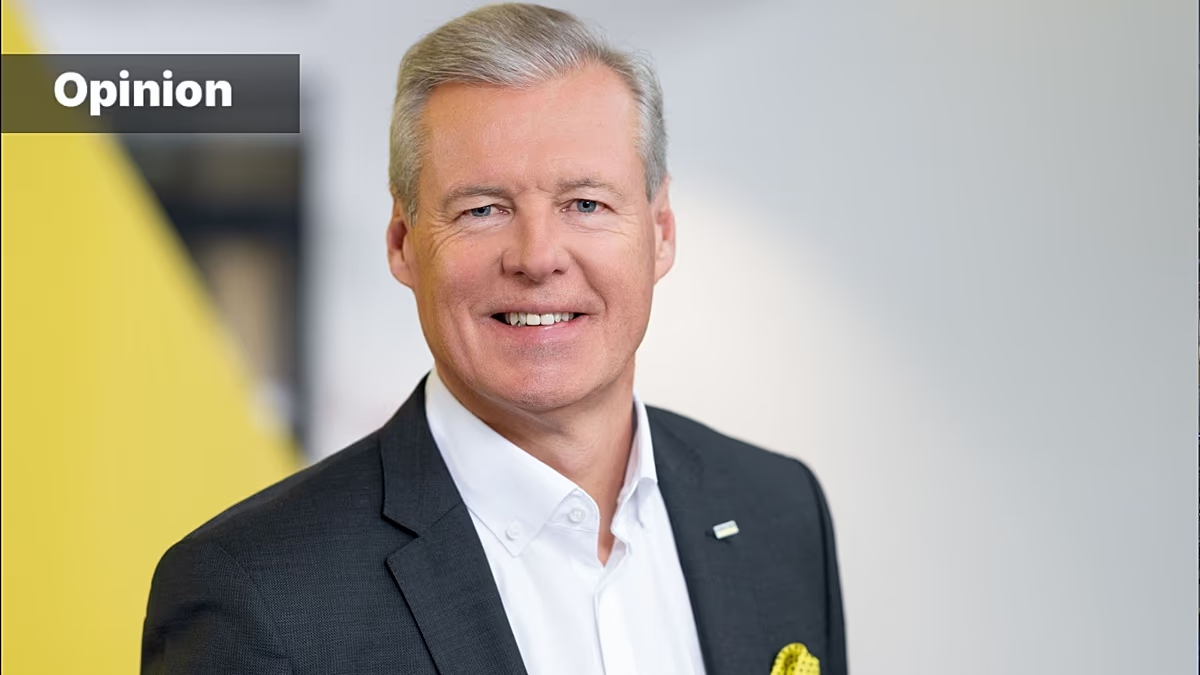
The opinions expressed in this article are those of the author and do not represent in any way the editorial position of Euronews.
For some time now, we in Europe are facing a perfect storm. Geopolitical crises are casting a shadow over the European economy. The unpredictable trade policy of the U.S. keeps threatening, without warning, to raise tariffs and erect trade barriers – a toxic scenario for free global trade and export-oriented companies.
ADVERTISEMENT

ADVERTISEMENT
Meanwhile, China is no longer merely a low-cost manufacturer but has become a highly aggressive technological competitor that, with its tremendous speed, threatens to outpace key European industries in future-oriented fields.
What is often perceived as pure technological supremacy or even innovative strength is, however, largely the result of a well-targeted governmental industrial policy. Massive subsidies in key strategic industries, along with a currency policy artificially focused on competitiveness, are leading to noticeable market distortions and overcapacity.
For private companies operating on a market-based basis, this creates an imbalance that makes fair global competition almost impossible.
Europe risks deindustrialisation
The consequences for the industrial heart of Europe are alarming. The loss of tens of thousands of industrial jobs and the decline in production volume show that deindustrialization is not an abstract threat – it is happening right now.
When plant closures and production relocations are being negotiated in key German industries such as the automotive and manufacturing sectors, it must be clear even to the most optimistic observer: We are at a critical turning point.
As a family-owned company with 170 subsidiaries in 87 countries, Kärcher has weathered these turbulent times robustly thanks to its balanced business model – combining B2B (editor’s note: Business to Business, i.e. corporate customers) and B2C (editor’s note: Business to Consumer, i.e. private customers) – and its unconditional focus on customers. We are investing significantly in research and development, setting new standards in autonomous cleaning robots and battery technologies, and driving digitalization across all areas of the company.
However, even innovation leaders cannot withstand increasingly challenging operating conditions and unfair competition in the long term. Considering the massive rise in structural and employee costs, expanding capacity or increasing headcount in domestic production is no longer economically feasible.
Reform fatigue and regulatory zeal are holding back investment
While the latest economic forecasts – which expect Germany’s growth to return to 1.3 percent this year – seem cautiously optimistic at first glance, we must not be misled by this modest increase. What we are seeing here is largely “borrowed growth,” artificially driven by special government funds, defense contracts, and subsidies.
A short-term boost fueled by debt is no substitute for a real, self-sustaining recovery in private investments. And the causes of the ongoing weakness are largely homegrown: a creeping reform fatigue and a regulatory frenzy on the part of government institutions that hinders rather than facilitates investment. Instead of promoting entrepreneurship, regulations from Brussels to Berlin are suffocating the courage to embrace change.
The ongoing uncertainty among people in Germany is also having an impact on society. The rise of political extremism is a clear sign that many people are calling for greater reliability and noticeable reforms. To regain confidence in our country’s economic strength and future viability, we now need clear direction and bold action.
For me personally, the attitude towards “working hard” has been ingrained in me since childhood on my parents’ family farm. Success doesn’t just fall from the sky; for me, it consists of 97 percent hard work and dedication, 2 percent talent, and 1 percent luck.
If we want to secure our prosperity and our social standards, we must once again recognize that value creation is the precondition for prosperity – and not the other way around. If you rest, you rust – that applies to people just as much as it does to economies.
Germany needs a fitness programme
That is why we need a real fitness program for Germany. Rigid rules, excessive bureaucracy, high energy costs, and steadily rising non-wage labor costs are poison for our business environment. If the total amount of social security contributions consistently far exceeds the historically critical threshold of 40 percent, then tax breaks, selective government subsidies, and special funds will amount to nothing more than ineffective paper measures as long as the business environment itself remains entrenched in its current state.
While the federal government’s political reform efforts are heading in the right direction, they fall far short of what is needed. Instead of tackling the root of the problem, authorities are allowing a flood of regulations to continue – regulations that tie up valuable employee time and cost our companies millions. Money and personnel that are needed for core business operations and innovation are being wasted on documentation requirements alone. This cannot be solved with cosmetic fixes.
We need the courage to provide real relief. A key lever for this would be, for example, a cultural shift within the administrative system: In the future, government departments must see themselves as digital enablers and service-oriented partners to the economy – pragmatic, fast, and AI-supported. If other countries are already moving toward eliminating reporting obligations overall, this must send a clear signal to Germany and all Europe.
More work, less bureaucracy, and a resolute trade policy
Furthermore, we should not avoid necessary debates on the labor market. Demographic trends require an increase in the overall volume of work in the economy. Incentives for overtime, flexible working hours, practical rules regarding continued pay during medical leave, and a noticeable reduction in bureaucracy when employing skilled workers are essential.
Those who reflexively condemn such debates as an attack on workers’ rights are turning a blind eye to reality and putting precisely those jobs at risk that they claim to be protecting. At the same time, we need a resolute trade policy at the European level that guarantees fair competition and consistently punishes rule-breakers – because free trade only works when everyone follows the same rules.
If we truly want to secure our competitiveness in the long term, we don’t need a bureaucratic approach – we need a return to a can-do mentality: less regulation, more personal responsibility, ambitious investment incentives, reliable framework conditions, and, above all, the courage to tackle issues properly and comprehensively once again. Real change begins in the mind – it’s time to act.
Alfred Kärcher SE & Co. KG was founded in 1935 and generated almost 3.5 billion euros in revenue in 2025. The family-owned company based in Winnenden, Germany, earns 86 percent of this abroad. The Kärcher Group operates 170 companies in 87 countries and employs 17,000 people worldwide. Kärcher’s portfolio comprises more than 3,000 products for cleaning and care, with Kärcher high-pressure cleaners being particularly well known.
