


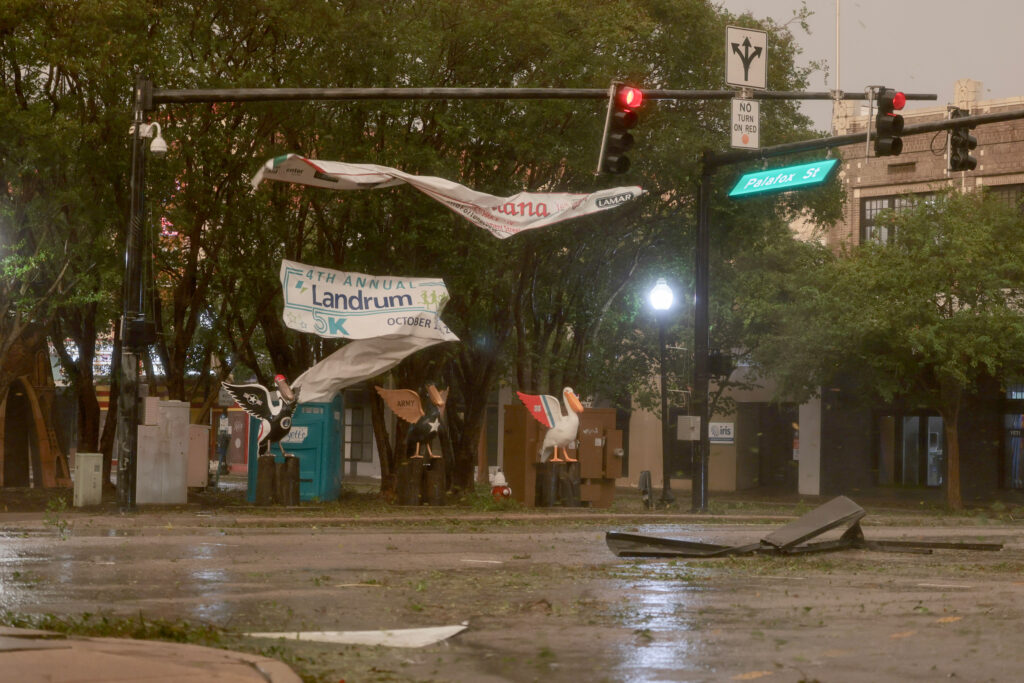
The call came late on a Wednesday afternoon in October, when the forecast cone stopped wobbling and started pointing steadily toward the Florida Panhandle. Tracie Hodson, who runs FavorHouse of Northwest Florida in Pensacola, decided to evacuate her domestic abuse treatment shelter.
By Thursday, her staff had relocated 15 women and 12 children. Some went north in Escambia County, away from the storm surge. Employees drove one family and another individual to a sister shelter in Panama City, three hours east. A woman who had nowhere else to go was placed, with her child, in a general community shelter. Then the staff went home and waited.
Hurricane Isaias made landfall near Destin at 8:30 p.m. on Friday, Oct. 9, as a Category 2 Storm with 105 mph winds. It killed at least four people, two of them in Florida.
On Saturday morning, FavorHouse’s shelter manager went to survey the damage. The buildings were still standing, but a tree fell across a long stretch of the privacy fence and clipped the back corner of the shelter, popping the soffit loose. The generator had quit roughly 18 hours into the outage, leaving spoiled food in four freezers and two refrigerators.
For the next 19 days, the shelter remained closed. FavorHouse’s outreach office had been running on internet-based phones; when the power and connection went, so did the hotline. Crisis calls were routed to Florida’s statewide domestic violence hotline and answered at Women in Distress of Broward County, on the other end of the state.
Hodson said, “We [had] just been a week not being able to provide the services that [were] desperately needed by our community members.”
What happened in Pensacola illustrates a growing concern among researchers, one Florida has almost no ability to measure: Climate change is simultaneously creating situations that can exacerbate domestic violence and weakening the systems survivors turn to for safety.
The Florida Panhandle has three certified domestic violence shelters. While FavorHouse was closed, the nearest was Shelter House in Fort Walton Beach, about 45 miles east—a drive Hodson put at an hour and a half to two hours in the days after the storm. The next closest shelter is in Panama City, roughly 140 miles away.
“We’re not really turning people away,” Hodson said during the closure. “We’re just not providing what we can and should until the shelter’s open again.”
Her injunction attorney kept working from her cell phone and appeared in domestic violence court that Wednesday, as she does every week. Outreach advocates remained in contact. The agency put people up in hotels where it was safe to do so and kept feeding them.
But for now, the shelter cannot offer its clients access to a secured, confidential building. Reopening required, among many other things, a temporary barrier where the fence had been; Florida requires that children at a certified shelter not be visible from the street.
Linda Parker, who is the president and CEO of Women in Distress of Broward County and has answered calls to Florida’s statewide domestic violence hotline since 2020, has seen how long that can actually take. After Hurricane Irma, which hit in September 2017 and took out her back fence, she said, it took nine months to repair. “You can’t stay closed for nine months.”
Parker’s organization has become a backup for centers across Florida.. When a center goes offline, hotline calls are routinely routed to Broward. At least one Florida center a year temporarily hands over its hotline because of a tropical storm or hurricane, Parker said
Because moving residents to hotel rooms or general population shelters is often impractical, Florida’s certified centers try to shelter in place—and depend on generators to keep the power on.
Those generators are now eight or nine years old. FavorHouse’s failed after 18 hours. Parker now tells centers to have theirs inspected a week before an impending storm.
Storm Science
A preliminary analysis from Climate Central found that human-caused ocean warming added about 7 mph to Isaias’ peak winds and about 6 mph to its wind speeds at landfall, and that the sea surface temperatures the storm crossed were made at least four times—and in places up to 600 times—more likely by climate change.
Using NOAA’s hurricane damage potential estimates, Daniel Gilford, the Climate Central scientist who led the attribution work, calculated that roughly 36 percent of Isaias’ total damage is attributable to the seemingly small increase in its landfall wind speed—somewhere between $360 million and $1.1 billion, against damage estimates that range from $1 billion to $3 billion. Gilford cautions that the estimates are inconsistent across agencies.
Research on heat points in another direction: not at the shelter, but at the household.
In 2025, researchers analyzing over 150,000 domestic violence calls to New Orleans police between 2011 and 2021 found calls rose about 7 percent during heat waves lasting five or more consecutive days. The senior author, Anita Raj of Tulane University’s Newcomb Institute, told Inside Climate News that she expected something similar in Florida, with the differences coming down to policy and infrastructure—better-run shelters dampening the effect, more households without air conditioning amplifying it.
Raj is insistent about the mechanism. Heat does not make someone commit violence, but it can exacerbate a situation where violence has already occurred, raising the odds it escalates into something that requires a call.
In a separate 2025 study, Pin Wang at the University of Maryland and colleagues analyzed data from more than 400,000 women across 42 countries. The researchers found extreme heat was associated with an increased risk of intimate partner violence risk—with a stronger association than drought.
Both Parker and Hodson described a summer pattern. “Heat makes everybody cranky. And when you’ve got an unhealthy relationship, that crankiness gets misplaced a lot onto the victim,” Hodson said.
At Pensacola’s airport, the heat index reached at least 105 degrees on 14 days in 2026. Eleven of those fell in two stretches: five consecutive days in late July, when the index topped 111, and six in mid-August, when it reached 113. An analysis that Climate Central conducted for Inside Climate News found climate change made the daily high temperatures on the first four days of the July stretch at least four times more likely, and at least three times more likely in August.
Hodson remembers those conditions. “We were full at that point,” she said.
This story is funded by readers like you.
Our nonprofit newsroom provides award-winning climate coverage free of charge and advertising. We rely on donations from readers like you to keep going. Please donate now to support our work.
Parker, who has examined statewide domestic violence call volume for six years, described a reliable seasonal cycle: a rise beginning in July, a dip around October and a climb through the holidays. “I think that our spikes are more based off other things that are going on,” like population growth, post-pandemic strain and economic pressure, she said. Broward County’s hotline took 19,000 calls this year, about 2,000 more than last year.
The state’s incident-based crime reporting system does not disaggregate domestic violence from other violent crime, according to a 2026 legislative analysis. The most recent FDLE annual summary covering domestic violence offenses is from 2021.
Bethany Backes, director of the Violence Against Women Faculty Cluster at the University of Central Florida, is leading a state-funded evaluation of Florida’s domestic violence resources. Backes said that her team has encountered similar obstacles in trying to obtain current data.
And even where numbers exist, they don’t always tell the full story. Calls to police measure who calls, not what happened, said Arnab Dey, the New Orleans study’s lead author. The number of incidents reported can rise after a disaster simply because people are living closer together with more witnesses.
A 2018 study in Violence and Gender analyzed 819,684 assault reports across all 67 Florida counties between 1999 and 2007, using reports of simple assault as a proxy for intimate partner violence. In counties that spent more than 199 days under a major disaster declaration, the number of assaults rose by roughly 78 per county per year.
Jennifer Horney, a disaster epidemiologist at the University of Delaware and one of the study’s authors, put the finding simply: “More days of disaster declaration, more reports of assault.”
The team chose 2004 because four hurricanes crossed Florida in a single season, touching every county and hitting some repeatedly. That gave the researchers what Horney called “a range of exposures” to compare, while the things that vary between states—emergency management, policy, funding—stayed constant.
The effect lasted four years. Horney said that happens often in disaster research, and that it compounds. “The more disasters you have, the more it’s like a cumulative mental health effect,” she said. “Anywhere that’s going to be subject to multiple disasters over time, it’s not additive; it’s multiplicative.”
Horney is careful about determining what simple assault statistics can and cannot indicate. What the broader record supports, she said, is that “domestic violence or interpersonal violence … has increased after all different kinds of disasters … it’s because those power dynamics change. There’s a lot of pressure to remain a household unit because of eligibility for aid.”
All of this is happening as funding is running dry.
Passed by Congress in 1984, the Victims of Crime Act funds much of the country’s domestic violence through penalties collected in federal criminal cases, rather than tax revenue. The money is distributed to states, which pass it down to local organizations. But as federal prosecutions and settlements have brought in less money, the fund has shrunk—and so have the grants.
Hodson expects about a 46 percent cut in her Victims of Crime Act funding next year; about $154,000, the reduction could force her to cut at least two of her programs. A tight budget also has her paring back on post-storm repairs. Her insurance deductible was higher than her estimated $40,000 to $50,000 cleanup bill, so she did not file a claim. The trees alone cost about $12,000. She has requested emergency funds and launched a community fundraising campaign.
State programs are also staring down budget constraints. In February, Florida’s attorney general rewrote a VOCA contract with the state attorney’s office in Orange and Osceola counties, cutting its domestic and family violence funding from about $478,461 to about $83,500—an 82 percent reduction—in a circuit that handled more than 11,000 domestic violence cases last year. The chief prosecutor of Orange and Osceola counties, Monique Worrell, has refused to sign it.
In Washington, U.S. Reps. Laurel Lee (R-Fla.) and Lucy McBath (D-Ga.) have introduced the FEMA for Safe Recovery Act, which would require FEMA to train its staff to recognize survivors of gender-based violence, place trained victim advocates in disaster shelters and require household check-ins with every adult in a family rather than only the head of household, a change advocates have pushed for years. It is unclear whether it will get a committee hearing before the session ends.
In Tallahassee, the legislature spent the spring expanding protections. Legislation that passed both chambers unanimously, raised victim relocation assistance to $2,500 per claim and created a statewide injunction database. None of it addressed whether the buildings would still be standing. In October, FavorHouse was still inhabitable.
On Oct. 28, 19 days after the storm, FavorHouse reopened its shelter around sunrise. The families who had been evacuated came back, along with survivors the agency housed at other locations while the building was undergoing repairs. The hotline calls were routed back to local advocates.
The fence has not been replaced. The roof still needs repair. The generator still doesn’t work—and hurricane season runs through Nov. 30.
About This Story
Perhaps you noticed: This story, like all the news we publish, is free to read. That’s because Inside Climate News is a 501c3 nonprofit organization. We do not charge a subscription fee, lock our news behind a paywall, or clutter our website with ads. We make our news on climate and the environment freely available to you and anyone who wants it.
That’s not all. We also share our news for free with scores of other media organizations around the country. Many of them can’t afford to do environmental journalism of their own. We’ve built bureaus from coast to coast to report local stories, collaborate with local newsrooms and co-publish articles so that this vital work is shared as widely as possible.
Two of us launched ICN in 2007. Six years later we earned a Pulitzer Prize for National Reporting, and now we run the oldest and largest dedicated climate newsroom in the nation. We tell the story in all its complexity. We hold polluters accountable. We expose environmental injustice. We debunk misinformation. We scrutinize solutions and inspire action.
Donations from readers like you fund every aspect of what we do. If you don’t already, will you support our ongoing work, our reporting on the biggest crisis facing our planet, and help us reach even more readers in more places?
Please take a moment to make a tax-deductible donation. Every one of them makes a difference.
Thank you,

Fellow
Kate Waxman is a Florida-based Outrider fellow at Inside Climate News, where she covers climate injustice across the state. She earned her M.S. in journalism from Columbia Journalism School and her B.A. in environmental science from Barnard, with reporting focused on coral reefs, climate science, and the communities closest to the water.
