


- A Brazilian federal court has ordered the removal of non-Indigenous occupants from the Piripkura Indigenous Territory in Mato Grosso, home to Indigenous people living in voluntary isolation.
- The order gives those affected 120 days to leave and remove cattle, machinery and other belongings.
- The ruling follows recent and new evidence of illegal deforestation and cattle ranching in the territory, including a recent inspection that identified 36.83 hectares (91 acres) of unauthorized clearing attributed to a rancher.
- Federal prosecutors have raised concerns about a new threat to the Piripkura in court files seen by Mongabay, including reports of clandestine airstrips allegedly being used for drug trafficking inside the territory, raising fears about violence and unwanted contact.
A federal judge in Brazil’s Mato Grosso state has ordered individuals, along with their employees, animals, machinery, equipment and movable property, to leave the Piripkura Indigenous Territory within 120 days. The Oct. 7 ruling reverses an earlier, contentious decision that allowed certain people to remain in the territory until the conclusion of the demarcation process.
The new ruling comes after Funai, Brazil’s Indigenous affairs agency, and Brazil’s environmental protection agency (IBAMA) discovered clandestine airstrips for drug trafficking and new deforestation associated with cattle ranching inside the territory. A judge has set a daily fine of 500 Brazilian reais (about $93) for those who remain after 120 days.
Since 2008, the area has been under a special protection regime to prevent outsiders from entering the land, though a 2025 court decision provisionally allowed some ranchers to remain. This decision was based on a provision of the contentious Marco Temporal law which stated that, until an Indigenous territory’s demarcation is completed and compensation for improvements made in good faith has been paid, non-Indigenous occupants retain certain rights to possess and use the land. In Dec. 2025, Brazil’s Supreme Court struck down the Marco Temporal Law, declaring it unconstitutional.
The territory is home to at least two Indigenous Piripkura people who live in voluntary isolation. Funai has not yet ruled out the possibility that more isolated people live there.
The new ruling “represents a very important step forward for the protection of the Piripkura, both for its practical effects and for the recognition of the special legal regime applicable to Indigenous peoples in voluntary isolation,” public prosecutor Daniel Luis Dalberto, head of the Office for Indigenous Peoples in Voluntary Isolation and Recent Contact, and Guilherme Fernandes Ferreira Tavares, told Mongabay via WhatsApp.
Dalberto and Fernandes from the Federal Public Prosecutor’s Office (MPF) said the 120-day deadline was intended to allow occupants to voluntarily leave the Piripkura territory and remove workers, cattle, machinery and other belongings in an organized manner. For those who fail to comply, Funai may implement further enforcement measures, including forced removal with police assistance if necessary, but, they emphasized, voluntary compliance remains a priority to minimize the risk of confrontation.
Under the ruling, Funai will oversee the operation, particularly through its specialists in protecting isolated Indigenous peoples, with support from IBAMA and security agencies if needed.
“This provision is crucial because enforcing a court order on Piripkura Indigenous land requires precautions that are not present in a typical repossession operation,” Dalberto and Fernandes said.
For decades, intense economic interests tied to land grabbing for cattle ranches and other agricultural activities have threatened Piripkura. In 2021, the area lost a total tree cover of 1,769 hectares (4,371 acres) — equivalent to 2,500 soccer fields — representing the largest increase since 2004, when the area lost was almost double (3,276 hectares or 8,095 acres).
While government crackdowns have successfully managed to reduce deforestation since the spike in 2021, new evidence from Funai and IBAMA demonstrates that the threats remain — and new ones are emerging.
New threats
During a recent joint inspection carried out by the Funai unit that protects isolated Indigenous groups and IBAMA, agents found clandestine airstrips used for drug trafficking, according to reports referenced in the case file of the recent court decision. The team also bumped into agents from Brazil’s highly specialized law enforcement unit tasked with securing the nation’s borders (GEFRON), who later arrested three people in the western Colniza region of Mato Grosso.
The GEFRON operation, which also involved agents from the Military Police and Federal Police and the public security air operations unit, CIOPAER, took place after they received reports that an aircraft from Bolivia had used a clandestine airstrip to unload narcotics. Besides the arrests, the team seized approximately 500 kilograms (1,100 pounds) of marijuana.
“The presence of illicit activities and invaders in the vicinity of the Indigenous Land represents a high risk to the physical integrity and health security of the voluntarily isolated Indigenous people,” a Funai spokesperson told Mongabay via email. “Unwanted contact can lead to the transmission of diseases to which the Piripkura have no immunity, in addition to increasing the risks arising from violence associated with organized crime.”
According to Funai, the decision to allow some people to remain inside Piripkura provided a legal shield for invaders, as they could use properties inside the reserve as a base to hide heavy machinery, such as tractors and trucks, and therefore hinder territorial protection actions. By the time IBAMA or police teams arrive, the equipment has been removed and hidden in the legal farms, complicating efforts to catch them in the act.

Repeat offenders
The case files also report new deforestation in 2026 by individuals who did not have the court’s permission to remain in Piripkura. One such offender is Roberson Gomes, also known as “Robinho”, a rancher who previously worked in the territory before the land use restriction order was implemented in 2008. He was removed, but government agents have found him inside the area many times since 2020.
According to the files, Robinho was first spotted in the area on Sep. 21, 2020, illegally developing livestock activities and installing new structures. At the time, he informed authorities that he had 620 head of cattle in the area. In 2024, during an inspection operation to investigate an increase in deforestation identified by satellite imagery, Funai found five men cutting down forest, as well as fuel and five chainsaws. The perpetrators said Robinho “was responsible.”
One year later, in 2025, Funai recorded new clearings intended for pasture formation in an area attributed to Robinho. On Feb. 26, 2026, Funai and IBAMA found a person who said they worked in cattle handling for Robinho. Satellite images identified 36.83 hectares (91 acres) of new deforestation at the site. Robinho was fined 185,000 Brazilian reais (about $34,390).
The files list several other offenders, including Gustavo Moura Pezzin Viguini, whose father was also removed in 2008. During an inspection carried out in 2020, Moura was found inside the Indigenous territory, claiming his father had donated his farm to him.
On Aug. 22, 2019, Funai recorded that a previously abandoned house had been extensively renovated, with the recent construction of a shed, the opening of a road, fences intended for raising cattle and the clearing of a large pasture area using fire. At the site, the caretaker told the agents that he worked for a person called Moura.
“I will resume productive activities on this property, rebuilding my house, my barn, and whatever is necessary for the regular operation of livestock farming,” stated Moura in writing after the 2019 inspection, according to Funai. In 2020, Funai reported that 160 head of cattle had been introduced into the area.

During an IBAMA operation on Feb. 26, 2026, a man named Luiz Carlos da Silva Rodrigues stated that he was leasing land from Moura and was the cattle ranching partner of Robinho. He reported owning approximately 450 head of cattle inside Piripkura.
Some offenders mentioned in the case files had only been found entering the Indigenous land for the first time years after the restrictions were implemented. This includes Elideto Ferreira Coelho, or “Betão”, characterized in Funai’s reports as a “notorious land grabber”. His first documented presence inside Piripkura was sometime between 2019 and 2020, when he entered the restricted area with a “supposed” engineer to georeference plots of land.
On May 8, 2020, Ferreira was once again identified by government agents inside the region. Shortly after, satellite images found deforestation in an area claimed by him that exceeded 300 hectares (741 acres), according to the case files.
In 2021, IBAMA returned again to carry out Operation Ajuricaba II and found new deforestation on a large scale. According to the case files, it totaled 1,938 hectares (4,789 acres) in an area that had previously been associated with Ferreira’s occupation. Reports say the area had by then been sold by Ferreira to a person named in the documents as Robson Lucas, who was fined for the deforestation.
While the new court ruling marks a step to protect the Piripkura Territory, challenges still remain. According to Dalberto and Fernandes, the main challenge will be the removal of illegal occupants and infrastructure without risking direct or indirect contact with the isolated people. This will require careful coordination between authorities, who must also navigate the region’s logistical difficulties, such as poor road conditions and the presence of cattle and heavy machinery, while ensuring the operation does not cause further environmental damage.
“The order has been given,” Jair Candor, the coordinator of the Funai unit that protects isolated Indigenous groups, told Mongabay via WhatsApp. “So, the next step is to file the formal submission with the court to notify these people and initiate the process for their removal.”
Priscilla Oliveira, a senior research officer for Survival International, told Mongabay that authorities also need to urgently move forward with the demarcation process, “It has now been more than 40 years since the Piripkura Indigenous Territory was first put forward for demarcation, and the process is still in its early stages.”
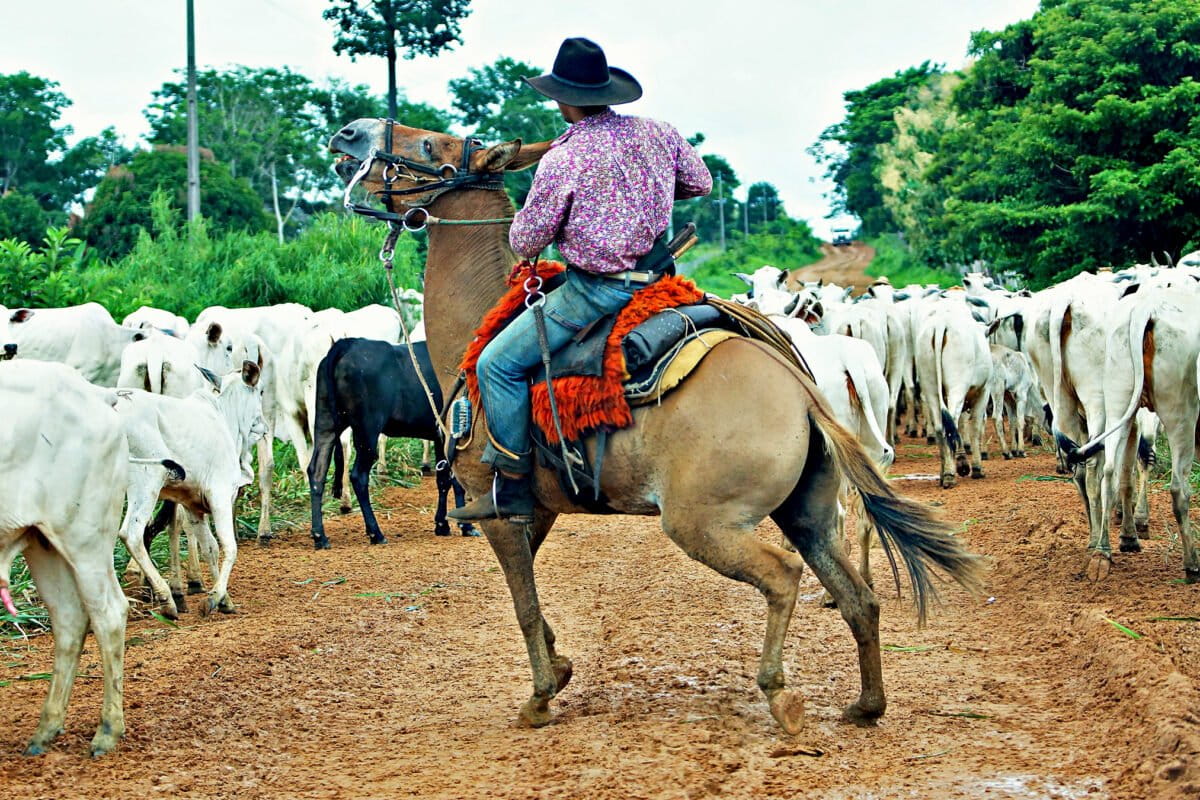
Banner image: A rancher with his cattle herd in Mato Grosso state. Image by Christopher Borges via Wikimedia Commons (CC BY-SA 3.0).
Brazil miner sees Indigenous land as ripe for exploration if protections expire
Cite this article
Aimee Gabay (2026). Ranchers in Brazil ordered to leave home of Indigenous people living in voluntary isolation. Mongabay Conservation news. DOI: https://doi.org/10.66709/news-334652

