


- A camera-trapping study in a protected area in northern Laos found community-led ecotourism plays a paradoxical role by reducing localized hunting pressure, but also scaring wildlife away from habitats around tourism hotspots.
- There were roughly twice the number of medium to large mammals on average in more remote parts of the forested landscape than at sites closer to trekking and kayaking routes, the camera-trap data showed.
- Experts caution against viewing tourism as a bigger threat to wildlife than more direct exploitation, such as hunting, logging and mining.
- They highlight the revenue that ecotourism generates and the support that it builds among local communities for conservation and sustainable livelihoods.
Clouded leopards, sun bears, and other medium to large mammals living in a protected but intensively hunted landscape in northern Laos might be selecting their forest hangouts based on the chatter of hikers and splashes of kayakers, according to new research.
The study, published in Global Ecology and Conservation, used camera-trap data from between 2013 and 2019 to investigate whether an award-winning community-based ecotourism initiative that has operated tours in Nam Ha National Protected Area since 1999 brings any benefits to local wildlife populations by creating a safe haven from hunting pressure.
“Hunting is a really integral part of the local culture, some of it legal, some of it illegal,” William Bleisch, lead author of the study and former program director at the Hong Kong-based China Exploration and Research Society, told Mongabay in an interview.
Bleisch said he and his colleagues were curious to find out whether tourism created “a kind of refuge” where people would forgo hunting either because they could see the economic and social benefits of wildlife tourism or because they were afraid of being reported by guides or tourists.
To test their theory, the team set up camera traps at 59 sites across the landscape, both within tourism hotspots and at more remote locations in the forest reserve.
They recorded a total 45 species of medium to large mammals across the whole landscape, including 15 globally threatened species. They found an average 4.58 species at sites close to trekking trails and kayaking routes, and almost twice as many species at sites farther away from tourism areas.
Bleisch said he was initially disappointed to find tourism doesn’t appear to have a refuge effect. However, he noted the legacy of hunting across northern Laos likely means wild animals are “just scared” of humans. “The animals don’t seem to make a distinction between benign tourists and hunters,” he said. “They just avoid places where there’s a lot of people.”
At the time of the study, customary subsistence hunting of nonprotected species outside of core conservation zones was considered legal, Bleisch said. However, “more dangerous” forms of sport hunting using high-powered weapons for protected species like sambar deer (Rusa unicolor) and gaur wild cattle (Bos gaurus) also occurred, he noted, as well as the use of wire snares capable of killing protected species.
As a result, it was possible to find a “whole cornucopia of dead animals” at the morning markets around the 222,400-hectare (549,600-acre) reserve, including slow lorises, giant squirrels, and critically endangered Sunda pangolins (Manis javanica), a protected species the study notes could soon be locally extinct given the proximity of the border with China and reports of illicit trade.
Sambar, a key hunting target, were one of three species identified in the study as most avoidant of tourism activity, alongside wild boar (Sus scrofa) and crab-eating mongoose (Urva urva). Eleven other species, including Asian elephants (Elephas maximus), golden jackals (Canis aureus), sun bears (Helarctos malayanus), and leopard cats (Prionailurus bengalensis) were also exclusively recorded in quieter, more remote areas, suggesting they might also be strongly avoiding humans, the study says.
In contrast, six species were only recorded in tourism areas, including marbled cats (Pardofelis marmorata), northern treeshrews (Tupaia belangeri), and black giant squirrels (Ratufa bicolor). Bleisch said these smaller predators and omnivores might benefit from the absence of larger species in tourist areas, reducing competition and predation pressure.

Paul Ouboter, director of Suriname-based conservation research organization NeoWild, who wasn’t involved in the research but did review the paper prior to publication, said the findings from Laos broadly reflect the patterns documented elsewhere in the world. Ouboter co-authored a 2021 study conducted in Brownsberg Nature Park in Suriname, for instance, that found most large mammals avoided tourism areas, with jaguars and pumas even adopting more nocturnal habits to minimize encounters with humans.
However, Ouboter cautioned against viewing tourism as a bigger threat to wildlife than more direct exploitation, such as hunting, logging, and mining. “We have seen that at Brownsberg Nature Park, so long as there are a lot of ecotourists walking on the trails, gold miners don’t expand into the park,” he told Mongabay, noting that when the park was closed during the COVID-19 pandemic, miners encroached and hunting increased.
“Ecotourism is still a good thing,” Ouboter said, noting its revenues help build support for conservation. “It can be a kind of shield to protect the area.”
Bleisch said further work would be needed in Nam Ha to fully understand how tourism might be reducing hunting pressure, and how hunting pressure influences mammal behavior. “Are these animals innately afraid of humans or is it learned?” he said. “Is it something that’s acquired from experience with hunting?”
The camera traps detected fewer hunters at tourism sites in Nam Ha compared to more remote parts of the landscape. However, formally quantifying hunting pressure by measuring snaring rates or hunting mortality would be an informative next step, Bleisch said.

For now, however, Bleisch said the evidence points to hunting as a key reason wildlife remain wary of people in Nam Ha. This impacts the animals and also undermines the potential for Nam Ha’s ecotourism businesses to truly flourish and contribute to local livelihoods, he said. “The tourism industry should take this seriously,” he said, noting an emerging union of tourism companies is taking steps to demand the government better protect the landscape.
Stricter habitat protection and controls on hunting should be key demands, Bleisch added, pointing to reserves in other parts of Asia, such as Nepal and India, where there’s little or no hunting and ample wildlife viewing opportunities.
However, a lack of state investment and withdrawal of overseas conservation funding is crippling conservation efforts in Laos. While past projects focused on patrolling and enforcement in core conservation zones in Nam Ha have successfully reduced hunting pressure, Bleisch said without sustained international support, the future of this globally significant landscape remains uncertain.
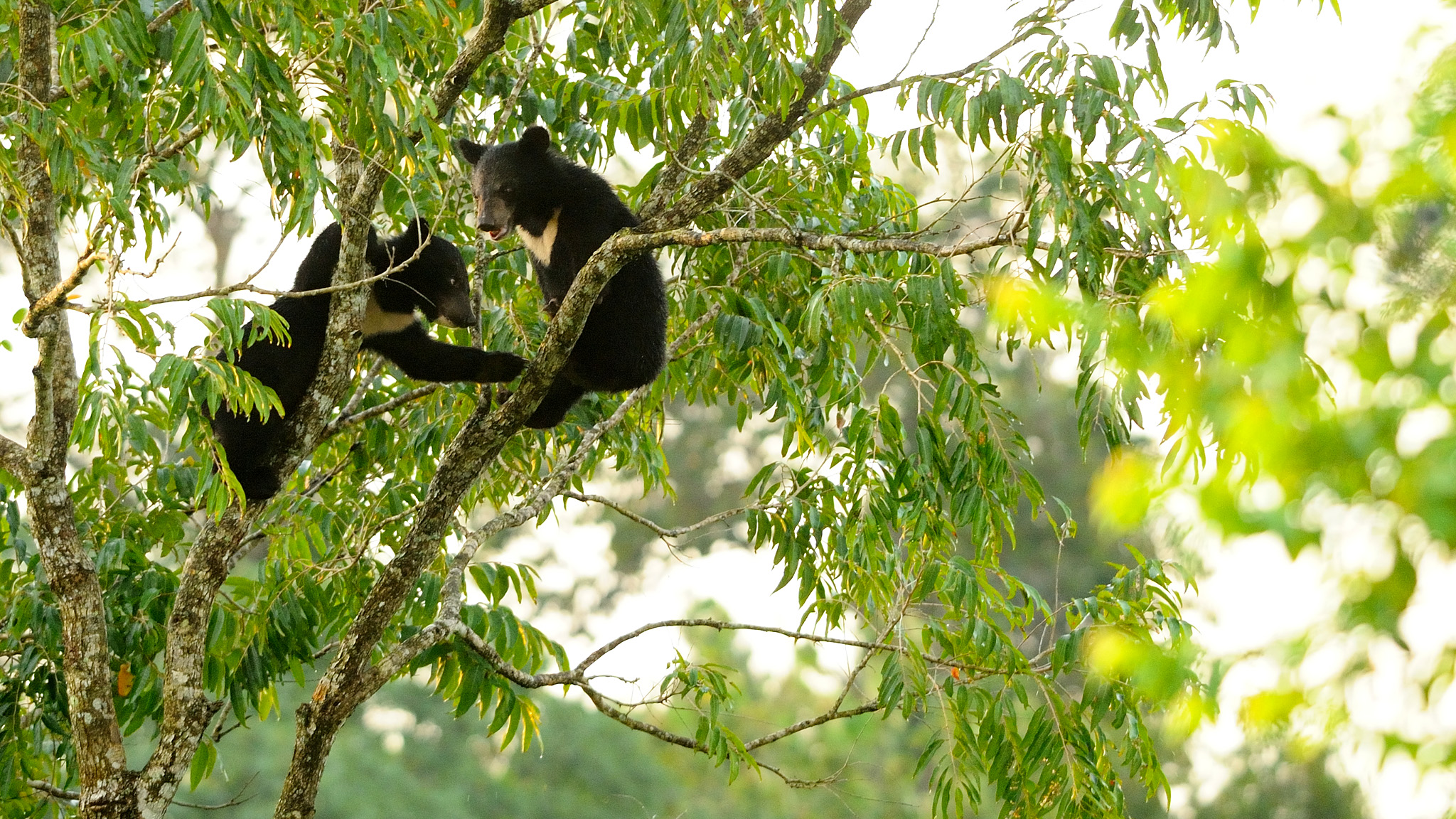
Banner image: Asian black bears were one of a high diversity of carnivores recorded in the Nam Ha landscape. These specific ones were photographed in Khao Yai National Park in Thailand. Image by Tontan Travel via Creative Commons (CC BY-SA 2.0).
Carolyn Cowan is a staff writer for Mongabay. Her reporting focuses on wildlife, ecology, and communities responding to environmental challenges across Southeast Asia.
Citations:
Bleisch, W. V., Buzzard, P., Weiser, F., Souliya, D., Khamvongxay, A., Eshoo, P., & Li, X. (2026). Wildlife-friendly tourism is associated with lower wildlife availability in the Nam Ha National Protected Area. Global Ecology and Conservation, 70, e04359. doi:10.1016/j.gecco.2026.e04359
Ouboter, D. A., Kadosoe, V. S., & Ouboter, P. E. (2021). Impact of ecotourism on abundance, diversity and activity patterns of medium-large terrestrial mammals at Brownsberg Nature Park, Suriname. PLOS ONE, 16(6), e0250390. doi:10.1371/journal.pone.0250390
See related story:
‘Action on the ground’ in Laos is needed to recover large mammals, protect more species
FEEDBACK: Use this form to send a message to the author of this post. If you want to post a public comment, you can do that at the bottom of the page.
Cite this article
Carolyn Cowan (2026). Ecotourism may deter hunters, but also keeps wildlife away, Laos study suggests. Mongabay Conservation news. DOI: https://doi.org/10.66709/news-334667

