


- A new study systematically mapped likely Philippine eagle nesting habitat on Mindanao, the Philippines’ second-largest island and the species’ main stronghold.
- Approved mining concessions overlap with 41% of highly suitable nesting habitat and 65% of its core areas, the researchers found, while only 35% of highly suitable habitat identified across the Eastern Mindanao Biodiversity Corridor lies within protected areas.
- Indigenous ancestral domains separately overlap with 65% of core high-quality nesting habitat, highlighting their importance to the species’ conservation.
- The study authors say their findings can help identify priority spots for conservation interventions.
A new study mapping the likely nesting habitats of the iconic Philippine eagle in its main stronghold warns that the threat of habitat loss — a key driver of its disappearance across much of its range — still looms large for the critically endangered species.
The study, published in Bird Conservation International, shows that approved mining concessions overlap with 41% of highly suitable nesting habitat and 65% of its core areas in eastern Mindanao, the Philippines’ southernmost and second-largest island. Only about 35% of the highly suitable habitat identified across the Eastern Mindanao Biodiversity Corridor falls within protected areas.
Indigenous ancestral domains separately overlap with 65% of core high-quality nesting habitat. (The figures do not necessarily represent the same areas, the study notes.)
“This study turns nearly four decades of field observations, nest records, GPS tracking and satellite information into something people can actually use,” study co-author Christopher J.W. McClure, vice president for global science at U.S.-based NGO The Peregrine Fund, said in a Sept. 24 statement issued by the Philippine Eagle Foundation.
“It helps us see where surveys and safeguards are needed most before important habitat is changed,” McClure added.
Juan Carlos Gonzalez, an ornithologist and curator for birds at the Museum of Natural History at the University of the Philippines Los Baños, who wasn’t involved in the research, said the findings are concerning because Philippine eagles (Pithecophaga jefferyi) already have limited suitable habitat inside protected areas and also persist in Indigenous-managed forests.
“Both represent the last stronghold for Philippine eagles in Mindanao, which make up the bulk of the surviving population,” Gonzalez told Mongabay by email.

Mining and nesting habitat
The study used 48 known nest locations, GPS tracking data from seven adult eagles, and remotely sensed information about vegetation, forest condition, and terrain.
The researchers modeled suitable nesting habitat across Mindanao, then mapped those sites against approved mining concessions, protected areas, and recognized ancestral domains.
Gonzalez said the study expands earlier research by projecting a continuous model across Mindanao and refining it through analyses of nesting hotspots and conservation gaps. He said the distribution data, information on nesting requirements, and statistical model selection provide “strong justification” for the results.
The authors caution that the presence of an approved concession doesn’t mean mining has begun or that eagle habitat has been destroyed. They say potential impacts depend on factors including the mining method, regulatory compliance, and environmental safeguards.
The maps instead identify areas where surveys and conservation measures should be prioritized, the authors write. They recommended systematic eagle surveys in concessions overlapping suitable habitat. Where proposed mining could affect breeding eagles, they call for temporary moratoriums while surveys and conservation assessments are completed.
Once important nesting areas are confirmed, the study recommends legally protecting them from mining and other extractive activities and establishing appropriate buffers.
The Philippine Eagle Foundation cited the Cabuaya-Luban landscape in Davao Oriental province as an example of a nest discovery followed by land-management changes.
After a nest was found there, authorities in Mati, the provincial capital, established a 7,000-hectare (17,300-acre) eagle sanctuary in 2005, the foundation said. Mining concession holder Asiaticus Management Corporation subsequently waived a similar size of its claim, to be protected as eagle habitat, according to the foundation.
The study authors also say that forests without recorded eagles should not automatically be treated as unimportant. Such areas may provide future nesting habitat, climate refuges, or dispersal routes. Satellite tracking cited in the study documented young eagles moving through riverside forests and smaller forest patches between larger forest blocks.

More than forest cover
Gonzalez said the amount of remaining forest alone doesn’t determine whether Philippine eagles have enough suitable places to breed.
Nesting pairs of eagles require tall, mature trees with trunks and branches wide enough to support their nests and withstand strong winds and rain, he said. Nest trees must also provide perches for adults and juveniles, and aerial plants that help form and protect nesting platforms.
According to Gonzalez, forest degradation and logging of large trees have reduced the number of potential nest sites, even in areas when some forest remains. He said the harvesting of large epiphytes, including giant Grammatophyllum orchids and aerial ferns, may further reduce suitable platforms.
“Nest habitat hotspots and nest habitat use are crucial to the survival of Philippine eagles, as we need to ensure breeding and natural pair selection in the wild to maintain genetic diversity,” Gonzalez said.
He added the overlap mapped in the study raises questions about whether mining and wildlife conservation can coexist in an archipelagic country with limited land and many island-endemic species.
“If we cannot help protect our national emblem from the impacts of mining activities, and offer no sufficient mitigation to prevent further habitat loss, then it would be definitely difficult to resolve issues for other wildlife species in the Philippines,” Gonzalez said.
He described the eagle, the Philippines’ national bird, as a keystone and flagship species and “the proverbial canary in the coal mine” for other Philippine wildlife.

Indigenous lands and eagle conservation
The study describes Indigenous forest guards, nest wardens, and community researchers as contributors to nest searches, eagle monitoring, and forest protection. The authors recommend stronger partnerships, Indigenous-led monitoring, and recognition of Indigenous knowledge systems and practices.
“For many years, Indigenous forest guards have walked these mountains with our biologists,” co-author Dennis Salvador, executive director of the Philippine Eagle Foundation, said in the foundation’s statement.
“They have helped find nests, monitor eagles and protect forests,” Salvador added. “This study now shows on a much bigger map what we have seen on the ground: protecting the Philippine eagle means working closely with the Indigenous communities who care for many of its most important forests.”
Gonzalez said the overlap between ancestral domains and core nesting habitat demonstrates the linked importance of biological and cultural diversity.
“We also need to emphasize the value of both biological and cultural diversity in the Philippines, and the contribution of Indigenous peoples as stewards for conservation,” he said.
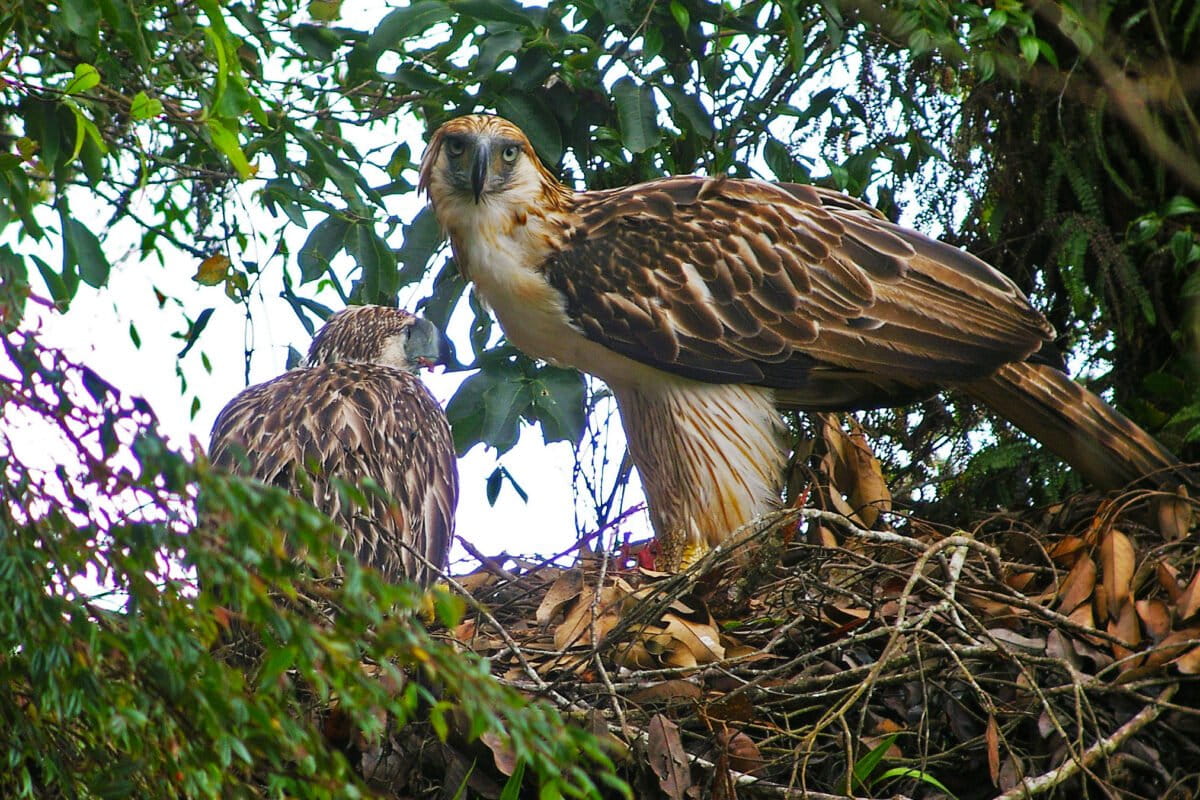
Banner image: A mother Philippine eagle, Aya, and her young in their nest at Mount Hamiguitan, Cabuaya, in 2005. Image courtesy of the Philippine Eagle Foundation.
Study warns up to a quarter of Philippine vertebrates risk extinction
Nickel mining damage near UNESCO site stirs outrage in southern Philippines
Citation:
Sutton, L. J., Ibañez, J. C., Salvador, D. I., Tirona, A. V. M. C., Opiso, G. S., Senarillos, T. L. P., … McClure, C. J. W. (2026). Directing conservation action for the Critically Endangered Philippine Eagle Pithecophaga jefferyi to mitigate mining impacts and maximise indigenous land management. Bird Conservation International, 36, e33. doi:10.1017/S0959270926100586
FEEDBACK: Use this form to send a message to the editor responsible for this story. If you want to post a public comment, you can do that at the bottom of the page.
Cite this article
Keith Anthony Fabro (2026). Philippine eagle habitat study maps mining risks and conservation priorities. Mongabay Conservation news. DOI: https://doi.org/10.66709/news-331291

