


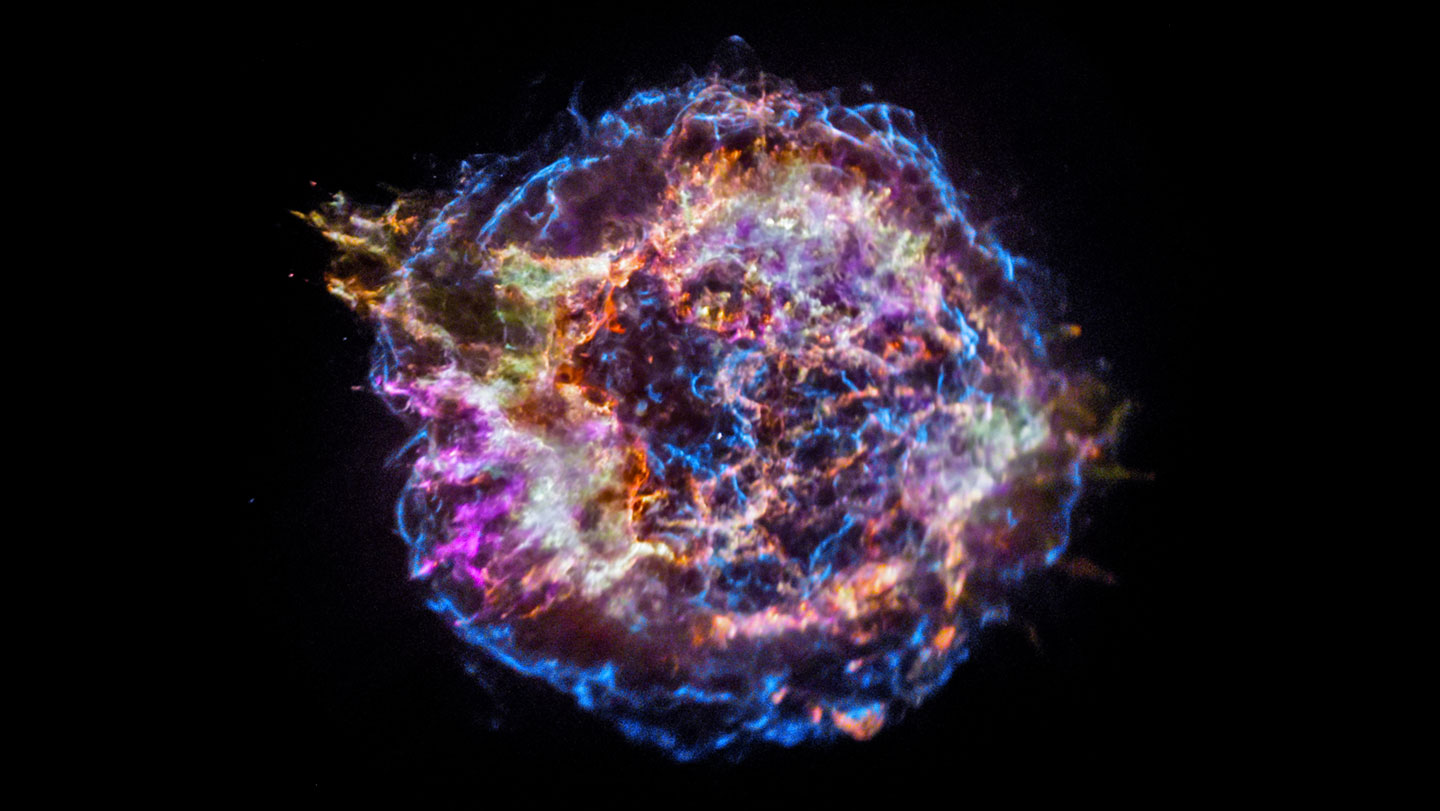
Chemical traces in some oddball stars hinted at the existence of hypernovas — a type of hyper-energetic supernova. But new mathematical models are questioning the hype on hypernovas.
Models of how elements mix across generations of stars suggests the parentage of stars attributed to hypernova events might have been standard supernovas and other relatively common cataclysmic stellar events instead, researchers report in the September Monthly Notices of the Royal Astronomical Society.
“The evidence for [hypernovas] is now very seriously challenged,” says astrophysicist Ralph Schönrich of University College London.
Not everyone is fully convinced of the change in the stars’ proposed origins, including astronomer Anna Frebel of Massachusetts Institute of Technology, who thinks both supernovas and hypernovas remain plausible candidates as the stars’ parents. Frebel notes, however, that the findings are a good reminder for astronomers to be careful about claiming uniqueness.
Astronomers look for clues to a star’s origins in the elements it contains. When an earlier star dies, it releases elements into space, sometimes in a supernova explosion. That material mixes with gas that may eventually form new stars. Different kinds of explosions leave different chemical patterns, so the relative amounts of elements in a star can help astronomers work out what happened before it formed.
But tracing a star’s origins this way depends on knowing how elements from an earlier explosion spread through space. Models have often treated a supernova’s expelled material as though it mixes evenly with the gas that forms new stars. The new research accounts for observations and computer models that have shown that these explosions can spread elements asymmetrically. For example, a clump of a supernova’s oxygen might go preferentially in one direction and nickel another. While the ejected elements get mixed with other dust and gases in interstellar space, the overabundance in some areas isn’t likely to average out, especially in the earliest generations of stars, which have fewer heavy elements, Schönrich says. As a result, two stars forming on opposite sides of a supernova site could have different compositions.
This isn’t surprising for astrophysicist Adam Burrows of Princeton University, who studies supernovas and was not involved in the research. Burrows says that the idea of irregular mixing from these events is well known among supernova researchers but not well shared with astronomers who study the evolution of galaxies and generations of stars. “They’re taking seriously what we have seen for a long time,” Burrows says.
Accounting for this uneven spread of materials, the researchers created a mathematical model to see if the element ratios produced from lopsided explosions could match the mix seen in some unusual stars in the Milky Way’s halo, the galaxy’s outer sphere of stars that contains a lot of old stars that are low in heavy elements. Previously, researchers thought the ratios of elements in these stars couldn’t have formed by regular events alone and proposed hypernovas as their source. But the researchers found their model matched the observed element ratios as well as or better than the hypernova model.
“A good fit tells us that a particular enrichment scenario is possible, but it does not necessarily tell us that it is the only scenario,” Frebel says. While ordinary supernovas may explain these stars’ chemistry, she says, the new models don’t rule out hypernovas.
Regardless of where these oddball stars came from, astronomers agree the results show that more studies on supernovas and gas mixing are needed.
