


Welcome back to Foreign Policy’s Latin America Brief.
The highlights this week: Brazilians prepare to vote in general elections, the United Nations Security Council extends its security mission in Haiti, and Colombian designers strut their stuff at Northern Hemisphere fashion weeks.
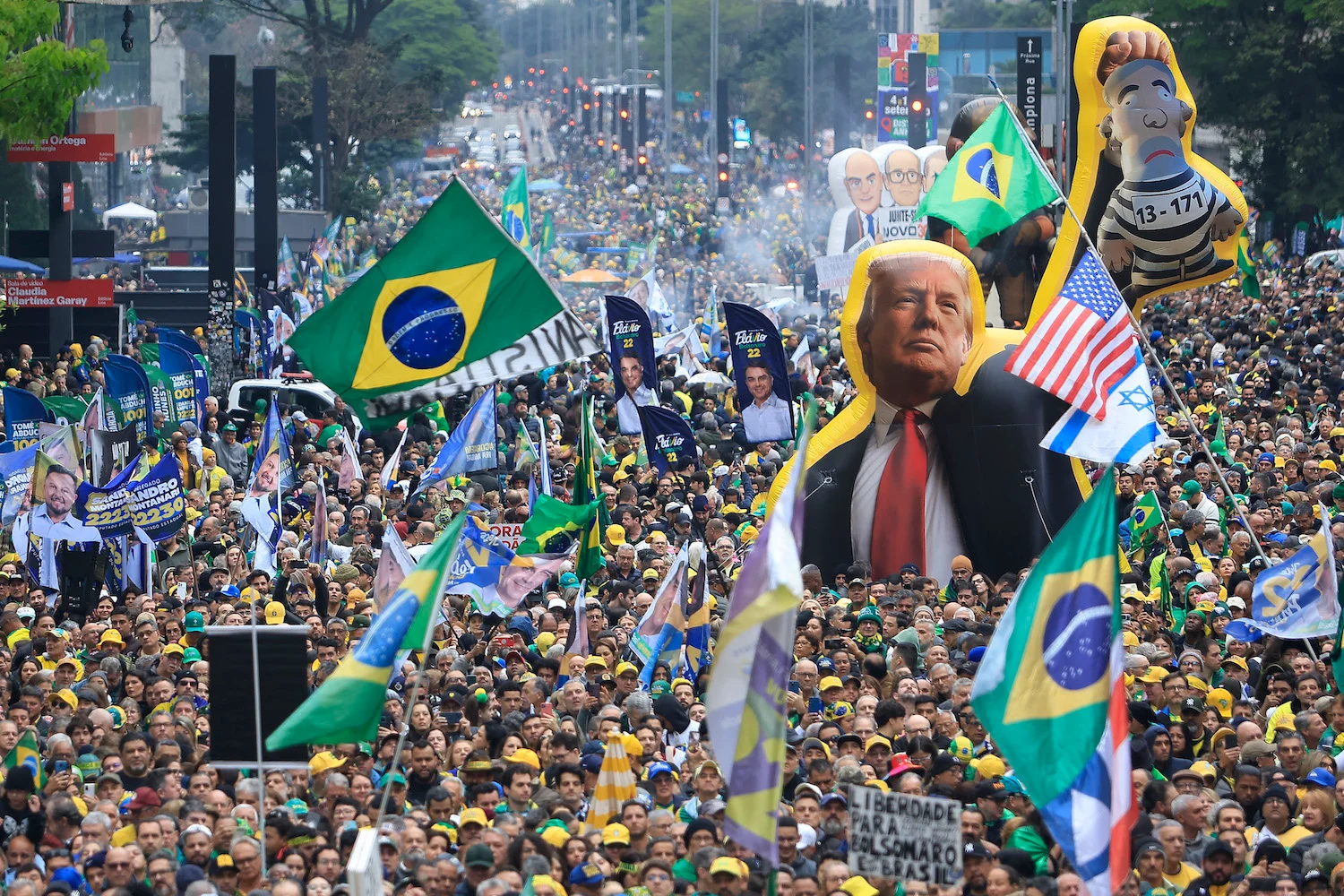
On Sunday, Brazilians will vote in general elections. The contest is set to be one of the biggest tests yet of how Latin Americans are feeling about U.S. President Donald Trump’s aggressive policies toward the region.
A dozen candidates are running for president. Polls suggest a tight race between the top two contenders: left-wing President Luiz Inácio Lula da Silva and right-wing Sen. Flávio Bolsonaro. They champion dramatically different visions for the country’s foreign policy, environmental policy, and treatment of democratic institutions.
Flávio Bolsonaro is the eldest son of former President Jair Bolsonaro, who remains under house arrest for plotting a coup following his 2022 election loss to Lula; the younger Bolsonaro has pledged to pardon his father. Bolsonaro lagged behind Lula in the polls as recently as July, when he struggled to attract a running mate who could diversify his ticket. He settled for a male candidate from his own Liberal Party (PL), and his first rallies were sparsely attended.
But Bolsonaro’s poll numbers have risen in recent weeks, and he and Lula are now neck and neck. His bump followed wall-to-wall media coverage of allegations of corruption by a Supreme Court justice seen as an ally of Lula—and skilled campaigning by PL leaders. If no candidate wins at least 50 percent of the vote on Sunday, the top two finishers will proceed to an Oct. 25 runoff.
PL President Valdemar Costa Neto has proved himself the “best political operator in Brazil” through both digital campaigning and training local candidates across the country, political scientist Jairo Nicolau said last week. He predicted broad wins for the PL at the federal and state levels, which would create pro-Bolsonaro momentum in the presidential race.
Each presidential candidate has been trying to chip away at constituencies that may have supported the opposite side in 2022. A few recent Foreign Policy pieces look at how and why.
Journalist Thayz Guimarães examined the politics of Brazil’s defense sector. Many in Brazil’s military historically voted for Jair Bolsonaro, and some took part in his failed coup attempt. A handful even planned to assassinate Lula, according to police.
But for the first time in his seven presidential runs, Lula has made strengthening Brazil’s defense sector a main campaign pledge, Guimarães reports. Lula has framed his new focus on military spending as a means to boost Brazil’s sovereignty amid U.S. aggression in the Western Hemisphere. It could also give military members a reason to support him.
Flávio Bolsonaro, meanwhile, has pledged close ties to Trump and vowed to join his militaristic anti-crime initiatives—a potential wedge issue in the election. Brazilians’ opinion of the United States has fallen under Trump, and many in Brazil’s foreign-policy community are wary about his push for greater U.S. influence over the country’s critical industries, I reported last month.
The PL is also trying to improve its record with female voters by elevating the profile of Michelle Bolsonaro. The former first lady, who is running for a Senate seat, uses the language of female empowerment to spread a message that “women could enter public life without giving up their identities as wives, mothers, and Christians,” social scientist Beatriz Della Costa writes.
Finally, Flávio Bolsonaro has sought to deepen his support within Brazil’s financial sector. Though the sector is historically friendly to right-wing candidates, influential former central bankers publicly backed Lula in 2022, saying that authoritarianism was a major risk to Brazil’s future.
Today, Bolsonaro appears to be trying to cement approval in the sector by pledging to slash Brazil’s deficit. Brazil’s hefty national debt is a significant problem—but keeping fiscal reform alive in Brazil’s fractured legislature is notoriously difficult, writes Adam Goldsmith, a former U.S. Treasury Department attaché in São Paulo.
Bolsonaro has not provided many details about his economic plans, but one of his top advisors has praised President Javier Milei’s policies in Argentina.
These three groups—the military, women, and financiers—are just some of the constituencies that Lula and Flávio are hoping to court before Sunday. Millions of voters still report being undecided or plan to vote for other candidates. We’ll be back next week with an update on how the candidates’ efforts to swing votes turned out.
Friday, Oct. 2: The Organization of American States (OAS) holds a foreign ministers’ meeting on Nicaragua.
Sunday, Oct. 4: Brazil holds presidential and legislative elections.
U.S. sanctions political, business figures. On Monday, the Trump administration announced a wave of visa restrictions on political and business figures in Bolivia, Colombia, Ecuador, and Peru. All countries have pro-Trump leaders and participate in the hard-line Shield of the Americas security initiative.
Washington claims the sanctioned individuals are connected to corruption or narco-trafficking but did not provide evidence. Many of them are linked to the political left.
Those sanctioned include a judge in Peru who recently ruled in favor of a Chinese company’s presence at the new Chancay megaport and Bolivian Attorney General Roger Mariaca, who was investigating a right-wing digital propagandist dubbed “MAGA’s man in LatAm” on charges of attempted femicide.
Mariaca said this week that the sanctions were a retaliation for his work. Bolivian police arrested him on Wednesday, and Bolivia’s interior minister said the next day that Mariaca was under investigation for criminal organization, money laundering, and drug trafficking.
LatAm-China trade watch. Last week’s China-U.S. tariff reduction was closely watched in Latin America, where countries upped their agricultural exports to China—especially soybeans and beef—following Trump’s trade war with the country last year. Beijing and Washington announced that they would reduce tariffs on $60 billion worth of bilateral trade.
For now, Brazilian agribusiness appears to have dodged at least one bullet: The tariff stepdown excluded soybeans, a major Brazilian export to China. Argentine trade specialist Miguel Poncé told Perfil that the U.S.-China announcement was “more noise than substance” because the two superpowers did not immediately specify the level of their tariff reductions.
Still, Brazilian farmers have another reason to worry about their sales to China. Beijing has been stepping up efforts to protect its local beef industry and this year put in place an annual quota for imported Brazilian beef before charging steep tariffs. Brazil hit that quota in recent days, triggering a 55 percent beef tariff.
China’s targets for self-sufficiency in food production over the next few decades are a medium-term worry for Brazilian farmers. Brazil’s efforts to diversify its trade relations and seek new markets for its exports—such as via trade talks at Mercosur—are thus a response not only to U.S. restrictions but also to Chinese ones.
Models walk down the catwalk in clothes by the Colombian brand Palma Canaria during Medellín Fashion Week in Medellín, Colombia, on July 30.Jaime Saldarriaga/AFP via Getty Images
Textiles take flight. Latin American designers expanded their presence in the Northern Hemisphere’s fall fashion week circuit in September. In addition to New York Fashion Week, Bogotá’s Chamber of Commerce sent designers to the Paris and Dubai events for the first time as part of its PUENTE project, which seeks to expose Colombian designers internationally.
The project featured lines such as Adriana Capasso, Day Moda Sostenible, and self-described ethical knitwear company Franchi e Punto. PUENTE doesn’t just hope to up the designers’ pedigree. It also aims to boost sales for Colombia’s hefty textile sector, which has been a target of industrial policy in recent years.
The designers’ participation overseas nods to the fact that Latin America is a fashion powerhouse in its own right. The Southern Hemisphere’s largest fashion week, in São Paulo, is set for later this month.
One of the most famous Latin American fashion designers is Carolina Herrera. Where was she born?
Mexico
Colombia
Argentina
Venezuela
Herrera was born in Caracas in 1939 and has been based in New York since 1980.

U.N. Secretary-General António Guterres meets with Chadian soldiers who are part of the international Gang Suppression Force in Port-au-Prince, Haiti, on June 16. Amélie Bottollier-Depois/AFP via Getty Images
On Tuesday, the United Nations Security Council renewed its endorsement of an international security force to fight gangs in Haiti for six more months.
The force was approved by the body around a year ago. It was pitched as both larger and more lethal actor than its predecessor, a Kenyan-led mission installed in 2024 that did not grow beyond around 1,000 personnel and did little to dent gang control.
The new force has also been underwhelming. Although the Security Council greenlit the deployment of 5,500 troops from multiple countries last year, only around 1,500 had arrived as of last month. Gangs still control up to 90 percent of Haiti’s capital, Port-au-Prince, by some estimates.
Despite those shortcomings, the force’s renewal represented a rare U.S. endorsement of multilateral action—and the U.N. system—under Trump. The United States co-sponsored the renewal resolution.
Last year, as Trump evaluated whether he would continue backing the OAS, he said he would like to see the body devote more attention to Haiti’s security crisis. The OAS has pushed for the security mission, and the United States has not exited the organization as it has other international bodies, such as UNESCO.
The international force in Haiti will soon have a chance to prove its worth: The country is preparing to hold its first presidential election since 2016 in December. National lawmakers are also due to be chosen. If that contest goes ahead safely and fairly, it could help Haiti move past its current crisis.
