


- In July, the European Commission confirmed leather’s exclusion from the EU Deforestation Regulation (EUDR) — this week, the change became official.
- The leather sector’s EUDR exemption is a victory for an industry that has lobbied hard for its removal, but challenges remain ahead of the deforestation regulation’s 2030 review, when policymakers will reassess whether hides should comply with deforestation rules.
- The industry is now seeking to rebuild its reputation through science, voluntary standards and stronger supply chain traceability, executives attending the Sustainable Leather Forum in Paris said, but traceability remains one of the sector’s biggest obstacles.
- Leather representatives maintain that hides’ low economic value means leather should not be held responsible for the environmental impacts of cattle production, but environmental group Earthsight has called the argument “misleading.”
PARIS — The prestigious Maison de la Chimie in central Paris hummed with confidence as leather representatives gathered to discuss the industry’s next steps to tackle what they call an unfair “negative perception” attributed to the material.
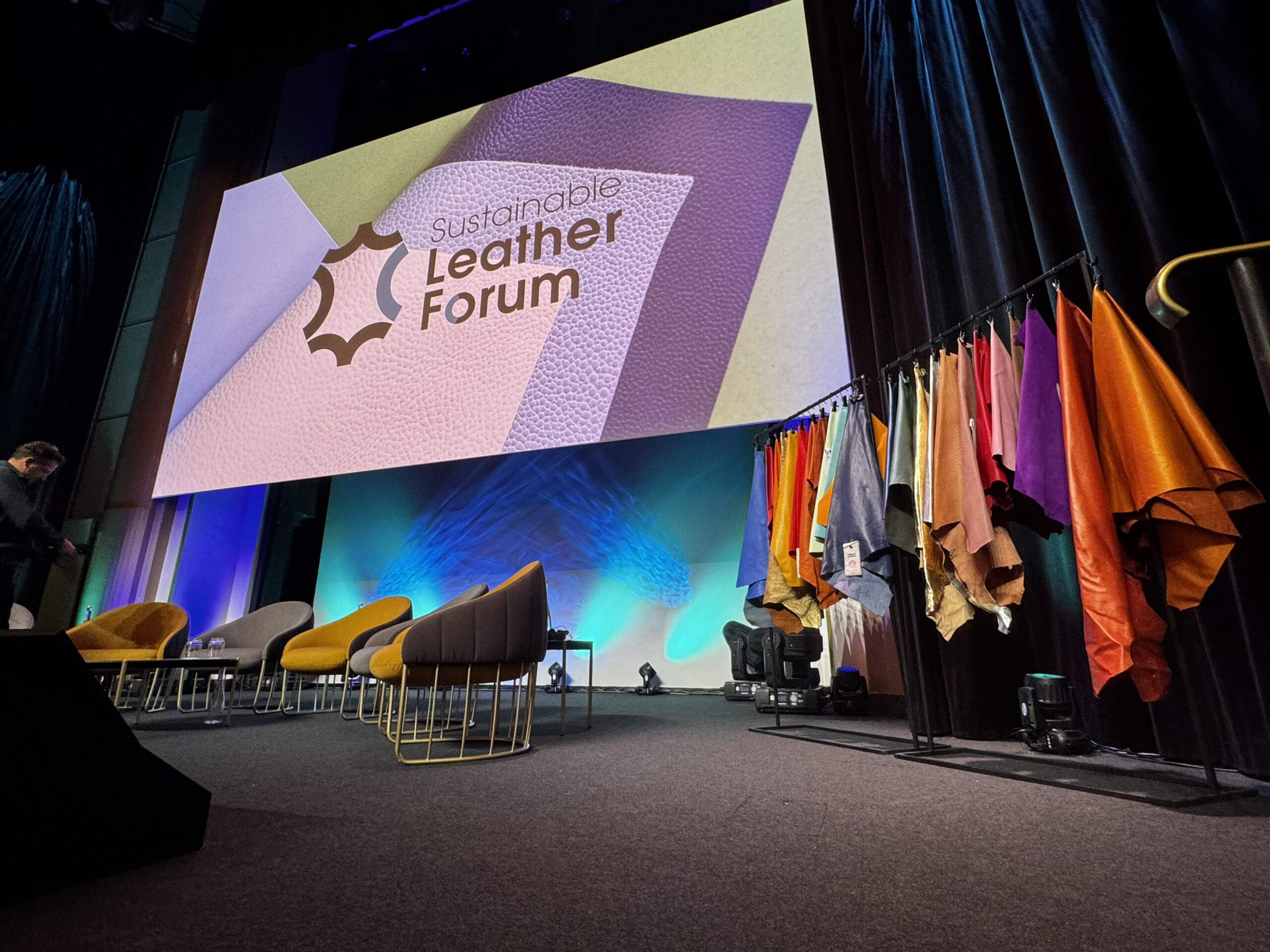
On Sept. 7, around 400 international tanners, luxury-brand representatives and meatpacking executives gathered for the eighth Sustainable Leather Forum. Speaking to their peers, panelists presented leather as a cornerstone of the circular economy: A way to make use of bovine hides that might otherwise go to waste.
Beyond the ornate halls of the 18th-century mansion, after intense lobbying, the EU has exempted leather from its landmark deforestation law while simultaneously keeping restrictions on beef. Critics say this creates a regulatory contradiction: Products from the same cow will be allowed to enter Europe under two very different sets of rules.
This juxtaposition has sharpened a long-simmering debate: If beef importers must prove their products are deforestation-free, why would hides from the same animals enter Europe with no equivalent oversight?
Environmental and supply chain researchers argue the exemption creates a loophole that effectively splits responsibility for a single production system and this ultimately weakens the law.
For industry representatives interviewed by Mongabay, the sector faces a reputational crisis. The EUDR did a “disservice” to a well-intentioned sector that benefits the environment by recycling a byproduct that otherwise would be discarded, a tannery executive said.
Indeed, according to the Leather and Hide Council of America (LHCA), a U.S. trade association, around 40% of cowhides produced globally go to waste.
A looming 2030 review
Following several months of intense lobbying in Brussels, the leather sector won the exemption for which it had fought so hard: In July, the European Commission formalized its decision to remove bovine hides from the list of commodities covered by its landmark anti-deforestation regulation (EUDR).
That process reached its final administrative step when the scrutiny period by the parliament and the European Council expired on September 14. The commission’s delegated act took effect, as no objections were raised.
However, the commission did not close the door permanently on future accountability or say that leather supply chains were clean. In fact, according to its own estimates, leather could have accounted for up to 17% of the total deforestation risk among products imported into the EU, an assessment highly contested by leather groups.
The commission effectively said that bovine hides were too economically marginal — and too difficult to regulate — to remain covered by the law for now. This amendment was published on July 13 and the law is currently set to take effect at the end of this year, following two years of delays and intense lobbying.
In the final comments of the amendments, the European Commission said that excluding leather might simply relocate rather than eliminate deforestation risks. Consequently, the regulation mandates a formal review of leather’s status in 2030, leaving the industry with a few years to demonstrate that voluntary systems can identify risks that the law will no longer require brands to investigate.
For leather companies, the political calculation is straightforward: Use the period before 2030 to prove that the sector can police its own supply chain.
“We will still need to see actually what the policies will be there in 2030, but that’s the next step,” said Edoardo de Paola, secretary general of COTANCE, an association representing European tanneries, at the Sustainable Leather Forum. “This is something we will need to debate on.”

De Paola acknowledged that this is a “point of concern”, considering the political scenario ahead of the review: “In 2029, there will be the EU elections, and an EU Commission adopting a maximalist approach in terms of environmental protection might be favorable to include leather in the EUDR.”
Leather representatives told Mongabay in the corridors of the event that it is crucial for the industry to solidify its message that the material is a byproduct of cattle and, therefore, should not be treated similarly to beef when it comes to environmental impact.
Changing the narrative with science
A way of tackling the issue is to make the case for leather’s sustainability credentials with scientific evidence, De Paola said. On stage, in a building that was built three centuries ago and officially dedicated as a space for scientific knowledge in 1934, he urged his peers to invest in more research to counter arguments posed by environmentalists and regulators.

“The perception of leather is generally negative among European Commission bodies,” he said. “I believe that this is because of a lack of studies fostering sustainability for the leather sector compared to alternative ones. When a policymaker writes a policy, essentially it bases its own choices on the available research studies.”
Indeed, when it comes to refuting links to deforestation, the European leather industry has relied mostly on a single study to back up claims it has made in public statements, presentations and communications with policymakers. Published by Italy’s Sant’Anna School of Advanced Studies in 2024, the report was funded by leather groups and has not yet been peer-reviewed.
Same cow, different rule
To defend its interests, the industry’s central argument is simple and based on economic asymmetry: Leather does not drive cattle production; it’s low value and is far removed from the cause of deforestation. According to COTANCE’s De Paola, raw hides account for roughly 1.5% of an animal’s value at slaughter.
Tanneries argue that they have limited leverage over cattle producers because the animal will be slaughtered for meat regardless of whether a tannery buys its hide. Rejecting one shipment, they say, may simply send the hide to another buyer.
“We are portrayed as an environmental pariah,” an attendee who preferred to remain anonymous told Mongabay. “It’s ridiculous to be held responsible when we have no control over this [deforestation]. The tanneries don’t tell us anything.”.

The economic argument, however, does not change the biological link between beef and leather, environmental groups say.
The question for leather is whether similar systems should be used to determine the origin of hides — even without a legal obligation under the EUDR. Miki Ng, a researcher at the environmental campaign group Earthsight, told Mongabay that if leather is genuinely a marginal byproduct, the industry should have little to lose from basic traceability and deforestation-free sourcing requirements.
“The argument that leather should be exempt because bovine hides have relatively low economic value is also misleading,” Ng said. “The European Commission’s own analysis recognises that hide sales can represent significant earnings for companies in the cattle sector that often run on narrow margins. More importantly, leather is part of a highly profitable global value chain that depends entirely on the same cattle supply chain as beef.”
The European Commission’s analysis, conducted to support the proposed regulations, was rooted in the assumption that low economic value does not necessarily mean low environmental significance.
It found that the environmental benefits of retaining leather in the EUDR could be substantial even though the hides themselves represent only a small fraction of the animal’s economic value. The commission estimated that keeping leather under the regulation could deliver between €979 million and €1.96 billion ($1.1 billion-$2.28 billion) in annual environmental benefits, while compliance costs would be about €16.7 million ($19.4 million) a year.
A falling-value material
There is little doubt that the economic value of hides has weakened in the last decade. A 2025 Reuters report citing Brazilian tannery DurliCouros said hides worth about $59 in 2014 were selling for roughly $5, equivalent to around 0.5% of the value of the cattle head. The company attributed this to weaker demand for leather products, as well as to oversupply.
Similarly, Kim Sena, sustainability director at JBS Couros, the leather arm of giant meatpacker JBS, highlighted the deterioration in the price of bovine hides — the only byproduct to have registered such a decrease in value in this market.

In the last 15 years, the market value of bovine hides has plummeted by 88%, Sena said. The calculation was based on the company’s data and information from the Center for Advanced Studies on Applied Economics (CEPEA) at the University of Sao Paulo (USP), the Brazilian consultancy group Scot Consultoria, and ABRA, the nonprofit trade association representing the animal rendering and recycling industry in Brazil.
Consumer behavior
The industry’s other challenges are competition from different materials, affordability and a shift in consumer behavior.
“In 2000, the global production of shoes was 12 billion pairs of shoes,” Luca Boltri, deputy director at UNIC, the Italian association of tanneries, told the forum. “In 25 years, the production of shoes globally doubled. I don’t think that the production of leather for shoes doubled in the last 25 years. This means that we have lost some shares.”

According to UN Comtrade, EU imports of raw hides and leather fell nearly 60% from $3.95 billion in 2015 to $1.73 billion in 2025. Over the same period, imports of plastic-coated textile fabrics used as leather substitutes, known as HS 5903 under the global product classification system, rose nearly 80% in value.
Measuring consumer preferences is difficult and evidence of their behavior is scarce, industry representatives said during the event. The recurring argument was that while affordability remains a powerful constraint, younger shoppers, especially in Europe, are more likely to look for second-hand fashion and for alternative materials as they increasingly question the material’s supply chains for environmental concerns and animal welfare.
In February 2025, consulting firm GlobeScan and online fashion platform Zalando surveyed 5,013 Gen Z and millennial consumers across France, Germany, Italy, Sweden and the UK. They found that 71% aspired to shop more sustainably, while 66% said they were already making more sustainable fashion choices.
“We talk amongst ourselves a lot about what we know about leather, but we [the industry] have failed in the past to tell the story or to highlight and display this information in the language that everyone talks, which is scientific communication”, UNIC’s Boltri said, highlighting how the industry wants consumers to see leather as natural, durable, repairable and not a driver of deforestation.
The traceability test
Critics want consumers to ask where the cattle came from. This brings the debate back to the issue that the tanning industry has most struggled to resolve: traceability.
The European leather sector has developed standards, including EN 18199, intended to establish minimum levels of traceability and allow different certification systems to recognize one another.
But the difficult part is upstream. Brazilian cattle supply chains are a well-known example of how mammoth this challenge is. Direct suppliers can be identified easily, but ranchers may move cattle from property to property, making it hard to determine where they might be linked to deforestation.
The sector relies heavily on public databases, animal transit guides (GTAs) and political willingness. While private systems exist, the lack of a unified national animal identification system means that indirect suppliers remain a blind spot for companies in Brazil, critics say.
As a result, the impact of cattle ranching on deforestation and human rights violations is widespread. Pasture expansion for cattle is the single largest direct cause of forest loss in the Brazilian Amazon and surrounding biomes. Several reports have linked cattle ranching — and leather — to a complex network of legal and illegal farms supplying the most relevant slaughterhouses in the country, with international connections.
“Bovine leather cannot exist without cattle production, and cattle remain the world’s largest driver of tropical deforestation,” Earthsight’s Ng said. “Reducing the debate to the price of a hide allows the industry to evade its responsibility for the upstream environmental impacts of its key raw material.”
If the sector can demonstrate that hides are genuinely traceable and that leather companies can identify and exclude high-risk cattle, it will have a stronger case when policymakers revisit the regulation in three years.
Banner image: Sustainable Leather Forum, Paris, September 2026. Image by Elisângela Mendonça.
Cite this article
Elisângela Mendonça (2026). Now exempt from EU deforestation rules, leather industry moves to repair reputation. Mongabay Conservation news. DOI: https://doi.org/10.66709/news-330162

