


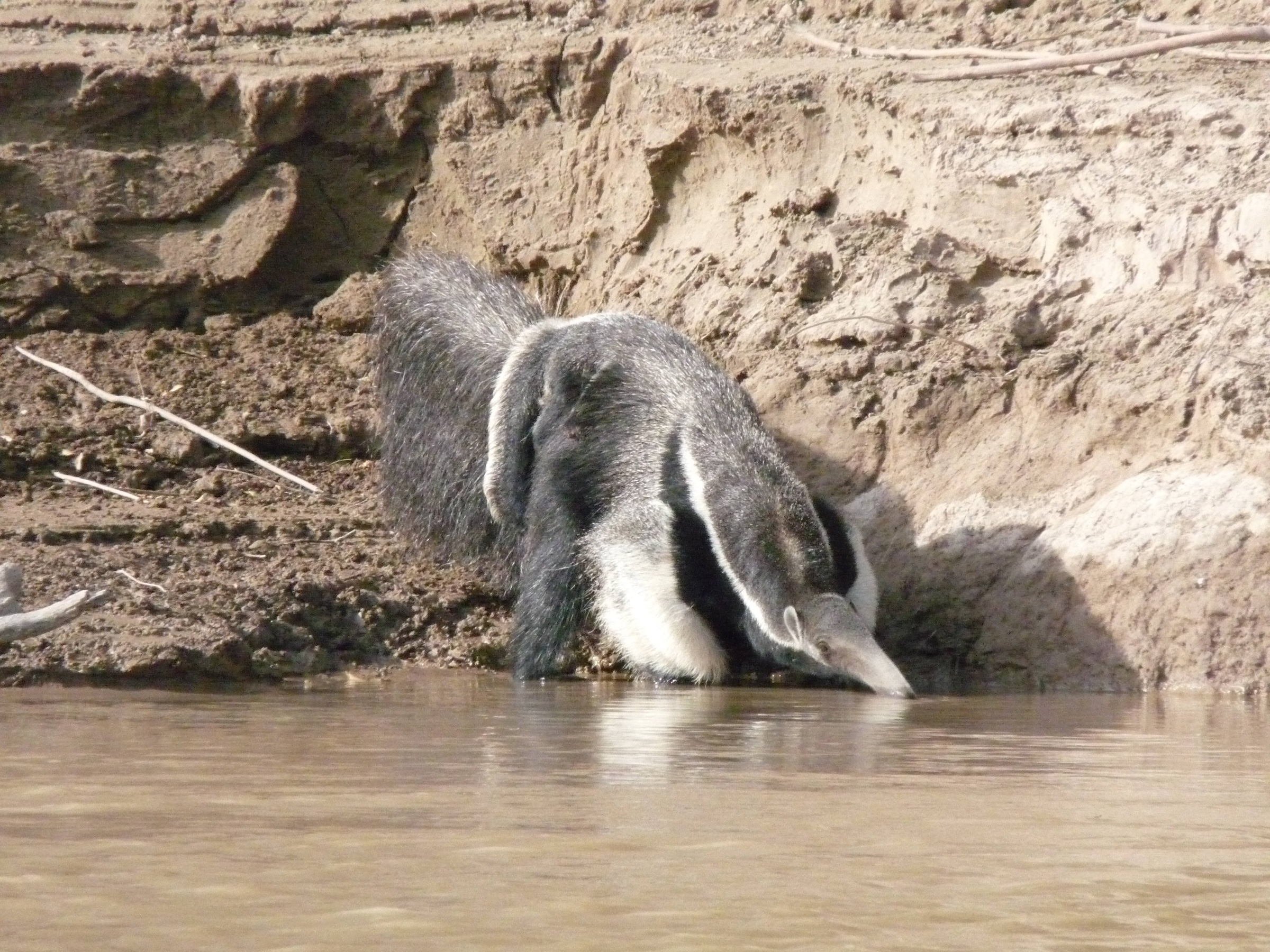
- The return of a giant anteater to the protected area in the humid Gran Chaco in Argentina has given researchers hope that ecosystem restoration could help restore biodiversity in an area threatened by habitat loss and agriculture.
- Passive restoration in the area meant removing pressures on the landscape from livestock, dogs, hunting, and fishing, which allowed the natural vegetation to recover.
- Experts say it’s too early to say if the anteater’s return is the start of the species’ recovery or just a one-off, and call for continuous monitoring.
In 2025, a giant anteater returned to the Alma Guaraní reserve in Argentina’s Corrientes province. It marked the first sighting of this vulnerable and emblematic mammal in the region since 1986. That return is believed to be the result of restoration work that began in the reserve in 2021, according to a paper published in Restoration Ecology, which makes the case that passive restoration in particular may have triggered the species’ return to the area.
“It was the first register of the giant anteater in 40 years in Corrientes province, and it was spontaneous,” said co-author Rosario Montiel, from the National University of the Northeast and CEO of climate and environmental startup RestoreData. “We think that in this area, in this reserve, this animal has found food and all its needs to settle there.”
It’s not known where the giant anteater came from. Montiel and colleagues suggest the individual, thought to be a male, may have crossed over from neighboring Chaco province, swimming across the nearby Parana River when water levels hit a historical low in 2024.
Giant anteaters (Myrmecophaga tridactyla) are classified as vulnerable on the IUCN Red List. Habitat loss is a major threat, driven primarily by the expansion of agriculture and livestock ranching, and is behind much of the species’ decline across Argentina and the wider Gran Chaco region. Infrastructure development, such as increasing road networks, and hunting are also significant threats. Anteaters are caught for the pet trade and accidentally killed by hunters’ dogs.
These pressures still exist throughout the landscape and could be behind the appearance of the individual in Alma Guaraní, according to Verónica Quiroga, a researcher at Argentina’s National Scientific and Technical Research Council, who wasn’t involved in the study.
“It could also mean that, as its natural habitat in the rest of the Argentine Chaco region dwindles, the species is moving in search of refuge elsewhere,” Quiroga told Mongabay by email. “I think the important thing now is to determine whether it’s an isolated individual, perhaps released from captivity and seeking refuge in the reserve, or whether individuals are dispersing from other areas of the Chaco where the species is still present.”
For Montiel, it’s a sign that the restoration efforts in the reserve are paying off. “All the different techniques that we implemented, the passive and active restoration, are starting to have results now,” she said. But whether this leads to population recovery in the area remains an open question.
A matrix approach to restoration
Habitat degradation in humid part of the otherwise semiarid Gran Chaco, due to agricultural expansion and forest loss, has resulted in am impoverishment of the landscape’s biodiversity. That means ant abundance is down by 30-50% compared to well-preserved areas, which directly affects species such as the giant anteater.
Alma Guaraní Natural Reserve covers approximately 6,400 hectares (about 15,800 acres) in the humid Gran Chaco, an area of wetlands and savannas that covers about a fifth of the Gran Chaco. The reserve has been the site of volunteer-led conservation work for more than a decade, with restoration efforts beginning in 2021,adopting a mix of approaches alongside sustainable land-use practices.
That includes passive restoration across more than 150 hectares (370 acres), giving the land a chance to regenerate naturally by using fencing to block off pressure from livestock, dogs, hunting, and fishing.
For the core part of the reserve, the team undertook active restoration across 11 hectares (27 acres). where they planted a mixture of 11 native tree species in areas degraded by wildfires. Those species include Peltophorum dubium, known as ibirá-pitá in Argentina; Enterolobium contortisiliquum, or the pacara earpod tree; and Handroanthus heptaphyllus, the pink trumpet tree.
A network of 20 camera traps set up throughout the reserve found that the giant anteater mostly remained in the passively restored areas. Based on the team’s study, the passive restoration efforts enabled a quick return to ecological functionality in around four years, including ample food such as ants and suitable habitat for the anteater. In these areas, native tree species like willow-leaf red quebracho (Schinopsis balansae), pink trumpet, pacara earpod, and Myracrodruon balansae, known in Argentina as urunday, dominated the landscape before the restoration. The study authors say structural recovery of these plots, such as increasing bromeliad mats and an accumulation of decaying logs, created conditions for ant populations to grow.

“We think that the passive restoration activities that we experimented with in this specific area made the anteater return,” Montiel said. Crucially, that means the reserve could now be acting as a “critical biological corridor” between the Ibera wetlands and the Gran Chaco.
“For restoring the functionality of some ecosystems, [active restoration] is not the only pathway that we should use,” Montiel said. “We should consider other kind of activities like passive restoration, like fences, like avoiding hunting, and avoiding dogs.”
The says this mixed “matrix” of both passive and active restoration in a landscape could be beneficial in other degraded areas of the Gran Chaco.
Elisa Carrión Narváez, the forest carbon and climate lead at The Nature Conservancy, agreed on the need for bespoke solutions suited to different types of landscapes.
“The real question is not active versus passive restoration, but where each approach is appropriate,” Carrión Narváez, who wasn’t involved in the study, told Mongabay in an interview.
“In some sites, reducing pressure and protecting natural regeneration may be enough,” she added. But that depends on certain factors, such as the level of degradation and the presence or absence of seed banks that will aid natural recovery.

“In more degraded areas, active restoration is needed through native tree planting, enrichment planting, or soil recovery,” she said.
TNC is working in the dry Gran Chaco, where the major aim of restoration is to build and maintain biodiversity corridors in both protected areas and productive, or agricultural, landscapes.
Carrión Narváez said the project in Alma Guaraní deserves recognition because of the challenge and costs involved in implementing restoration activities. “Finding a giant anteater is not just about finding an animal,” she said. “For me, it is about finding evidence that nature still has pathways through the landscape.”
From one anteater to recovery
As positive and encouraging as the return of the giant anteater to Corrientes is, it’s perhaps too soon to hail this as a recovery or expansion of the species’ distribution, Quiroga said. Though the giant anteater is still in the reserve, it remains the only one for now.
Montiel said monitoring of the anteater and other wildlife is ongoing in Alma Guaraní. According to Quiroga, that will be vital to determine if this does lead to the species’ recovery in the region.
“It’s important to continue these monitoring efforts to determine whether it was an isolated individual and an extraordinary sighting, or if the species is indeed currently expanding its range into that area,” she wrote in an email. “Hopefully, in the coming months/years, new records will appear, including more individuals and female offspring, which would mean that the species is stably recolonizing this site.”
If it is an expansion of its range, that doesn’t necessarily mean the species is recovering. A similar situation played out in Argentina’s Córdoba province when a giant anteater returned to the area in 2024. That represented a southward expansion of its distribution. But in the two years since then, no other anteaters have moved into the area, Quiroga said.
Montiel said her team is also in the early stages of planning reintroductions of other giant anteaters to the reserve, specifically females, to help recovery. But that remains a long way off.
“We don’t know if we are going to see others if we don’t start introducing them,” she said. A significant barrier is the surrounding landscape where threats to giant anteaters, such as free-roaming dogs, persist. “If the neighbors continue the same traditional land use it will be very difficult for these animals to move between these fragments of forest.”
For Carrión Narváez, that represents the ongoing challenge in the Gran Chaco region writ large. “We cannot think about conservation only inside protected areas,” she said. “We also need to work in the agricultural matrix.”
Banner image: For the first time in four decades, a giant anteater returned to a reserve undergoing restoration in Argentina’s Corrientes province. Image courtesy of Verónica Quiroga.
Citation:
Romero, V. L., Montiel, R., Cáceres, A. C., Barasoain, D., & Cirignoli, S. (2026). Integrating restoration techniques and wildlife monitoring: First record of the giant anteater (Myrmecophaga tridactyla) in the Alma Guaraní Reserve, Argentine Humid Chaco. Restoration Ecology, 34(5). doi:10.1111/rec.70415
FEEDBACK: Use this form to send a message to the author of this post. If you want to post a public comment, you can do that at the bottom of the page.
Cite this article
Sean Mowbray (2026). A giant anteater’s return in Argentina offers a case for letting nature restore itself. Mongabay Conservation news. DOI: https://doi.org/10.66709/news-329627

