


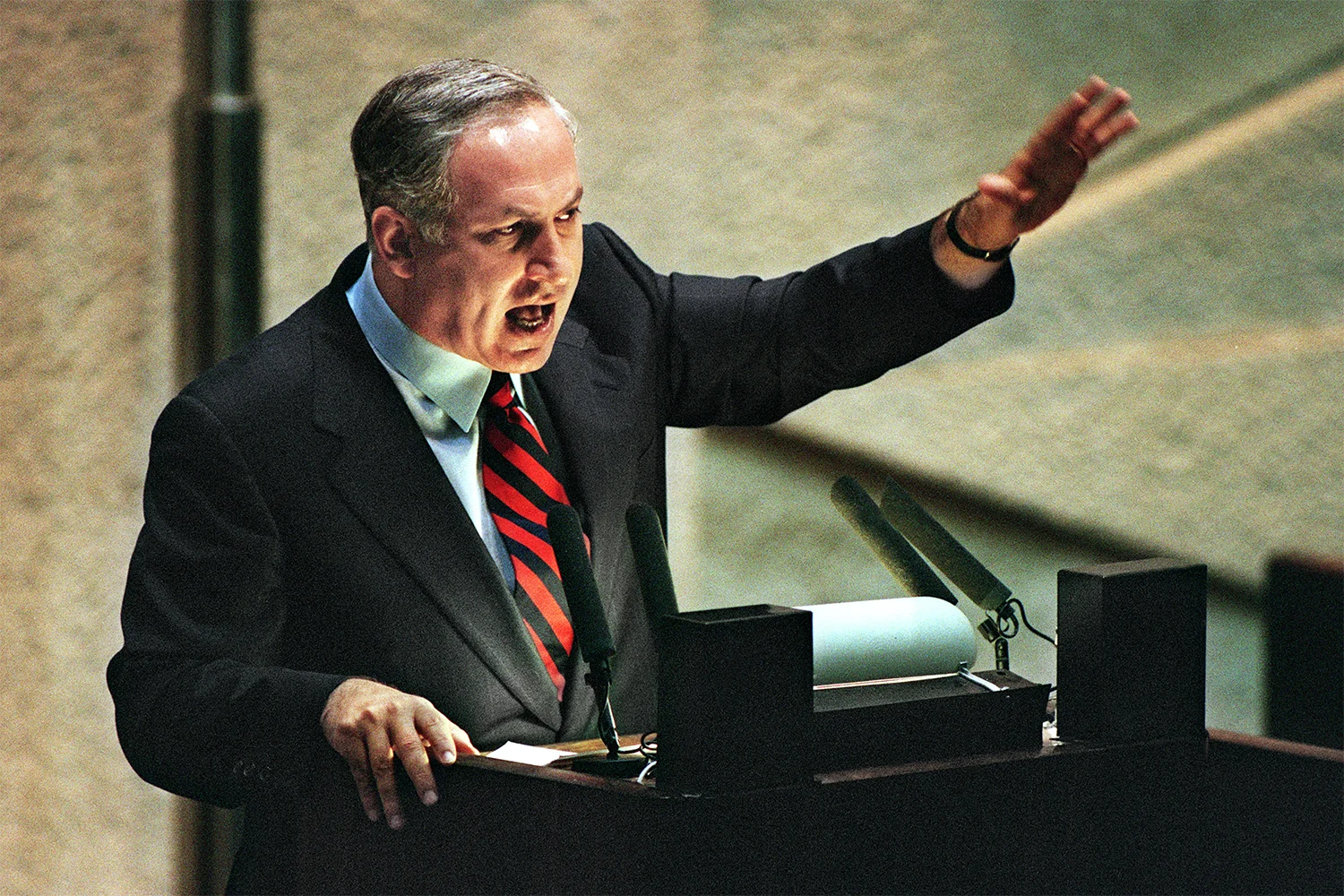
In 1978, a 28-year-old Ben Nitay—the Americanized name that Israeli Prime Minister Benjamin Netanyahu adopted at the time—explained to a Boston audience that “the stumbling block to the road for peace is this demand for a PLO state.” Since then, his life’s mission has been to prevent it.
In the 1990s, first as leader of the opposition to then-Israeli Prime Minister Yitzhak Rabin’s peace efforts and then, after Rabin’s death, as his successor, Netanyahu did everything in his power to delegitimize and derail the Oslo process. When he returned to office in 2009, his first task was to repel the Obama administration’s negotiation efforts and then, after the predictable failure of U.S. Secretary of State John Kerry’s attempt to negotiate peace in 2013, to remove the Palestinian issue from the agenda.
In the decade that followed, Netanyahu abandoned even the pretense of negotiations, declaring in 2015, “No Palestinian state on my watch.” His engagement with the Palestinian Authority, his potential partner, was limited to crippling it financially and undermining its legitimacy while his governments scattered settlements deep in Palestinian territory, making partition exceedingly more difficult and violence all but inevitable. Netanyahu’s current government, formed in 2022, includes Israel’s most abhorrent elements, which, until recently, were pariahs in Israeli politics, openly calling for resettling Gaza and Syria and for the ethnic cleansing of Palestinians.
To Israel’s strategic detriment, Netanyahu is conducting the war in Gaza with the apparent supreme goal of not allowing moderate Palestinians, particularly the Palestinian Authority, any foothold there, even if that means leaving Hamas in charge. Numerous proposals for an international stabilization force, which would rebuild Gaza and disarm Hamas, were rebuffed by Israel because they included steps toward Palestinian sovereignty. When Hamas itself suggested ceding control of Gaza to the Palestinian Authority, Netanyahu swiftly dismissed the idea.
Netanyahu’s obstructionism was never in the service of a competing solution. Its success was always dependent on the concealment of that fundamental lack. But the bankruptcy of Netanyahu’s Palestinian strategy—to his and Israel’s detriment—has now been exposed. Israel has failed in Gaza, is stuck in Lebanon, and, after dragging the United States into a debacle in the Gulf, has ignited the entire region and upended the global economy. Now, Iran seems to have the upper hand while Israel is more isolated than ever.
All this adds up to a strategic failure of unprecedented proportions. Still, a better outcome is attainable. But to achieve it, Netanyahu’s failed approach, which led to the current quagmire, must be recognized and replaced.
Israeli settlers raise an Israeli flag during a ceremony for a new settlement on Mount Tarousa, in the occupied West Bank, on June 16.Hazem Bader/AFP via Getty Images
Netanyahu’s basic approach to the conflict can be summarized as: status quo today, status quo tomorrow, status quo forever.
Though he indulges the far right’s annexationist fantasies, Netanyahu has never bought into them. He is too sober and too secular to take seriously the Messianic visions motivating the fanatics of Greater Israel—the Jewish supremacists who believe that Israel should dominate all of historic Palestine and that, with abundant violence and some divine intervention, the Palestinians can be forced to surrender to their status as noncitizen subjects in their own land. Netanyahu knows how to secure their support but doesn’t share their fantasies. While talk of Israel’s de facto annexation of the West Bank has become popular, the fact remains that Netanyahu’s governments have never seriously proposed annexingthe West Bank, let alone Gaza, despite persistent pressure from his base.
Netanyahu’s approach is premised on two assumptions: that the status quo is better than the alternative and that the status quo is, in fact, static. The alternative, namely partition, is in Netanyahu’s view, which crystallized back when Jordan and Iraq were still formidable threats tantamount to the destruction of Israel. It is precisely because he knows there is no feasible alternative to the two-state solution that he clings to the status quo.
Netanyahu’s policy of “managing the conflict” is the strategic expression of this conception. It is not premised on the idea, which is shared by many, that resolving the conflict is presently unattainable but on the conviction that it is permanently unnecessary.
As Netanyahu’s former aid and current rival, Naftali Bennett, put it, the Palestinian issue is “shrapnel in the butt”—uncomfortable but not unbearable. With a combination of force and clever management tactics, Israel could continue to dominate millions of disenfranchised Palestinians indefinitely. At the heart of these tactics is the division of Palestine into West Bank townships managed by a frail and persistently undermined Palestinian Authority, as well as a jail strip in Gaza controlled by Hamas, which would be contained with a cocktail of Qatari dollars and periodic Israeli strikes.
Though few in the international community shared these assumptions, many Western ambassadors, negotiators, foreign ministers, and heads of state were willing to go along with them. In December 2016, Kerry declared the two-state solution to be in “serious jeopardy” and the peace process to be effectively frozen. The Obama administration shifted from brokering peace to managing the conflict. The subsequent Trump administration explicitly abandoned the traditional two-state framework of Mideast diplomacy, replacing it with the “Peace to Prosperity” alternative, effectively jettisoning Palestinian independence in return for large economic investment. U.S. President Joe Biden never seriously pushed for resuming negotiations, declaring that the “ground is not ripe.” Western countries and most Arab countries largely followed the United States’ lead, pledging allegiance to the two-state solution but exerting no real effort to bring it about.
Exhausted and exasperated by decades of failed attempts and dashed hopes, many were glad to table the intractable blood feud, and the peace process turned from a work plan to a pro forma refrain. Taking flight from the sticky business of political realities, intellectuals and pundits began toying with “creative” ideas and “conceptual” frameworks. The solid, if worn out, two-state solution was abandoned for the glittering mirage of binationalism. And the question of Palestine was shelved for a decade.

Palestinians leave a distribution center with humanitarian aid packages in Gaza on Sept. 30, 2025. Eyad Baba/AFP via Getty Images
These illusions were shattered with devastating poignancy on Oct. 7, 2023. Hamas’s surprise attack was explosive proof that the conflict could be shelved but not buried—and that it is anything but static. The painful rupture of the illusion of stability triggered a tantrum of aggression in Israel. Enabled by a meek U.S. administration, Israel chose to bring vengeance upon the people of Gaza rather than remove the threat posed by Hamas. This marks a notable shift in Israel’s approach to the region and to its own security.
Since its founding, Israel has had to cope with enemies who reject its very right to exist. Before declaring independence, the country’s founder and first prime minister, David Ben-Gurion, prepared the fledgling nation to confront its enemies, who he knew would attack it on multiple fronts. All his successors made security their top priority. They appreciated the importance of maintaining military superiority, but they also knew that military might alone would not make it a safe haven. In a hostile Middle East, force is an indispensable means, but the end was integration and peaceful coexistence.
One of the starkest expressions of this attitude emerged from Revisionist Zionism, on which Netanyahu was raised. Netanyahu’s father was an avid follower of its founder, Ze’ev Jabotinsky, who published an essay titled “The Iron Wall” in 1923. In it, Jabotinsky proclaimed that the aims of Zionism could only be achieved on the basis of parity and peace with Palestine’s Arabs. Overcoming their natural hostility, he argued, would require the establishment of an “iron wall” of Jewish force, which would extinguish any hope of annihilating Jewish nationalism. Once such aspirations withered away, moderate voices would emerge and agreements would be attainable.
Israel had repeatedly failed to live up to those proclamations, choosing territorial expansion and ethnic domination over opportunities for peace. What sets Netanyahu and his far-right government apart is the rejection of the pursuit and the aspiration.
Jabotinsky and Ben-Gurion both yearned for a time when “both peoples will be able to live together in peace, like good neighbors,” as the former put it. Netanyahu’s political raison d’être is the elimination of any such outcome.
When his strategy of stagnation led to the bloodiest day for Jews since the Holocaust, a desperate Netanyahu, flanked by his discredited security chiefs, turned to brutality. Days after the pogrom, a former head of Israel’s Shin Bet intelligence agency told me that there’s nothing more dangerous than generals with a bruised ego. The brutal reaction of this bruised ego soon evolved into a strategic dogma: eliminating every threat, destroying every enemy, and employing as much force for as long as necessary until all have been wiped off the face of the earth.

Palestinian leader Yasser Arafat, Israeli Foreign Minister Shimon Peres, and Israeli Prime Minister Yitzhak Rabin pose with Nobel Peace Prizes in Oslo on Dec. 10, 1994.Erik Johansen/Scanpix/AFP via Getty Images
In the days of the Oslo process, Shimon Peres, a former Israeli prime minister, used to talk about the emergence of “a new Middle East.” Netanyahu and his friends on the Israeli right mocked Peres as a delusional fool. Since Oct. 7, they began using the very same terminology. In their new Middle East, however, Israel is not a naive lamb lying in peace among the wolves but the regional wolf instead. Unencumbered by international law, the interests and rights of others, or common morality, their Israel asserts itself as a regional hegemon through unrestrained military aggression.
Unsurprisingly, the replacement of strategy with lashing out has been an unmitigated disaster. Despite the appalling death toll and destruction inflicted on Gaza, Hamas remains the dominant force in the strip. Hezbollah continues to target northern Israel from Lebanon and inflict daily casualties on Israeli forces. This debacle inflamed Netanyahu’s enthusiasm to attack Iran. The Islamic Republic offers a rationalization for his failure. “,” Netanyahu said in . “.” If his promise of “total victory” has been stalling, it is because the “head of the octopus,” as he called Iran, remains intact. Iran is the threat of threats, and the only way to deal with threats is to bomb them to oblivion.
Taking out Iran is Netanyahu’s escape from the dead end that he has led Israel into. Cutting off the head of the octopus will debilitate its arms and pave the way back to the cherished status quo. With their Iranian backers removed, the forces confronting Israel will be neutered and the occupation will be able to grind on.
A year after 9/11, Netanyahu declared to Congress: “If you take out Saddam, Saddam’s regime, I guarantee you that it will have enormous positive reverberations on the region.” There were reverberations, though few of them were positive. Now, he is advocating the same approach toward Iran. The only reason that it has yet to have similarly devastating consequences is that it has failed so far. The Iranian regime proved more resilient than Netanyahu and U.S. President Donald Trump wanted to believe, and it is likely to emerge from the conflict stronger than it entered it.

Netanyahu, now prime minister, testifies about Israel’s conflict with Iraq in Washington on Sept. 12, 2002.Manny Ceneta/AFP via Getty Images
The fiasco in the Gulf forces a reckoning with the path not taken—the alternative that Netanyahu’s strategy was designed to thwart.
In 2002, all 22 members of the Arab League joined the Arab Peace Initiative (API), which proposed full normalization of relations with Israel in return for a complete withdrawal from the territories that it captured in 1967 and the establishment of an independent Palestinian state. The proposal, repeatedly reaffirmed by the Arab League, was a historic breakthrough that could have provided a framework for an alliance of relatively moderate regional powers that included Saudi Arabia, Egypt, Jordan, Qatar, Morocco, and the United Arab Emirates. Such an alliance remains the most promising avenue for reining in Iranian nuclear ambitions and confronting other extreme actors in the region.
Israel all but dismissed the initiative. With some of the Second Intifada’s harshest terror attacks devastating Israeli cities immediately after its release, the timing could have been better. Still, through many challenging upheavals, it has not been rescinded for almost a quarter of a century. When Trump announced his “Peace to Prosperity” program in 2020 (another fanciful adventure prompted by Netanyahu), the Arab League reiterated the API as the only feasible framework. Even after the devastation inflicted on Gaza, Arab leaders proposed reactivating the API. The Israeli premier paid lip service to the initiative, describing it as having “positive elements” but refused to engage it.

Arab League Secretary-General Amr Moussa (left) and Lebanese Foreign Minister Mahmoud Hammoud (right) meet in Beirut on March 25, 2002.JOSEPH BARRAK/AFP via Getty Images
There could be no better expression of the Iron Wall doctrine than the API. Why, then, is it a nonstarter in Israeli politics? As any observer of the country will know, the obvious answer is the demand to terminate Israel’s control over the West Bank and replace it with Palestinian self-government.
Although the vast majority of Israel’s security experts acknowledge that partition is the only viable long-term solution, Netanyahu’s politics of delegitimization have made saying so in public a form of social and professional death. After years of debilitating centrism, built on studious avoidance of the Palestinian issue, hardly anyone in the opposition dares to mention a Palestinian state in public—though many endorse it in private. This is a cause rather than a consequence of public opinion shifting away from the two-state solution.
Israel’s obsession with the occupation and settlement of Palestinian territories dictates repelling any opening for peace and integration. It has turned Israel into a rogue state, wreaking havoc in its neighborhood and destroying itself in the process.
To be sure, opposition to Israel’s existence is not driven solely by the Palestinian plight. The Islamic Republic’s hostility toward the Jewish state is not likely to dissipate with the resolution of the Israeli-Palestinian conflict and neither is that of other radical actors in the region, such as Hezbollah, the Houthis, and radical Palestinian factions, be they nationalist or Islamist—just as the cessation of Palestinian violence is not likely to quell the supremacist ambitions of some Israelis. Nevertheless, resolving the Palestinian issue remains the single most decisive condition for regional stability.
The fallout of Oct. 7, which drew in the United States and disrupted the global economy, is a stark reminder that this is not a local matter. The region, shaped by factions no less than by national boundaries, resembles Serbia in 1914 more than Yugoslavia in 1990. Everything is local, but nothing remains local, especially not wars.
Now, the war is upending the region and reverberating around the globe, from fuel pumps in California and school closures in the Philippines to the status of NATO and the Falkland Islands. Israel’s obstinacy is dragging its allies and neighbors into the abyss, upsetting global trade and destabilizing an already shaky international order.

Filipinos protest against the United States and Israel’s intervention in Iran outside the U.S. Embassy in Manila, Philippines, on March 3.Ezra Acayan/Getty Images
None of this would be possible without the enablement of Washington and Europe. Whether active or passive, the coddling of Israel’s nationalist frenzy under Netanyahu has contributed to the decimation of the Israeli peace camp and facilitated Netanyahu’s control over Israeli public opinion to the point where even his competitors do not dare to challenge his failed approach to national security. Netanyahu’s bullying of every regional actor, friend, and foe has set back Israel’s security, undermined its international standing, and wrecked its moral stature. The creed that has taken hold over the Israeli mind following Oct. 7—that all threats can and must be eliminated by force alone—is pushing Israel to dig deeper, breeding hostility at a greater pace than it can crush it. This is a realization that will hopefully dawn on Israelis as the country heads to elections in the fall.
But international actors must also take their lesson. The Israeli-Palestinian conflict is a problem, and it is also their problem. The continued bloodletting between the river and the sea is not just a pain for those of us destined to live together on this punished land. It is a regional and global menace, which is only ignored at the price of greater peril in the future. Containing the Iranian threat and reducing the risk of another flare-up hinges on a regional realignment, the key obstacle to which is the Israeli-Palestinian conflict.
Those of us who never fell for the illusion that the conflict could be managed, who warned that the status quo is neither static nor stable, know now that the current trajectory promises nothing but calamity. Gaza remains a lingering catastrophe. The oppression and dispossession in the West Bank have mutated into an unabashed, state-sponsored ethnic cleansing. This can only end in disaster, one that might make Oct. 7 seem like a prelude.

A Palestinian child receives hot food from a charity kitchen in the Nuseirat refugee camp in Gaza on Oct. 21, 2025.Eyad Baba/AFP via Getty Images
None of this is inevitable. But a different outcome requires a fundamentally different approach. First, the bilateral framework must be replaced with a regional one. This should not mean expanding the Abraham Accords, which were little more than a failed attempt to bypass the Palestinian issue. The regional approach must place Palestine first and recruit the region to provide the necessary pressure and credible security guarantees to both sides. This applies both to the process and to the substance of potential agreement.
A regional framework remains the only viable means of overcoming the principal stumbling block—assurances that do not rely on mutual trust. After the trauma of Oct. 7 and the brutality inflicted on Gaza, Israelis and Palestinians have little appetite to hear about peace. But the lingering stalemate and the realization that the current policy of maximum aggression at all times has achieved nothing will force a reckoning at some point. The ideology of Greater Israel remains alien to most Israelis. If they oppose Palestinian liberation, it is because they have been persuaded to believe that it is a hazard to their security.
The alternative is not a return to the illusory stability of managed conflict or to the delusion of binationalism. Those options expired on Oct. 7. Continuing on the current path entails deeper entrenchment, wider conflagration, and the eventual realization—at far greater cost—that no amount of firepower can bury what must ultimately be negotiated.
Like an ancient sin or a chronic disease, the more the conflict is repressed, the more violently it resurfaces. The question is not whether a reckoning will come but whether it arrives by design or by catastrophe. Can you confirm this is the exact wording of the quote?
