


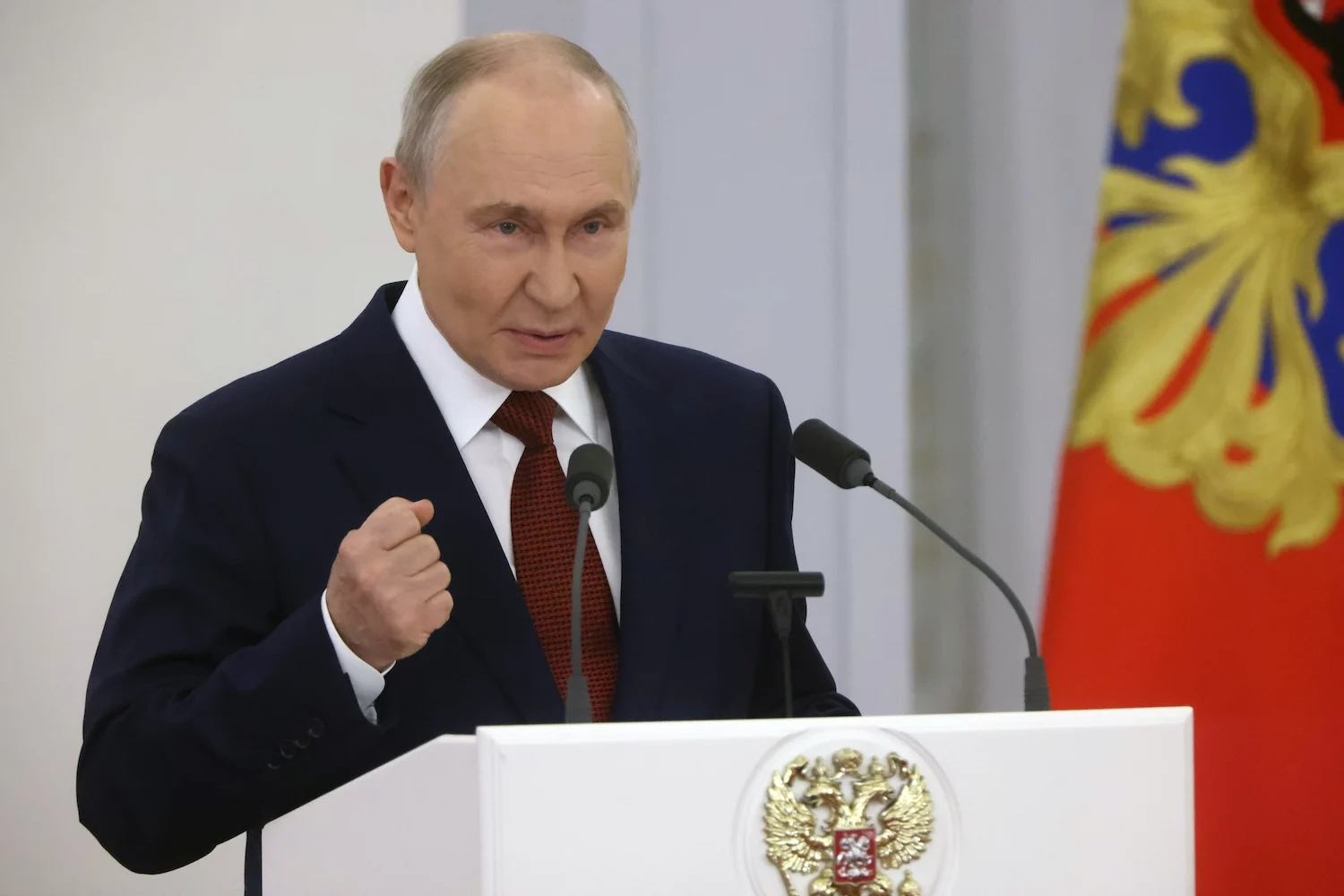
As allied leaders gathered in Ankara, Turkey, in early July, NATO Secretary-General Mark Rutte declared the dawn of “NATO 3.0,” a rebalanced alliance underwritten by a $80 billion military package for Kyiv. But behind the new architecture sat a familiar assumption, unchanged after four years of war: that enough conventional pressure on the battlefield will eventually force Russian President Vladimir Putin toward a negotiated off-ramp.
This is a mistake—a failure of Western mirror imaging, in that it projects a particular strategic logic onto a leader who is not playing by it. Putin’s war is not governed by rational international relations or conventional military strategy; it is governed by the political theory of autocracy and regime survival.
As allied leaders gathered in Ankara, Turkey, in early July, NATO Secretary-General Mark Rutte declared the dawn of “NATO 3.0,” a rebalanced alliance underwritten by a $80 billion military package for Kyiv. But behind the new architecture sat a familiar assumption, unchanged after four years of war: that enough conventional pressure on the battlefield will eventually force Russian President Vladimir Putin toward a negotiated off-ramp.
This is a mistake—a failure of Western mirror imaging, in that it projects a particular strategic logic onto a leader who is not playing by it. Putin’s war is not governed by rational international relations or conventional military strategy; it is governed by the political theory of autocracy and regime survival.
Autocrats stay in power only as long as the coalition of elites around them believes they can still deliver what elite loyalty is based on: whether revenue, security, or victory. When that belief breaks, the elites who sustain autocrats move against them. Slobodan Milosevic’s coalition drew that conclusion within 16 months of the Yugoslav leader’s concession to NATO; Leopoldo Galtieri’s junta drew it within three days of Argentina’s Falklands surrender; and Omar al-Bashir’s own security chiefs drew it once South Sudan’s secession from Sudan cut off the oil revenue that had bought their loyalty for 30 years.
Different triggers—negotiation, defeat, insolvency—but the same result: regime change.
Putin adheres to this political logic, not the West’s. He does not see an off-ramp but a dead end. With none of his military or political objectives met, Putin cannot enter genuine negotiations without risking his regime. Forcing a reckoning is therefore no easy task. Autocratic regimes are engineered to absorb costs that would collapse any comparable Western government. It is why the coming months will mark the war’s most dangerous phase, not its likeliest path to peace.
For most of the war, both Russian elites and the wider population could treat the conflict as remote, insulated by an economy still exporting oil at scale. However, from the start of this year through early July, Ukrainian long-range drones struck Russian oil refineries nearly 200 times, disabling eight of the country’s 10 largest facilities—including in Omsk, more than 1,500 miles from the border. The result is a fuel crisis without precedent for a top-three oil producer: More than 90 percent of Russian regions are now rationing oil and diesel, and domestic gasoline output is running about one third below demand. The pressure is severe enough that even Putin has publicly admitted that the shortages are real.
This campaign fractures the Kremlin along both axes of the autocratic-coalition dynamic. First, it directly impacts the revenue that buys the inner circle’s loyalty. Second, the shortages demand an immediate, resource-heavy internal security response to contain any spark of civil unrest. Any move during this moment toward diplomatic compromise would read to Russia’s siloviki as an admission of the type of vulnerability that ends autocrats. Western rationale would expect such a moment to drive negotiation, yet autocratic logic demands escalation.
That same rationale led the Nazi regime to project retaliatory power through V-1 and V-2 missile attacks after the July 1944 plot to assassinate Adolf Hitler and the Normandy landings. Putin needs to demonstrate his monopoly on state force, security, and control. The tools available to him are narrow: The state treasury, already strained, cannot fund any new serious mobilization or breakthrough in the Donbas. What is available are tools of signal, not necessarily strategic, breakthrough.
The first is ballistic strikes. Russia has intensified massed ballistic missile barrages on Ukrainian cities known to be facing severe Patriot interceptor shortages. The strikes on Kyiv in early July were among the year’s deadliest, with the July 2 attack alone leading to more than 30 civilian deaths. Timed on the eve of the Ankara summit, they read as a signal of domestic control as much as an attack on Kyiv.
The second tool is infrastructure war. Since the start of this year, Moscow has carried out 250 attacks against Naftogaz facilities, indicating a sustained campaign against Ukraine’s gas production and energy infrastructure, rather than a series of isolated strikes. The attacks intensified in July when Russian forces struck Naftogaz gas facilities in Poltava, Kharkiv, and Sumy, targeting Ukraine’s winter preparations and reassuring Moscow’s security chiefs that the state can still strike hard, even as its own refineries burn.
The third is hybrid war. Beyond Ukraine, the Kremlin is waging sub-threshold coercion against European allies. This intensified in the lead-up to Ankara, with Polish Prime Minister Donald Tusk disclosing U.S. intelligence that Russia could strike a NATO member within months.
Each signal tells Russian elites the same thing, which is that Putin remains central to their survival.
This external escalation runs alongside internal ones that most Western commentary misses. Coercive capacity is expanding: The Federal Security Service has reclaimed formal control over pretrial detention; treason and espionage prosecutions have reached their highest point since 1997; and Russia’s National Guard now operates its own General Staff, reporting directly to Putin’s Security Council. Elites face increased pressure themselves: Ruslan Tsalikov, once former Russian Defense Minister Sergei Shoigu’s closest deputy, now faces prosecution on corruption charges carrying potentially decades in prison. The parallel move by state communications watchdog Roskomnadzor to severely limit access to Telegram and WhatsApp, along with internet shutdowns, completes the picture: Control is being tightened in every direction the regime can reach, inward as much as outward.
Putin will continue to escalate with the capabilities available to him until the political cost of aggression finally exceeds the political cost of bargaining. Historically, a tipping point for an autocrat has only arrived through acute crises across several fronts at once: Ayatollah Ruhollah Khomeini rejected cease-fire terms for years during the Iran-Iraq War, declaring Iran would fight Iraq even if the war lasted 20 years. That was until military collapse, economic exhaustion, and direct U.S. naval confrontation finally converged in 1988.
Even then, the regime he led survived; only his refusal to negotiate did not. Ukraine’s refinery campaign has finally caused a moment of strain for Putin’s regime, but the Kremlin is still far from negotiating.
Until a convergence of crises arrives, Ukraine has to survive the escalation that Putin’s logic demands. Closing the current air defense gap to stop Russia’s missile strikes will buy Ukraine and the West the time to keep the economic and military fronts open long enough for a political breakthrough to follow. The other task is to widen the pressure: extending strikes beyond Crimea and refineries to Russia’s railways, ports, and military-industrial enterprises, revenues from which also buy the inner circle’s loyalty. Europe holds a major lever of its own. Russia’s shadow fleet is the mechanism keeping that revenue moving around Western sanctions. Denying these vessels port access and sanctioning the owners and intermediaries that manage them will close a channel that Kyiv’s strikes cannot reach directly.
NATO 3.0 will succeed only if it embraces the truth that in personalist autocracies, pressure hardens a regime before it weakens one. The strategic challenge for the West is to generate crises across multiple fronts long enough for the coalition that keeps Putin in power to conclude that continued war poses the greater threat to its survival. Only then will negotiation become politically tenable. Until Western strategy recognizes this logic, it will continue to misread Russian escalation when it may instead be the necessary, and most dangerous, prelude to any eventual settlement.
