


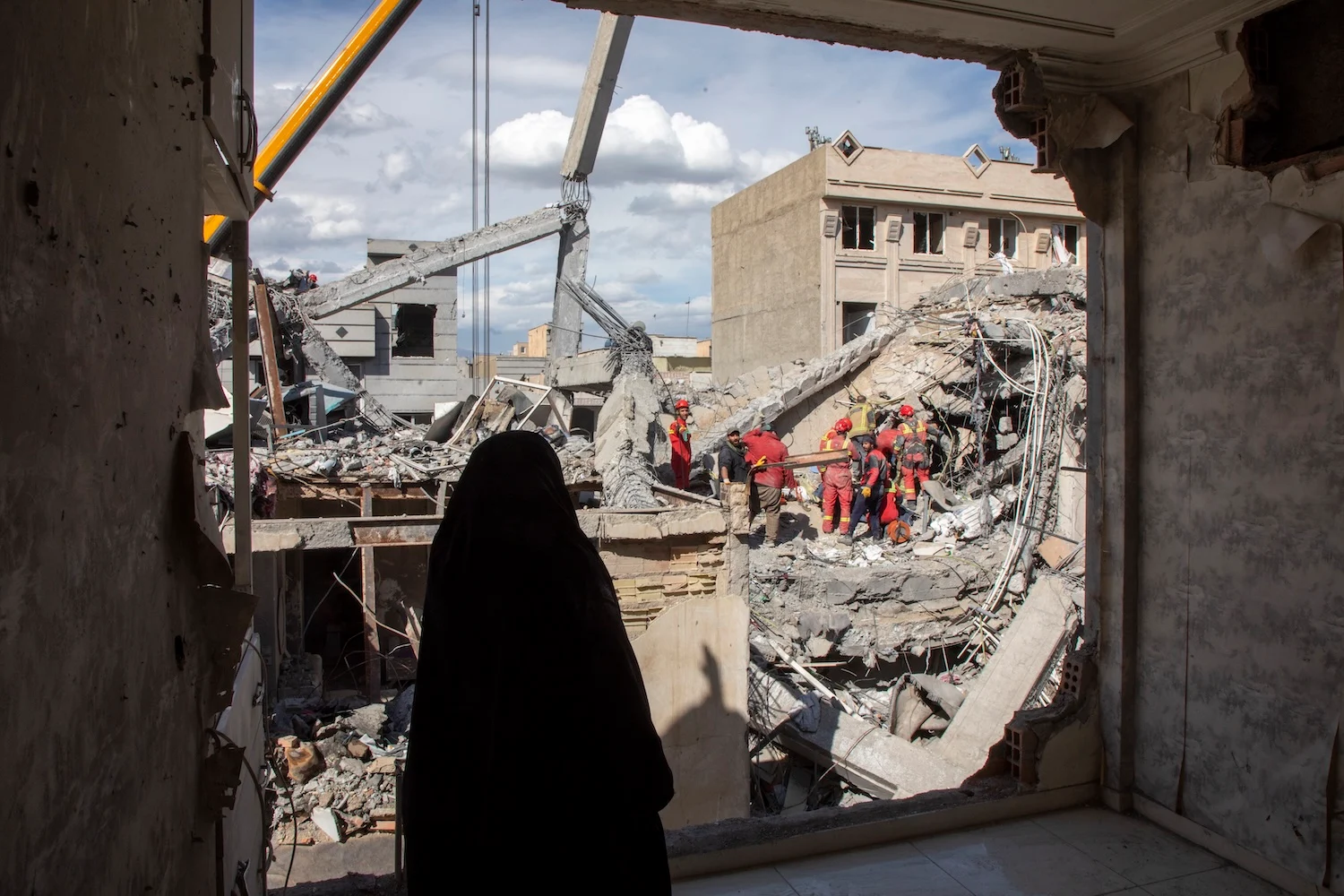
Iran has stood up to two of the world’s most powerful militaries, held its position on the nuclear issue, and continued to back its Lebanese proxy. But if that represents a victory, it’s a Pyrrhic one when considered from an economic perspective.
Iran has faced staggering losses to its military infrastructure and economy. Inflation has skyrocketed, the Iranian rial has plummeted, unemployment is high, and a U.S. blockade threatens trade in and out of the country.
Iran has stood up to two of the world’s most powerful militaries, held its position on the nuclear issue, and continued to back its Lebanese proxy. But if that represents a victory, it’s a Pyrrhic one when considered from an economic perspective.
Iran has faced staggering losses to its military infrastructure and economy. Inflation has skyrocketed, the Iranian rial has plummeted, unemployment is high, and a U.S. blockade threatens trade in and out of the country.
“The enemy has realized that it cannot force the Iranian nation into submission through military strikes,” Iranian President Masoud Pezeshkian said recently. “The economy and people’s livelihoods are the most important front in confronting the enemy.” What sounds like a boast could be taken as a warning. The United States and Israel have failed to force Iran to capitulate militarily. But it remains an open question how Iran will manage its debilitating economic losses.
Its adversaries clearly hope that economic pressure will still force the Iranian government to make substantial concessions in negotiations—or even lead to an uprising that topples the regime. It’s possible, however, that the continuation of war will instead push Iranians’ economic woes to the background, strengthening hard-liners amid a weakened economy.
Iran has suffered hundreds of billions of dollars in losses since the start of the war even though the scale of the damage is disputed. In April, Iran’s government put the losses at $270 billion, while the Washington-based Foundation for Defense of Democracies estimated $144 billion—with a range stretching from $50 billion to $300 billion. Iranian Deputy Labor Minister Gholamhossein Mohammadi said in April that more than a million jobs were lost as a result of the war, while an Iranian economist upped that figure to 10 million to 12 million jobs at risk, or roughly half of Iran’s workforce. Whatever the exact loss, the numbers are grim.
U.S. President Donald Trump speaks in more absolute terms, claiming that Iran’s navy and air force were totally destroyed. “Their navy is totally gone—100 percent,” Trump told Fox News in late May. “Their air force is totally gone—100 percent.” A BBC investigation confirmed in June that more than 50 military sites had been damaged across Iran, including air bases, naval assets, and compounds of the Islamic Revolutionary Guard Corps (IRGC) and the paramilitary Basij, which is tasked with crushing dissent.
Nearly a fifth of Iran’s industrial base suffered damage, and rebuilding the petrochemical hubs at Mahshahr and Assaluyeh could take more than a decade. The Iranian rial had been weakened by years of sanctions and in April fell to a record low of 1.9 million per U.S. dollar. By June, consumer prices were up by more than 88 percent, according to data released by Iran’s Fars news agency.
The economic shock is severe, but Iran is not exactly new to such crises. Then-Iranian President Hassan Rouhani said in 2020 that sanctions had cost Iran $150 billion.
The impact of Trump’s withdrawal from the Iran nuclear deal in 2018 and reimposition of sanctions, combined with years of governmental mismanagement, culminated in large protests in December, with Iranians demanding better standards of living. Thousands were killed in a subsequent government crackdown.
The U.S.-Israeli war followed this uprising. Statements from Trump and Israeli Prime Minister Benjamin Netanyahu suggest that both saw military intervention as a way to encourage Iranians to return to the streets and, with U.S. and Israeli air support, potentially overthrow the government. That didn’t happen. Even those who opposed the government still didn’t back the bombing of their universities or appreciate Trump’s threat of eliminating them as a civilization and controlling their country’s oil resources. The bombing of a girls’ school early in the war, which preliminary investigations conclude Washington was responsible for, has ruled out any chance of Iranians standing up in any way that could be seen as supportive of the United States.
As the economic crisis worsens, the United States and Israel are once again wondering whether it can rattle the government, albeit with different end goals in mind.
Israeli Finance Minister Bezalel Smotrich recently counted the cost of the war on Iran and said the current situation was the best situation for Israel: “[We] must remember that the ultimate goal of Israel, and not necessarily the United States, is to undermine and weaken the regime in Iran—to the point of overthrowing it.” Smotrich’s comments suggest that he believes economic collapse could eventually contribute to the fall of the Iranian government, which remains a key Israeli objective.
Trump, however, revised his goals later on in the war: denying Iran a nuclear weapon and freeing the Strait of Hormuz, not regime change.
The U.S.-Iran memorandum of understanding called for sanctions waivers, the resumption of Iran’s oil exports, phased access to more than $100 billion in frozen assets, and the creation of a $300 billion reconstruction fund to help reduce Iran’s economic suffering. Even though it was called off when clashes resumed, it reflected that Trump isn’t opposed to Iran’s economic recovery—if he gets what he wants.
But he isn’t shy about inflicting economic pain either and sees it as a way to achieve his objectives. Trump has suggested that Iran will be unable to withstand economic losses and sooner or later accept U.S. terms. In April, he told Axios that the U.S. blockade of Hormuz, which aims to strangle the Iranian ability to export, was “somewhat more effective than the bombing.”
Yet most experts believe that Iran will not relent on its nuclear program or give up control of Hormuz and that increasing economic pain in the middle of a war will neither usher in sustainable political change nor soften Iran’s hard-liners. There are several reasons.
First, Washington’s determination to keep up the pressure may not match the capacity of Iran’s hard-liners to keep fighting. It would also be foolish to expect the IRGC to sit on its hands as the bombing escalates and Iran’s economy crumbles. Iran could attack more cargo vessels, killing sailors and causing panic in the shipping industry with a cascading effect on the global economy. It could lay more mines on the seabed, hit U.S. bases more frequently, and kill more U.S. soldiers, testing Trump’s resolve to keep going.
Iran has already activated its allies in Yemen, the Houthis, who are poised to control the Bab el-Mandeb, the region’s other major maritime chokepoint. Last week, Iran flexed its muscle and gave a taste of how the war could widen when the Houthis fired missiles and drones at Saudi oil facilities on the Red Sea.
Moreover, Iran has been dealing with Western sanctions for years and has figured out ways to work around them. It uses hundreds of ships that are part of a shadow fleet and difficult to track when they turn off their transponders. Iran also evades sanctions by transferring oil mid-sea—from ship to ship.
Some accounts suggest that the Iranian people have suffered enormously but that has also increased the threshold of pain they can endure. While rising costs, declining business activity, and layoffs have punctured their pockets, Iranians are currently preoccupied with the war.
“This trend of inflation has been going on for decades—people are shocked for a while, then they move on,” a U.K.-based Iranian told me. He said his sense after talking to his family back home in Tehran was that people found it “harder to protest” during the war.
Neither Trump nor Netanyahu has articulated a convincing strategy for the day after—or for the many conditions that would have to be in place to achieve their respective objectives.
Israeli strategists admit that despite their best efforts, the Iranian government hasn’t been sufficiently weakened. “The state has been weakened but not enough,” said Yaakov Amidror, a former national security advisor to Netanyahu. “End of the day, it’s not about weakening the state for the sake of weakening but for Iranians to topple the regime. That didn’t happen yet.”
There is no surefire way of toppling the Iranian government, surely not a quick one. An external actor has only a limited number of options. But that has been known for a while. There was a reason U.S. President Barack Obama adopted a different strategy. The 2015 nuclear deal envisaged that economic benefits would improve Iranians’ standards of living over time, strengthen the moderates, and create conditions for political change from within.
Trump instead deployed “maximum pressure” against Iran, followed by a war and a blockade. It might create conditions that culminate in massive outrage against the government and sudden uprisings. But there is no guarantee that would overthrow the government in the absence of an organized political opposition.
For now, Trump is strengthening Iran’s hard-liners, who will no doubt outlast his term in office. The attacks and the blockade give them a reason to remain on a war footing—and the effects of a crumbling economy are likely to fall more heavily on the people than on the government and its revolutionaries.
